

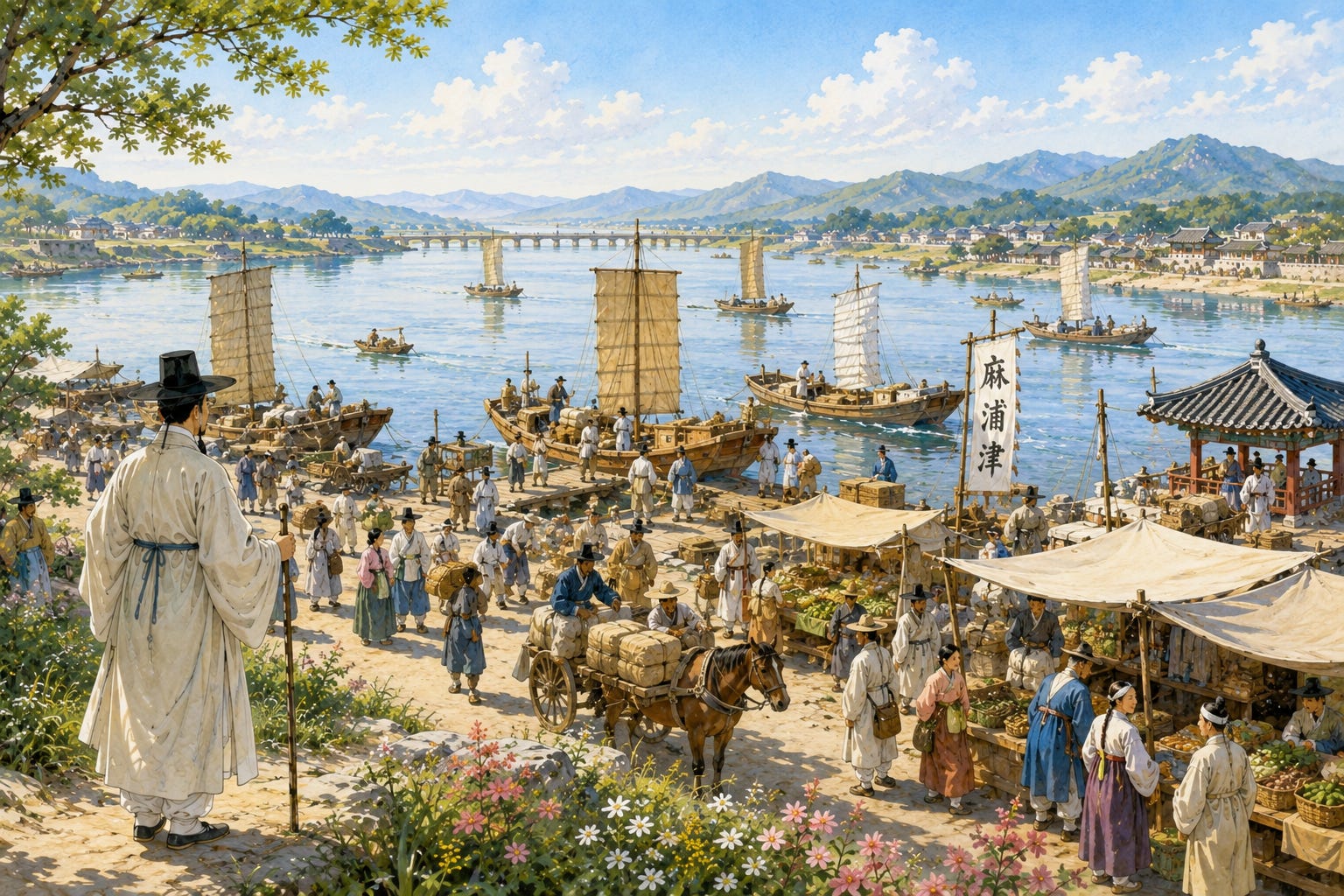
As I read Maporok in Volume 7 of Gani-jip, the first thought that came to my mind was that wherever people gather, stories of life naturally unfold. For centuries, Mapo served as an important riverside ferry and marketplace where travelers, merchants, and goods from many regions converged. Choi Rip did not view it merely as a center of transportation and commerce. Instead, he observed the boats crossing the river, the bustling crowds, and the lively exchange of goods, recognizing in them a vivid portrait of society and the enduring rhythm of human life.
Much like today’s airports, seaports, and railway stations, Mapo was a place where countless people passed through every day. Individuals from different regions met, exchanged news and ideas, and contributed to the flow of commerce and culture. Through these scenes, Choi Rip reminds us that societies flourish through human connection and communication. Reading his account encouraged me to reflect on how essential meaningful relationships and collaboration remain in our increasingly interconnected world.
What impressed me most was Choi Rip’s warm and compassionate view of ordinary people. Regardless of their social status or occupation, he respected those who worked diligently in their daily lives. Merchants, travelers, boatmen, and local residents were not merely background figures in his narrative; they represented a community sustained by mutual dependence, trust, and shared purpose. His observations remind us that diversity and cooperation have always been among the greatest strengths of any society.
Another meaningful lesson in Maporok is that the river is much more than a beautiful natural landscape. It is a living pathway that connects people, ideas, and opportunities. Along its waters, goods are transported, cultures are exchanged, and new relationships are formed. Choi Rip quietly suggests that although the world is constantly changing, the values of trust, cooperation, and human solidarity remain timeless.
Reading this work led me to reflect on what we should preserve amid the rapid changes of modern society. Technology continues to transform our lives, making the world more convenient and more connected than ever before. Yet the most valuable assets we possess are still our ability to respect one another, to build trust, and to grow together as members of a community. Through his vivid portrayal of Mapo, Choi Rip celebrates not only the vitality of a busy riverside town but also the enduring warmth of human relationships.
Although Maporok was written centuries ago, it continues to offer profound insights into the nature of cities and communities today. The places that connect people may change over time, but their essential purpose remains the same. We all live through our relationships with others, and it is through those connections that we learn, develop, and discover the deeper meaning of life.
Maporok is far more than a record of a historic ferry town. It is a timeless reflection on community, communication, and the values that unite humanity. As I closed the book, I found myself wanting to cherish the relationships in my own life more deeply, to appreciate every encounter, and to contribute to a society built on understanding, cooperation, and mutual respect. I believe this is the enduring message that Choi Rip sought to share with readers through Maporok. +++
{Solti}
July 24, 2026
“Mapo (麻浦) refers to Mapo-gu in Seoul, Korea. 麻浦 is the name of an area located north of the Han River. Its current administrative district is Mapo-gu (麻浦區). It includes western Seoul neighborhoods such as Hongdae, Hapjeong, Sangam, and Gongdeok. In short, 麻浦 = Mapo in Seoul.”
강가에서 만난 사람과 세상의 이야기
『간이집』 제7권 「마포록(麻浦錄)」을 읽고
『간이집』 제7권 「마포록(麻浦錄)」을 읽으며 가장 먼저 떠오른 생각은 “사람이 모이는 곳에는 언제나 삶의 이야기가 흐른다”는 것이었다. 마포(麻浦)는 예로부터 강을 따라 사람들이 오가고 물자가 모이던 중요한 나루이자 시장이었다. 최립은 그곳을 단순한 교통의 중심지로 바라보지 않았다. 그는 강을 오가는 배와 분주한 사람들, 다양한 물건들이 만들어 내는 활기 속에서 당시 사회의 모습과 인간의 삶을 깊이 관찰하였다.
오늘날의 항구나 공항, 기차역처럼 마포는 수많은 사람들이 스쳐 지나가는 공간이었다. 서로 다른 지역에서 온 사람들이 만나고, 새로운 소식과 문화가 오가며, 경제와 생활이 이어지는 곳이었다. 최립은 이러한 풍경을 통해 세상은 사람들의 만남과 교류 속에서 발전한다는 사실을 보여 준다. 그의 기록을 읽으며 현대 사회 역시 연결과 소통이 얼마나 중요한가를 다시 생각하게 되었다.
특히 인상 깊었던 점은 바쁜 공간 속에서도 사람을 바라보는 그의 따뜻한 시선이었다. 그는 신분이나 직업에 관계없이 각자의 자리에서 최선을 다해 살아가는 사람들의 모습을 존중하였다. 나루를 오가는 상인, 여행객, 뱃사공, 백성들의 모습은 단순한 풍경이 아니라 서로 의지하며 살아가는 공동체의 모습이었다. 이러한 시선은 오늘날 다양성과 상생의 가치를 다시 일깨워 준다.
또한 「마포록」은 강이 단순한 자연경관이 아니라 사람과 사람을 이어 주는 생명의 길임을 보여 준다. 강을 따라 물자가 이동하고 문화가 전해지며 새로운 만남이 이루어진다. 최립은 이러한 모습을 통해 세상은 끊임없이 흐르고 변화하지만, 사람을 향한 신뢰와 협력은 변하지 않는 가치라는 사실을 조용히 전하고 있다.
이 작품을 읽으며 나는 현대 사회의 빠른 변화 속에서도 우리가 잃지 말아야 할 것이 무엇인지 생각하게 되었다. 기술은 발전하고 세상은 더욱 편리해졌지만, 서로를 존중하고 신뢰하며 함께 살아가는 마음은 예나 지금이나 가장 중요한 자산이다. 최립은 마포의 활기찬 풍경을 통해 공동체의 힘과 인간적인 따뜻함을 보여 주었다.
『마포록』은 오래된 기행문이지만 오늘날의 도시와 사회를 이해하는 데에도 깊은 통찰을 제공한다. 사람과 사람을 연결하는 공간은 시대에 따라 모습이 달라질 뿐, 그 본질은 변하지 않는다. 우리는 모두 누군가와 연결되어 살아가며, 그 관계 속에서 배우고 성장한다는 사실을 이 글은 다시 일깨워 준다.
『간이집』 제7권 「마포록」은 한 나루터를 기록한 여행기가 아니라 사람과 공동체, 그리고 소통의 가치를 일깨워 주는 아름다운 고전이다. 이 책을 덮으며 나 역시 바쁜 일상 속에서도 주변 사람들과의 인연을 더욱 소중히 여기고, 서로를 이해하며 함께 성장하는 삶을 살아가고 싶다는 다짐을 하게 되었다. 그것이 최립이 「마포록」을 통해 오늘의 독자들에게 전하고자 한 가장 소중한 메시지일 것이다. +++
2026년 7월 24일
{솔티}
麻浦(마포)는 한국 서울특별시 마포구를 가리키는 지명임.
麻浦는 한강 북쪽에 있는 지역 이름
현재 행정구역으로는 마포구(麻浦區)
홍대, 합정, 상암, 공덕 등이 포함된 서울 서쪽 지역
즉, 麻浦 = 서울 마포를 뜻하는 한자 표기임.

Prof. Dr. Young Choi (Editor in Chief) — Regent University
Young B. Choi is a Professor in the Department of Engineering & Computer Science at Regent University. He published 38 books with ‘Selected Readings in Cybersecurity’ (2018) (over 800 copies archived globally at university/college libraries around the world) and ‘Cybersecurity Applications and Artificial Intelligence’ (2023) available in seven major world languages. He proposed the world’s first global and universal telecommunications “Service Order Handling (SOH)” Model (T-SOH Model) (1995) with Dr. Adrian Tang. With this innovative research work, he received the IEEE NOMS ’96 Best Paper Award and became the first recipient of the Outstanding Contribution Award of the TeleManagement Forum in 1998. His research areas include Natural Language Processing-focused AI, AI-applied cybersecurity, network and telecom service management, and Korean studies on Gani Choi Rip’s Jeonggwan (靜觀: Quiet Contemplation) philosophy and Shilhak ( 實學: Practical Learning).