
When we think of a literary scholar in the Joseon Dynasty, we often imagine a gentleman poet composing elegant verses about nature, the moon, and the changing seasons. Choi Rip (1539–1612), known by his pen name Gani (簡易), certainly possessed extraordinary literary talent. Yet, upon opening Volume I of Gani-jip (Collected Works of Gani), one quickly discovers that his primary concern was not merely poetry or aesthetics. His deepest interests lay in the welfare of the nation and the lives of its people. This volume is less a collection of literary works than a record of a public intellectual’s policy recommendations, social critiques, and patriotic reflections.
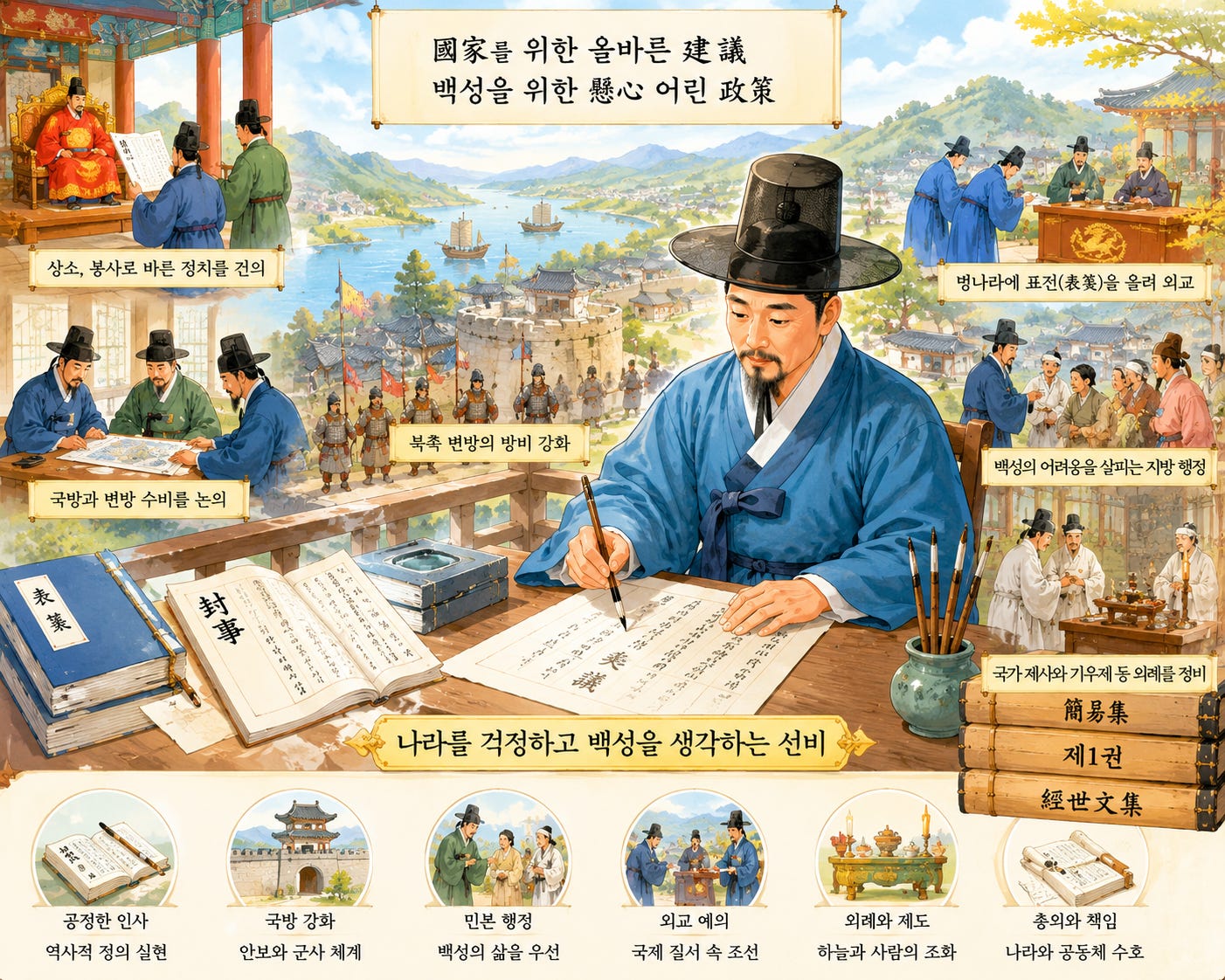
The opening memorials and petitions reveal how seriously Choi Rip regarded public affairs. As a government official, he did not ignore the problems he observed around him. He advocated reforming flawed personnel systems and restoring justice to individuals who had been unfairly treated. In modern terms, he called for fairness, accountability, and historical justice. His writings consistently demonstrate the mindset of a conscientious public servant who placed the well-being of the state above personal gain.
One of the most striking features of his work is his commitment to principles over political interests. Joseon society was increasingly divided by factional politics, and individuals were often judged according to their political affiliations. Choi Rip, however, insisted that people should be evaluated according to their merits and faults rather than partisan loyalties. His position reflects ideals that resonate strongly with contemporary notions of the rule of law, impartiality, and ethical governance.
His concern for national security was equally practical. Several essays in Volume I address military affairs and the defense of the northern frontier. Joseon faced persistent threats from northern tribes and maritime raiders, and the nation would soon experience the devastating Imjin War (1592–1598). Choi Rip argued that military preparedness and border defense were essential for national survival. He believed that scholarship should not remain confined to abstract theories but should contribute directly to solving real-world problems.
The documents written during his service as a local magistrate reveal another side of his character. He viewed government not as a mechanism for preserving official authority but as an institution dedicated to the welfare of ordinary people. He paid close attention to local conditions and sought practical ways to improve the lives of the residents under his administration. His writings are therefore marked not by ornamental rhetoric but by sincere concern for the realities faced by common citizens.
The diplomatic documents included in this volume are equally fascinating. Many of them are formal messages sent to the Ming imperial court, including congratulatory and ceremonial communications. At first glance these texts may appear merely procedural, yet they offer valuable insight into the diplomatic relations between Joseon Korea and Ming China. Through them, we gain a deeper understanding of Joseon’s place within the East Asian international order of the sixteenth century.
The volume also contains commendatory writings and public addresses submitted by the people of regions such as Pyongyang and Haeju. These documents reveal what ordinary citizens valued in their leaders and how they evaluated good governance. They remind us that the ultimate judgment of political leadership comes not from those in power but from the people themselves.
The memorial and ritual texts concerning prayers for rain and state ceremonies provide a window into the worldview of the Joseon era. During times of drought, officials and communities conducted ceremonies to pray for rain, believing that human conduct, nature, and Heaven were interconnected. Although modern scientific perspectives differ significantly, these writings vividly illustrate the moral and cosmological assumptions that shaped Joseon society.
Particularly moving are the proclamations urging resistance during times of national crisis. In these texts, Choi Rip emerges not merely as a scholar but as a patriot. He called upon communities to unite in defense of their country and emphasized the values of loyalty, responsibility, and collective action. His writings reflect the same spirit of civic commitment that inspired many scholar-officials and volunteers during the Imjin War.
The policy questions and critical essays included in the volume reveal Choi Rip’s role as an educator and thinker. He reflected deeply on the qualities required of capable leaders and argued that learning should never be detached from practical reality. In his view, scholarship existed not simply for intellectual achievement but for the cultivation of virtuous individuals and the creation of a stable and just society.
The concluding inscriptions and commemorative writings underscore the importance of historical memory. Recording the achievements of exemplary individuals was, for Choi Rip, more than an act of remembrance; it was a means of educating future generations. He believed that preserving the wisdom of the past could guide those who would shape the future.
After reading Volume I of Ganijip, it becomes impossible to regard Choi Rip merely as a gifted writer. He was a policymaker concerned with governance, an administrator devoted to the people, a strategist mindful of national security, an educator committed to moral cultivation, and a historian determined to preserve collective memory. Throughout his writings runs a single, enduring question: How can a good society be built and sustained?
Today, as artificial intelligence and digital technologies transform the world at an unprecedented pace, the principles that Choi Rip championed—fair governance, public responsibility, ethical leadership, sound education, and historical consciousness—remain profoundly relevant. In this sense, Volume I of Ganijip is far more than a classical collection of official writings. It serves as a timeless guide to public service and civic responsibility. More than four centuries after his death, Choi Rip’s voice still challenges us to consider an essential question: What responsibilities do scholars and intellectuals bear toward society and the common good? +++
{Solti}
June 1, 2026
[독후감] 나라를 걱정한 문장가의 목소리
《국역 간이집》 제1권을 읽고
우리는 흔히 조선시대의 문인이라고 하면 아름다운 시를 짓고 자연을 노래한 선비를 떠올린다. 그러나 간이(簡易) 최립(崔岦, 1539–1612)의 모습은 조금 다르다. 물론 그는 당대 최고의 문장가 가운데 한 사람이었지만, 《국역 간이집》 제1권을 펼쳐 보면 그의 관심은 꽃과 달보다 나라와 백성에게 더 가까이 가 있었다는 사실을 알게 된다. 이 책은 시집이라기보다 한 시대를 살아간 지식인의 정책 보고서이자 사회 비평서이며, 동시에 국가를 향한 충정의 기록이다.
제1권의 첫머리에 실린 여러 상소문을 읽다 보면 최립이 얼마나 나라 일을 진지하게 고민했는지를 쉽게 알 수 있다. 그는 관직 생활을 하면서 보이는 문제를 그냥 지나치지 않았다. 잘못된 인사 제도는 고쳐야 한다고 주장했고, 억울하게 평가받은 사람의 명예는 회복되어야 한다고 생각했다. 오늘날로 말하면 공정한 인사 원칙과 역사적 정의를 요구하는 목소리였다. 그의 글에서는 자신의 이익보다 국가의 올바른 운영을 먼저 생각하는 공직자의 자세가 드러난다.
특히 눈길을 끄는 것은 정치적 이해관계보다 원칙을 중시하는 태도이다. 당시 조선은 붕당 정치가 점차 심화되던 시기였다. 사람들은 당파에 따라 평가받기 쉬웠고 정치적 희생자가 생기기도 했다. 그러나 최립은 특정 세력의 편을 들기보다 공과(功過)를 객관적으로 따져야 한다고 주장했다. 이는 오늘날 우리가 말하는 법치주의와 공정성의 정신과도 통하는 부분이다.
국가 안보에 관한 그의 관심도 매우 현실적이었다. 제1권에는 북방 방어와 군사 문제를 논한 글들이 실려 있다. 조선은 당시 북방 여진 세력과 왜구의 위협 속에 있었으며, 훗날 임진왜란이라는 거대한 재난을 맞게 된다. 최립은 국가의 안전을 위해 군사 체계를 정비하고 국경 방어를 강화해야 한다고 주장하였다. 그는 학문이 현실 문제를 해결하는 데 사용되어야 한다고 믿었던 것이다.
지방관으로 근무하면서 남긴 글에서는 백성에 대한 따뜻한 시선을 발견할 수 있다. 그는 행정의 목적이 관청의 편의가 아니라 백성의 안정을 위한 것이라고 생각했다. 지방의 민심을 살피고 백성들의 어려움을 해결하는 것이 좋은 정치라고 보았다. 그래서 그의 문장 속에는 화려한 수사가 아니라 현실을 바라보는 진솔한 고민이 담겨 있다.
외교 문서들도 흥미롭다. 오늘날의 외교부 문서에 해당하는 표전(表箋)들은 명나라 황제에게 보내는 축하문이나 위문문 등으로 이루어져 있다. 겉으로 보기에는 형식적인 글처럼 보이지만, 당시 조선과 명나라의 국제 관계를 이해하는 중요한 자료가 된다. 이를 통해 우리는 조선이 동아시아 국제질서 속에서 어떤 위치에 있었는지를 엿볼 수 있다.
또한 제1권에는 평양과 해주 등지의 주민들이 올린 송덕문과 감사문이 실려 있다. 이는 단순히 지방 관리의 치적을 기록한 문서가 아니다. 그 속에는 백성들이 어떤 관리를 존경했는지, 무엇을 좋은 정치라고 생각했는지가 담겨 있다. 결국 정치의 평가는 권력자가 아니라 백성이 내린다는 사실을 보여 주는 대목이라 할 수 있다.
제문과 기우제 관련 글들은 조선시대 사람들의 세계관을 이해하게 해 준다. 가뭄이 들면 하늘에 비를 기원하고, 국가적 행사 때는 정성을 다해 제례를 올렸다. 오늘날 과학적 시각과는 다를 수 있지만, 당시 사람들은 인간과 자연, 그리고 하늘이 서로 연결되어 있다고 믿었다. 최립의 문장은 이러한 시대정신을 생생하게 전해 준다.
특히 의병을 독려하는 격문에서는 그의 애국심이 강하게 드러난다. 나라가 위기에 처했을 때 그는 단순히 책상 앞에서 글만 쓰는 학자가 아니었다. 공동체를 지키기 위해 백성들이 힘을 모아야 한다고 외쳤고, 충성과 책임의 가치를 강조했다. 이러한 모습은 임진왜란 시기 수많은 선비들이 보여 준 실천적 애국정신과 맥을 같이한다.
책문과 평론에서는 교육자이자 사상가로서의 최립을 만날 수 있다. 그는 국가를 운영할 인재에게 어떤 자질이 필요한지 고민했고, 학문이 현실과 동떨어져서는 안 된다고 보았다. 학문은 사람을 바르게 만들고 사회를 안정시키는 데 기여해야 한다는 것이 그의 생각이었다.
마지막에 실린 비문들은 역사 기록의 중요성을 일깨워 준다. 훌륭한 인물의 삶과 업적을 기록하여 후대에 전하는 일은 단순한 추모가 아니라 역사 교육의 과정이었다. 최립은 기록을 통해 과거의 지혜가 미래 세대에 이어질 수 있다고 믿었다.
《국역 간이집》 제1권을 덮고 나면 우리는 최립을 단순한 문장가로 기억할 수 없다. 그는 정책을 고민한 행정가였고, 백성을 걱정한 지방관이었으며, 국가의 안보를 생각한 전략가였다. 동시에 학문과 도덕을 중시한 교육자이자 역사 의식을 가진 기록자였다. 그의 글 속에는 “좋은 사회는 어떻게 만들어지는가”라는 질문이 끊임없이 흐르고 있다.
오늘날 인공지능과 디지털 기술이 세상을 빠르게 변화시키고 있지만, 공정한 인사, 책임 있는 행정, 국민을 위한 정책, 올바른 기록과 교육의 중요성은 여전히 변하지 않는다. 그런 의미에서 《간이집》 제1권은 단순한 고전 문집이 아니라 현대 사회에도 유효한 공공성과 책임의 교과서라고 할 수 있다. 최립이 남긴 문장들은 400여 년의 시간을 넘어 오늘 우리에게도 “국가와 사회를 위해 지식인은 무엇을 해야 하는가”라는 질문을 던지고 있다. +++
{솔티}
2026년 6월 1일

Young Choi, PhD is a Professor at Regent University bringing a rare combination of technical expertise and creative spirit to everything he does. A scholar in AI, cybersecurity, and network & telecommunications service management, he has published 38 books including AI and cybersecurity area books, over 200 refereed articles, and over 20 book chapters. Beyond the academy, Dr. Choi is a passionate poet, essayist, calligrapher, and wooden block laser engraving artist whose reflective writing invites readers to rediscover life’s beauty in quiet contemplation(靜觀). He lives under the motto: “Study hard and give generously without holding back! (열심히 공부해서 아낌없이 남주자 !: 열공아남!)”
Published books: https://www.amazon.com/stores/Young-Choi/author/B0DMZ5S6R7?ref=ap_rdr&shoppingPortalEnabled=true