

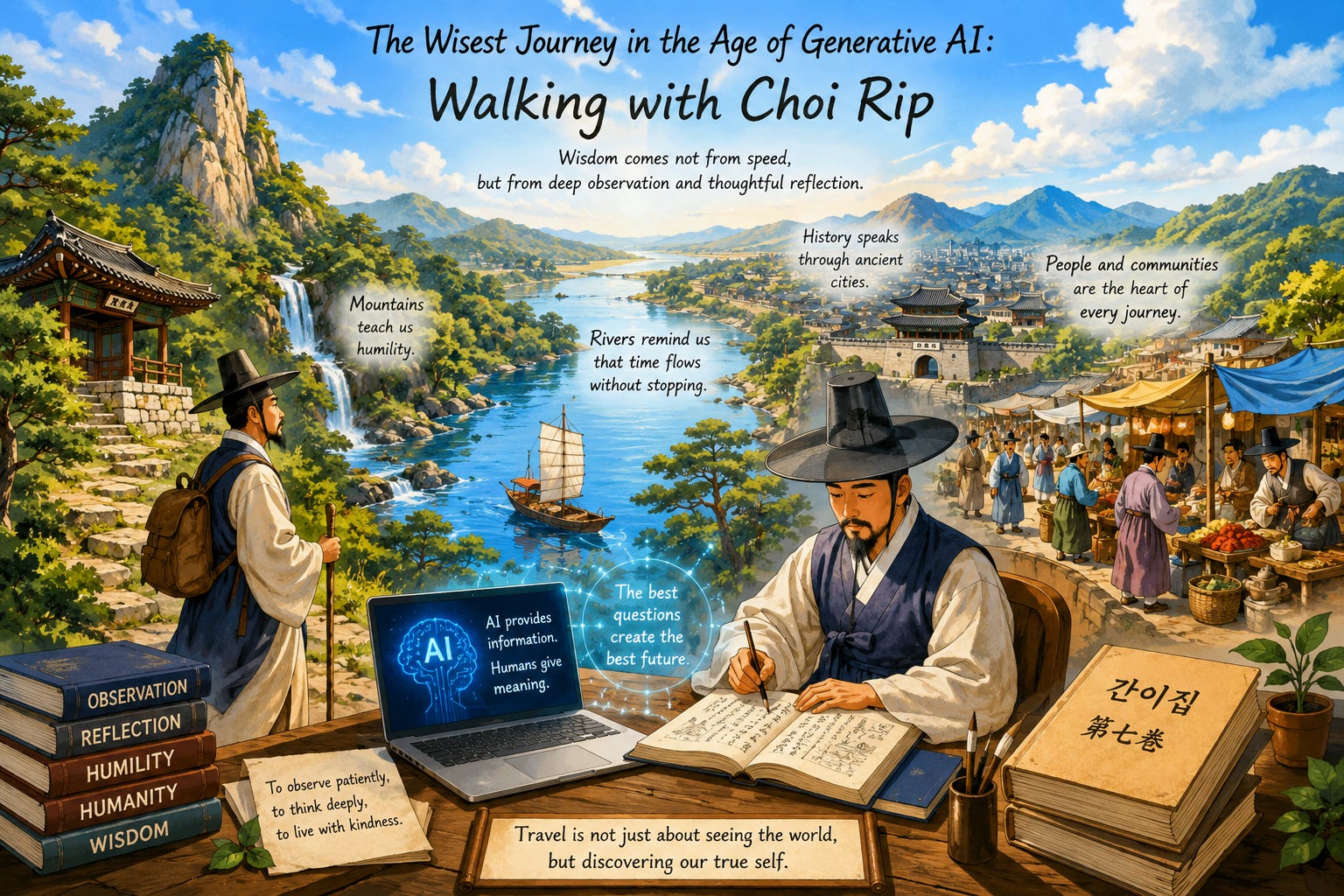
We are living in an age when artificial intelligence writes essays, creates paintings, composes music, and even helps us make everyday decisions. When we have a question, we often ask AI before opening a book. Before setting out on a trip, many of us consult AI for travel recommendations and itineraries. Never before has the world changed so rapidly.
Yet one day, a simple question came to my mind:
“AI can make us smarter—but can it also make us wiser?”
With that question, I opened Volume 7 of The Korean Translation of Gani-jip. To my surprise, the travel writings left by the Joseon scholar Choi Rip more than four centuries ago spoke directly to those of us living in the age of Generative AI.
Volume 7 includes several travel essays, including Gongsanrok (公山錄), Songdorok (松都錄), Yeogangrok (驪江錄), Maporok (麻浦錄), and Gapo Haengnok (甲午行錄). At first glance, they appear to be simple accounts of journeys through mountains, rivers, historic cities, and villages. Yet as I continued reading, I realized that they are far more than travel journals. They are, in essence, a book that teaches us how to think.
While climbing Mount Gong, Choi Rip did not merely admire the towering peaks before him. He learned humility from the mountains. Standing beside the flowing river, he did not measure its depth or width; instead, he contemplated the passage of time and the meaning of life. In the ancient city of Songdo, he looked beyond the ruins to discover history itself. In Mapo, he saw not only a bustling marketplace but also the lives of ordinary people and the strength of community.
Generative AI can process enormous amounts of information, recognize patterns, and produce remarkably coherent responses. Yet AI does not experience wonder. It does not feel moved by a breathtaking landscape, nor can it truly sense the weight of history while standing before an ancient fortress. Those experiences belong to humanity alone.
For Choi Rip, travel was never about collecting data; it was about discovering meaning. Today’s AI systems learn from trillions of words and countless datasets, yet Choi Rip found lifelong wisdom in a single journey, a single encounter, or the quiet flow of a river. His writings remind us that the depth of observation is often more valuable than the quantity of information. More than four centuries ago, he had already demonstrated a truth that remains profoundly relevant today.
Another aspect of Volume 7 that impressed me deeply was Choi Rip’s remarkable way of thinking. He never viewed nature as an isolated subject. He connected it with history, linked history with people, and ultimately related everything back to his own life. In many ways, his intellectual approach resembles what AI researchers today describe as a knowledge graph or integrative thinking. Long before such concepts existed, Choi Rip naturally practiced them through careful observation and thoughtful reflection.
As Generative AI becomes increasingly powerful, one uniquely human ability grows even more valuable—the ability to ask meaningful questions. AI excels at answering questions, but truly great questions still originate in the human mind. Throughout his travels, Choi Rip continuously questioned both the world around him and himself.
“Why do mountains make us humble?”
“Why does a river never stop flowing?”
“Why does an ancient city continue to speak to us across the centuries?”
Because he asked these questions, every journey became more than physical movement; it became a lifelong education.
Perhaps the greatest lesson of Volume 7 is that only those who are willing to slow down can truly understand the world. Today, AI enables us to obtain vast amounts of information within seconds. Yet the meaning of life is shaped not by the speed of information retrieval but by the depth of reflection. Choi Rip understood nature because he slowed his pace. He understood himself because he embraced moments of silence.
Equally inspiring is his profound respect for people. He never judged those he met according to their social status. Merchants, boatmen, scholars, and ordinary villagers all deserved his attention and respect. He sought to understand their lives with empathy and sincerity. His human-centered perspective closely echoes the principles of modern AI ethics, which emphasize respect for human dignity. No matter how advanced technology becomes, its value ultimately depends on whether it serves humanity.
Many people assume that success in the AI era depends primarily on mastering new technologies. Yet Volume 7 tells a very different story. The more advanced our technology becomes, the more deeply we must observe, reflect, and empathize. AI can perform calculations with extraordinary speed, but empathy begins with human beings. AI can generate explanations, but inspiration is born from the human heart.
Although Choi Rip traveled through mountains and rivers, his greatest journey was inward. He explored his own mind as much as the landscapes before him. More than four centuries later, that journey continues through every reader who opens his work. Generative AI will undoubtedly continue to evolve, becoming increasingly capable and sophisticated. Yet no matter how intelligent future AI systems become, they can never replace distinctly human qualities: humility before nature, a willingness to learn from history, compassion toward others, and the lifelong practice of self-reflection.
Volume 7 of The Korean Translation of Gani-jip is far more than a collection of historical travel essays. It is a textbook on how to think as a human being and a timeless guide to human wisdom that remains profoundly relevant in the age of Generative AI.
AI may provide us with more answers than ever before. Yet a better life still begins with better questions. And one of the most beautiful ways to learn how to ask those questions is to walk beside Choi Rip—climbing mountains, following rivers, exploring ancient cities, and discovering the wisdom hidden within each journey.
Perhaps, in this era of Generative AI, the first lesson we need is not a new algorithm, but the timeless wisdom found in Volume 7 of Gani-jip (The Gani Collection)—to observe patiently, think deeply, and live with kindness. +++
{Solti}
July 25, 2026
생성인공지능 시대, 최립과 함께 떠나는 가장 지혜로운 여행
『국역 간이집』 제7권이 오늘의 우리에게 들려주는 이야기
우리는 지금 인공지능이 글을 쓰고, 그림을 그리고, 음악을 만드는 시대를 살아가고 있다. 궁금한 것이 생기면 책보다 먼저 AI에게 묻고, 여행을 떠나기 전에도 AI에게 일정을 추천받는다. 세상은 그 어느 때보다 빠르게 변하고 있다.
그런데 문득 이런 생각이 들었다.
“AI는 우리를 더 똑똑하게 만들 수는 있지만, 더 지혜롭게도 만들 수 있을까?”
이 질문을 품고 『국역 간이집』 제7권을 펼쳤다. 400여 년 전 조선의 문인 최립이 남긴 여행기들은 놀랍게도 오늘날 생성인공지능 시대를 살아가는 우리에게도 깊은 울림을 전해 주었다.
제7권에는 공산록 (公山錄), 송도록 (松都錄), 여강록 (驪江錄), 마포록 (麻浦錄), 갑오행록 (甲午行錄) 등 여러 기행문이 실려 있다. 처음에는 단순히 산과 강, 도시를 여행하며 기록한 글이라고 생각했다. 그러나 한 편 한 편 읽어 갈수록 이것은 여행기가 아니라 ’생각하는 방법을 배우는 책’이라는 사실을 깨닫게 되었다.
최립은 산을 오르면서도 단순히 높은 봉우리를 바라보지 않았다. 그는 산을 통해 인간의 겸손을 배웠다. 강을 바라보면서도 물의 깊이나 넓이를 기록하지 않았다. 그는 끊임없이 흐르는 강물을 보며 시간과 인생을 생각했다. 오래된 도시 송도에서는 폐허를 보지 않고 역사를 읽었으며, 마포에서는 시장의 번잡함보다 사람들의 삶과 공동체를 발견하였다.
생성인공지능도 수많은 정보를 분석한다. 그러나 AI는 스스로 감동하지는 않는다. 아름다운 풍경을 보아도 마음이 움직이지 않고, 오래된 성곽을 보아도 역사의 무게를 느끼지 못한다. 그것은 결국 인간만이 할 수 있는 일이다.
최립의 여행은 데이터를 모으는 과정이 아니라 의미를 찾는 과정이었다. 오늘날 AI는 엄청난 양의 데이터를 학습하지만, 최립은 한 번의 여행과 한 번의 만남, 한 줄기의 강물 속에서도 평생 기억할 지혜를 발견하였다. 어쩌면 정보의 양보다 관찰의 깊이가 더 중요하다는 사실을 그는 이미 수백 년 전에 우리에게 보여 준 것이다.
『간이집』 제7권을 읽으며 또 하나 놀라웠던 점은 그의 사고방식이었다. 그는 자연을 자연으로만 보지 않았다. 역사와 연결했고, 사람과 연결했으며, 자신의 삶과 연결하였다. 오늘날 AI 연구자들이 말하는 ‘지식 그래프(Knowledge Graph)’나 ‘융합적 사고’를 그는 이미 자연스럽게 실천하고 있었던 셈이다.
생성인공지능의 시대가 될수록 인간에게 더욱 필요한 능력은 질문하는 힘이다. AI는 질문에 답하지만, 좋은 질문은 결국 사람이 만든다. 최립은 여행을 하며 끊임없이 스스로에게 질문을 던졌다.
“왜 이 산은 사람을 겸손하게 만드는가?”
“왜 강물은 멈추지 않는가?”
“왜 옛 도시는 지금도 우리에게 말을 거는가?”
이러한 질문이 있었기에 그의 여행은 단순한 이동이 아니라 평생의 공부가 되었다.
제7권이 우리에게 주는 가장 큰 교훈은 천천히 바라보는 사람만이 깊이 이해할 수 있다는 사실이다. 오늘날 우리는 AI 덕분에 몇 초 만에 수많은 정보를 얻을 수 있다. 그러나 삶의 의미는 검색 속도가 아니라 사유의 깊이에서 만들어진다. 최립은 걸음을 늦추었기에 자연을 읽을 수 있었고, 침묵했기에 자신의 마음을 들을 수 있었다.
또 하나 인상 깊은 것은 그의 따뜻한 인간애이다. 그는 여행지에서 만난 사람들을 신분으로 평가하지 않았다. 상인과 뱃사공, 선비와 평범한 백성을 모두 존중하며 그들의 삶을 이해하려 했다. 이것은 오늘날 AI 윤리에서 강조하는 인간 존중과도 맞닿아 있다. 아무리 뛰어난 기술이라도 사람을 위한 것이 아니라면 그 가치는 오래가지 못한다.
우리는 흔히 AI 시대에는 기술만 배우면 된다고 생각한다. 그러나 『간이집』 제7권은 정반대의 이야기를 들려준다. 기술이 발전할수록 인간은 더 많이 관찰하고, 더 깊이 생각하며, 더 따뜻하게 공감해야 한다는 것이다. AI는 계산을 잘하지만, 공감은 사람에게서 시작된다. AI는 설명할 수 있지만, 감동은 사람이 만들어 낸다.
최립은 산과 강을 여행했지만, 사실은 자신의 마음을 여행하고 있었다. 그리고 그 여행은 400년이 지난 오늘, 우리에게도 계속 이어지고 있다. 생성인공지능은 앞으로도 계속 발전할 것이다. 그러나 아무리 뛰어난 AI가 등장하더라도 자연 앞에서 겸손해지는 마음, 역사를 통해 배우려는 자세, 사람을 존중하는 따뜻한 시선, 그리고 자신을 끊임없이 돌아보는 성찰은 결코 기계가 대신할 수 없는 인간만의 능력이다.
『국역 간이집』 제7권은 오래된 기행문 모음집이 아니다. 그것은 인간답게 생각하는 법을 가르쳐 주는 여행의 교과서이며, 생성인공지능 시대에도 결코 낡지 않는 인간 지혜의 지도이다.
우리는 AI에게 더 많은 답을 얻을 수 있다. 그러나 더 좋은 삶은 여전히 좋은 질문에서 시작된다. 그리고 그 질문을 배우는 가장 아름다운 방법 가운데 하나가 바로 최립과 함께 산을 오르고, 강을 따라 걷고, 옛 도시를 여행하는 일이다.
어쩌면 생성인공지능 시대에 우리가 가장 먼저 배워야 할 것은 새로운 알고리즘이 아니라, 『간이집』 제7권이 들려주는 ‘천천히 보고, 깊이 생각하며, 따뜻하게 살아가는 법’인지도 모른다. +++
2026년 7월 25일
{솔티}

Prof. Dr. Young Choi (Editor in Chief) — Regent University
Young B. Choi is a Professor in the Department of Engineering & Computer Science at Regent University. He published 38 books with ‘Selected Readings in Cybersecurity’ (2018) (over 800 copies archived globally at university/college libraries around the world) and ‘Cybersecurity Applications and Artificial Intelligence’ (2023) available in seven major world languages. He proposed the world’s first global and universal telecommunications “Service Order Handling (SOH)” Model (T-SOH Model) (1995) with Dr. Adrian Tang. With this innovative research work, he received the IEEE NOMS ’96 Best Paper Award and became the first recipient of the Outstanding Contribution Award of the TeleManagement Forum in 1998. His research areas include Natural Language Processing-focused AI, AI-applied cybersecurity, network and telecom service management, and Korean studies on Gani Choi Rip’s Jeonggwan (靜觀: Quiet Contemplation) philosophy and Shilhak ( 實學: Practical Learning).