
Kang, Younghill. East Goes West: The Making of an Oriental Yankee. 1937. Penguin Classics, 2019. ISBN 9780143134305. 432 pages, $18.00.
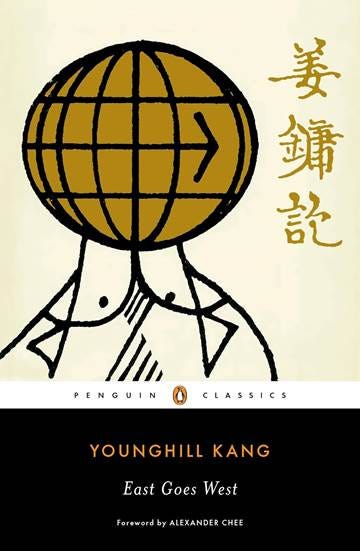
Cover image: East Goes West by Younghill Kang. Image reproduced for purposes of review and commentary.
This book is a reprint of Younghill Kang’s East Goes West: The Making of an Oriental Yankee (1937), originally published by Charles Scribner’s Sons. East Goes West is a sequel to Kang’s The Grass Roof (1931), also published by Charles Scribner’s Sons and considered by many the first Korean American novel. Given its historical importance and lasting appeal, East Goes West was republished by Penguin Classics in 2019. This edition includes a foreword by Alexander Chee and an afterword by Sunyoung Lee.
The Grass Roof is an important work that portrays life in Korea under Japanese domination and the protagonist’s decision to come to the United States. It is in East Goes West, however, that Kang explores the aspirations, observations, and self-positioning of a young Korean immigrant in American society. The two novels complement each other, with the first depicting the circumstances that lead to emigration and the second examining the immigrant’s experiences in his adopted country.
As a semiautobiographical novel and an important early Asian American work, East Goes West portrays its protagonist’s initial euphoria about America, his experiences and observations, and his gradual understanding of his place in American society. Although Chungpa Han arrives with high hopes for Western civilization, his encounters with American life expose him to racial bigotry, social barriers, and contradictions between American ideals and actual practices. Despite his growing disillusionment, he ultimately decides to remain in the United States. His journey illustrates the complex experience of an immigrant who becomes attached to his adopted country while recognizing its shortcomings.
Younghill Kang (1903–1972) was born in Korea and came to the United States in 1921 with the assistance of a missionary. Like his fictional protagonist, he attended Dalhousie University in Canada on a scholarship before pursuing further studies at Harvard University. He earned a bachelor’s degree in 1925 and a master’s degree in English education in 1927. Kang’s educational experiences and familiarity with both East Asian and Western literature inform East Goes West, in which the protagonist’s intellectual interests shape his understanding of the society he encounters. The novel draws on Kang’s experience as an early Korean immigrant while presenting a broader account of the challenges of living between two cultures.
The novel follows Chungpa Han, an ambitious young Korean who leaves his homeland for economic opportunity, professional success, and personal advancement in New York. After traveling through Yokohama, Vancouver, and Halifax, he pursues an education in Canada and Boston. He initially believes that Western civilization offers a superior model for humanity and hopes to embrace American life. His encounters with employers, students, missionaries, and other immigrants, however, complicate his idealistic expectations. He experiences both racial prejudice and generous hospitality, while the tragic story of his fellow Korean To Wan Kim and Helen Hancock exposes the limits of Christian charity and American tolerance. By the end of the novel, Chungpa recognizes that Western civilization is not as superior as he once believed, but he also realizes that returning to Korea would leave him feeling estranged from the American life he has come to know.
At the beginning of the story, Chungpa has a strong desire to acculturate to American life. In Korea, he attended mission schools despite his father’s opposition because he believed that the future of humanity lay in Western civilization rather than in his native Confucian culture. Western learning even encouraged him to seek a romantic partner through his own judgment rather than relying on the decisions of his ancestors, astrologers, or traditional spiritual beliefs. His arrival in America is almost a religious experience. He feels as though he has been reborn and welcomes the noise and energy of Manhattan as part of his initiation into a new life. When he washes his hair at a hotel, he imagines that he is cleansing himself of the old world and its traditions. His response reveals how completely he associates America with a new beginning and liberation from the customs of his homeland.
His early experiences, however, expose the distance between his idealized image of America and the realities of immigrant life. Although Chungpa possesses extensive knowledge of East Asian poetry and philosophy and is familiar with eminent European writers and poets, he has only four dollars when he arrives. His intellectual ambitions do not protect him from menial work or racial humiliation. As a houseboy, he must follow the strict instructions of a white employer who orders him to address her as Madame, open doors for her, and avoid using the front door except when opening it for others. When his suitcase accidentally opens and his books spill out, she wonders whether they carry germs. Her children laugh at his nervousness and confusion. After he arrives an hour and a half late one evening, the woman dismisses him and his fellow Korean worker, Pak. When Chungpa attempts to win her favor by vacuum-cleaning the living room, she responds with a spiteful smile and ridicules him for behaving more like a comedian than a competent servant.
This tragicomic episode illustrates how Chungpa’s intellectual identity is disregarded when he occupies a subordinate social position. His employer sees him not as a scholar with literary ambitions but as a foreign servant whose value depends on his ability to perform domestic duties. His familiarity with Shakespeare, which he regards as evidence of his intellectual interests, offers little protection against the indignities of his work.
Chungpa also encounters racial hostility at Maritime University in Nova Scotia. A fellow student, Leslie Robin, uses a racist insult to express his resentment at having to live alongside an Asian student. Chungpa is so indignant that he feels greater anger than he had experienced in response to the rudeness of New Yorkers. He soon realizes, however, that Leslie’s attitude does not represent everyone at the school. Other students show him kindness and consideration, even as the institution remains shaped by assumptions of British racial and cultural superiority.
Indeed, Chungpa’s experiences in Canada and the United States reveal a complicated mixture of prejudice and generosity. At Maritime University, many students accept him and try to treat him kindly. Yet he also recognizes the paternalism behind their behavior. He interprets their special attention and protection as expressions of the colonial belief that white people have a responsibility to guide and protect people of other races. His observation complicates the apparently benevolent treatment he receives. Kindness may be genuine, but it can also rest on assumptions about racial and cultural superiority.
In Boston, the president of a bookselling company, D. J. Lively, and his wife invite Chungpa to live in their home and treat him as their own son. A farmer and his wife, who are devout Baptists, also welcome him as a member of their household. These experiences make his encounters with white Americans more complex than a simple account of racial hostility would suggest. Chungpa receives genuine assistance from people who respect him, but their generosity does not necessarily mean that they regard Asians as equal members of American society.
The contradiction becomes clear when Chungpa discovers that the Livelys oppose interracial marriage. Mrs. Lively advises him against dating American women and insists that people of different racial backgrounds should marry within their own groups. Her husband agrees, regarding interracial marriage as contrary to God’s intentions. Their religious convictions thus become a justification for racial separation.
The tragic relationship between To Wan Kim, a Korean poet and philosopher, and Helen Hancock, a young white woman, further exposes the limits of American Christian charity. Although Helen loves To Wan, her parents warn him against interpreting her affection as permission to pursue a romantic relationship. Instead, they present her feelings as an expression of sisterly concern and Christian benevolence. When To Wan visits their church, the congregation stares at him and whispers behind his back. Helen is eventually shunned by Boston’s polite society, consults numerous psychiatrists, and dies in a rest home. In despair, To Wan kills himself. Through this tragic story, Kang reveals the painful consequences of racial prejudice in a society that professes Christian values.
Chungpa is perplexed by the combination of graciousness and bigotry he encounters among white Americans. His embrace of Protestant Christianity earns him the trust of many people, while his unfamiliarity makes him an object of curiosity and benevolent attention. At the same time, he is treated as the racial and cultural Other, set against an idealized white West. His experiences illustrate how acceptance can remain conditional even when it appears generous.
As the novel progresses, Chungpa reaches a better understanding of what it means to be an early Asian immigrant in North America, caught between two cultural worlds. His euphoria about the New World gives way to a cautious optimism about Western civilization. In addition to recognizing the social barriers facing Asian immigrants, he realizes that Western civilization is not as superior as he once believed. His conversations with To Wan are instrumental in this change. To Wan challenges Chungpa’s complacent view of America and Western civilization. He also criticizes American education for its superficiality and lack of specialization. Through their conversations, Chungpa begins to question the assumptions that originally brought him to the United States.
By the end of East Goes West, Chungpa realizes that he cannot renounce his new life in America despite its shortcomings. He believes that his period of exile has largely run its course, yet returning to Korea would create a new form of displacement because he has become attached to America. His outlook and identity have been shaped by Western culture, and he can imagine returning to his native village only for a visit. Chungpa, who came to the United States as an exile, has thus become an exile in his native land. His final self-positioning is a compromise. He accepts America as an imperfect country in which he has established a life and to which he has become attached. He has become an American in many respects while retaining his Oriental identity, as the novel’s subtitle suggests.
Kang’s novel remains valuable for its portrayal of the complicated experiences of an early Asian immigrant. Its combination of comedy, personal observation, and social criticism reveals the contradictions of a country that offers opportunity and hospitality while maintaining racial and cultural barriers in the early twentieth century. Chungpa’s experiences challenge the assumption that Western civilization is inherently superior, while his final decision to remain in America resists a simple narrative of either disillusionment or triumph. He does not fully resolve the tensions between his two cultural worlds. Instead, he learns to live with them. This unresolved condition is one of the novel’s most enduring insights.
About the Author

Professor of English and Creative Writing and Associate Dean of the School of Humanities and Theology, Missouri Baptist University
John J. Han, PhD, is the author, editor, co-editor, or translator of 38 books published by Rodopi, Peter Lang, McFarland, Bloomsbury Academic, and other presses. He has published hundreds of scholarly articles and more than 3,000 poems, mostly haiku, in journals and anthologies around the world. His forthcoming book, Echoes from the Hills: Critical Essays on Ozarks Literature, co-edited with C. Clark Triplett, will be published by the University of Arkansas Press. He is in his 28th year as a full-time faculty member at Missouri Baptist University, where he has taught since 1999. He has also taught at Kansas State University, the University of Nebraska–Lincoln, Nebraska Wesleyan University, and Washington University in St. Louis. He has served as a visiting scholar at Georgia College & State University and the University of Ljubljana in Slovenia.
© K-Global Scholars and Professionals Forum. All rights reserved. Content published in the K-GSP Forum may not be reproduced, distributed, or transmitted in any form without prior written permission from the K-GSP Forum, except for brief quotations with full attribution.