
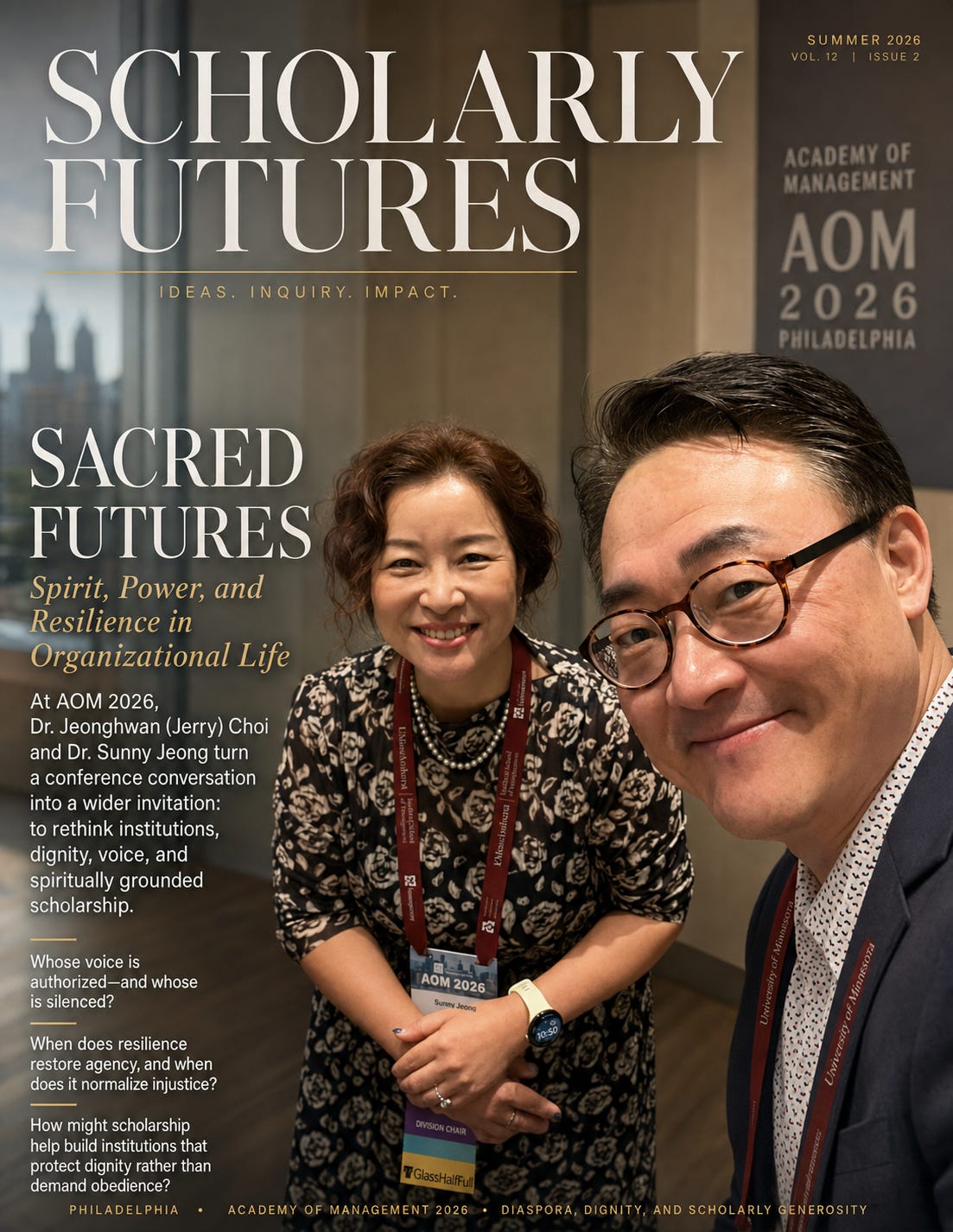
There is a particular kind of meeting that happens at a conference and refuses to stay there. It follows you home. It reorganizes what you thought you already understood. When Dr. Jeonghwan (Jerry) Choi and Dr. Sunny Jeong sat down together at the Academy of Management’s 2026 meeting in Philadelphia (July 31 ~ August. 04, 2026), both KGSP members, both carrying the long memory of the diaspora, they were doing more than catching up between sessions. They were building a table.
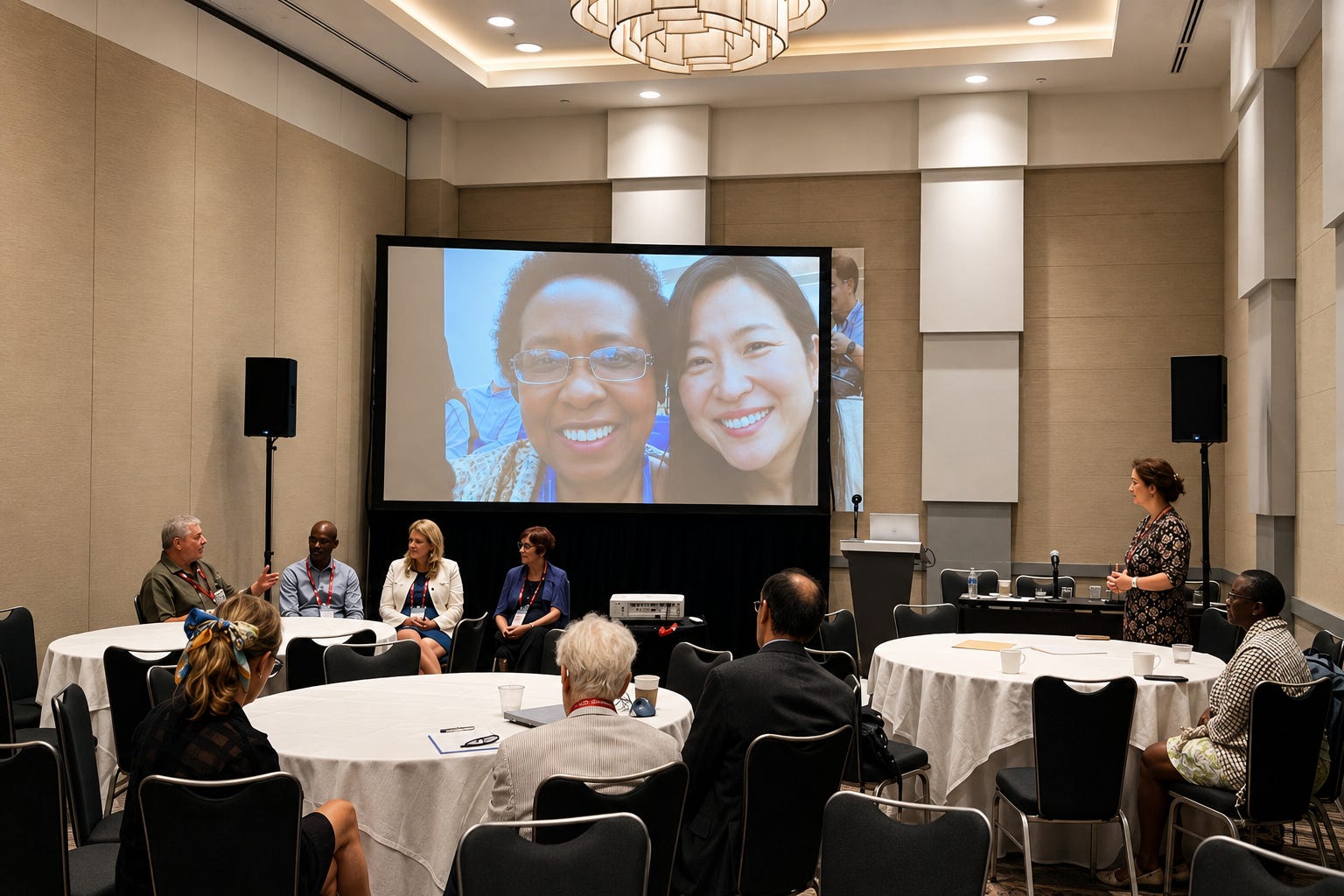
The occasion was a Management, Spirituality and Religion professional development workshop tied to a forthcoming Palgrave Macmillan volume, Reimagining Spirit, Power, and Resilience in Organizational Life. Dr. Choi leads a section within it with a title that reads almost like a challenge: Power, Politics, Organizational Energies, and Global Institutions.
Dr. Jeong opened the workshop; Dr. Choi followed with what he calls, pointedly, an invitation rather than a presentation. The distinction matters. Much of academic life trains us to arrive with finished answers. They came instead to cultivate beginnings.
The uncomfortable premise
Dr. Choi’s opening rests on a claim that sounds obvious until you sit with its consequences: institutions are never neutral. They distribute voice, legitimacy, safety, opportunity, and, just as deliberately, silence. In a moment shaped by war, displacement, ecological strain, democratic erosion, and institutional burnout, he argues, we cannot talk honestly about spirituality or resilience without also talking about power.
This is where his provocation cuts against the grain of mainstream management scholarship. That literature often treats spirituality as a private comfort, a coping resource that helps people stay positive and keep performing. Useful, perhaps. But Dr. Choi presses on the cost. A spirituality reduced to endurance can teach people to survive institutional harm without ever asking who created the harm, who benefits from it, and whose knowledge or dignity was excluded to begin with. Resilience, in that framing, risks becoming a quiet instruction to absorb injustice.
So he reframes the question. What happens when spirituality becomes not only a source of personal resilience, but a source of moral courage, collective resistance, reclaimed voice, and institutional transformation? The section he leads leans into conversations management scholarship has tended to keep at its margins: postcolonial and decolonial readings of global institutions, academic resistance inside transnational higher education, the spiritual aftermath of retaliation and betrayal, and the Indigenous, Asian, African, and diasporic wisdom traditions that unsettle dominant assumptions about authority and knowledge.
Why Korean scholars, why now
It is not incidental that two Korean scholars are the ones pulling this thread. The diasporic vantage point, holding more than one world at once, belonging fully to neither, is exactly the standpoint from which the neutrality of institutions becomes visible. You notice the water when you have lived on more than one shore. Dr. Jeong and Dr. Choi bring that doubled sight to a field that has too often mistaken a particular cultural inheritance for a universal one.
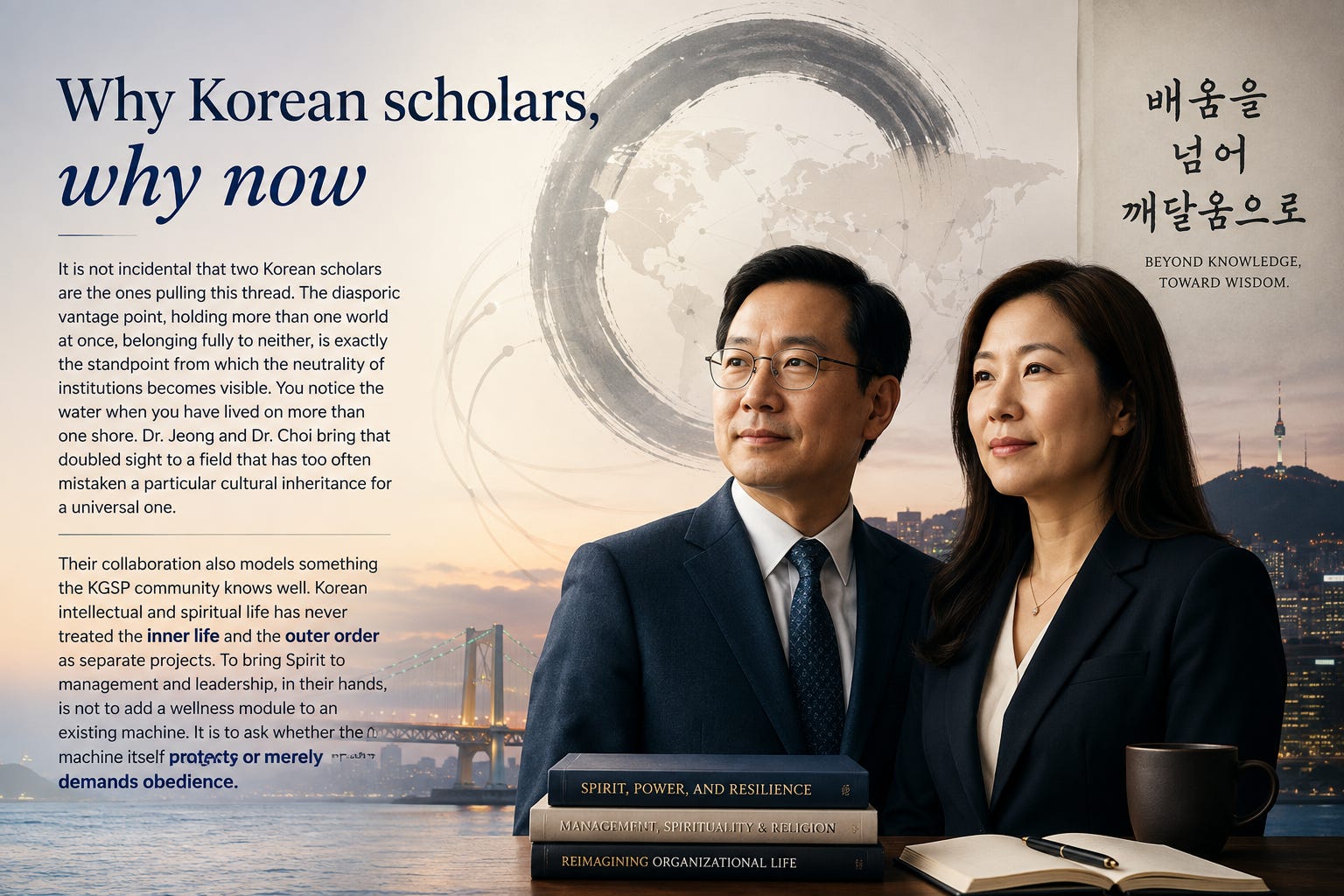
Their collaboration also models something the K-GSP community knows well. Korean intellectual and spiritual life has never treated the inner life and the outer order as separate projects. To bring Spirit to management and leadership, in their hands, is not to add a wellness module to an existing machine. It is to ask whether the machine itself protects dignity or merely demands obedience.
An invitation, still open
The three questions Dr. Choi placed on the table are worth carrying past the conference room:
Whose voice is authorized, and whose voice is silenced?
When does resilience restore agency, and when does it normalize injustice?
And how might spiritually grounded scholarship help us imagine institutions that protect dignity rather than demand obedience?
Notice that none of these can be answered alone. That may be the deeper point of the photograph from Philadelphia, two colleagues, shoulder to shoulder, smiling. The work they are describing cannot be done by a lone author defending finished conclusions. It asks for a table, for many voices, for what they call scholarly generosity: naming the promise of an idea before critiquing it, making room for the quieter voice, refusing to speak for others.
For those of us in the KGSP community who lead, teach, research, or simply try to stay whole inside institutions that were not built with us in mind, the invitation lands close to home. Sacred futures, they remind us, are not found. They are made, together, and usually at a table someone had the courage to set.
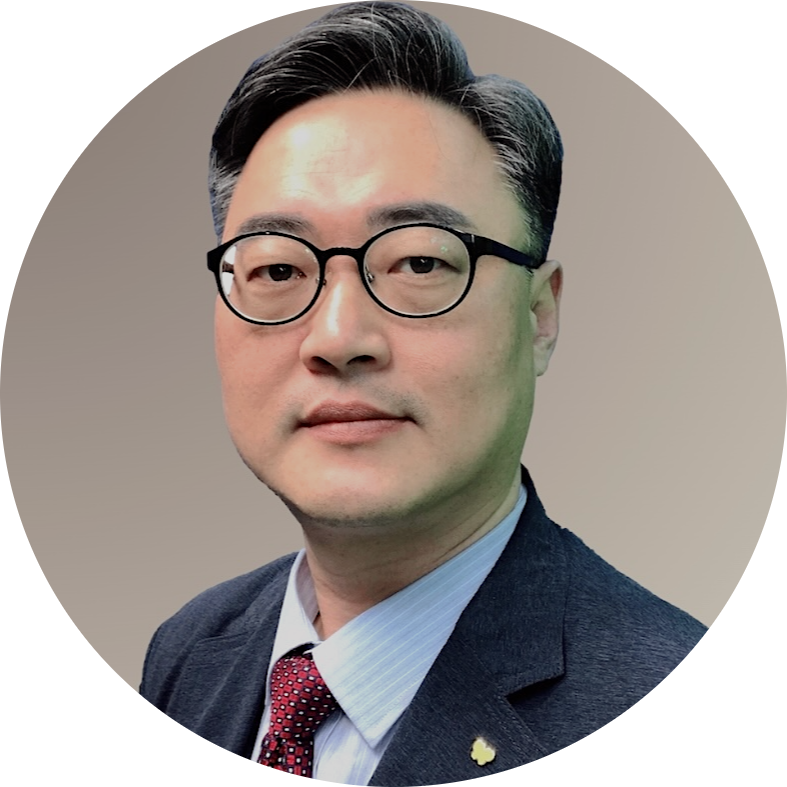
Prof. Dr. Jeonghwan (Jerry) Choi (Managing Editor), University of Maine at Presque Isle
Jeonghwan (Jerry) Choi, PhD is an Associate Professor of Business at the University of Maine at Presque Isle and Editor-in-Coordination of K-GSP Forum (contact: jeonghwan.choi at gmail.com). With over 25 years of industry and consulting experience, he specializes in leadership development, human resource management, organizational behavior, and social entrepreneurship. His research focuses on workforce resilience, organizational health, and self-directed leadership — bridging rigorous scholarship with practical insight to cultivate leaders who create meaningful, sustainable, and humane organizations.

Prof. Dr. Sunny Jeong is an Associate Professor of International Business and resilience strategist, integrating mindfulness and emotional intelligence to cultivate meaningful work, compassionate leadership, and global impact through research, keynotes, and storytelling.
© K-Global Schoalrs and Professionals Forum. All rights reserved. Content published in the K-GSP Forum may not be reproduced, distributed, or transmitted in any form without prior written permission from the K-GSP Forum, except for brief quotations with full attribution