

Executive Summary
Sustainable enterprise partnerships are built not only on complementary capabilities, but also on trust, transparent governance, and strategic alignment among stakeholders. Long-term collaboration succeeds when partners balance execution, relationship management, and institutional credibility while maintaining accountability and mutual respect. Enterprises that cultivate clear roles, constructive communication, and shared purpose are better positioned to create resilient and high-performing partnerships in complex environments. This paper develops a multi-level framework linking relational trust, governance structures, and strategic alignment to explain how sustainable partnerships evolve across individual, organizational, and national contexts.
Keywords: Trust, Governance, Strategic Alignment, Collaboration, Sustainability
1. Introduction
In today’s turbulent geopolitical environment — marked by energy disruptions, rising fuel costs, supply chain instability, and cascading economic uncertainty — the ability to develop and sustain collaborative partnerships has become critical across individual, organizational, and national levels. Volatility in global energy markets, reflected in sustained increases in fuel prices, has generated far-reaching consequences across industries. For example, escalating operating costs in the aviation sector — where fuel represents a major expense — have contributed to severe financial strain, as illustrated by the bankruptcy of Spirit Airlines. These developments demonstrate how external shocks propagate across interconnected systems, reinforcing that no organization, industry, or nation operates in isolation. In this context, resilient and strategically aligned partnerships are essential for managing uncertainty, mitigating systemic risk, and sustaining operational continuity, innovation, and long-term competitiveness.
Evidence from multinational corporations, global supply chains, and innovation ecosystems shows that partnerships often fail not due to insufficient resources, but because of misaligned expectations, unclear governance, weak communication, and unmanaged power dynamics. In contrast, high-performing collaborations emphasize strategic alignment, transparent decision-making, mutual accountability, and adaptive leadership that balances execution with relational sustainability. Such partnerships function as systems of shared value creation, where integrating diverse competencies, institutional credibility, relational trust, and governance enables resilience and sustained competitive advantage in complex environments.
These dynamics align with relational and dynamic capability perspectives in strategic management, where value is co-created through inter-organizational collaboration rather than internal resources alone (Dyer, Singh, & Hesterly, 2018; Teece, 2018). Research further shows that external shocks — such as the COVID-19 pandemic — have intensified the need for integrated approaches across entrepreneurship, supply chains, and strategy, underscoring the importance of resilient and adaptive partnerships (Ketchen & Craighead, 2020).
2. Foundations of Sustainable Enterprise Partnerships
Sustainable enterprise partnerships evolve progressively from relational trust to governance alignment and strategic integration, where trust, governance, and shared purpose dynamically reinforce one another to strengthen organizational resilience, coordinated decision-making, and long-term sustainability.
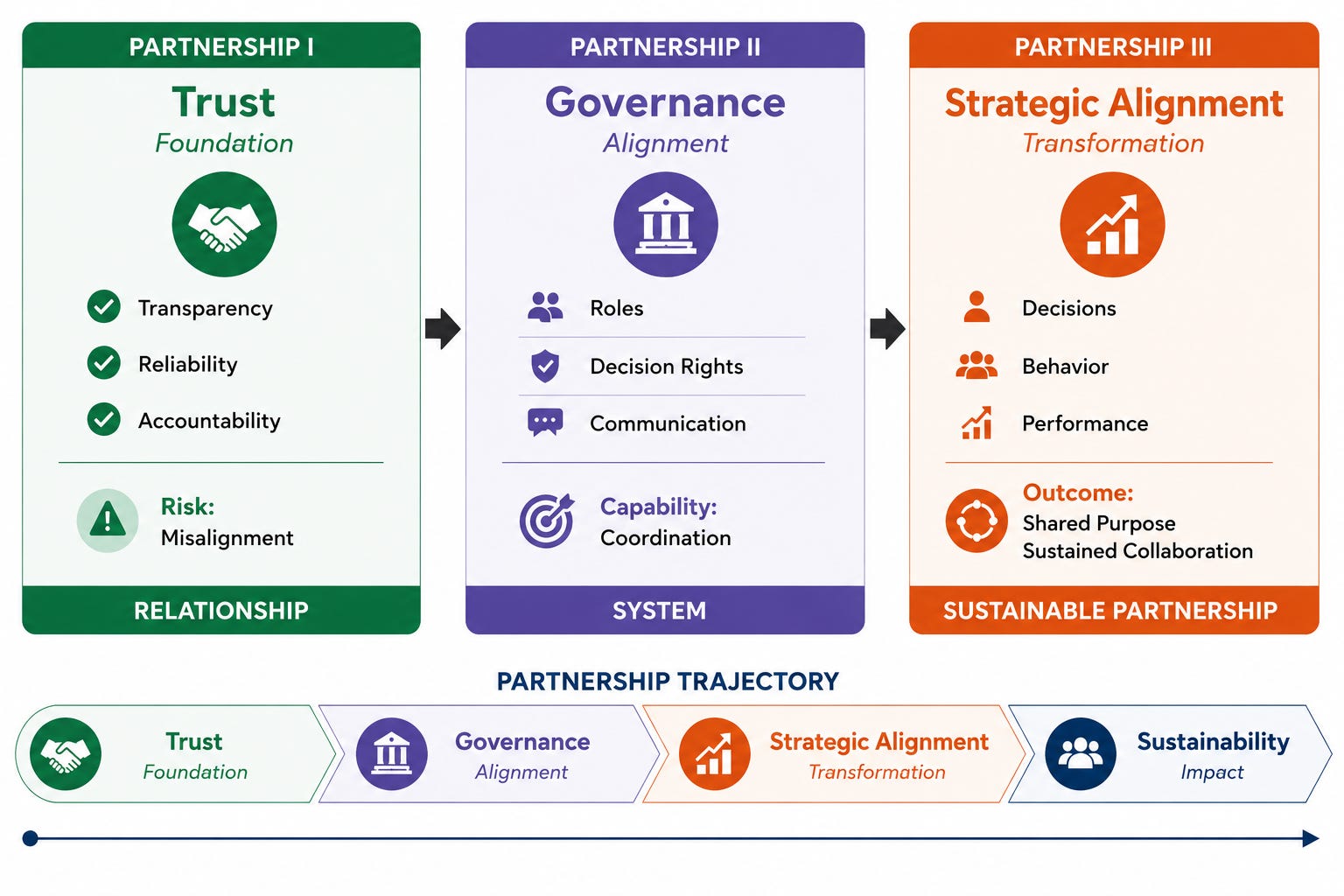
Figure 1
Partnership Trajectory Toward Sustainable Collaboration
Figure 1 illustrates the developmental trajectory of sustainable enterprise partnerships, showing how long-term collaboration evolves progressively from trust-based relationships to governance alignment, strategic integration, and ultimately organizational sustainability. The framework emphasizes that sustainable partnerships are not built through isolated capabilities alone, but through the continuous reinforcement of transparency, coordination, shared purpose, and adaptive collaboration across relational, structural, and strategic dimensions.
This evolutionary perspective aligns with relational and integration-based views of inter-organizational collaboration, which emphasize that long-term performance depends on the alignment of relational trust, structural coordination, and strategic integration across organizational boundaries (Schoenherr & Swink, 2012; Dyer et al., 2018).
2.1. Trust as the Cornerstone of Long-Term Collaboration
Trust is the foundational element of sustainable enterprise partnerships because it enables organizations and individuals to collaborate beyond short-term transactions and immediate self-interest. In global business environments characterized by uncertainty, interdependence, and rapid change, trust reduces transactional friction, strengthens communication, and supports collaborative decision-making across organizational and cultural boundaries. Partnerships grounded in trust are better positioned to navigate crises, adapt to disruptions, and sustain long-term strategic cooperation because trust creates confidence that partners will act responsibly even under pressure or uncertainty. Trust also reflects perceptions of fairness and relational integrity, which have been shown to significantly influence cooperative behavior and long-term commitment among exchange partners (Kumar, Scheer, & Steenkamp, 1995).
Research and case observations from multinational firms demonstrate that trust is not established through rhetoric alone, but through consistent behavior over time. Transparency, accountability, reliability, ethical conduct, and responsiveness contribute significantly to the development of relational capital among partners and strengthen collaborative resilience. Sustainable partnerships also create psychological safety that encourages constructive dialogue, innovation, mutual learning, and the effective integration of complementary strengths across interdisciplinary and cross-functional collaborations. Behavioral antecedents such as transparency, reciprocity, and shared expectations play a critical role in shaping collaborative intent, particularly in environments where cooperation and competition coexist (Czakon, Klimas, & Mariani, 2020).
2.2. Governance and Strategic Role Alignment
While trust is essential, sustainable partnerships cannot rely solely on interpersonal goodwill or informal understanding. Effective governance structures provide the organizational discipline necessary to sustain collaboration, manage complexity, and prevent destructive power imbalances. Governance establishes clarity regarding decision rights, accountability mechanisms, communication protocols, and conflict-resolution processes, allowing partnerships to function with consistency and transparency over time. In complex enterprise environments, governance serves as the structural foundation that aligns diverse stakeholders around common objectives while reducing ambiguity and operational friction. Without clear governance, even highly capable partnerships may struggle with confusion, inefficiency, or internal conflict. From a systems perspective, governance mechanisms function as integrative structures that align processes, information flows, and decision-making across organizational boundaries, reinforcing both operational coordination and strategic consistency (Schoenherr & Swink, 2012).
Case studies of successful enterprises reveal that clearly defined roles and strategic alignment significantly strengthen long-term partnership sustainability. Partnerships are more resilient when participants understand their responsibilities, the scope of their authority, shared performance expectations, and collective strategic objectives. Governance also protects partnerships from the risks associated with informal power concentration, where highly capable individuals may gradually dominate decision-making through expertise, charisma, or operational control. Sustainable partnerships therefore require balanced leadership systems that integrate execution capability, relational coordination, and strategic oversight. In global supply chain networks and entrepreneurial ecosystems alike, enterprises that combine trust-based relationships with robust governance frameworks are better positioned to achieve long-term adaptability, innovation, and organizational sustainability. These governance structures also enable dynamic capability development by supporting coordinated adaptation, resource orchestration, and long-term value creation in changing environments (Teece, 2018).
2.3. Complementary Strengths and Adaptive Leadership
Sustainable enterprise partnerships are strengthened when partners contribute complementary capabilities rather than duplicating identical roles, perspectives, or expertise. High-performing collaborations often emerge from the strategic integration of diverse strengths, including operational execution, relational coordination, strategic vision, technical expertise, and institutional credibility. Rather than viewing differences as obstacles, sustainable partnerships recognize that diverse competencies create synergy, enabling organizations to respond more effectively to complex market conditions, technological disruptions, and evolving stakeholder expectations. The integration of complementary capabilities across organizations reflects the relational view of competitive advantage, where value is generated through the combination of unique resources and collaborative synergies that cannot be achieved independently (Dyer et al., 2018).
Global case studies across multinational enterprises, supply chain networks, and entrepreneurial ventures demonstrate that partnerships become more resilient when leaders recognize and leverage the unique competencies of each participant. Operationally driven individuals may accelerate execution, relationship-oriented partners help maintain trust and organizational cohesion, and strategic leaders contribute long-term perspective and institutional stability. Sustainable partnerships therefore require adaptive leadership, emotional maturity, constructive communication, and respect for diverse perspectives to create environments where innovation, trust, and long-term collaboration can thrive. Empirical evidence from global firms further demonstrates how strategic alignment of complementary strengths contributes to sustained competitive positioning and international expansion, as illustrated in the evolution of Korean multinational enterprises such as LG and SK (Hong et al., 2025).
Trust builds relationships, but governance sustains them.
3. Power Dynamics and Organizational Sustainability in Enterprise Partnerships
As partnerships evolve toward long-term sustainability, effective collaboration depends not only on shared vision and complementary strengths, but also on how influence, authority, communication, and accountability are balanced within organizational relationships and systems. Power dynamics within partnerships can also be understood through relational and behavioral perspectives, where cooperation, competition, and coordination interact to shape performance outcomes and long-term sustainability (Czakon et al., 2020).
3.1. The Role of Power Balance in Collaborative Performance
Power dynamics are an unavoidable component of enterprise partnerships because differences in expertise, institutional reputation, financial resources, social networks, and operational influence naturally shape how decisions are made and how authority is exercised. Sustainable partnerships do not eliminate power differences; rather, they manage them through balanced governance, mutual accountability, and transparent communication. In many organizational settings, operationally dominant individuals often emerge as primary drivers of execution and decision-making. While such leadership can accelerate innovation and organizational performance, excessive concentration of informal power may gradually weaken collaboration, reduce transparency, and discourage constructive dissent within the partnership.
Partnerships become vulnerable when authority depends primarily on personality rather than collectively agreed structures, roles, and processes. Conversely, partnerships characterized by balanced influence tend to foster stronger organizational resilience and long-term adaptability. Strategic thinkers, operational leaders, relational coordinators, and institutional stakeholders each contribute different forms of value creation that strengthen collaborative systems. Enterprises that successfully integrate these diverse forms of influence are better positioned to sustain trust, adaptability, innovation, and long-term performance in complex and interconnected business environments.
3.2. Communication, Conflict Management, and Relational Resilience
Effective communication serves as the connective infrastructure of sustainable partnerships. Long-term collaboration requires not only frequent interaction, but also clarity, responsiveness, psychological safety, and mutual respect among stakeholders. Miscommunication, selective information sharing, and unresolved interpersonal tensions are among the most common contributors to partnership deterioration. Sustainable partnerships therefore depend on communication systems that encourage transparency, accountability, and continuous dialogue across organizational and interdisciplinary boundaries.
Case observations from global enterprises indicate that resilient partnerships normalize constructive disagreement rather than suppressing it. High-performing teams encourage participants to challenge ideas, raise concerns, and engage in critical dialogue without fear of retaliation or relational damage. Conflict itself is not inherently destructive; when managed appropriately, it often strengthens organizational learning, innovation, and strategic alignment. Leaders who demonstrate emotional intelligence, active listening, tactful feedback, and timely follow-up contribute significantly to partnership stability and relational trust. Enterprises that cultivate communication cultures emphasizing inclusiveness and professionalism are more likely to sustain long-term collaborative resilience.
3.3. Long-Term Sustainability Through Shared Purpose and Institutional Trust
Sustainable enterprise partnerships ultimately depend on the development of shared purpose and institutional trust. While short-term collaborations may succeed through transactional incentives alone, enduring partnerships require alignment around broader strategic vision, ethical standards, and long-term organizational objectives. Shared purpose provides direction and cohesion, enabling partners to move beyond immediate self-interest toward collaborative value creation that benefits both organizational performance and long-term stakeholder relationships.
Institutional trust develops gradually through consistent behavior, demonstrated competence, fairness in decision-making, and respect for collective contributions. Enterprises that maintain high standards of governance, transparency, and ethical leadership strengthen their reputational capital among internal and external stakeholders alike. This credibility becomes particularly important within global supply chains, innovation ecosystems, and international business networks where long-term collaboration depends heavily on trustworthiness and reliability. As enterprises continue to operate within increasingly interconnected and interdisciplinary environments, sustainable partnerships will remain a critical source of strategic advantage, innovation capacity, and organizational resilience.
4. Sustainable Korea–United States Collaboration Across Multiple Levels
The evolving partnership between South Korea and the United States demonstrates how sustainable collaboration can be strengthened across individual, firm, and national levels through trust, strategic alignment, complementary capabilities, and shared long-term purpose amid growing geopolitical and technological uncertainty.
4.1. Individual-Level Partnerships: Human Capital, Trust, and Cultural Synergy
Sustainable collaboration between South Korea and the United States increasingly begins at the individual level through relationships built on trust, shared learning, and cross-cultural understanding. Scholars, entrepreneurs, engineers, students, executives, artists, and professionals from both countries contribute to collaborative ecosystems that extend beyond formal institutional agreements. Universities, professional associations, leadership networks, and interdisciplinary research collaborations serve as important bridges connecting human talent, innovation, and long-term relational trust. As global challenges become more interconnected, people-to-person partnerships play an increasingly critical role in strengthening communication, adaptability, and collaborative resilience across national and organizational boundaries.
Korea’s expanding global cultural influence has also significantly strengthened these individual-level connections. The rise of Korean soft power through entertainment, media, digital platforms, and global cultural enterprises such as BTS has increased international familiarity with Korean culture, values, and creativity, particularly among younger generations worldwide. These cultural dynamics complement academic and professional exchanges by fostering mutual respect, openness, and long-term engagement. Sustainable collaboration therefore depends not only on formal agreements or economic interests, but also on the development of human-centered relationships grounded in trust, communication, and shared purpose.
4.2. Firm-Level Partnerships: Innovation, Supply Chain Resilience, and Industrial Collaboration
At the firm level, sustainable collaboration between Korean and American enterprises has become increasingly important in strengthening global supply chain resilience, technological innovation, and industrial competitiveness. Korean firms have emerged as globally respected leaders in semiconductors, electric vehicle batteries, shipbuilding, advanced manufacturing, consumer electronics, biotechnology, and defense industries. As global industries confront rising geopolitical uncertainty, technological competition, and supply chain fragmentation, American firms and institutions increasingly recognize the strategic importance of long-term partnerships with highly capable and dependable Korean enterprises.
Collaborative initiatives involving semiconductor investments, advanced battery production, clean energy technologies, digital infrastructure, and defense manufacturing demonstrate how Korean and American firms are evolving beyond transactional relationships toward strategic ecosystems of joint value creation. Such partnerships combine Korea’s manufacturing excellence, operational discipline, and technological capability with America’s research infrastructure, capital markets, entrepreneurial ecosystems, and global institutional reach. Sustainable industrial collaboration requires more than contractual agreements; it depends on trust, transparent governance, complementary strengths, and long-term strategic coordination. Enterprises that successfully integrate these dimensions are better positioned to strengthen innovation capacity, reduce systemic risk, and sustain competitive advantage in increasingly interconnected global markets. These collaborative ecosystems reflect dynamic capability development and inter-organizational value creation processes, where firms jointly adapt to technological change and global market dynamics through coordinated investment, innovation, and governance structures (Teece, 2018; Dyer et al., 2018).
4.3. National-Level Partnerships: Strategic Trust and Alliance Sustainability
At the national level, the Korea–United States relationship has evolved beyond a traditional security alliance into a multidimensional strategic partnership grounded in shared democratic values, institutional trust, and long-term geopolitical alignment. In an era characterized by supply chain disruptions, technological rivalry, regional instability, and economic uncertainty, both nations increasingly recognize the importance of reliable and dependable collaboration partners. South Korea’s rise as a globally respected nation in semiconductors, batteries, shipbuilding, digital innovation, and defense industries has elevated its role from regional ally to critical strategic partner for the United States.
This evolving relationship reflects a new level of sustainable collaboration built on mutual interdependence rather than one-sided dependency. South Korea contributes advanced industrial capability, technological competitiveness, and growing global cultural influence, while the United States continues to provide geopolitical leadership, institutional stability, advanced research ecosystems, and global market access. As global uncertainty increases, the Korea–United States partnership represents an important model of sustainable collaboration strengthened through complementary capabilities, strategic trust, and shared long-term vision.
5. Conclusion
Sustainable enterprise partnerships are built through the integration of trust, governance, complementary strengths, and shared strategic purpose, enabling resilience, innovation, and long-term value creation in increasingly complex environments (Dyer et al., 2018; Teece, 2018; Ketchen & Craighead, 2020). The evolving collaboration between South Korea and the United States exemplifies this model, where Korea’s advanced manufacturing capabilities in shipbuilding, semiconductors, batteries, and defense industries — combined with its growing cultural influence — complement the United States’ leadership in research, capital markets, and global institutions. In an era of geopolitical uncertainty and systemic risk, this partnership reflects a broader shift toward collaborative resilience, where sustained success depends not on unilateral strength, but on trusted, well-aligned partnerships across technological, industrial, and strategic domains. The strategic implications and evolving dynamics of this important collaboration will be examined further in subsequent research.
References
Czakon, W., Klimas, P., & Mariani, M. (2020). Behavioral antecedents of coopetition: A synthesis and measurement scale. Long Range Planning, 53(1), 101875.
Dyer, J. H., Singh, H., & Hesterly, W. S. (2018). The relational view revisited: A dynamic perspective on value creation and value capture. Strategic Management Journal, 39(12), 3140–3162.
Hong, P. C., Singh, N., Kim, S. C., Lee, A., & Park, Y. W. (2025). Pathways to global leadership for Korean firms: Unveiling the strategic evolution of LG and SK in the market dynamics. Asia Pacific Business Review. Advance online publication.
Ketchen, D. J., Jr., & Craighead, C. W. (2020). Research at the intersection of entrepreneurship, supply chain management, and strategic management: Opportunities highlighted by COVID-19. Journal of Management, 46(8), 1330–1341.
Kumar, N., Scheer, L. K., & Steenkamp, J.-B. E. M. (1995). The effects of supplier fairness on vulnerable resellers. Journal of Marketing Research, 32(1), 54–65.
Schoenherr, T., & Swink, M. (2012). Revisiting the arcs of integration: Cross-validations and extensions. Journal of Operations Management, 30(1–2), 99–115.
Teece, D. J. (2018). Business models and dynamic capabilities. Long Range Planning, 51(1), 40–49.
About the Author

Distinguished Professor, Dr. Paul Hong — University of Toledo
Paul C. Hong is a Distinguished University Professor and Chair of Information Systems and Supply Chain Management at the University of Toledo. His work focuses on leadership, governance, and decision-making in the AI era, integrating strategy, technology, and institutional trust. He has published extensively in leading academic journals and writes on how individuals and organizations navigate complexity, disruption, and global transformation.
© K-Global Scholars and Professionals Forum. All rights reserved. Content published in the K-GSP Forum may not be reproduced, distributed, or transmitted in any form without prior written permission from the K-GSP Forum, except for brief quotations with full attribution.
한국은 최첨단 혁신기술 산업 (반도체, AI, 배터리, 원전, 생명공학, 방산등)의 경쟁력과 초강력 소프트파워 문화를 선도하는 기업의 두가지 측면에서 거의 세계 유일의 국가가 아닌가 생각을 합니다. 한국에는 다행인지 모르겠지만 미국을 포함한 (트럼프 대통령이 이를 바로 잡기 위해서 노력하고 있지만) 유럽등 선진국가들이 지난 10~20 년간 급격한 사회주의화와 글로벌리즘화를 추진하였으며, 이는 그나라 기업이 경쟁력을 점점 상실하는 결과를 가져왔습다고 생각을 합니다.
글로벌 산업의 지정학적 불확실성, 공급망 관리 측면에서 미국 기업들이 한국 기업과의 장기적 파트너십을 점점 더 강하게 인식하는것은 한국에는 전례없는 큰 기회가 될것입니다.