

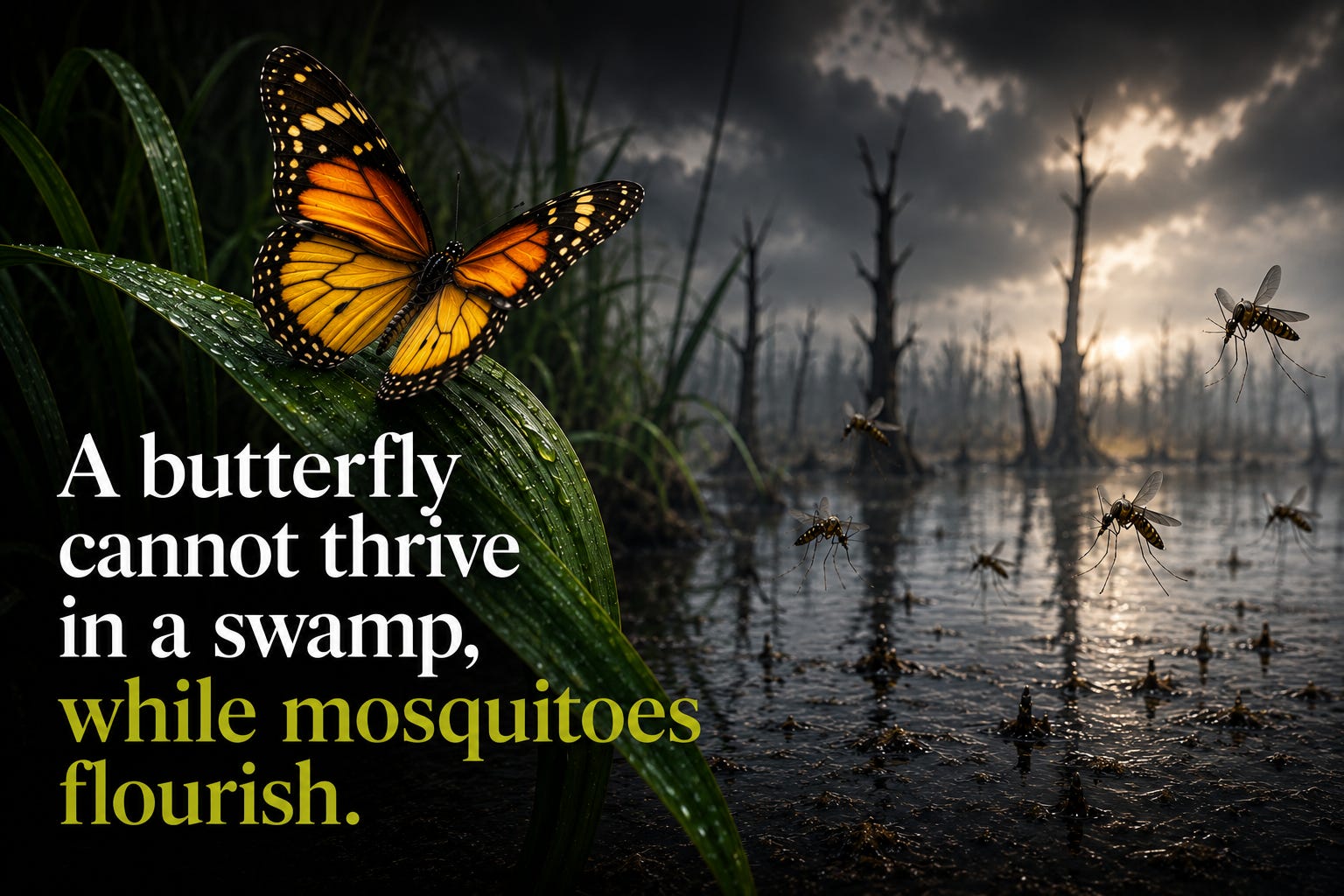
Picture a butterfly dropped into a swamp. It doesn’t get eaten. It just can’t breathe there, while mosquitoes multiply in the same water. Dyer (2026) used this image in a widely read essay this spring, arguing that the most emotionally intelligent employees are often the first ones a toxic workplace breaks. Not the weakest. The most attuned.
Sit with that claim long enough and a harder question follows: why would sensitivity, normally an asset, become a liability at all?
Reading the Room Becomes the Wound
Notice what emotionally intelligent people actually do at work. They register tone shifts, withdrawn eye contact, the gap between what a leader announces and what a team actually feels. Call it depth of processing, the term researchers use for high sensory and social sensitivity. In a healthy team, that depth builds trust fast. Strip away psychological safety, though, and the same depth turns into static. Signals contradict each other constantly. Nothing resolves. Hobfoll’s (1989) Conservation of Resources theory frames this precisely: empathy withdraws energy faster than an unsafe culture lets it recover, and the account never balances.
Watch, too, what happens to people who try to fix things. They name what isn’t working. They push for honesty. In a functioning culture, that effort gets rewarded, a pattern consistent with findings that compassionate behavior improves well-being, which in turn drives engagement (Pansini et al., 2024). In a toxic one, Dyer (2026) notes, honesty often gets punished instead, because the honest voice disrupts an equilibrium the culture has quietly settled into. Frost’s (2003, as cited in the systematic review by [Management Review Quarterly], 2023) earlier account of unacknowledged emotional pain in organizations describes the same mechanism: pain that leadership fails to name does not disappear. It curdles into toxicity.
Carrying Two Grammars at Once
Think about what this costs Korean-American professionals specifically. Many run two interpretive systems in a single meeting: the contextual restraint of Nunchi (눈치, sense), tuned to hierarchy and unspoken feeling, layered against the flatter directness many American institutions expect. Call that fluency an asset, because it is. It builds bridges few others can build.
Bring that same fluency into a toxic environment, though, and it becomes a second tax. Absorb not only what a culture says, but what it declines to say, in two languages simultaneously. Resist the urge to read the resulting exhaustion as a personal failing that more discipline should fix. Treat it in
Leadership Decides Which Species Survives
Trace this back to its source, and leadership behavior explains almost everything. Edmondson’s (1999) research on psychological safety shows unsafe cultures don’t merely wear people down. They select for who remains, retaining those willing to go quiet or harden, losing those who cannot stop noticing.
Ask, then, a sharper question than “is our culture toxic.” Look at who has actually stayed on your team over the past two years. That roster tells you what your organization has been breeding for, whether you meant to breed it or not.
Leave with this: the butterfly isn’t fragile. It simply refuses to mistake a swamp for home. The harder work, for any leader, is building ground worth staying on.
The harder work, for any leader is building ground worth staying on.
[Korean]
늪 속의 나비: 유해한 조직 문화가 공감 능력에 하는 일
나비 한 마리가 더러운 시궁창 늪에 떨어졌다고 상상해 보라. 잡아먹히는 것은 아니다. 다만 그곳에서는 숨을 쉴 수가 없다. 같은 환경에 모기는 오히려 번성한다.

엘리스 다이어(Elise Dyer)는 지난봄 널리 회자된 에세이에서 이 이미지를 빌려, 정서 지능이 가장 높은 직원일수록 유해한 직장에서 가장 먼저 무너지는 경우가 많다고 짚었다. 가장 약해서가 아니라, 가장 예민하게 느끼기 때문이다.
이 주장을 곱씹다 보면 더 까다로운 질문에 이르게 된다. 평소엔 강점이던 민감함이 왜 하필 부채로 뒤바뀌는가.
분위기를 읽는 힘, 즉 뛰어난 “눈치”가 상처로 돌아올 때
정서 지능이 높은 사람들이 실제로 직장에서 하는 일을 들여다보자. 이들은 말투의 미묘한 변화를 알아채고, 눈을 피하는 순간을 놓치지 않으며, 리더의 발표와 팀이 실제로 느끼는 감정 사이의 틈까지 읽어낸다. 연구자들은 이를 ‘깊은 처리(depth of processing)’라 부른다. 감각과 사회적 민감도가 높은 사람들에게 나타나는 특성이다. 건강한 팀에서라면 이 깊이가 신뢰를 빠르게 쌓아 올린다. 그러나 심리적 안전감이 사라진 순간, 같은 능력은 잡음으로 뒤바뀐다. 신호들이 서로 어긋나며 끊임없이 부딪히고, 무엇 하나 명확히 해소되지 않는다. 스티븐 홉폴(Stevan Hobfoll)의 자원보존이론은 이 지점을 정확히 짚는다. 공감은 안전하지 않은 조직이 되돌려주는 속도보다 훨씬 빠르게 에너지를 소진시키며, 그 계좌는 끝내 균형을 이루지 못한다.
무언가를 고치려 애쓰는 사람들에게 일어나는 일도 눈여겨볼 만하다. 이들은 무엇이 잘못됐는지 말하고, 솔직함을 요구한다. 제대로 작동하는 조직이라면 이런 노력은 보상받는다. 하지만 다이어가 지적하듯, 유해한 조직에서는 오히려 처벌받기 일쑤다. 솔직한 목소리가 그 조직이 조용히 안착시킨 균형을 흔들어 놓기 때문이다.
두 개의 언어를 동시에 짊어지는 일
이것이 한인 미국인 전문가들에게 구체적으로 어떤 대가를 요구하는지 생각해 보자. 많은 이들이 한 번의 회의 안에서 두 가지 해석의 틀을 동시에 작동시킨다. 위계와 말로 드러나지 않는 감정을 헤아리는 “눈치”라는 한국식 절제된 감각, 그리고 미국 조직 대부분이 기대하는 보다 평면적이고 직접적인 소통 방식이다. 이 이중의 언어 감각은 분명한 자산이다. 남들이 놓지 못하는 다리를 놓아준다.
문제는 이 유창함을 그대로 유해한 환경 속으로 가져갈 때 생긴다. 그 순간 그것은 두 번째 세금이 된다. 조직이 말하는 것뿐 아니라 말하지 않는 것까지, 두 언어로 동시에 받아들이게 되는 셈이다. 그렇게 쌓인 피로를 더 참고 절제해야 할 개인의 결함으로 읽으려는 충동을 물리쳐야 한다. 대신 그것을 그 공간에 대한 정확한 신호로 받아들이는 편이 낫다.
리더십이 살아남는 종을 결정한다
근원을 따라가 보면, 결국 리더십의 행동이 거의 모든 것을 설명한다. 에이미 에드먼슨(Amy Edmondson)의 심리적 안전감 연구는 안전하지 않은 조직 문화가 단순히 사람을 지치게 만드는 데 그치지 않는다는 것을 보여준다. 그런 문화는 누가 남을지를 선별한다. 침묵하거나 무뎌지기를 택한 사람은 남고, 끝까지 알아차리기를 멈추지 못하는 사람은 떠난다.
그렇다면 “우리 조직 문화가 유해한가”보다 더 날카로운 질문을 던져야 한다. 지난 2년간 실제로 팀에 남아 있는 사람이 누구인지 살펴보라. 그 명단이야말로, 의도했든 의도하지 않았든, 조직이 무엇을 길러왔는지를 말해준다.
이 한 문장을 안고 가시길 바란다. 나비는 연약한 존재가 아니다. 다만 늪을 집으로 착각하지 않을 뿐이다.
결국 리더에게 남겨진 더 어려운 과제는, 머물 만한 가치가 있는 땅을 만드는 일이다.
Reference:
Dyer, E. (2026, May 11). Why emotionally intelligent people struggle most in toxic workplaces [Newsletter essay]. LinkedIn Pulse.
Edmondson, A. C. (1999). Psychological safety and learning behavior in work teams. Administrative Science Quarterly, 44(2), 350–383. https://doi.org/10.2307/2666999
Frost, P. J. (2003). Toxic emotions at work: How compassionate managers handle pain and conflict. Harvard Business School Press.
Hobfoll, S. E. (1989). Conservation of resources: A new attempt at conceptualizing stress. American Psychologist, 44(3), 513–524. https://doi.org/10.1037/0003-066X.44.3.513
Pansini, M., Buonomo, I., & Benevene, P. (2024). Fostering sustainable workplace through leaders’ compassionate behaviors: Understanding the role of employee well-being and work engagement. Sustainability, 16(23), Article 10697. https://doi.org/10.3390/su162310697
Ramachandran, S. et al (2023). Whither compassionate leadership? A systematic review. Management Review Quarterly. https://doi.org/10.1007/s11301-023-00340-w
About the Author:

Prof. Dr. Jeonghwan (Jerry) Choi (Managing Editor), University of Maine at Presque Isle
Jeonghwan (Jerry) Choi, PhD is an Associate Professor of Business at the University of Maine at Presque Isle and Editor-in-Coordination of K-GSP Forum (contact: jeonghwan.choi at gmail.com). With over 25 years of industry and consulting experience, he specializes in leadership development, human resource management, organizational behavior, and social entrepreneurship. His research focuses on workforce resilience, organizational health, and self-directed leadership — bridging rigorous scholarship with practical insight to cultivate leaders who create meaningful, sustainable, and humane organizations.
© K-Global Scholars and Professionals Forum. All rights reserved. Content published in the K-GSP Forum may not be reproduced, distributed, or transmitted in any form without prior written permission from the K-GSP Forum, except for brief quotations with full attribution.