

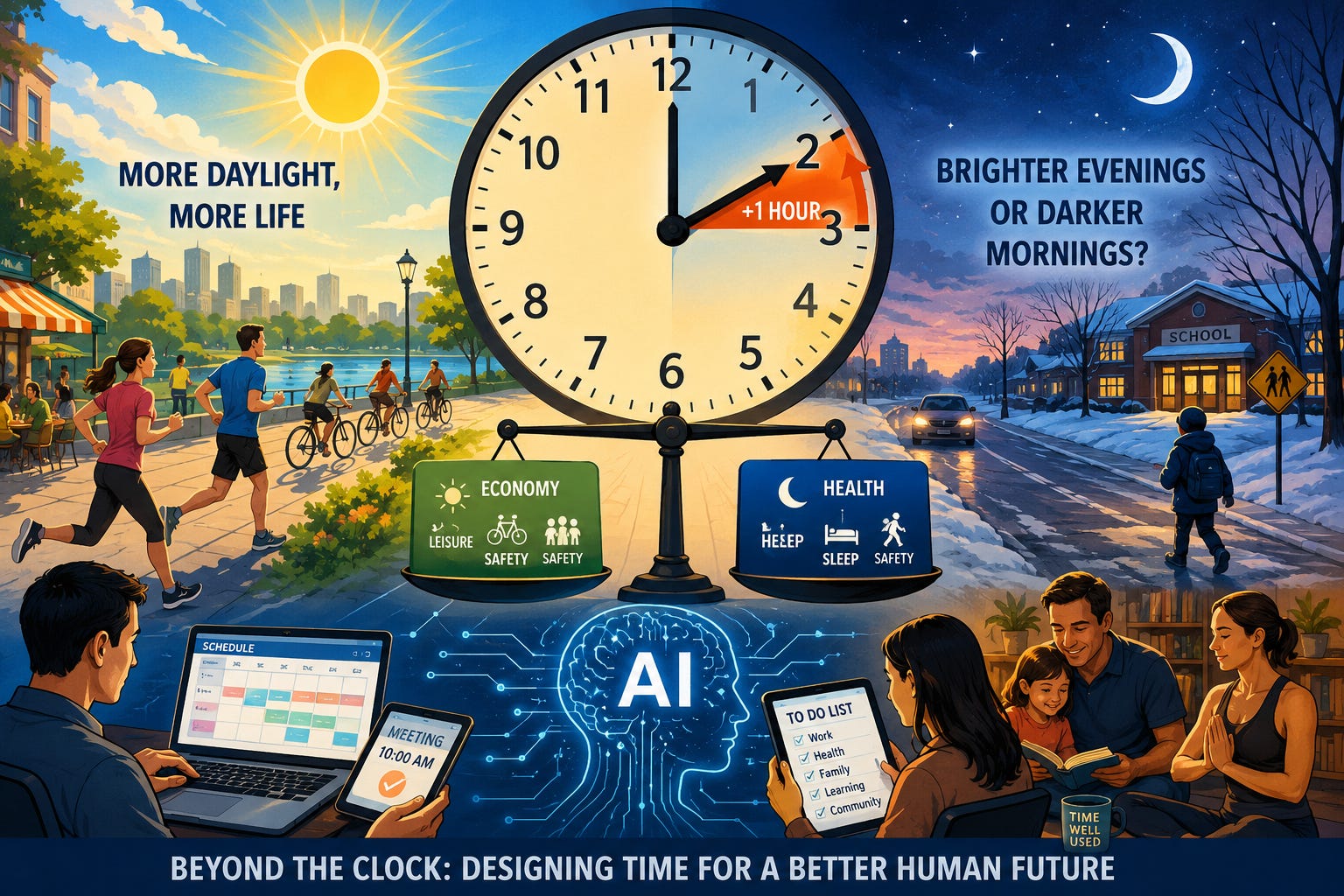
In July 2026, the U.S. House of Representatives overwhelmingly passed the Sunshine Protection Act by a bipartisan vote of 308 to 117. If the legislation ultimately clears the Senate and receives the President’s signature, Americans would no longer need to adjust their clocks twice a year. At first glance, the proposal appears to concern nothing more than a one-hour time change. In reality, however, it raises a far deeper question: How should humanity understand time, live in harmony with nature, and improve the quality of life in the twenty-first century?
The debate over Daylight Saving Time (DST) extends well beyond politics. It invites us to reconsider the relationship between technology, health, productivity, and human happiness.
The Clock Changes, but the Sun Does Not
Every March Americans move their clocks forward by one hour, and every November they move them back. This ritual has become so familiar that many scarcely question it. Yet millions experience disrupted sleep, difficulty concentrating, and fatigue during the transition. Parents often notice changes in their children’s sleep schedules, while workers struggle through the first Monday after the switch.
The reason is simple. Time displayed on a clock is a human invention, but the circadian rhythm—our biological clock—is a product of nature. When social time drifts too far from natural time, our bodies pay the price.
Thus, the current debate is not merely about convenience. It is about designing a human-centered system of time that better reflects the realities of modern life.
Why Many Americans Favor Permanent Daylight Saving Time
Supporters of permanent DST present several compelling arguments.
First, eliminating the twice-yearly clock changes would remove unnecessary confusion and inconvenience. In an era when international business, digital communication, and global travel depend upon precise scheduling, consistency has considerable value.
Second, proponents emphasize economic benefits. Longer daylight during the evening encourages shopping, dining, outdoor recreation, tourism, and community activities. Businesses that depend on consumer leisure often report higher economic activity when daylight extends into the evening hours.
Third, advocates argue that brighter evenings may improve public safety. Some transportation studies suggest that additional daylight during evening commuting hours can reduce traffic accidents and encourage outdoor exercise.
Perhaps most importantly, modern lifestyles have shifted dramatically. Most people no longer work according to agricultural schedules. Instead, leisure, family gatherings, and recreational activities largely occur after work, making evening daylight particularly valuable.
The Concerns Behind the Opposition
Despite these advantages, critics raise equally significant concerns.
The primary objection centers on dark winter mornings. In northern states, permanent DST could delay sunrise until after 9:00 a.m. during parts of winter. Children would travel to school in darkness, and many workers would begin their daily commute before sunrise, potentially increasing safety risks.
Sleep scientists also point out that Standard Time aligns more naturally with human circadian biology. Exposure to natural morning sunlight helps regulate sleep cycles, mental alertness, and overall health. A permanent shift away from that rhythm could have unintended consequences.
History reinforces these concerns. During the 1973–1974 energy crisis, the United States experimented with year-round Daylight Saving Time in an effort to conserve fuel. Public dissatisfaction quickly emerged as families confronted dark winter mornings, leading Congress to abandon the policy within a year. Today’s debate demonstrates that history often revisits familiar questions under new circumstances.
Time in the Age of Artificial Intelligence
One striking aspect of today’s discussion is how different the world has become since the 1970s.
Remote work has become common.
Virtual meetings connect colleagues across continents.
Artificial intelligence now organizes calendars, schedules appointments, summarizes emails, and even assists in managing our daily routines.
Increasingly, people design their work around flexibility rather than fixed office hours.
Yet despite these technological advances, AI cannot rewrite the biological rhythms that evolution has shaped over thousands of years. Technology may help us manage our schedules more efficiently, but nature continues to govern human health.
This reality reminds us that innovation should complement human biology rather than compete against it.
Lessons for Korea and Other Nations
Republic of Korea currently does not observe Daylight Saving Time, having discontinued its temporary use after the 1988 Seoul Olympics. Nevertheless, America’s debate offers valuable lessons for many countries.
For decades, societies often equated longer working hours with greater productivity. In the AI era, however, this assumption is rapidly losing relevance.
Tomorrow’s competitive advantage will belong not simply to those who work longer, but to those who work more intelligently, more creatively, and more sustainably.
Policies concerning time should therefore consider not only economic output but also health, family life, education, and overall well-being.
Toward a New Philosophy of Time
Generative AI is steadily reducing the amount of time required for many routine tasks.
Translation.
Writing.
Programming.
Data analysis.
Administrative work.
As AI assumes more repetitive responsibilities, humanity faces a new question:
What should we do with the time we save?
The answer cannot be merely “work more.”
Rather, saved time should become an opportunity for deeper family relationships, lifelong learning, physical exercise, artistic creativity, volunteer service, and personal reflection.
The true purpose of technological progress is not simply to increase efficiency, but to enrich human life.
America’s debate over Daylight Saving Time is far more than a legislative dispute about moving clock hands. It is a conversation about balancing nature and technology, productivity and health, economic growth and human flourishing.
Governments may decide whether clocks should move forward or backward.
But only individuals and societies can determine whether the time they gain becomes more meaningful.
As artificial intelligence increasingly performs tasks once reserved for humans, time itself becomes our most precious resource. Unlike money or technology, time is distributed equally to every person, yet its value depends entirely upon how wisely it is used.
The future, therefore, will not belong merely to societies that save time. It will belong to societies that transform saved time into greater human happiness, creativity, wisdom, and purpose.
That may be the most enduring lesson emerging from America’s Daylight Saving Time (DST) debate—and one that resonates far beyond the boundaries of the United States. +++
{Solti}
시간을 바꾸는 것이 아니라 삶을 바꾸는 일
미국의 서머타임 논쟁이 우리에게 던지는 질문
2026년 7월, 미국 하원은 Sunshine Protection Act를 압도적인 초당적 표결(308 대 117)로 통과시켰다. 이 법안이 최종적으로 상원을 통과하고 대통령의 서명을 받게 되면 미국은 더 이상 매년 봄과 가을 두 차례 시계를 앞뒤로 조정하지 않게 된다. 그러나 이것은 단순히 시계의 바늘을 고정하는 문제가 아니다. 인류가 시간을 어떻게 이해하고, 자연과 어떻게 조화를 이루며, 삶의 질을 어떻게 높일 것인가에 관한 철학적 질문이기도 하다.
시계는 바뀌지만 태양은 바뀌지 않는다
매년 3월이면 시계를 한 시간 앞당기고, 11월이면 다시 한 시간을 늦춘다. 미국인들은 이를 너무나 익숙하게 받아들여 왔다. 그러나 많은 사람들은 월요일 아침 출근길에 피곤함을 느끼고, 부모들은 아이들의 수면 리듬이 흐트러지는 것을 경험한다.
시간은 인간이 만든 사회적 약속이지만, 생체시계(circadian rhythm)는 자연이 만든 질서이다. 따라서 사회적 시간이 자연의 시간과 지나치게 멀어질 때 우리는 피로와 혼란을 경험하게 된다.
이번 논쟁은 단순한 편의성의 문제가 아니라 인간 중심의 시간 체계를 어떻게 설계할 것인가에 대한 사회적 실험이라 할 수 있다.
왜 영구 서머타임을 원하는가?
찬성론자들은 여러 이유를 제시한다.
첫째는 생활의 편리성이다.
매년 두 번 시계를 조정해야 하는 번거로움이 사라진다.
둘째는 경제적 효과이다.
퇴근 후 밝은 시간이 길어지면 쇼핑, 스포츠, 관광, 외식 등이 활발해질 가능성이 있다.
셋째는 교통 안전이다.
저녁 시간대의 밝은 환경이 교통사고 감소에 도움이 될 것이라는 연구들도 존재한다.
무엇보다 현대인은 대부분 저녁 시간에 여가생활을 즐긴다. 따라서 해가 늦게 지는 것은 많은 사람들에게 삶의 만족도를 높여 줄 수 있다는 주장이다.
반대하는 사람들의 목소리
그러나 반대 의견도 만만치 않다.
가장 큰 이유는 겨울 아침의 어둠이다.
북부 지역에서는 겨울철 해가 오전 9시 이후에야 뜨는 곳도 생긴다.
아이들이 어두운 길을 걸어 학교에 가야 하고, 새벽에 일하는 근로자들은 더욱 위험한 환경에서 출근하게 된다.
수면 전문가들도 인간의 생체 리듬은 표준시(Standard Time)에 더 잘 맞는다고 설명한다.
실제로 미국은 1974년 석유파동 당시 영구 서머타임을 시행했다가 국민들의 불만과 안전 문제 때문에 1년도 되지 않아 철회한 경험이 있다. 역사는 같은 질문을 다시 던지고 있는 셈이다.
기술 시대의 시간
흥미로운 것은 오늘날 우리가 살고 있는 시대는 1974년과 전혀 다르다는 점이다.
재택근무가 늘어났고,
온라인 회의가 일상이 되었으며,
인공지능이 우리의 일정까지 관리해 준다.
이제 많은 사람들은 해가 떠오르는 시간보다 자신의 업무 스타일에 맞추어 하루를 설계한다.
그러나 AI가 아무리 발전해도 인간의 생체리듬까지 바꿀 수는 없다.
기술은 시간을 관리할 수 있지만, 인간의 건강은 자연이 결정한다.
한국이 배울 수 있는 교훈
대한민국은 현재 서머타임을 시행하지 않는다.
1988년 서울올림픽 당시 잠시 실시한 경험이 있지만 이후 중단되었다.
그러나 이번 미국의 논쟁은 한국에도 중요한 시사점을 준다.
우리는 종종 “더 오래 일하는 것”을 생산성이라고 생각한다.
하지만 AI 시대에는
더 오래 일하는 사람이 아니라,
더 건강하게 일하는 사람이 경쟁력을 갖는다.
시간 제도 역시 생산성만이 아니라 행복, 건강, 가족, 교육을 함께 고려해야 한다.
AI 시대가 요구하는 새로운 시간 철학
생성형 AI는 우리의 업무 시간을 줄여 주고 있다.
자동 번역,
문서 작성,
프로그래밍,
데이터 분석까지 AI가 수행한다.
그렇다면 인간은 절약된 시간을 어디에 사용할 것인가?
가족과 보내는 저녁 시간,
운동,
독서,
예술,
지역사회 봉사,
그리고 자기 성찰.
결국 시간 제도의 목적은 경제 성장만이 아니라 인간다운 삶이어야 한다.
AI 시대는 우리에게 더 많은 시간을 선물하고 있다.
중요한 것은 그 시간을 어떻게 사용할 것인가이다.
미국 의회의 서머타임 논쟁은 단순한 행정 절차가 아니다.
그것은 인간과 자연, 경제와 건강, 기술과 삶의 균형을 다시 생각하게 만드는 사회적 토론이다.
시계를 한 시간 앞당길 것인지, 뒤로 돌릴 것인지는 결국 정치가 결정할 수 있다.
그러나 우리의 삶을 풍요롭게 만드는 것은 시계가 아니라 시간을 사용하는 방식이다.
AI가 인간의 노동을 대신하는 시대일수록 우리는 시간을 더욱 소중히 여겨야 한다. 시간은 돈보다 귀하고, 기술보다 오래 남으며, 누구에게나 공평하게 주어진 유일한 자산이다.
따라서 진정한 미래 사회는 시간을 절약하는 사회가 아니라, 절약된 시간을 인간의 행복으로 바꾸는 사회일 것이다. 그것이 미국의 서머타임 논쟁이 오늘 우리 모두에게 던지는 가장 깊은 메시지이다. +++
{솔티}
2026년 7월 16일

Prof. Dr. Young Choi (Editor in Chief) — Regent University
Young B. Choi is a Professor in the Department of Engineering & Computer Science at Regent University. He published 38 books with ‘Selected Readings in Cybersecurity’ (2018) (over 800 copies archived globally at university/college libraries around the world) and ‘Cybersecurity Applications and Artificial Intelligence’ (2023) available in seven major world languages. He proposed the world’s first global and universal telecommunications “Service Order Handling (SOH)” Model (T-SOH Model) (1995) with Dr. Adrian Tang. With this innovative research work, he received the IEEE NOMS ’96 Best Paper Award and became the first recipient of the Outstanding Contribution Award of the TeleManagement Forum in 1998. His research areas include Natural Language Processing-focused AI, AI-applied cybersecurity, network and telecom service management, and Korean studies on Gani Choi Rip’s Jeonggwan (靜觀: Quiet Contemplation) philosophy and Shilhak ( 實學: Practical Learning).
시의 적절한 의견이십니다. 👍😊