
Introduction
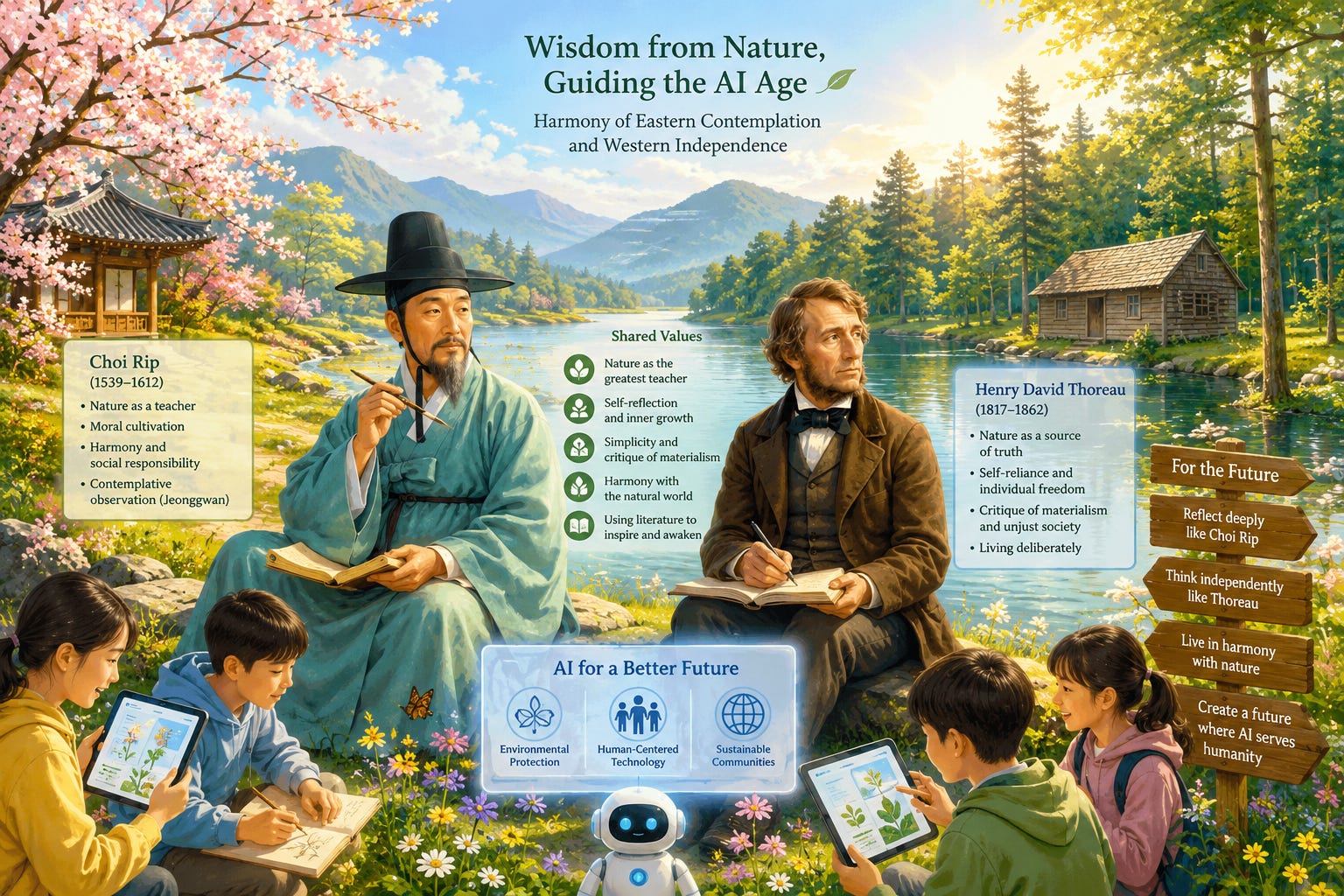
The sixteenth-century Korean scholar Choi Rip (1539–1612) and the nineteenth-century American thinker Henry David Thoreau (1817–1862) lived in different eras and cultural traditions, yet they shared a profound belief that nature is not merely a backdrop for human life but a fundamental teacher of human existence. Choi Rip contemplated nature through the lens of Confucian self-cultivation and the aesthetic spirit of pungnyu (refined cultural enjoyment), while Thoreau sought freedom, self-reliance, and spiritual awakening through his transcendentalist engagement with the natural world. Both thinkers regarded nature as a pathway to recovering authentic humanity, though their philosophical foundations and practical approaches differed significantly.
In today’s age of artificial intelligence, when machines increasingly perform tasks once reserved for human intellect, nature is gaining renewed importance as a space for restoring human wisdom, creativity, and emotional balance. Comparing Choi Rip and Thoreau offers valuable insights into how Eastern and Western traditions can contribute to shaping a more humane future.
Similarities Between Choi Rip and Thoreau’s Views of Nature
Nature as the Greatest Teacher
Choi Rip believed that nature teaches human beings to empty themselves of excessive desires and discover the essence of life. Mountains, rivers, changing seasons, and natural landscapes frequently appear in his poetry and prose as sources of wisdom and moral cultivation.
Similarly, Thoreau viewed nature as a superior educator. In Walden, he suggested that one could learn more from living attentively in nature than from formal institutions.
For example, Choi Rip’s travels through Korea’s scenic landscapes during his service as governor of Gangneung and Thoreau’s two years and two months of life beside Walden Pond both demonstrate a commitment to learning directly from nature.
Nature as a Space for Self-Reflection
A central aspect of Choi Rip’s philosophy was Jeonggwan (靜觀), or contemplative observation. Through quiet observation of nature, he sought deeper understanding of both the world and the self.
Thoreau likewise embraced solitude in nature as a means of self-discovery. His famous statement, “I wished to live deliberately,” reflects his desire to examine life’s essentials through reflective engagement with the natural world.
Whether contemplating autumn leaves or observing ripples on a lake, both thinkers used nature as a mirror for introspection and spiritual growth.
Critique of Materialism
Although Choi Rip served in government, he did not regard wealth or status as ultimate goals. His writings repeatedly emphasize simplicity, moderation, and moral integrity.
Thoreau offered a more explicit criticism of materialism and industrial society. He famously warned that people often become enslaved by their possessions rather than masters of them.
In today’s world of consumer culture, digital distractions, and constant connectivity, both thinkers would likely encourage individuals to pursue simpler and more meaningful lives.
Emphasis on Harmony with Nature
Choi Rip believed that human beings should live in harmony with the natural order. Influenced by Confucian concepts such as the unity of heaven and humanity (Cheon-In-Hap-Il), he saw human flourishing as inseparable from the rhythms of nature.
Similarly, Thoreau argued that humans are participants in nature rather than its rulers. He encouraged people to respect natural cycles and ecological balance.
Choi Rip’s appreciation of seasonal rhythms and Thoreau’s close observation of natural processes both reveal a shared ecological sensitivity.
Literature as a Medium for Appreciating Nature
Both thinkers used literature to communicate the beauty and significance of nature.
Choi Rip expressed his insights through classical Korean poetry and prose, transforming landscapes into sources of philosophical reflection.
Thoreau conveyed his ideas through works such as Walden and Walking, inspiring generations of readers to appreciate and protect the natural environment.
Their writings demonstrate that literature can awaken ecological awareness and deepen human sensitivity toward nature.
Differences Between Choi Rip and Thoreau’s Views of Nature
Different Philosophical Foundations
Choi Rip’s understanding of nature was rooted primarily in Neo-Confucian philosophy. Nature served as a means for moral cultivation and for understanding the universal principles governing human life.
Thoreau’s perspective emerged from American Transcendentalism. He emphasized personal intuition, individual spiritual experience, and direct communion with the divine through nature.
Thus, Choi Rip focused more on moral order and ethical development, whereas Thoreau emphasized personal freedom and spiritual independence.
Different Approaches to Social Engagement
Choi Rip was both a scholar and a government official. He sought to apply wisdom gained from nature to public service and responsible governance.
Thoreau, by contrast, often positioned himself as a critic of governmental authority. His opposition to slavery and the Mexican-American War led him to refuse paying taxes, an act that inspired his influential essay Civil Disobedience.
In this sense, Choi Rip worked primarily within existing institutions to promote reform, while Thoreau challenged institutions from outside.
Different Interpretations of the Human–Nature Relationship
For Choi Rip, nature primarily functioned as a setting for cultivating virtuous character. Human beings learned from nature in order to become morally better persons.
Thoreau, however, stressed the intrinsic value of nature itself. He viewed wilderness as possessing worth independent of human interests and utility.
From the perspective of contemporary environmental ethics, Thoreau’s view aligns more closely with ecocentrism, while Choi Rip’s remains more anthropocentric and educational.
Different Emphases on Community and Individuality
Choi Rip believed that self-cultivation ultimately serves family, society, and the broader community. Personal growth was inseparable from social responsibility.
Thoreau placed greater emphasis on individual autonomy and independence. His experiment at Walden Pond symbolized liberation from social conventions and excessive conformity.
These contrasting perspectives reflect broader cultural tendencies: Eastern traditions often emphasize relationships and communal harmony, while Western traditions frequently prioritize individual freedom and self-determination.
Different Approaches to Environmental Preservation
Choi Rip preserved nature primarily through cultural appreciation, literary documentation, and philosophical reflection. His writings safeguarded the memory and meaning of landscapes for future generations.
Thoreau, on the other hand, became a direct intellectual precursor to modern environmentalism. His ideas influenced conservation movements, wilderness preservation efforts, and the development of national parks in the United States.
Consequently, Choi Rip contributed mainly to the spiritual and cultural preservation of nature, while Thoreau contributed more directly to institutional environmental protection.
Conclusion: Integrating Eastern and Western Nature Philosophies in the AI Age
Although Choi Rip and Thoreau belonged to different civilizations, both recognized nature as a source of wisdom, self-understanding, and human flourishing. Choi Rip emphasized moral cultivation, social harmony, and contemplative reflection, whereas Thoreau highlighted personal freedom, self-reliance, and spiritual independence. Together, their perspectives offer complementary insights for navigating the challenges of the AI era.
First, East Asian societies can benefit from Choi Rip’s philosophy of contemplative observation (Jeonggwan). As artificial intelligence increasingly assists or even replaces human decision-making, people must cultivate the capacity for deep reflection, ethical judgment, and inner wisdom. Educational institutions and workplaces should encourage practices such as nature observation, mindfulness, and humanistic inquiry.
Second, Western societies can draw inspiration from Thoreau’s emphasis on independent thinking and self-reliance. As dependence on AI systems and large technology platforms grows, individuals must maintain critical thinking, intellectual autonomy, and ethical responsibility. Digital citizenship and AI ethics education will become increasingly important.
Third, both Eastern and Western societies should promote Nature-Based AI Education. Students can observe natural phenomena, document patterns, and use AI tools to analyze data, thereby integrating technological competence with ecological awareness and emotional intelligence.
Fourth, future smart cities can combine Choi Rip’s philosophy of harmony with Thoreau’s ecological vision. AI technologies may optimize transportation, energy systems, and public services, while human communities preserve green spaces, cultural traditions, and meaningful relationships with nature. Such an approach would foster a sustainable partnership among humanity, technology, and the natural environment.
Fifth, future AI systems should evolve beyond merely replicating human intelligence toward supporting human wisdom. Choi Rip’s emphasis on ethical reflection and Thoreau’s commitment to independent judgment can serve as guiding principles for the development of responsible and human-centered AI. The essential question should not be merely what AI can do, but what AI ought to do in service of humanity.
Ultimately, the harmonious human being envisioned by Choi Rip and the free human being championed by Thoreau represent two indispensable pillars of a flourishing future. By integrating Eastern self-cultivation with Western self-reliance, communal responsibility with individual freedom, and technological innovation with reverence for nature, humanity can build a more sustainable, ethical, and genuinely human civilization in the age of artificial intelligence. +++
{Solti}
May 21, 2026

Young Choi, PhD is a Professor at Regent University bringing a rare combination of technical expertise and creative spirit to everything he does. A scholar in AI, cybersecurity, and network & telecommunications service management, he has published 38 books including AI and cybersecurity area books, over 200 refereed articles, and over 20 book chapters. Beyond the academy, Dr. Choi is a passionate poet, essayist, and wooden block laser engraving artist whose reflective writing invites readers to rediscover life’s beauty in quiet contemplation(靜觀). He lives under the motto: “Study hard and give generously without holding back! (열심히 공부해서 아낌없이 남주자 !: 열공아남!)”
Published books: https://www.amazon.com/stores/Young-Choi/author/B0DMZ5S6R7?ref=ap_rdr&shoppingPortalEnabled=true
2 Likes