
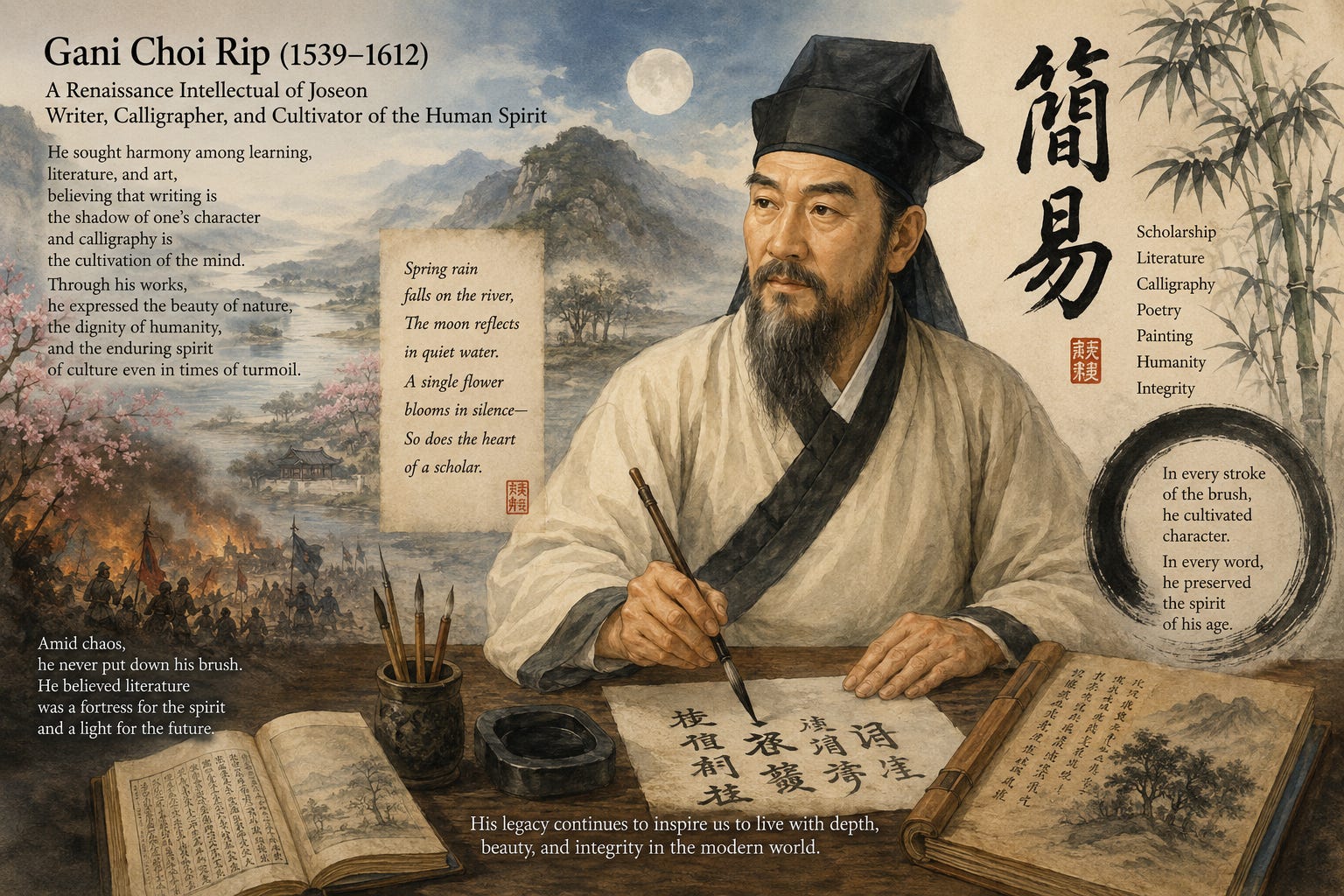
Choi Rip was not merely a poet or scholar of the mid-Joseon period. He was one of Korea’s representative Renaissance-style intellectuals who understood literature, philosophy, politics, and art as parts of one integrated worldview. In particular, his literary and calligraphic activities transcended artistic expression; they played a crucial role in recording the spirit of his age, cultivating human dignity, and establishing enduring cultural standards for future generations.
Today, although we live amid an overwhelming abundance of digital information and imagery, we often experience a profound lack of human depth and spiritual refinement. In such an era, Choi Rip’s writings and calligraphy are not simply relics of an old scholar, but living cultural legacies that demonstrate how human thought and art can be elevated into moral and aesthetic excellence. His prose embodied intellectual depth, while his brushwork revealed disciplined character and inner cultivation. Thus, his literary and calligraphic achievements were not merely artistic practices but important intellectual assets symbolizing the spiritual sophistication of Joseon culture.
One of the most remarkable characteristics of Choi Rip’s literary work was his pursuit of harmony between scholarship and literature. Rather than limiting himself to the interpretation of Confucian classics, he explored human emotion, the beauty of nature, and the ethical questions surrounding how people should live amid social turmoil. His writings emphasized human reflection and spiritual balance more than rigid moral formalism. Such an approach was highly original within the often dogmatic Neo-Confucian literary environment of his time.
His prose possessed both simplicity and profound resonance. Choi Rip excelled at condensing philosophical insight into concise and restrained language. As a result, his style displayed elegance through moderation rather than ornamentation. This literary approach later influenced many scholars and writers of the late Joseon period, particularly those associated with practical learning and intellectual reform. He genuinely sought to embody the ideal that “writing is the shadow of one’s character.”
Through poetry, Choi Rip delicately portrayed the harmony between nature and humanity. In spring rain, moonlight, flowing rivers, or a single blossom, he discovered reflections of human existence itself. His poetry conveyed not exaggerated emotion but rather the quiet beauty of contemplative observation. This arose from the fusion of Eastern natural philosophy and artistic sensibility. Modern readers continue to find healing and deep reflection in his works for precisely this reason.
Even during the national catastrophe of the Imjin War, he never abandoned his brush. The war shattered the lives and intellectual worlds of countless scholars, yet Choi Rip emphasized even more strongly the importance of moral duty and cultural preservation amid chaos. He believed literature was not merely an object of aesthetic appreciation but a spiritual fortress protecting civilization itself. In this sense, his literary activity may be understood as both cultural resistance and spiritual restoration.
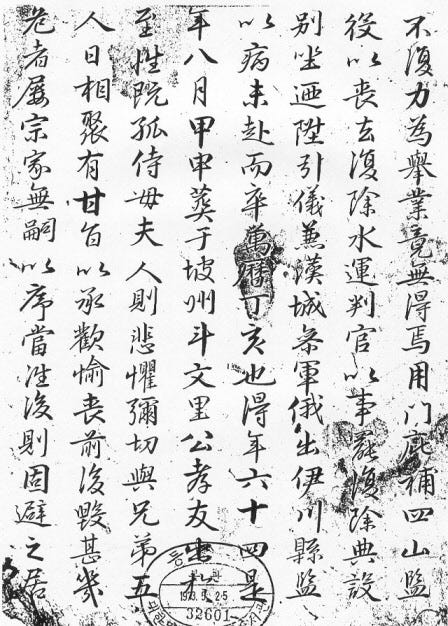
Autograph of Gani(dang) Choi Rip (National Library of Korea)
Source: Tongcheon Choi Clan Chuwonrok (2000)
© Tongcheon Choi Clan Genealogy Compilation Committee
간이당 최립 친필 (국립중앙도서관)
출처: 통천최씨 추원록 (2000년)
© 통천최씨대동보편찬위원회
Choi Rip’s calligraphy was deeply connected to his literary philosophy. In East Asian tradition, calligraphy was never viewed as mere technical skill; it was regarded as an art that revealed the writer’s personality and state of mind. Choi Rip likewise expressed his inner world and scholarly cultivation through brushwork. His script was neither excessively decorative nor artificially restrained, but instead possessed dignity, balance, and quiet elegance. His handwriting reflected both his moral character and intellectual maturity.
Within his calligraphy, one can observe the restrained beauty and natural flow characteristic of the Joseon scholar-gentleman tradition. His brush movements were powerful yet gentle, structured yet free. This was not merely a matter of technique, but an expression of his attitude toward life itself. Choi Rip regarded calligraphy as a means of cultivating the mind and disciplining the spirit. Thus, his calligraphy functioned not simply as visual art but as a practice of spiritual self-cultivation.
Moreover, Choi Rip understood poetry, calligraphy, and painting as interconnected disciplines. This integrated understanding lay at the core of East Asian artistic philosophy. Writing prose, composing poetry, and practicing calligraphy were not separate activities but parts of one unified process of cultivating human character. Choi Rip embodied this ideal throughout his life. For this reason, he may be described not merely as a literary figure, but as a “philosopher of the arts.”
His literary and calligraphic works became important cultural standards for later generations of scholars and artists. His achievements were admired not simply as technical models, but as examples of how artistic beauty and inner humanity could coexist harmoniously. Scholars of the late Joseon period especially praised his restrained aesthetics and refined spiritual world. This demonstrates that Choi Rip was not merely a man of his own era, but a cultural figure whose influence transcended time.
The renewed relevance of Choi Rip in today’s age of artificial intelligence and digital media stems from this very quality. Modern society has become accustomed to speed, stimulation, and fragmented information, whereas Choi Rip’s writings and calligraphy encourage slowness, depth, and the recovery of human dignity. He considered “how deeply one thinks” to be more important than “how much one knows.” This perspective offers valuable insight for contemporary education and culture alike.
Ultimately, Choi Rip’s greatest contribution did not lie solely in leaving behind beautiful writings and elegant calligraphy. Through literature and brushwork, he revealed the dignity of the human spirit and the essence of culture itself. His life demonstrated that scholarship, art, philosophy, and humanity cannot truly be separated. Therefore, Choi Rip should be remembered not only as an outstanding writer and calligrapher of the Joseon Dynasty, but also as a Renaissance cultural figure who embodied the profound spirit of East Asian humanism. +++
{Solti}
May 13, 2026

Young Choi, PhD is a Professor at Regent University bringing a rare combination of technical expertise and creative spirit to everything he does. A scholar in AI, cybersecurity, and network & telecommunications service management, he has published 38 books including AI and cybersecurity area books, over 200 refereed articles, and over 20 book chapters. Beyond the academy, Dr. Choi is a passionate poet, essayist, and wooden block laser engraving artist whose reflective writing invites readers to rediscover life’s beauty in quiet contemplation(靜觀). He lives under the motto: “Study hard and give generously without holding back! (열심히 공부해서 아낌없이 남주자 !)”
Published books: https://www.amazon.com/stores/Young-Choi/author/B0DMZ5S6R7?ref=ap_rdr&shoppingPortalEnabled=true