

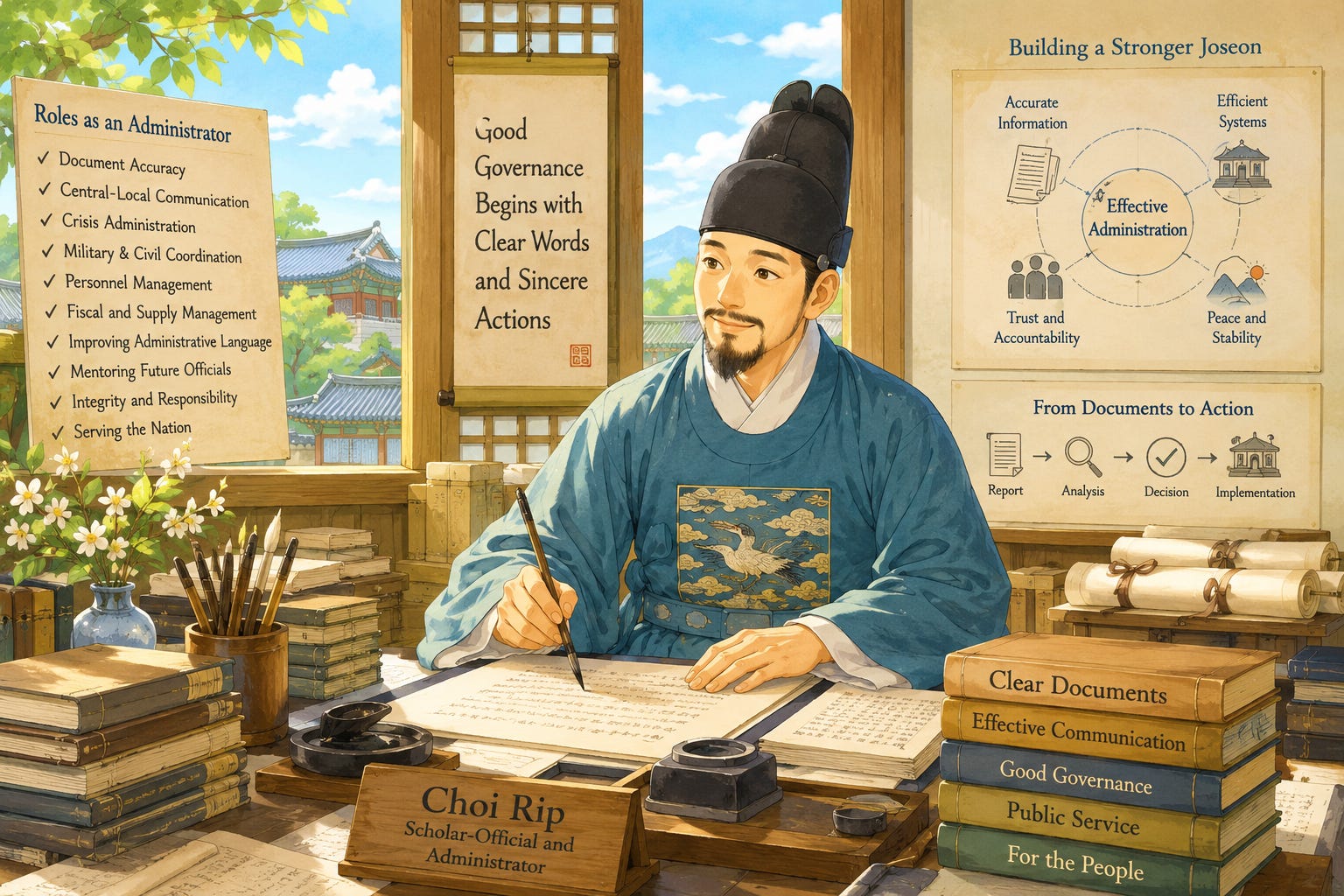
Choi Rip is often remembered as a literary figure, calligrapher, and diplomatic writer. However, his historical significance extends far beyond the literary domain into the practical machinery of state administration in mid-Joseon Korea. He functioned as a bureaucratic intellectual who actively participated in the processes through which policy was documented, communicated, and implemented. In particular, during and after the Imjin War (Japanese invasions of Korea, 1592–1598), his administrative role became closely tied to crisis governance and the stabilization of state communication systems. This essay expands his administrative contributions into ten analytical dimensions and synthesizes their broader significance.
First, Choi Rip’s entry into officialdom reflected not only personal academic achievement but also the structural logic of Joseon’s civil service system. Through the civil examinations, he entered the bureaucracy, and from the beginning he was recognized not only for literary talent but also for his capacity to handle official documents with clarity and precision—an essential administrative skill in a text-centered governance system.
Second, within the central bureaucracy, he contributed to improving the formal rigor and logical coherence of state documents. In Joseon governance, official documents were not merely records but active instruments of policymaking. Choi Rip helped strengthen clarity, structure, and consistency in administrative writing, thereby improving the reliability of governmental communication.
Third, he also functioned as an interpreter of administrative information. Reports sent from local magistracies often contained distortions due to regional interests or informational gaps. He played a role in reorganizing and refining such reports so that the central government could obtain a more accurate understanding of local conditions—an early form of policy analysis and information normalization.
Fourth, during the Imjin War, his administrative role became critical in maintaining state functionality under crisis conditions. As the bureaucratic system faced disruption, he contributed to sustaining document circulation and ensuring that emergency directives could still be transmitted across regions. In this sense, his work was directly linked to the survival of governmental continuity.
Fifth, he served as a connective agent between military administration and civil governance. In Joseon, military and civil functions were not strictly separated, and military operations depended heavily on written orders and reports. Choi Rip’s organizational refinement of military documents contributed to improving coordination between command structures and administrative execution.
Sixth, although indirectly, he influenced personnel administration by shaping the standards of bureaucratic evaluation documents. Since appointments and promotions were heavily dependent on written recommendations and assessments, his emphasis on clarity and rational structure helped reinforce a more systematic and credible evaluation culture within officialdom.
Seventh, he contributed to fiscal and logistical administration by organizing records related to taxation, military supplies, and resource distribution. These elements formed the backbone of state survival during wartime, and his work helped ensure that administrative records were structured, traceable, and usable for decision-making.
Eighth, Choi Rip elevated the quality of administrative language itself. He moved beyond simple reporting toward persuasive, logically constructed bureaucratic discourse. This contributed to the refinement of official writing styles and influenced later developments in Joseon administrative documentation practices.
Ninth, he embodied an integrated intellectual approach in which literature and administration were not separate domains. His writing combined aesthetic refinement with functional governance purposes, merging expressive language with policy communication. This dual-function style was uncommon and demonstrated a sophisticated understanding of bureaucratic communication.
Tenth, although he was not a formal educator, he served as an informal mentor within bureaucratic culture. His writing style and administrative reasoning became models for younger officials, contributing to the internal transmission of administrative norms within the bureaucratic system.
In conclusion, Choi Rip made significant contributions not only as a literary figure but as a stabilizer and enhancer of Joseon’s document-based administrative system. He ensured continuity of governance during crisis, strengthened communication between central and local authorities, and elevated bureaucratic writing into a form of structured intellectual practice. From a modern perspective, he may be understood as an early practitioner of policy communication and administrative information design. His legacy thus transcends literature, positioning him as a practical administrative thinker who helped shape the operational logic of premodern governance systems. +++
{Solti}
May 16, 2026

Young Choi, PhD is a Professor at Regent University bringing a rare combination of technical expertise and creative spirit to everything he does. A scholar in AI, cybersecurity, and network & telecommunications service management, he has published 38 books including AI and cybersecurity area books, over 200 refereed articles, and over 20 book chapters. Beyond the academy, Dr. Choi is a passionate poet, essayist, and wooden block laser engraving artist whose reflective writing invites readers to rediscover life’s beauty in quiet contemplation(靜觀). He lives under the motto: “Study hard and give generously without holding back! (열심히 공부해서 아낌없이 남주자 !: 열공아남)”
Published books: https://www.amazon.com/stores/Young-Choi/author/B0DMZ5S6R7?ref=ap_rdr&shoppingPortalEnabled=true