
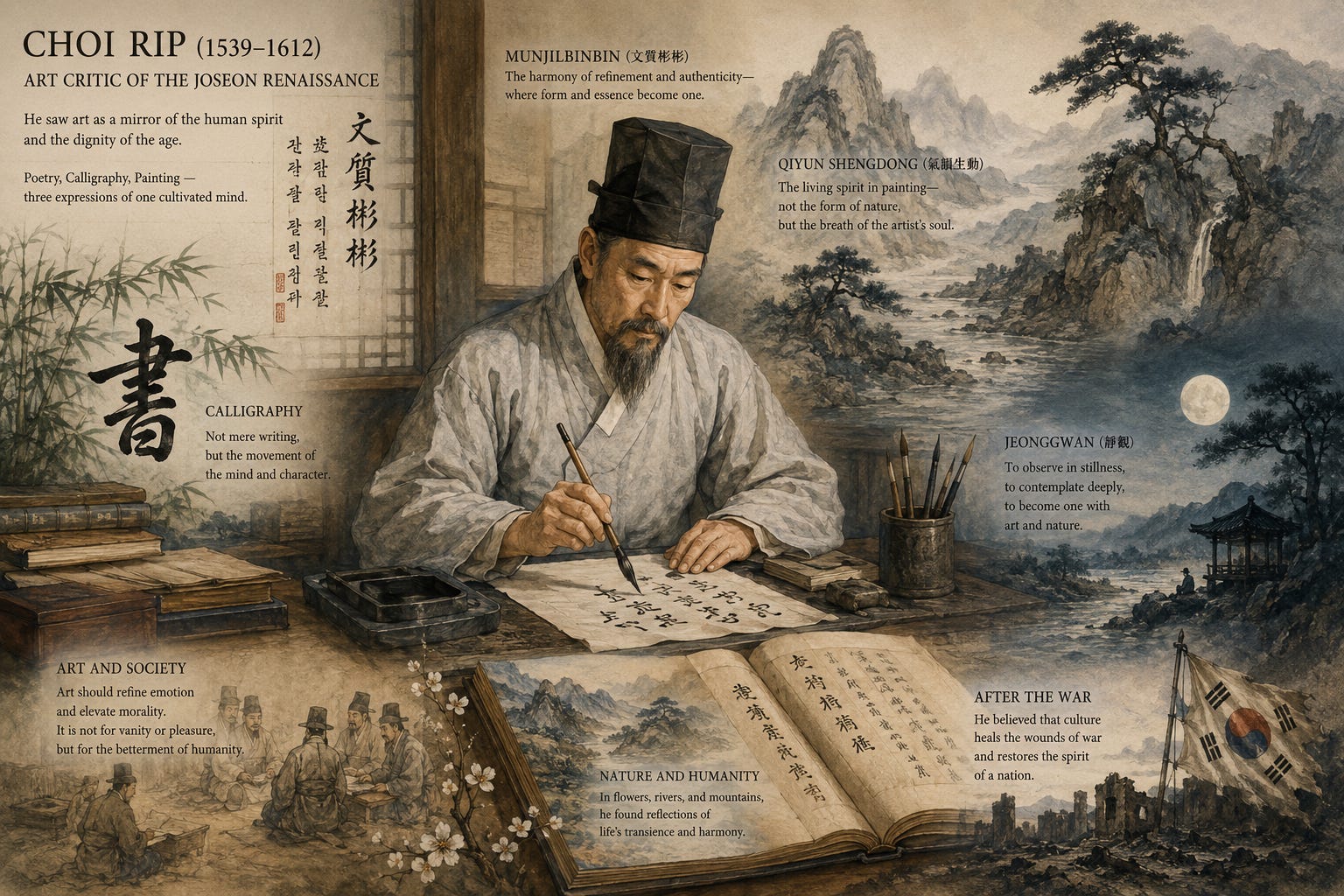
Choi Rip, the distinguished scholar and literary figure of mid-Joseon Korea, is widely remembered as a poet, essayist, and intellectual. Yet beyond these identities stood another remarkable dimension of his legacy: his role as an art critic of profound aesthetic sensitivity. He was not merely a creator of literature but an interpreter of artistic spirit who sought to uncover the moral, philosophical, and emotional essence embedded within works of art. To Choi Rip, poetry, calligraphy, and painting were not separate disciplines, but interconnected expressions of cultivated humanity.
The age in which Choi Rip lived was one of extraordinary cultural refinement. Neo-Confucian scholarship flourished, and literati culture reached new heights through poetry, painting, and calligraphy. Within this intellectual atmosphere, Choi Rip emerged not simply as a participant in artistic culture but as a discerning critic who reflected deeply on the meaning and purpose of art itself. He valued not superficial brilliance, but the spiritual depth and inner integrity residing beneath artistic form.
At the center of his aesthetic philosophy was the Confucian ideal of munjilbinbin (文質彬彬) — the harmonious balance between refinement and authenticity. Choi Rip believed that excessive ornamentation weakened artistic truth, while excessive simplicity diminished emotional resonance. True beauty, in his view, arose when elegant expression and moral substance existed in equilibrium. This delicate balance became a recurring principle in his reflections on literature and visual art.
His sensitivity toward calligraphy was especially profound. Choi Rip regarded handwriting not merely as written language, but as the visible movement of the human spirit. In the rhythm of brushstrokes, the tension of lines, and the silence of empty space, he perceived traces of the artist’s temperament and intellectual discipline. For him, calligraphy criticism was never limited to technical evaluation; it was an inquiry into character, sincerity, and cultivated consciousness.
His perspective on painting was equally sophisticated. Choi Rip did not see painting as simple imitation of nature. Rather, he sought what East Asian aesthetics calls giwoon sangdong (氣韻生動) — spiritual vitality and living resonance. Even within a quiet landscape painting, he searched for the painter’s inner stillness, philosophical temperament, and emotional breath. Such an approach reveals a strikingly modern sensibility, anticipating contemporary ideas about the artist’s interior world and subjective vision.
Choi Rip also believed that art carried social and ethical responsibility. Art, he argued, should not exist merely for entertainment or luxurious display; it should refine human emotion and elevate communal morality. He warned against works driven solely by vanity, excess, or sensory stimulation. His criticism therefore united aesthetic judgment with ethical reflection, viewing beauty and virtue as inseparable companions.
Nature occupied a central place within his artistic vision. Choi Rip possessed an extraordinary sensitivity to subtle natural phenomena — drifting clouds, river mist, falling blossoms, moonlit silence. In these quiet details, he discovered reflections of human transience and spiritual harmony. His literary criticism frequently revealed this contemplative gaze, suggesting that art loses its vitality when severed from the rhythms of nature.
A defining principle within his criticism was the spirit of jeonggwan (靜觀), or contemplative observation. He believed art should not be consumed hastily, but encountered through stillness, patience, and inward reflection. To gaze quietly upon a painting or poem was, for Choi Rip, an act of self-cultivation. Such an attitude feels especially meaningful in today’s digital culture, where images are endlessly consumed yet rarely contemplated.
The devastation of the Imjin War further deepened his cultural consciousness. Choi Rip understood that war destroys not only cities and institutions, but also the spiritual fabric of civilization. In the aftermath of national trauma, he regarded literature and art as essential forces for restoring cultural dignity and moral order. His art criticism therefore became more than aesthetic commentary; it evolved into a form of cultural healing and intellectual reconstruction.
Another remarkable aspect of his thought was his respect for creative individuality. Although grounded in Confucian tradition, Choi Rip did not advocate rigid formalism. He believed artistic tradition should inspire creation rather than imprison it. Such a perspective reveals an unusually open and humanistic understanding of art within the structured intellectual climate of Joseon society.
From a contemporary perspective, Choi Rip’s art criticism appears strikingly modern. He approached art not as decoration, but as a profound exploration of humanity, ethics, emotion, and civilization itself. His criticism sought harmony between beauty and morality, contemplation and expression, tradition and creativity. In this sense, his aesthetic philosophy transcends its historical moment and continues to speak meaningfully to modern readers.
In conclusion, Choi Rip should be remembered not only as a poet and scholar, but also as one of the most refined art critics of the Joseon Renaissance spirit. Through his reflections on poetry, calligraphy, and painting, he explored the relationship between artistic beauty and human character with extraordinary intellectual depth. His criticism was ultimately an inquiry into how art might elevate the human soul and restore cultural integrity. For this reason, Choi Rip remains a timeless aesthetic thinker whose contemplative vision continues to resonate far beyond his own era. +++
{Solti}
May 13, 2026

Young Choi, PhD is a Professor at Regent University bringing a rare combination of technical expertise and creative spirit to everything he does. A scholar in AI, cybersecurity, and network & telecommunications service management, he has published 38 books including AI and cybersecurity area books, over 200 refereed articles, and over 20 book chapters. Beyond the academy, Dr. Choi is a passionate poet, essayist, and wooden block laser engraving artist whose reflective writing invites readers to rediscover life’s beauty in quiet contemplation(靜觀). He lives under the motto: “Study hard and give generously without holding back! (열심히 공부해서 아낌없이 남주자 !)”
Published books: https://www.amazon.com/stores/Young-Choi/author/B0DMZ5S6R7?ref=ap_rdr&shoppingPortalEnabled=true