
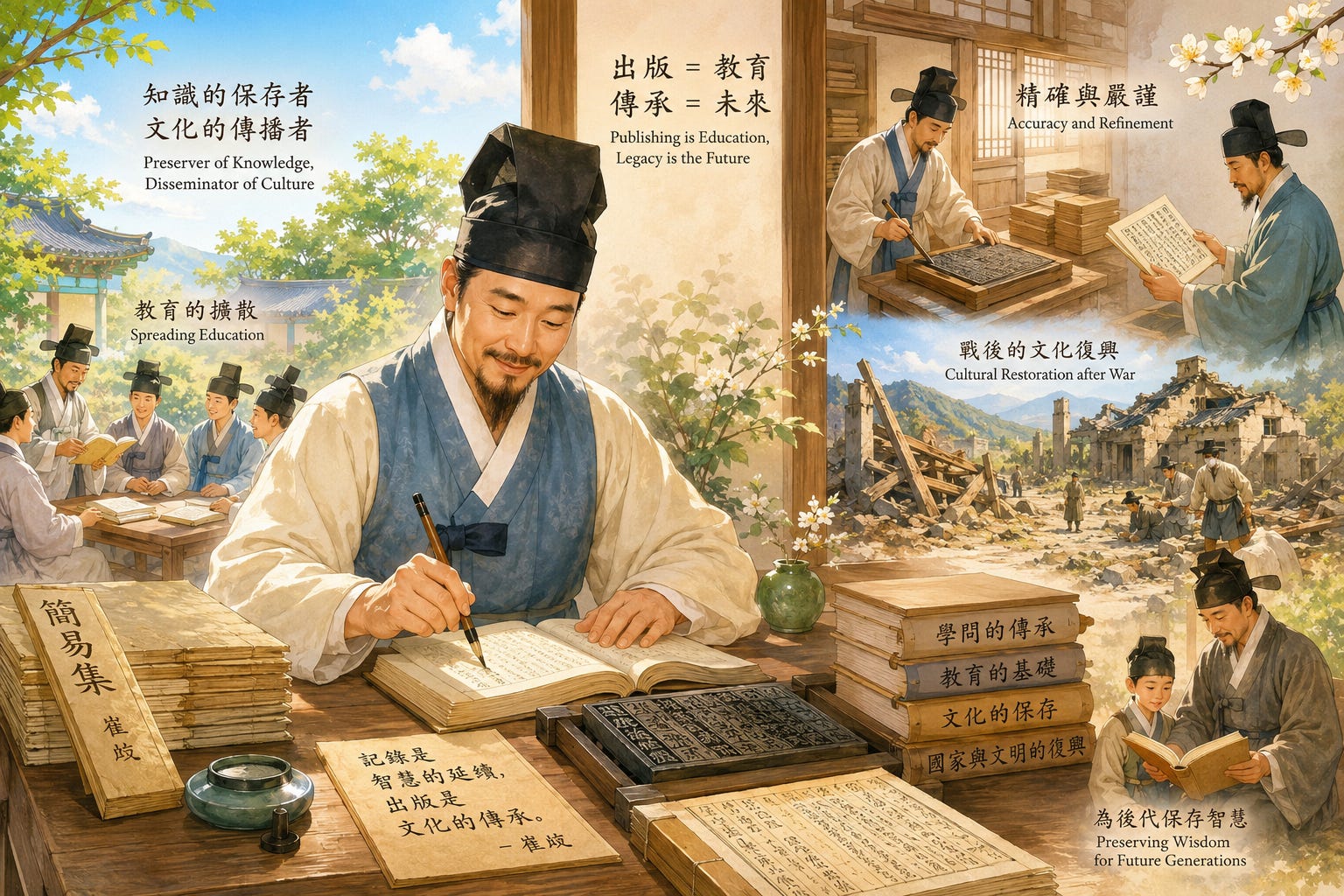
Choi Rip, widely recognized as a statesman, scholar, diplomat, and poet of the mid-Joseon Dynasty, is generally remembered for his literary brilliance and intellectual achievements. Yet a closer examination of his life reveals that he was also a visionary who deeply understood the importance of publishing and the circulation of knowledge. In the Joseon period, publishing was far more than the mechanical act of printing books; it was closely tied to state governance, the transmission of scholarship, cultural preservation, and the cultivation of future generations. Within this historical context, Choi Rip actively participated in the compilation, preservation, and dissemination of texts, recognizing these activities as essential responsibilities of an intellectual.
Particularly during and after the devastation of the Imjin War, he maintained a strong conviction that the continuity of scholarship and culture had to be protected even amid national crisis. His commitment to publishing was therefore not merely an interest in book production but a profound sense of responsibility to preserve knowledge for posterity. Through his editorial and literary efforts, he contributed to sustaining Joseon’s intellectual traditions and strengthening its cultural identity within the broader East Asian scholarly world.
Above all, Choi Rip possessed a profound awareness of the importance of recording and preserving knowledge. He believed that human memory fades, but ideas preserved through writing could transcend generations. This conviction is evident in his efforts to organize and preserve his literary and scholarly works systematically. Such efforts reflected not personal vanity but the historical responsibility expected of a Joseon intellectual.
One of his most significant publishing-related activities was his dedication to the compilation of literary collections. In Joseon society, a literary anthology was not simply a collection of writings; it functioned as an intellectual archive containing a scholar’s philosophy, political thought, educational ideals, and worldview. By carefully organizing his writings, Choi Rip enabled future scholars to understand the intellectual currents of his time. In many respects, this resembled the modern concept of building scholarly databases and preserving academic heritage.
Choi Rip also understood publishing as an extension of education. He believed that a well-crafted book could serve as a great teacher. Since access to quality books was limited in many provincial regions of Joseon, the publication of literary collections and classical texts played an essential role in improving educational opportunities. His publishing efforts therefore contributed to the decentralization of knowledge and the wider dissemination of learning throughout society.
Moreover, he placed great emphasis on literary refinement and textual accuracy. Publishing during the Joseon Dynasty relied heavily on manual transcription and woodblock printing, processes that frequently introduced errors. Choi Rip valued precision in language and elegance in expression, paying careful attention to proofreading and editorial correction. This reveals the remarkably sophisticated editorial consciousness of Joseon scholars.
Following the Imjin War, Joseon experienced a severe cultural crisis as countless books and cultural artifacts were destroyed. Choi Rip recognized that publishing would play a decisive role in rebuilding scholarship and restoring cultural continuity. To reconnect the fragmented intellectual traditions of the nation, the preservation and republication of texts became indispensable. In this sense, he viewed publishing as a form of civilizational reconstruction.
His publishing activities extended beyond the compilation of his own writings. Through active exchanges with contemporary scholars, he contributed to the formation of an intellectual community. Joseon literati frequently read one another’s works and composed prefaces and commemorative essays, thereby creating collaborative scholarly networks. Choi Rip played an important role within this vibrant culture of intellectual exchange and cooperative publishing.
He also demonstrated a strong concern for preserving educational materials for future generations. Within the Neo-Confucian tradition of Joseon, the writings of respected scholars served as foundational educational texts. Choi Rip understood that the continuation of scholarship depended upon the preservation and publication of exemplary works. Publishing, therefore, was not simply the production of books but the transmission of intellectual heritage.
Choi Rip further contributed to the development of a publishing culture that harmonized literary artistry with academic scholarship. His writings were not merely didactic or philosophical; they possessed exceptional literary elegance. Consequently, his collections became valuable resources not only for scholars but also for poets and literary figures. His work demonstrates how Joseon publishing culture flourished through the integration of scholarship and artistic refinement.
At the same time, he sought to preserve Joseon’s cultural identity through publishing. Although East Asia at the time operated largely within a Sinocentric cultural order, Joseon scholars endeavored to cultivate distinctive literary and intellectual traditions of their own. Choi Rip’s literary collections and publishing efforts reflected the originality and cultural confidence of Joseon intellectual life.
Most importantly, Choi Rip’s philosophy of publishing continues to offer valuable lessons for the modern digital age. Contemporary society produces and consumes vast amounts of information, yet the systematic preservation and transmission of meaningful knowledge remain essential tasks. Choi Rip was not simply a prolific writer; he was a cultural strategist who reflected deeply on what kinds of knowledge should be preserved and how they should be transmitted to future generations.
The publishing activities of Choi Rip represented far more than the compilation of literary works; they constituted a historical effort to preserve knowledge and sustain the cultural continuity of Joseon society. He viewed publishing as an extension of scholarship, a foundation for education, and a vital mechanism for maintaining civilization itself. Especially during times of war and social upheaval, he never abandoned the importance of recording and preserving intellectual achievements. For this reason, he may rightly be regarded not merely as a literary figure but as a guardian of culture.
Today, in an era shaped by digital technology and overwhelming flows of information, Choi Rip’s publishing philosophy remains profoundly relevant. His legacy reminds us that beyond the mere production of information lie deeper responsibilities: the preservation of intellectual integrity, the ethics of documentation, and the safeguarding of cultural heritage for future generations. In this sense, Choi Rip transcends the boundaries of his own time and stands as an enduring protector of human knowledge and civilization. +++
{Solti}
May 9, 2026

Young Choi, PhD is a Professor at Regent University bringing a rare combination of technical expertise and creative spirit to everything he does. A scholar in AI, cybersecurity, and network & telecommunications service management, he has published 38 books including AI and cybersecurity area books, over 200 refereed articles, and over 20 book chapters. Beyond the academy, Dr. Choi is a passionate poet, essayist, and wooden block engraving artist whose reflective writing invites readers to rediscover life’s beauty in quiet contemplation(靜觀). He lives under the motto: “Study hard and give generously without holding back! (열심히 공부해서 아낌없이 남주자 !)”
Published books: https://www.amazon.com/stores/Young-Choi/author/B0DMZ5S6R7?ref=ap_rdr&shoppingPortalEnabled=true