
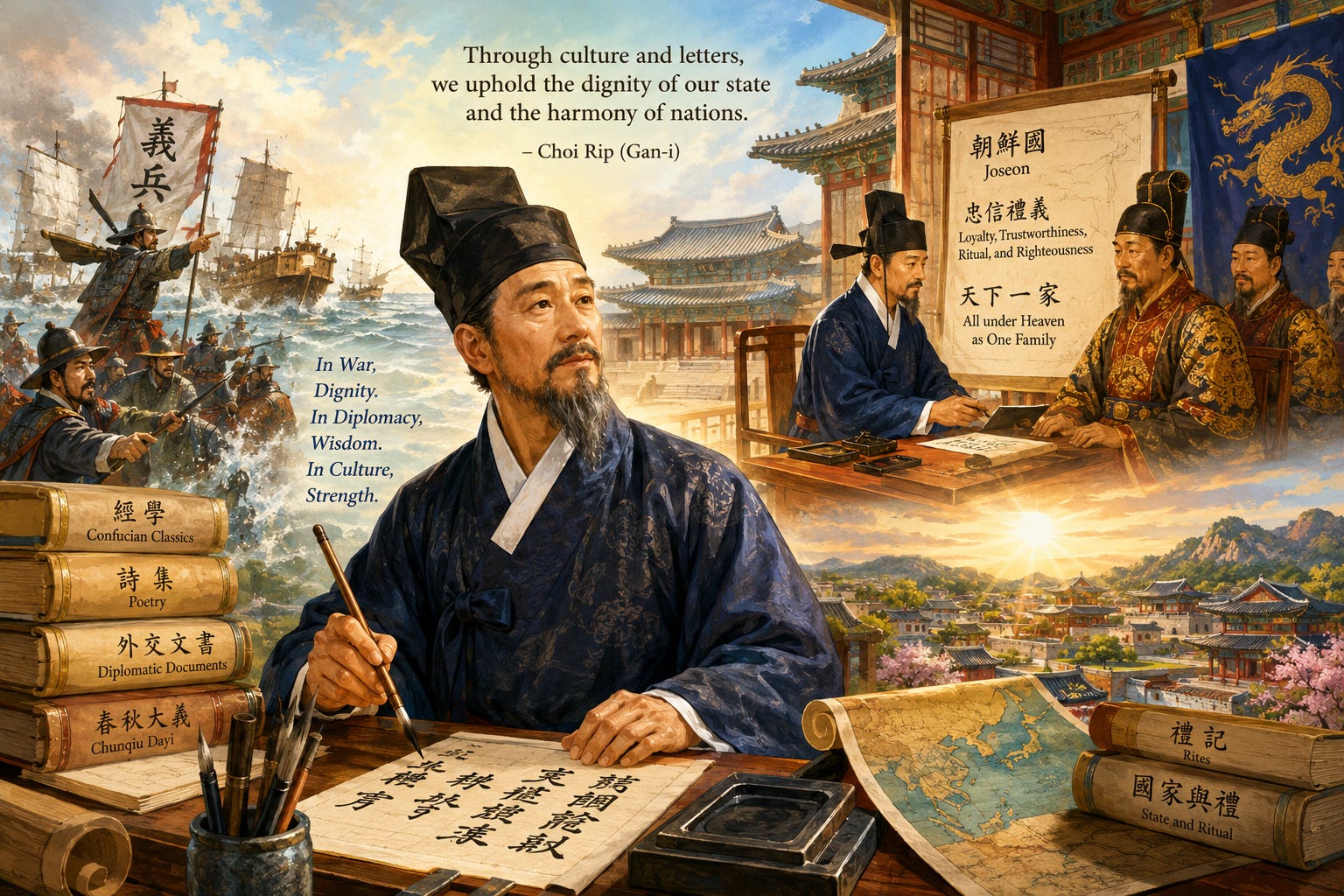
Choi Rip, one of the most distinguished literary figures of the mid-Joseon period, is often remembered primarily as an exceptional classical Confucian scholar and poet. Yet a closer examination of his life reveals that he was far more than a refined man of letters. In times of national crisis, he emerged as an intellectual who sought to defend Joseon not through military power alone, but through diplomacy, culture, and moral dignity. During the Imjin War, Choi Rip attempted to preserve the honor and international standing of Joseon through the power of language, diplomatic wisdom, and civilizational confidence. His diplomacy was not merely a political technique; it was a moral endeavor aimed at safeguarding the dignity of both humanity and the state.
The late sixteenth century was a period of profound upheaval in East Asia. In Japan, Toyotomi Hideyoshi, having completed the unification of the country, began to pursue imperial ambitions toward the Asian continent. Meanwhile, the Ming dynasty, despite visible signs of decline, still maintained its position as the center of the East Asian order. Joseon, though internally stable under its Confucian system, struggled to respond effectively to rapidly changing geopolitical realities, while factional divisions within the court deepened. Within this turbulent environment, Choi Rip viewed diplomacy not simply as negotiation between states, but as an intellectual effort to mediate conflicts between civilizations, values, and historical visions.
One of the defining characteristics of Choi Rip’s diplomatic philosophy was his belief in “diplomacy through culture and letters.” He understood that successful diplomacy required more than military calculation; it demanded an understanding of the psychology, culture, and moral reasoning of the opposing side. Diplomatic correspondence and ceremonial protocols were not administrative formalities but symbolic expressions of national dignity. Through his mastery of classical prose and profound understanding of Confucian scholarship, Choi Rip sought to demonstrate that Joseon was not merely a vulnerable kingdom, but a civilized state sharing in the broader moral tradition of East Asian Confucianism.
As tensions with Japan intensified before the outbreak of war, the Joseon court failed to fully grasp the magnitude of Japanese military ambitions. Choi Rip, however, belonged to a small group of intellectuals who perceived the significance of Japan’s internal transformation and expansionist intentions. Through diplomatic communications and observations of Japanese envoys, he discerned signs of a political ambition that extended beyond ordinary neighborly relations. His insight reflected not only political awareness but also a deep civilizational understanding of the ideological changes occurring within Japan.
When the Imjin War erupted in 1592, Joseon rapidly descended into chaos. The capital, Hanseong, fell, and King Seonjo fled northward to Uiju. Amid such devastation, Joseon’s diplomatic structure also entered a state of disorder. Yet precisely at this moment, the role of intellectuals became even more critical. War was not solely a military confrontation; it was also a struggle over legitimacy and the future configuration of regional order. Choi Rip participated actively in drafting diplomatic documents that articulated Joseon’s loyalty, legitimacy, and moral standing before the Ming court.
In particular, he contributed to shaping Ming China’s perception of Joseon not merely as a tributary state, but as a cultural and moral partner within the Confucian world order. Militarily weak though Joseon may have appeared, it possessed a highly developed intellectual and institutional culture. Choi Rip skillfully embedded this cultural identity into diplomatic language, seeking to establish solidarity with Ming scholars and officials. Such cultural diplomacy became a powerful asset that military strength alone could not secure.
One of the most remarkable aspects of Choi Rip’s diplomatic conduct was his determination to preserve humanity and ritual propriety even amid the brutality of war. The conflict was accompanied by massacres, destruction, and widespread hatred. Nevertheless, Choi Rip believed that diplomacy ultimately depended upon the restoration of trust between human beings. This was not naive idealism, but a pragmatic recognition that nations would inevitably need to rebuild relationships once the war had ended.
He also placed extraordinary importance on the power of language itself. To Choi Rip, diplomatic writing was not merely communication; it was the face and spirit of the nation. For this reason, Joseon’s diplomatic documents had to embody refinement, coherence, and moral authority. Rather than employing rhetoric designed solely to intimidate or humiliate, he favored a style that would lead others to recognize Joseon’s dignity voluntarily. In many ways, this approach foreshadowed what is now described as public diplomacy and cultural diplomacy.
During the Imjin War, Joseon suffered severe military disadvantages, yet it retained considerable strength in terms of cultural legitimacy and moral symbolism. Choi Rip understood that these intangible assets constituted the core of Joseon’s diplomatic influence. He emphasized that Joseon was not simply a victim pleading for assistance, but a participant in the preservation of the broader Confucian civilizational order of East Asia. Such arguments helped reinforce the moral justification for Ming intervention in the war.
Following the war, Choi Rip continued to emphasize the importance of rebuilding the nation through scholarship and culture. He did not regard diplomacy as a narrow calculation of national interests alone. Rather, he believed diplomacy represented the encounter between a nation’s intellectual and moral character and the outside world. In his view, no country lacking learning, ethical cultivation, and cultural refinement could possess genuine diplomatic power. This insight closely resembles the modern concept of soft power.
The diplomatic legacy of Choi Rip extends far beyond a collection of official documents or records of diplomatic missions. He embodied the ideal of the Joseon intellectual who could interpret international order and represent his nation through culture, scholarship, and moral eloquence. Even in an age dominated by military conflict, he believed in the enduring power of civilization and in the ability of language and learning to shape the destiny of nations.
Today, the world once again faces geopolitical rivalry and civilizational tensions. In an era when military and economic power alone cannot fully explain national influence, Choi Rip’s diplomatic philosophy acquires renewed relevance. He demonstrated that diplomacy is not merely a technique for coercing adversaries, but an intellectual art that connects different civilizations and systems of values. The dignified diplomatic spirit embodied by this Joseon scholar remains a profound legacy for contemporary Korean diplomacy and cultural engagement with the world. +++
{Solti}
May 8, 2026

Young Choi, PhD is a Professor at Regent University bringing a rare combination of technical expertise and creative spirit to everything he does. A scholar in AI, cybersecurity, and network & telecommunications service management, he has published 38 books including AI and cybersecurity area books, over 200 refereed articles, and over 20 book chapters. Beyond the academy, Dr. Choi is a passionate poet, essayist, and wooden block engraving artist whose reflective writing invites readers to rediscover life’s beauty in quiet contemplation(靜觀). He lives under the motto: “Study hard and give generously without holding back! (열심히 공부해서 아낌없이 남주자 !)”
Published books: https://www.amazon.com/stores/Young-Choi/author/B0DMZ5S6R7?ref=ap_rdr&shoppingPortalEnabled=true