
Abstract
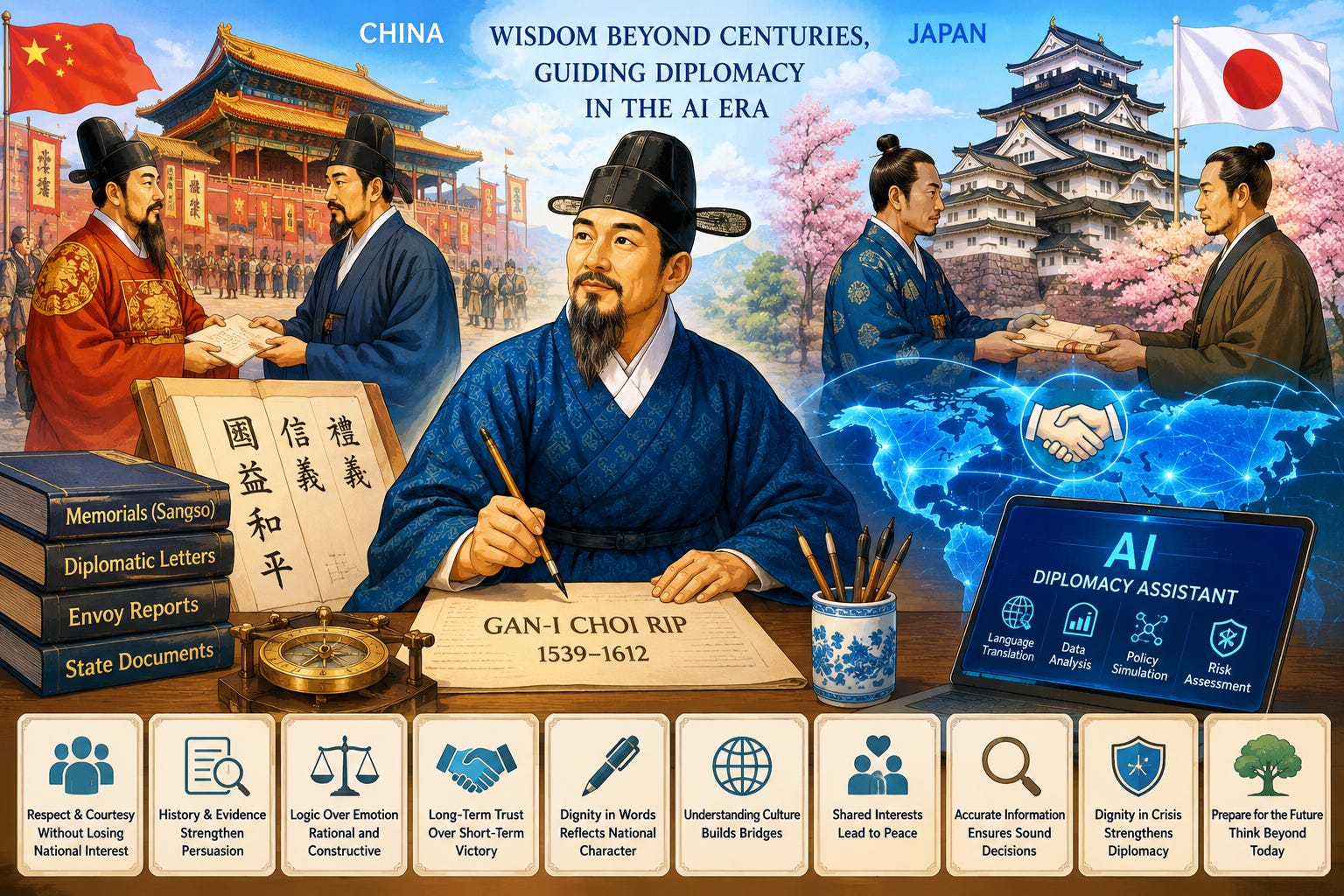
Artificial intelligence is transforming diplomacy at an unprecedented pace. Governments now employ AI for multilingual communication, policy analysis, risk prediction, and international negotiations. Yet technological capability alone cannot replace the wisdom, judgment, and moral character required for successful diplomacy. More than four centuries ago, the Joseon scholar and statesman Gani (Simplified Master) Choi Rip (1539–1612) demonstrated remarkable diplomatic leadership through official memorials, diplomatic correspondence, envoy reports, and state documents addressed to Ming China and Japan. His writings reveal a diplomatic philosophy grounded in respect, reason, historical awareness, cultural understanding, and national dignity. This essay examines five diplomatic strategies Choi Rip employed in dealing with Ming China and five additional strategies evident in his communications with Japan. It further explores how these principles can inspire AI-assisted diplomacy in the twenty-first century. Although diplomatic technologies have changed dramatically, the ethical foundations of diplomacy remain remarkably constant. Choi Rip’s legacy offers valuable guidance for governments, scholars, and AI developers seeking to build trustworthy, human-centered international cooperation.
A Question
Diplomacy has always depended upon communication. In the sixteenth century, diplomatic success relied on carefully written memorials, official letters, and state documents carried across mountains and seas by royal envoys. In the twenty-first century, diplomacy increasingly depends upon artificial intelligence capable of translating languages instantly, analyzing geopolitical trends, summarizing treaties, and assisting international negotiations.
Yet one fundamental question remains:
Can artificial intelligence replace diplomatic wisdom?
The life and writings of Choi Rip (1539–1612) suggest that the answer is no.
Widely recognized as one of Joseon’s greatest prose stylists and diplomatic writers, Choi Rip produced official documents that combined literary elegance with political precision. His diplomatic correspondence was never merely beautiful writing; it served as an instrument for protecting national interests while preserving peaceful international relations.
Remarkably, many principles embedded in his diplomatic writings anticipate modern concepts of strategic communication, evidence-based negotiation, intercultural competence, and long-term trust building. His legacy therefore provides valuable insights for AI-assisted diplomacy in an increasingly interconnected world.
I. Five Diplomatic Strategies toward Ming China
1. Respect First, National Interest Always
One of the most striking characteristics of Choi Rip’s memorials addressed to Ming officials is their respectful tone. Every document begins with courtesy, humility, and recognition of diplomatic protocol.
However, beneath this respectful language lies unwavering protection of Joseon’s national interests.
His diplomacy demonstrates that courtesy should never be mistaken for weakness.
In modern AI-assisted negotiations, this principle remains highly relevant.
Generative AI can recommend culturally appropriate wording, but policymakers must ensure that core national objectives remain clear and uncompromised.
AI Application
AI-assisted diplomatic drafting
Cultural adaptation of negotiation language
Automatic verification that essential policy objectives remain consistent throughout negotiations
2. Persuade Through History Rather Than Emotion
Instead of relying upon emotional appeals, Choi Rip frequently cited historical precedents and previous diplomatic agreements.
His arguments often rested upon one powerful idea:
“This has been the established practice throughout history.”
Historical legitimacy strengthened diplomatic persuasion.
Today’s AI systems possess unprecedented abilities to analyze historical treaties, legal precedents, and international agreements.
Diplomatic persuasion in the AI era increasingly depends upon evidence supported by historical and legal data.
AI Application
Treaty comparison systems
Historical precedent retrieval
AI-supported international legal analysis
3. Let Logic Govern Emotion
Even when addressing injustice or misunderstanding, Choi Rip rarely allowed emotion to dominate his writing.
His prose remained calm, rational, and carefully structured.
This intellectual discipline reflects an enduring diplomatic principle:
Reason persuades more effectively than anger.
AI naturally excels at organizing logical arguments and reducing emotional bias.
Human diplomats contribute empathy, ethical judgment, and contextual understanding, while AI strengthens analytical reasoning.
Together they create more balanced diplomacy.
4. Build Long-Term Trust Rather Than Short-Term Victory
Choi Rip viewed diplomacy as the gradual accumulation of mutual trust rather than the pursuit of immediate political victories.
He understood that successful interstate relations extend far beyond a single negotiation.
The same principle governs AI cooperation today.
International partnerships involving AI governance, cybersecurity, and data sharing require sustained trust among governments.
Trust remains the true infrastructure of international collaboration.
AI Application
Trust-based AI governance frameworks
Long-term policy consistency analysis
International transparency monitoring
5. Diplomatic Writing Reflects National Character
For Choi Rip, every diplomatic document represented the dignity of Joseon.
Official correspondence served not only administrative purposes but also demonstrated the intellectual and cultural sophistication of the nation itself.
In today’s digital world, official emails, online statements, and AI-generated diplomatic communications similarly shape international perceptions.
Generative AI can assist governments in producing language that is both accurate and dignified, but the values expressed within those words must continue to originate from human leadership.
II. Five Diplomatic Strategies toward Japan
1. Understand the Other Culture Before Negotiating
Choi Rip recognized that effective diplomacy begins with understanding the counterpart’s cultural traditions, communication styles, and political expectations.
Negotiation succeeds only when mutual understanding precedes persuasion.
Modern AI provides extraordinary capabilities for analyzing cultural communication patterns across different societies.
AI Application
Cross-cultural communication analysis
Country-specific linguistic adaptation
AI-supported diplomatic etiquette recommendations
2. Seek Shared Interests Rather Than Conflict
Rather than emphasizing confrontation, Choi Rip frequently highlighted opportunities for peaceful exchange and mutual prosperity.
He understood that lasting peace depends upon common interests rather than temporary compromises.
Today’s AI systems can simulate thousands of negotiation scenarios, identifying solutions that maximize mutual benefits.
This represents one of AI’s greatest contributions to international diplomacy.
3. Accurate Information Is the Foundation of Sound Diplomacy
During diplomatic missions, Choi Rip carefully documented political conditions, economic developments, and cultural observations.
He recognized that national policy depends upon reliable information.
This lesson has become even more significant in the AI era.
Artificial intelligence is only as trustworthy as the quality of its underlying data.
Poor data inevitably produces poor diplomatic decisions.
AI Application
AI-supported intelligence verification
Misinformation detection
International data validation systems
4. Preserve Dignity During Crisis
Negotiations with Japan occasionally occurred under tense political circumstances.
Yet Choi Rip consistently maintained composure, courtesy, and intellectual restraint.
His writings demonstrate that dignity itself becomes a diplomatic resource.
In the age of social media and instant communication, maintaining respectful discourse is more important than ever.
AI can assist by identifying inflammatory language before official statements are released.
5. Negotiate for Future Generations
Choi Rip looked beyond immediate political disputes.
His diplomatic vision considered relationships that would continue for decades beyond his own lifetime.
Modern AI strategy requires similar foresight.
Governments must evaluate not only present geopolitical challenges but also the long-term consequences of AI governance, cybersecurity cooperation, digital sovereignty, and ethical technology development.
Strategic diplomacy always looks beyond the present moment.
Choi Rip’s Diplomatic Legacy for the AI Era
If Choi Rip were alive today, he would almost certainly recognize the extraordinary potential of generative artificial intelligence.
As one of Joseon’s greatest literary masters, he would likely appreciate AI’s remarkable ability to organize language, analyze documents, and communicate across cultures.
Yet he would almost certainly insist upon one essential distinction.
Artificial intelligence can generate language.
Only human beings can generate wisdom.
AI can translate words.
Human beings build trust.
AI analyzes data.
Human leaders determine national interest.
Technology enhances diplomacy, but character defines diplomacy.
This timeless lesson has become increasingly important as governments worldwide adopt AI-assisted foreign policy tools.
Responsible diplomacy in the AI era therefore requires not only technological innovation but also ethical leadership rooted in historical understanding and cultural wisdom.
Four centuries separate Choi Rip’s diplomatic missions from today’s AI-driven international order.
The tools have changed dramatically.
The principles have not.
Respect others without abandoning national interests.
Persuade through evidence rather than emotion.
Protect dignity in every communication.
Build trust instead of temporary victories.
Prepare today for the relationships of tomorrow.
These principles guided Choi Rip’s diplomacy with both Ming China and Japan, and they continue to illuminate the path toward responsible AI-enabled global governance.
As artificial intelligence increasingly participates in international negotiations, Choi Rip reminds us that diplomacy ultimately remains a profoundly human endeavor.
Technology may accelerate communication, but wisdom gives it direction.
Perhaps Choi Rip himself would summarize his diplomatic philosophy with these words:
“A noble sentence preserves a nation’s dignity; noble diplomacy preserves its people.”
In the twenty-first century, we may respectfully add one more thought:
Artificial intelligence may empower great diplomats, but it can never replace the wisdom of one.
For this reason, Choi Rip’s diplomatic writings remain not merely historical documents but enduring guides for ethical leadership in the age of artificial intelligence. +++
{Solti}
July 17, 2026
간이 최립의 외교 지혜와 AI 시대의 새로운 외교
“16세기의 외교 문서는 21세기의 인공지능에게 무엇을 가르칠 수 있는가?”
오늘날 국제사회는 인공지능이 국가 경쟁력을 좌우하는 시대에 들어섰다. 외교 역시 더 이상 외무부만의 영역이 아니다. AI는 실시간 번역을 하고, 국제 여론을 분석하며, 수백만 건의 협정문을 비교한다. 그러나 아무리 뛰어난 AI라도 인간의 지혜를 대신할 수는 없다.
조선 최고의 문장가 가운데 한 사람이었던 간이 최립은 명나라와 일본을 상대하면서 수많은 외교 문서를 남겼다. 그의 문장은 단순히 아름다운 글이 아니라 국가를 지키는 무기였다. 그의 외교는 오늘날 AI 시대에도 놀라울 만큼 현대적인 통찰을 제공한다.
Ⅰ. 중국(명나라)과의 외교 전략 다섯 가지
1. 예(禮)를 앞세우되 국익은 결코 양보하지 않는다.
최립의 대명 외교 문서를 보면 첫 문장은 언제나 상대에 대한 존중으로 시작된다.
그러나 내용을 자세히 읽어 보면 국가의 이익은 단 한 줄도 양보하지 않는다.
겉으로는 겸손하지만 논리는 매우 치밀하다.
오늘날 AI 외교에서도 마찬가지이다.
AI는 협상 문장을 더욱 공손하게 만들 수 있지만, 핵심 요구사항은 더욱 명확하게 정리해야 한다.
AI 활용
AI 기반 협상문 초안 작성
상대국 문화에 맞는 표현 자동 추천
핵심 요구사항 자동 검증
2. 역사와 사례를 근거로 설득한다.
최립은 자신의 주장보다 역사적 선례를 더 많이 인용한다.
“이전에도 그러하였다.”
이 한마디는 감정보다 강한 설득력을 가진다.
AI 시대에도 데이터와 사례 기반 의사결정이 가장 설득력이 있다.
AI 활용
과거 국제조약 자동 검색
유사 사례 비교
국제 판례 분석
3. 감정보다 논리를 앞세운다.
최립의 문장에는 분노가 거의 없다.
억울함을 말하면서도 논리 구조는 흐트러지지 않는다.
AI 역시 감정을 배제하고 객관적인 자료를 제공하는 데 강점이 있다.
인간은 감성을 더하고 AI는 논리를 더하면 최고의 협상이 가능하다.
4. 장기적인 신뢰를 우선한다.
최립은 한 번의 승리보다 오랫동안 지속되는 우호 관계를 더 중요하게 여겼다.
국제관계는 결국 신뢰의 축적이라는 사실을 알고 있었기 때문이다.
AI 시대의 국제협력도 동일하다.
데이터 공유와 AI 공동 연구 역시 신뢰 없이는 불가능하다.
5. 문장이 국가의 품격을 결정한다.
최립은 문장을 곧 국가의 얼굴이라고 생각했다.
외교문서는 단순한 행정문서가 아니라 국가의 문화 수준을 보여주는 작품이었다.
오늘날 이메일 한 통도 국가 이미지를 만든다.
생성형 AI는 이러한 품격 있는 문장을 더욱 쉽게 만들 수 있다.
Ⅱ. 일본과의 외교 전략 다섯 가지
1. 상대 문화를 먼저 이해한다.
최립은 일본과 교섭할 때 일본인의 표현 방식과 사고방식을 충분히 고려하였다.
상대를 이해해야 협상이 시작된다는 사실을 알고 있었다.
AI는 문화 차이를 분석하는 데 매우 뛰어나다.
국가별 표현 방식도 자동으로 조정할 수 있다.
2. 갈등보다 공통의 이익을 찾는다.
최립은 분쟁보다 교역과 평화를 강조하였다.
공통의 이익이 있어야 평화가 오래 지속된다는 사실을 이해하였다.
AI도 협상에서 Win-Win 시나리오를 수천 가지 제안할 수 있다.
3. 정확한 정보가 최고의 외교이다.
최립은 사행 중 얻은 정보를 매우 세밀하게 기록하였다.
정확한 정보가 국가 정책의 기초가 된다는 사실을 알고 있었기 때문이다.
오늘날 AI 역시 데이터 품질이 성패를 결정한다.
잘못된 데이터는 잘못된 외교를 만든다.
4. 위기에서도 품위를 잃지 않는다.
일본과의 교섭은 때로 긴장감이 높았다.
그러나 최립의 문장은 언제나 절제되어 있다.
품위는 협상의 힘이라는 사실을 보여준다.
AI 시대에도 온라인 외교에서는 이러한 언어 절제가 더욱 중요하다.
5. 미래를 준비하는 외교를 한다.
최립은 현재의 문제만 해결하지 않았다.
앞으로 수십 년 동안 지속될 관계까지 고려하였다.
오늘날 AI 전략 역시 10년, 20년 후를 내다보아야 한다.
AI 시대에 다시 배우는 최립의 외교
최립이 오늘날 살아 있다면 아마도 생성형 AI를 가장 먼저 연구했을지도 모른다.
그는 문장을 사랑한 사람이었기 때문이다.
그러나 그는 AI에게 모든 것을 맡기지는 않았을 것이다.
AI는 문장을 만들 수 있지만,
품격은 인간이 만든다.
AI는 번역할 수 있지만,
신뢰는 인간이 쌓는다.
AI는 데이터를 분석할 수 있지만,
국익을 판단하는 것은 결국 사람이다.
최립은 아마 이렇게 말했을 것이다.
“좋은 문장은 나라를 살리고, 좋은 외교는 백성을 살린다.”
오늘날 우리는 여기에 한 문장을 더할 수 있다.
“좋은 AI는 훌륭한 외교관을 돕지만, 훌륭한 외교관을 대신할 수는 없다.”
16세기 조선의 한 문장가는 붓으로 세계와 대화했다.
21세기의 우리는 AI와 함께 세계와 대화한다.
도구는 바뀌었지만 외교의 본질은 변하지 않았다.
상대를 존중하고, 사실을 바탕으로 설득하며, 품격 있는 언어로 신뢰를 쌓는 것.
이것이 바로 간이 최립이 오늘날 AI 시대의 세계 외교에 남긴 가장 소중한 유산이다. +++
{솔티}
2026년 7월 17일

Prof. Dr. Young Choi (Editor in Chief) — Regent University
Young B. Choi is a Professor in the Department of Engineering & Computer Science at Regent University. He published 38 books with ‘Selected Readings in Cybersecurity’ (2018) (over 800 copies archived globally at university/college libraries around the world) and ‘Cybersecurity Applications and Artificial Intelligence’ (2023) available in seven major world languages. He proposed the world’s first global and universal telecommunications “Service Order Handling (SOH)” Model (T-SOH Model) (1995) with Dr. Adrian Tang. With this innovative research work, he received the IEEE NOMS ’96 Best Paper Award and became the first recipient of the Outstanding Contribution Award of the TeleManagement Forum in 1998. His research areas include Natural Language Processing-focused AI, AI-applied cybersecurity, network and telecom service management, and Korean studies on Gani Choi Rip’s Jeonggwan (靜觀: Quiet Contemplation) philosophy and Shilhak ( 實學: Practical Learning).