
Abstract
In an era defined by artificial intelligence, big data, and instant access to global information, the meaning of knowledge is undergoing a fundamental transformation. While modern technologies provide unprecedented access to information, they also raise a critical question: how can humanity transform information into wisdom?
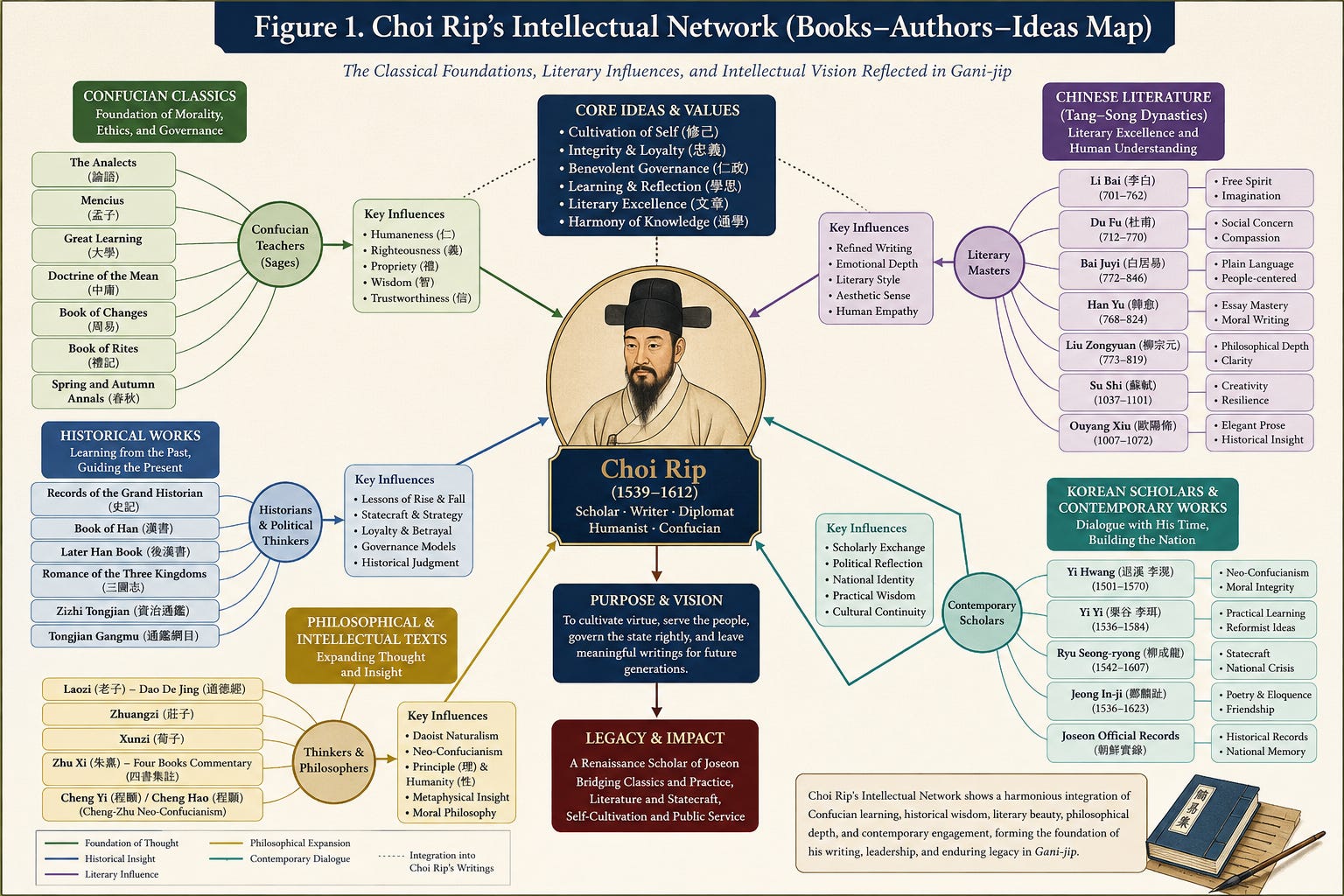
More than four centuries ago, Korean scholar and literary master Choi Rip (崔岦, 1539–1612) confronted a similar challenge in a different historical context. Living during the turbulent sixteenth century of the Joseon Dynasty, Choi Rip developed an extraordinary intellectual world through lifelong reading, reflection, and creative writing. His collected works, Gani-jip (簡易集), reveal a sophisticated network of classical texts, including Confucian scriptures, Chinese historical works, Tang-Song literature, philosophical writings, and Korean scholarly traditions.
This article examines Choi Rip’s intellectual foundation through the books referenced in Gani-jip and explores how his approach to reading provides meaningful lessons for leadership, education, and human-centered knowledge management in the AI era.
Keywords: Choi Rip, Gani-jip, Joseon intellectual history, classical learning, Confucianism, knowledge management, AI humanities, leadership
1. Introduction: A Scholar Who Built Wisdom Through Reading
The twenty-first century is often described as the age of information abundance. Artificial intelligence systems can summarize books, analyze historical documents, and generate sophisticated texts within seconds. However, the ability to process information does not automatically create wisdom.
The life of Choi Rip offers a valuable historical perspective on this issue.
Born in 1539 during the Joseon Dynasty, Choi Rip became one of Korea’s most respected literary figures. He was recognized for his exceptional writing ability, diplomatic documents, and mastery of classical Chinese literature. His reputation was so significant that he was often regarded as one of the finest prose writers of his time.
However, the foundation of his achievement was not simply talent. It was disciplined reading.
For Choi Rip, books were not passive sources of information. They were intellectual companions through which he examined humanity, politics, morality, and the meaning of life.
2. Gani-jip as a Map of Intellectual Civilization
The Gani-jip is more than a collection of essays and literary works. It represents the intellectual landscape of a Joseon scholar.
The books reflected in his writings demonstrate several layers of knowledge:
Confucian classics for moral cultivation
Historical texts for political wisdom
Literary works for aesthetic and emotional understanding
Philosophical writings for intellectual expansion
This interdisciplinary approach resembles modern concepts of liberal education and knowledge integration.
Unlike specialized knowledge systems today, Renaissance scholars viewed knowledge as interconnected. Choi Rip’s intellectual world reflects this broader vision.
3. Confucian Classics: The Foundation of Character and Leadership
The foundation of Choi Rip’s reading world was Confucian learning.
Works such as:
Analects (論語)
Mencius (孟子)
Great Learning (大學)
Doctrine of the Mean (中庸)
provided the ethical framework for his understanding of individuals and society.
For Choi Rip, learning was not merely an academic pursuit. It was a lifelong process of self-improvement.
The Confucian principle of:
“Cultivating oneself before governing others” (修己治人)
was central to Joseon leadership philosophy.
Modern leadership studies emphasize similar ideas: effective leaders require integrity, emotional intelligence, and responsibility before exercising authority.
Thus, Choi Rip’s classical education offers a timeless leadership model.
4. History as a Laboratory of Human Experience
Among the books influencing Choi Rip, historical works occupied a particularly important position.
4.1 Records of the Grand Historian (史記)
Written by Sima Qian, Shiji was not simply a historical record. It was a profound examination of human ambition, loyalty, failure, and moral choices.
Joseon scholars read Shiji not only to learn history but also to understand human nature.
For Choi Rip, history provided examples of:
wise governance,
political mistakes,
personal responsibility,
moral courage.
4.2 Zizhi Tongjian (資治通鑑)
Sima Guang’s monumental historical work became an essential political textbook in East Asia.
The purpose of history was not merely remembering the past. It was learning how to make better decisions in the future.
In this sense, historical learning functioned as an early form of strategic intelligence.
Today’s AI systems analyze massive datasets to predict future trends. Choi Rip’s generation analyzed historical patterns to develop political wisdom.
5. Literature as Human Understanding
Choi Rip’s intellectual world was deeply connected with Chinese literary traditions.
Du Fu: Poetry and Social Responsibility
Du Fu’s poetry reflected the suffering of ordinary people during political instability.
From Du Fu, Choi Rip learned that literature should not only express beauty but also demonstrate compassion.
Han Yu: The Power of Classical Writing
Han Yu emphasized that writing should communicate meaningful ideas and moral principles.
This perspective influenced Choi Rip’s belief that excellent writing requires both intellectual depth and ethical purpose.
Su Shi: Creativity and Resilience
Su Shi represented intellectual flexibility, creativity, and emotional balance.
His ability to maintain dignity despite political difficulties provided a model for scholars facing adversity.
6. Choi Rip’s Reading Method: From Knowledge to Wisdom
The greatest lesson from Choi Rip is not simply what he read, but how he read.
His intellectual process can be summarized as:
Reading → Reflection → Interpretation → Creative Expression → Social Contribution
This model differs from information consumption.
Modern AI can retrieve and organize knowledge. However, wisdom requires:
critical thinking,
ethical judgment,
empathy,
creativity.
These qualities define human intellectual leadership.
7. Lessons for Education in the AI Era
The educational challenge of the AI era is not memorization.
Information is increasingly available everywhere.
The essential question is:
How do we educate people who can think deeply and act responsibly?
Choi Rip’s educational philosophy suggests five principles:
1. Read deeply, not simply quickly
Knowledge requires reflection.
2. Connect different fields
Great ideas emerge from intellectual connections.
3. Combine knowledge with ethics
Information without morality can create harm.
4. Transform learning into creativity
Reading should produce new ideas.
5. Use knowledge for society
True scholarship serves humanity.
8. AI and the Return of Humanistic Intelligence
Artificial intelligence represents one of humanity’s greatest technological achievements.
However, AI does not eliminate the need for human wisdom. Instead, it increases that need.
The future will not belong simply to those who possess the most information.
It will belong to those who can:
interpret information,
evaluate consequences,
understand human values,
create meaningful solutions.
Choi Rip’s intellectual journey demonstrates that wisdom emerges when knowledge meets reflection.
9. Conclusion: Rediscovering a Korean Intellectual Renaissance
Choi Rip represents a Korean form of intellectual Renaissance.
His world was built not on technological power but on the power of reading, thinking, and writing.
The books referenced in Gani-jip reveal a scholar who connected:
Confucian ethics,
historical analysis,
literary creativity,
philosophical reflection.
More than four hundred years later, his message remains relevant:
Knowledge becomes wisdom only when it transforms human character and improves society.
In the AI era, humanity does not need fewer readers. It needs deeper readers.
Choi Rip’s legacy reminds us that the ultimate purpose of learning is not information accumulation, but the creation of wise and responsible human beings.
References
Bloom, B. S., Engelhart, M. D., Furst, E. J., Hill, W. H., & Krathwohl, D. R. (1956). Taxonomy of educational objectives: The classification of educational goals. Handbook I: Cognitive domain. David McKay.
De Bary, W. T. (1989). The liberal tradition in China. Columbia University Press.
Kalton, M. C. (1994). To become a sage: The ten diagrams on sage learning by Yi T’oegye. Columbia University Press.
Lee, P. H. (1993). Sources of Korean tradition: Volume 1: From early times through the sixteenth century. Columbia University Press.
Sima Guang. (1956). Zizhi Tongjian (資治通鑑). Zhonghua Shuju.
Tu, W. (1985). Confucian thought: Selfhood as creative transformation. State University of New York Press.
Choi, R. (1612). Gani-jip (簡易集).
Institute for the Translation of Korean Classics. (2007–2020). Translated Collection of Gani-jip (國譯簡易集).
최립의 지적 르네상스: AI 시대의 독서, 지혜, 그리고 리더십
《간이집(簡易集)》에 인용된 서적을 통해 재발견하는 16세기 한국 학자의 지적 유산
초록(Abstract)
본 연구는 조선 중기의 대표적 문장가인 간이(簡易) 최립(崔岦, 1539–1612)의 문집 『간이집(簡易集)』에 나타난 고전 인용과 독서 세계를 분석하여 그의 지적 형성 과정과 사상적 배경을 고찰한다. 최립은 조선 사대부 문인으로서 유교 경전을 기반으로 하면서도 중국 역사서, 당송 문학, 철학서, 다양한 문헌을 폭넓게 활용하였다. 그의 독서는 단순한 지식 축적이 아니라 인간 수양, 국가 경영, 문학 창작, 역사적 성찰을 위한 통합적 지적 활동이었다.
본 논문은 『논어』, 『맹자』, 『주역』 등 유교 경전과 『사기』, 『한서』, 『자치통감』 등 역사서를 중심으로 최립의 독서 체계를 분석하고, 이백·두보·한유·소동파 등 중국 문인들의 영향을 통해 그의 문장론과 인간관을 살펴본다. 또한 그의 독서 태도가 오늘날 생성형 AI 시대의 지식 활용과 어떤 의미 있는 연결점을 갖는지 논의한다.
주제어: 최립, 간이집, 조선 문학, 독서 문화, 성리학, 고전 연구, AI 시대의 인문학
1. 서론: 책을 통해 시대와 대화한 조선의 지식인
16세기 조선은 정치적 혼란과 사상적 변화가 동시에 진행된 시대였다. 사림 세력이 성장하고 성리학이 국가 운영의 중심 이념으로 자리 잡았으며, 문인들은 단순한 문장 능력을 넘어 도덕성과 정치적 책임을 요구받았다.
이러한 시대적 환경 속에서 최립은 뛰어난 문장가이자 외교 문서 작성자로 활동하였다. 그는 중국 사신 접대와 외교 문서 작성에서 탁월한 능력을 인정받았으며, 당대 최고의 문장가 중 한 사람으로 평가받았다.
그러나 최립의 진정한 특징은 그의 문장 기술보다 그 문장을 형성한 독서의 깊이에 있다.
『간이집』은 한 개인의 문집이지만 동시에 16세기 조선 지식인의 독서 지도를 보여 주는 문화적 기록이다.
2. 최립 독서 세계의 중심: 유교 경전과 인간 수양
조선 사대부의 지적 기반은 유교 경전이었다.
최립 역시 『논어』, 『맹자』, 『대학』, 『중용』을 바탕으로 인간과 사회를 이해하였다.
공자는 인간 완성의 핵심을 인(仁)과 예(禮)에서 찾았으며, 맹자는 인간의 도덕적 가능성과 정의로운 정치의 중요성을 강조하였다.
최립의 글에서도 이러한 가치관이 반복된다.
그에게 학문은 시험을 위한 지식이 아니라:
자신을 다스리는 방법
타인을 이해하는 방법
국가를 올바르게 운영하는 방법
이었다. 이는 조선 성리학이 추구했던 수기치인(修己治人)의 이상과 일치한다.
(De Bary, 1989)
3. 역사서 읽기: 과거를 통해 미래를 판단하다
최립의 독서 세계에서 중요한 위치를 차지하는 것은 역사서였다.
『사기(史記)』와 인간 이해
사마천의 『사기』는 단순한 역사 기록이 아니라 인간 행동에 대한 철학적 분석서였다.
최립과 같은 조선 문인들은 『사기』를 통해:
충성과 배신
성공과 실패
개인과 국가의 관계
를 배웠다.
사마천은 역사를 통해 인간의 운명과 선택을 기록했고, 최립은 이를 통해 현실 정치와 인간 본성을 이해하였다.
『자치통감』과 정치적 판단
『자치통감』은 중국 역사를 통해 통치자의 판단과 국가 운영 원리를 보여 주는 책이었다.
조선 사대부에게 이 책은 정치 교육서였다.
최립 역시 역사적 사례를 활용하여 현재의 문제를 해석하였다.
이는 오늘날 데이터 기반 의사결정과 비교할 수 있다.
현대 사회가 빅데이터를 통해 미래를 예측한다면, 조선 지식인은 역사를 통해 미래를 판단하였다. (Sima Guang, 1084/1956)
4. 문학적 독서: 당송 문인의 정신을 배우다
최립은 중국 문학 전통에도 깊이 영향을 받았다.
두보(杜甫): 시대를 고민하는 시인
두보는 개인 감정보다 사회적 책임을 강조한 시인이었다.
그의 시에는 전쟁, 백성의 고통, 국가의 위기가 담겨 있다.
최립 역시 문학을 단순한 아름다움이 아니라 사회적 책임과 연결하였다.
한유(韓愈): 문장의 힘
한유는 고문운동을 통해 문장은 올바른 사상을 담아야 한다고 주장하였다.
최립의 문장관 역시 이러한 전통과 연결된다.
좋은 글은 아름다운 표현만으로 완성되는 것이 아니라:
깊은 사고
올바른 가치
정확한 표현
을 갖추어야 한다는 것이다.
소동파(蘇東坡): 지성과 인간미
소동파는 정치가, 문인, 철학자로서 다양한 분야에서 활동하였다.
최립이 보여 준 폭넓은 학문 세계 역시 소동파적 지식인의 모습과 닮아 있다.
5. 최립의 독서 방식: 암기가 아닌 창조적 재해석
최립은 고전을 그대로 반복하지 않았다.
그는:
읽기 → 이해하기 → 비교하기 → 자신의 문장으로 재창조하기
라는 과정을 거쳤다.
이는 현대 교육학에서 말하는 고차원적 학습(higher-order learning)과 연결된다.
Bloom의 교육목표 분류에서도 단순 기억보다 분석, 평가, 창조 단계가 높은 학습으로 평가된다. (Bloom et al., 1956)
최립의 독서는 바로 이러한 창조적 학습이었다.
6. AI 시대에 다시 보는 최립의 독서 철학
오늘날 생성형 AI는 인간보다 훨씬 빠르게 정보를 검색하고 요약한다.
그러나 최립의 독서 방식은 AI 시대에 중요한 질문을 던진다.
“정보를 얼마나 많이 가지고 있는가?”
보다 중요한 질문은:
“그 정보를 어떻게 지혜로 변화시키는가?”
이다.
AI는 『사기』를 요약할 수 있다.
그러나 사마천이 왜 인간의 선택과 운명을 기록했는지 깊이 이해하는 것은 인간의 몫이다.
AI는 두보의 시를 분석할 수 있다.
그러나 전쟁 속에서 인간의 고통을 느끼는 감성은 인간 독자의 경험이다.
최립의 독서 세계는 AI 시대 인문학의 방향을 제시한다.
결론: 『간이집』은 조선 지식인의 정신 지도이다
『간이집』에 나타난 도서들은 단순한 참고문헌 목록이 아니다.
그것은 최립이라는 한 지식인이 평생 무엇을 고민했는지를 보여 주는 정신의 지도이다.
그 지도에는:
유교의 도덕성
역사의 교훈
문학의 아름다움
철학적 성찰
인간에 대한 이해
가 함께 존재한다.
최립은 책을 통해 세상을 이해했고, 세상을 통해 인간을 이해했다.
400여 년이 지난 오늘날, 그의 독서 철학은 우리에게 새로운 메시지를 준다.
“지식은 저장하는 것이 아니라 삶 속에서 지혜로 변환될 때 비로소 가치가 있다.”
AI 시대의 진정한 지식인은 가장 많은 정보를 가진 사람이 아니라, 가장 깊이 생각하고 가장 인간적으로 활용하는 사람이다.
참고문헌
Bloom, B. S., Engelhart, M. D., Furst, E. J., Hill, W. H., & Krathwohl, D. R. (1956). Taxonomy of educational objectives: The classification of educational goals. Handbook I: Cognitive domain. David McKay.
De Bary, W. T. (1989). The liberal tradition in China. Columbia University Press.
Kalton, M. C. (1994). To become a sage: The ten diagrams on sage learning by Yi T’oegye. Columbia University Press.
Lee, P. H. (1993). Sources of Korean tradition: Volume 1: From early times through the sixteenth century. Columbia University Press.
Sima Guang. (1956). Zizhi tongjian (The comprehensive mirror in aid of governance). Zhonghua Shuju.
최립. (1612). 간이집(簡易集).
한국고전번역원. (2007–2020). 국역 간이집. 한국고전번역원.
{솔티}
2026년 7월 14일

Prof. Dr. Young Choi (Editor in Chief) — Regent University
Young B. Choi is a Professor in the Department of Engineering & Computer Science at Regent University. He published 38 books with ‘Selected Readings in Cybersecurity’ (2018) (over 800 copies archived globally at university/college libraries around the world) and ‘Cybersecurity Applications and Artificial Intelligence’ (2023) available in seven major world languages. He proposed the world’s first global and universal telecommunications “Service Order Handling (SOH)” Model (T-SOH Model) (1995) with Dr. Adrian Tang. With this innovative research work, he received the IEEE NOMS ’96 Best Paper Award and became the first recipient of the Outstanding Contribution Award of the TeleManagement Forum in 1998. His research areas include Natural Language Processing-focused AI, AI-applied cybersecurity, network and telecom service management, and Korean studies on Gani Choi Rip’s Jeonggwan (靜觀: Quiet Contemplation) philosophy and Shilhak ( 實學: Practical Learning).