
Today, we live in an era where knowledge is one of the most valuable forms of capital. Artificial intelligence can provide vast amounts of information within seconds, and the internet connects the world’s knowledge in real time. Yet possessing information does not automatically lead to wisdom. The real challenge lies in selecting, interpreting, and applying knowledge to solve practical problems. In this regard, the life of Choi Rip (1539–1612), better known by his pen name Gani (簡易), offers remarkable insights for modern readers.
Although Choi Rip is often remembered primarily as a poet, he was far more than a literary figure. He served as a scholar, educator, diplomat, administrator, critic, and thinker. He lived through the national crisis of the Imjin War, administered local governments, traveled to Ming China on diplomatic missions, and left behind thousands of poems and essays that continue to be studied today. These accomplishments were not accidental; they resulted from a disciplined system of learning, reflection, and knowledge management.
Modern organizations define knowledge management as the process of creating, sharing, organizing, and applying knowledge to enhance performance and competitiveness. Remarkably, centuries before the term was coined, Choi Rip practiced these principles throughout his life. His methods provide valuable lessons for students, researchers, business leaders, educators, and public servants navigating the complexities of the AI age.
He Made Lifelong Learning a Way of Life
One of Choi Rip’s most distinguishing characteristics was his unwavering commitment to learning.
While many scholars of the Joseon period viewed passing the civil service examination as the culmination of education, Choi Rip regarded it merely as the beginning of a lifelong intellectual journey. Even after entering government service, he continued to study extensively. His interests ranged from Confucian classics and history to literature, military strategy, diplomacy, geography, and philosophy.
In today’s rapidly changing world, lifelong learning has become essential. Medical professionals must stay current with new treatments, cybersecurity experts must adapt to emerging threats, and educators must keep pace with evolving technologies and research. Choi Rip’s life reminds us that intellectual growth should never cease. Learning is not an activity confined to youth; it is a lifelong pursuit.
He Connected Reading to Real Life
For Choi Rip, reading was never an isolated academic exercise.
When studying history, he sought lessons for governance and leadership. When reading classical texts, he searched for principles applicable to human relationships, ethics, and public administration. Knowledge gained from books was valuable only when it informed action and improved judgment.
As a local administrator, he frequently applied historical insights to contemporary challenges. Rather than treating books as repositories of abstract theories, he viewed them as practical guides for addressing real-world problems.
Today, countless individuals read books for professional development, yet the true measure of reading is not the number of books completed but the extent to which ideas are implemented. Choi Rip exemplified the transformation of information into practical wisdom.
He Turned Knowledge into Lasting Assets Through Writing
Human memory is fragile. Brilliant ideas can disappear unless they are recorded and organized.
Choi Rip understood this reality deeply. Throughout his life, he documented his observations, experiences, and reflections through poetry, essays, travel accounts, letters, and literary criticism. These writings became a personal knowledge repository that preserved his intellectual growth and accumulated insights.
Modern organizations refer to this process as knowledge asset creation. Research findings, project experiences, institutional procedures, and professional expertise are documented so that they can be reused and shared. Choi Rip practiced the same principle centuries ago.
The reason scholars can study his thoughts today is that he carefully preserved them in writing. His records transformed temporary experiences into enduring intellectual resources.
In the digital era, journals, blogs, digital notebooks, and knowledge databases serve similar functions. Recording ideas remains one of the most powerful tools for learning and innovation.
He Learned Directly from the Field
Choi Rip believed that books alone could not reveal the full complexity of human society.
During his service as a government official, he carefully observed agricultural practices, local markets, social customs, and the everyday lives of ordinary people. These firsthand experiences enriched his understanding and informed his writings.
Many successful leaders today emphasize the importance of direct observation. Effective managers visit production facilities, interact with customers, and listen to employees rather than relying solely on reports. Researchers conduct field studies to verify theories against reality.
Knowledge detached from practice often becomes sterile. Choi Rip’s emphasis on experiential learning anticipated modern approaches such as field-based research, experiential education, and evidence-based decision-making.
He Cultivated the Habit of Asking Questions
The foundation of genuine knowledge is not memorization but inquiry.
Rather than accepting established ideas uncritically, Choi Rip continually asked probing questions: Why do social problems persist? Why do certain policies succeed while others fail? How can institutions better serve the people?
This spirit of inquiry foreshadowed the practical scholarship that later characterized the Korean Silhak tradition. Progress begins when individuals challenge assumptions and seek deeper understanding.
Modern innovation follows the same pattern. New technologies and business models often emerge from simple yet profound questions. By consistently asking “why” and “how,” Choi Rip demonstrated that intellectual curiosity is the engine of creativity and reform.
He Viewed People as the Most Valuable Knowledge Resource
Choi Rip did not pursue knowledge in isolation.
He actively exchanged ideas with scholars, writers, officials, and intellectuals of his time. Through letters, poetry exchanges, conversations, and debates, he expanded his perspectives and refined his thinking.
Today, organizations recognize that innovation often arises through collaboration. Universities encourage interdisciplinary research, corporations build cross-functional teams, and professionals participate in global networks to exchange expertise.
Social media platforms, virtual conferences, and international collaborations are modern equivalents of the scholarly networks that Choi Rip cultivated. He understood that knowledge flourishes through human interaction and collective learning.
He Expanded His Perspective Through International Experience
Choi Rip participated in several diplomatic missions to Ming China, exposing him to different cultures, political systems, and intellectual traditions.
These journeys broadened his worldview. He carefully observed foreign institutions, literary developments, economic practices, and scholarly debates. Yet he did not blindly imitate what he encountered. Instead, he evaluated new ideas critically and considered how they might be adapted to the realities of Joseon society.
In the modern world, international travel, global research partnerships, study-abroad programs, and multinational projects provide similar opportunities for intellectual growth. Exposure to different perspectives encourages innovation and self-reflection.
Choi Rip’s openness to learning from other cultures reflects a global mindset that remains essential in the twenty-first century.
He Used the Arts to Foster Creativity
For Choi Rip, artistic pursuits were not merely recreational activities.
He composed poetry, practiced calligraphy, appreciated paintings, and engaged in literary criticism. Through these activities, he cultivated emotional sensitivity, imagination, and aesthetic judgment.
Particularly noteworthy was his appreciation for the concept of giun saengdong (氣韻生動), often translated as “spiritual resonance and life-force.” He believed that great art possesses vitality and authentic expression that transcend technical skill.
Modern innovators increasingly recognize the importance of integrating technology with the humanities and arts. Creativity emerges when analytical thinking is balanced by imagination and emotional insight.
While AI can process data and generate content, uniquely human capacities such as artistic intuition, empathy, and aesthetic appreciation remain indispensable. Choi Rip’s life illustrates the enduring value of artistic cultivation in intellectual development.
He Applied Knowledge to Solve Social Problems
For Choi Rip, scholarship was never an end in itself.
He believed that knowledge should contribute to society and improve people’s lives. As an administrator, he sought practical solutions to local challenges. During periods of political instability and national crisis, he used his learning to support effective governance and social resilience.
Today, universities and research institutions increasingly emphasize societal impact. Advances in artificial intelligence, healthcare, environmental sustainability, and education are expected to address real-world problems rather than remain purely theoretical.
Choi Rip’s example reminds us that the highest purpose of knowledge is public service and social betterment.
He Preserved Knowledge for Future Generations
One of the most remarkable aspects of Choi Rip’s knowledge management philosophy was his commitment to intellectual inheritance.
He organized and preserved his writings so that future generations could learn from them. His collected works, the Gani-jip (Gani-jip), survived centuries and continue to provide valuable insights into Joseon intellectual life.
Modern societies face similar responsibilities. Governments, universities, corporations, and individuals must preserve important knowledge through digital archives, databases, libraries, and institutional memory systems.
Creating knowledge is important, but preserving and transmitting it may be even more important. Choi Rip recognized that wisdom achieves its greatest value when it continues to benefit future generations.
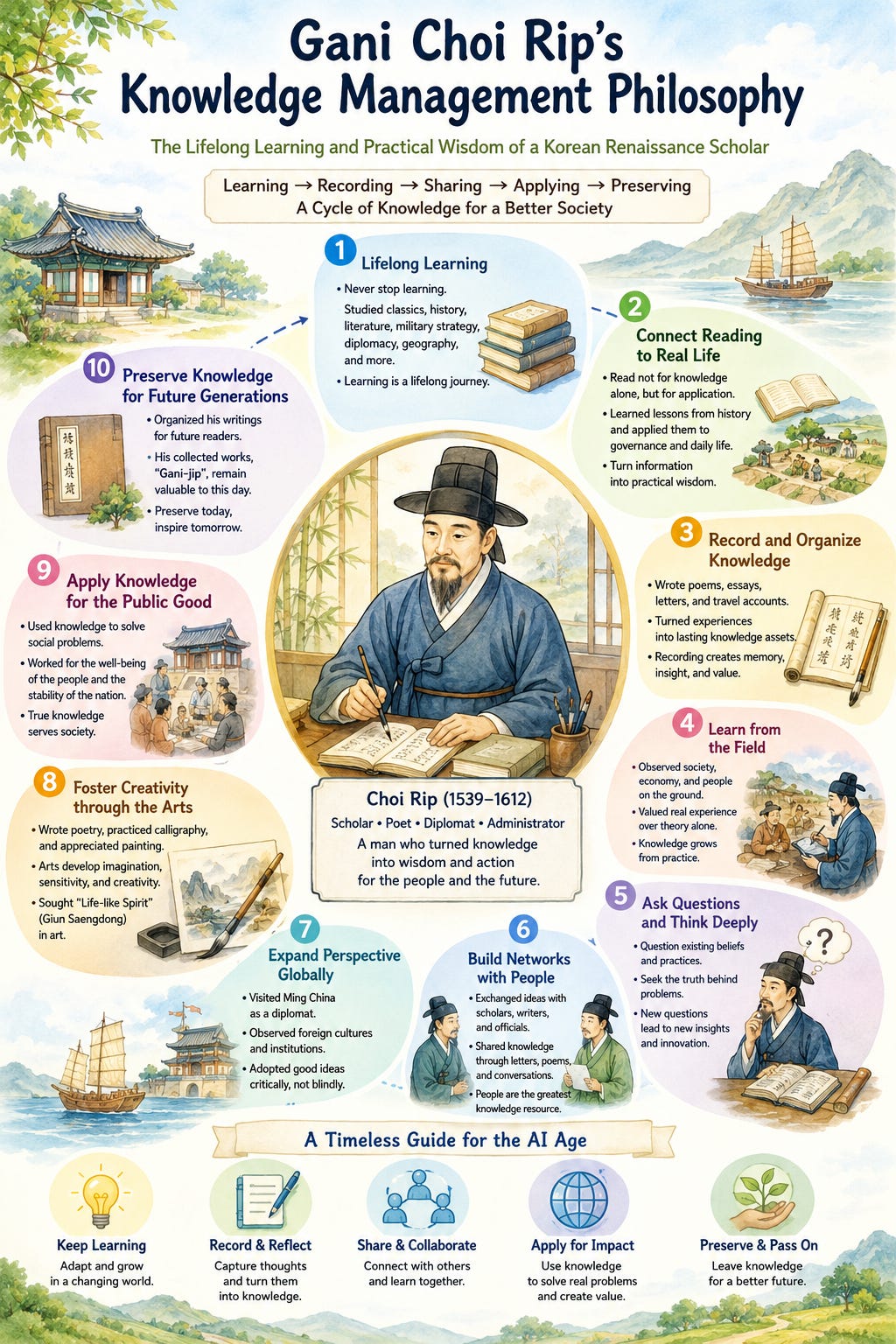
Choi Rip’s philosophy of knowledge management was far more than a method of studying or reading. It was a comprehensive cycle of learning, recording, sharing, applying, and preserving knowledge.
He pursued lifelong learning, connected reading to practical realities, transformed experiences into documented knowledge, and learned directly from the world around him. He questioned assumptions, built intellectual networks, embraced international perspectives, nurtured creativity through the arts, and dedicated his knowledge to public service. Finally, he preserved his insights so that future generations could continue to learn from them.
Remarkably, these principles closely resemble the practices of many of history’s greatest innovators. Leonardo da Vinci filled notebooks with observations and sketches that fueled his creativity. Benjamin Franklin combined reading, experimentation, and civic engagement to improve society. Peter Drucker emphasized the central role of knowledge workers in modern organizations. Choi Rip belongs in this distinguished tradition of Renaissance-style thinkers who integrated learning with action.
In the age of artificial intelligence, machines can retrieve information, analyze data, and generate content with unprecedented speed. Yet humans remain responsible for determining what is worth learning, connecting knowledge across disciplines, applying wisdom ethically, and creating lasting value for society. In this sense, Choi Rip’s knowledge management philosophy is not merely a historical legacy; it is a timeless framework for intellectual leadership in the twenty-first century. His life demonstrates that true knowledge is not measured by what we know, but by how we use, share, and preserve it for the benefit of others and the generations that follow. +++
{Solti}
May 27, 2026

Young Choi, PhD is a Professor at Regent University bringing a rare combination of technical expertise and creative spirit to everything he does. A scholar in AI, cybersecurity, and network & telecommunications service management, he has published 38 books including AI and cybersecurity area books, over 200 refereed articles, and over 20 book chapters. Beyond the academy, Dr. Choi is a passionate poet, essayist, and wooden block laser engraving artist whose reflective writing invites readers to rediscover life’s beauty in quiet contemplation(靜觀). He lives under the motto: “Study hard and give generously without holding back! (열심히 공부해서 아낌없이 남주자 !: 열공아남!)”
Published books: https://www.amazon.com/stores/Young-Choi/author/B0DMZ5S6R7?ref=ap_rdr&shoppingPortalEnabled=true