

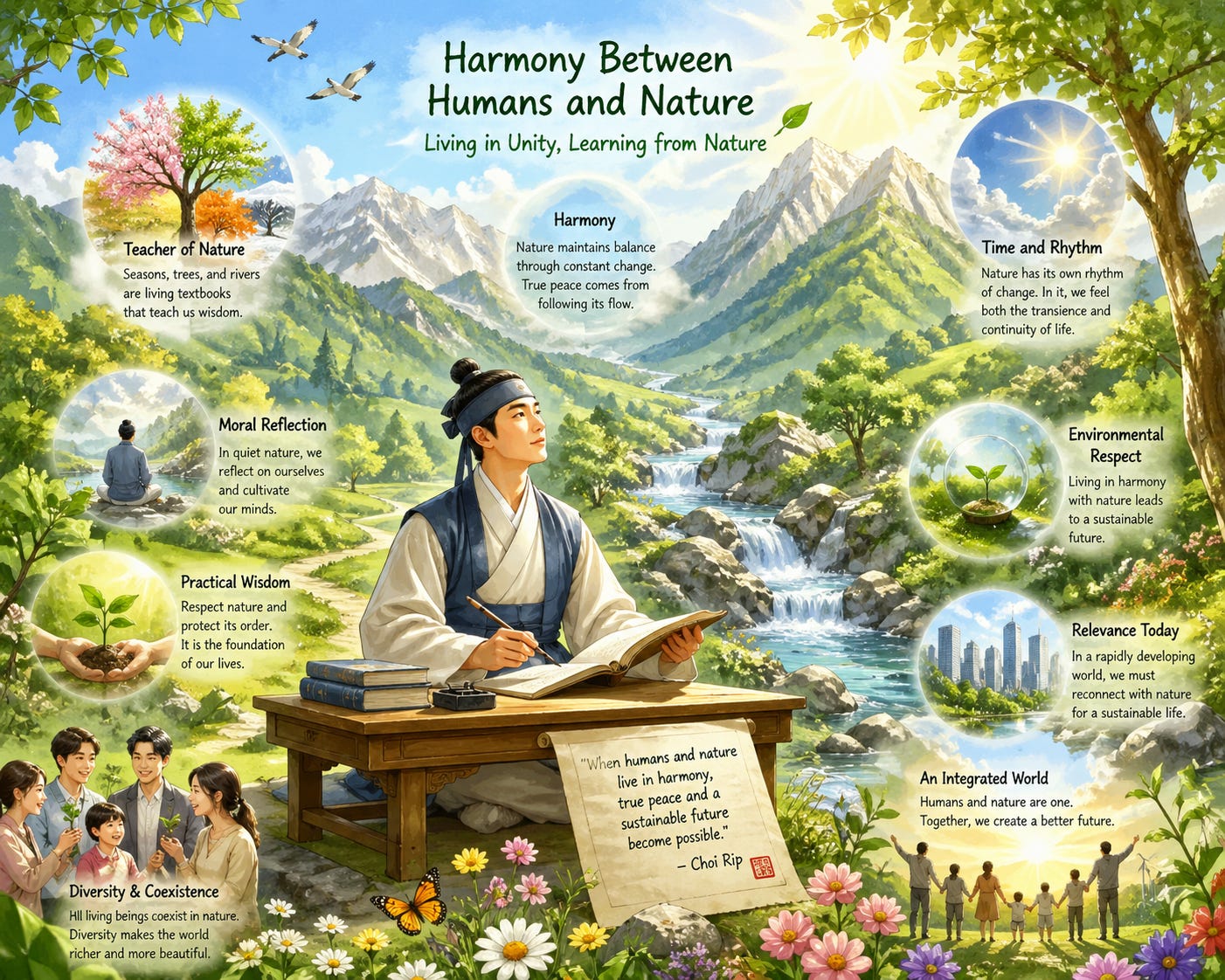
Choi Rip’s view of nature does not begin with mere appreciation of scenery, but with a profound insight that humans and the universe breathe within a single, unified order. He did not regard nature as something external, but as a mirror of the inner self. Mountains and rivers, wind and clouds are independent beings, yet intimately connected to the human mind. This perspective forms a central axis that runs through his entire philosophy.
One of the most striking features of his view of nature is harmony. Nature is in constant change, yet it maintains its own balance. Choi Rip sought to apply this principle of harmony to human society and individual life. He believed that when people let go of excessive desire and attachment and follow the natural flow, they can attain true peace and freedom.
He also regarded nature as a teacher. Rather than relying on artificial knowledge or authority, he sought wisdom within the principles of nature. The cycle of seasons, the growth of trees, and the flow of water were all living textbooks to him. This attitude offers meaningful implications even for modern education.
For Choi Rip, nature was also a space for moral reflection. In nature, he examined human nature and reflected upon his own life. Especially in the quiet of the mountains or beside flowing water, he emptied his mind and turned inward. This is deeply connected to the Confucian practice of self-cultivation.
His view of nature also contains practical wisdom. Nature is not merely an object of contemplation but the very foundation that sustains human life. He emphasized respecting nature and not disrupting its order. This idea resonates strongly with contemporary environmental ethics.
Choi Rip also valued the diversity and inclusiveness of nature. Nature is a space where various forms of life coexist, and none is unnecessary. This understanding contributes to emphasizing diversity and coexistence within human society.
His philosophy of nature is vividly reflected in his poetry and prose. He did not simply describe nature, but delicately expressed the meanings and emotions embedded within it. His literary works became a medium through which the relationship between nature and humanity was deeply explored.
His view of nature is also closely related to his perception of time. Nature is constantly changing, yet within that change there exists a certain rhythm. Within this rhythm, he sensed both the transience and continuity of life. This invites reflection on how humans should live within time.
In modern society, Choi Rip’s view of nature holds even greater significance. As technology and industry advance, humans are becoming increasingly distant from nature. Yet his thought calls us to reexamine our relationship with it. Without harmony with nature, sustainable life is impossible.
Ultimately, Choi Rip’s view of nature dissolves the boundary between humans and nature, aiming toward an integrated world. He sought the essence of humanity within nature and explored the direction of life through it. His philosophy remains relevant today, offering deep resonance and an opportunity for reflection. +++
{Solti}
April 29, 2026
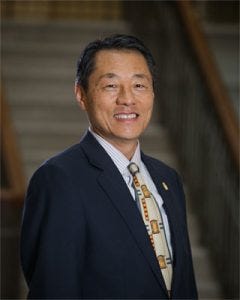
Young Choi, PhD is a Professor at Regent University bringing a rare combination of technical expertise and creative spirit to everything he does. A scholar in AI, cybersecurity, and network & telecommunications service management, he has published 38 books including AI and cybersecurity area books, over 200 refereed articles, and over 20 book chapters. Beyond the academy, Dr. Choi is a passionate poet, essayist, and wooden block engraving artist whose reflective writing invites readers to rediscover life’s beauty in quiet contemplation. He lives under the motto: “Study hard and give generously without holding back! (열심히 공부해서 아낌없이 남주자 !)”
Published books: https://www.amazon.com/stores/Young-Choi/author/B0DMZ5S6R7?ref=ap_rdr&shoppingPortalEnabled=true