

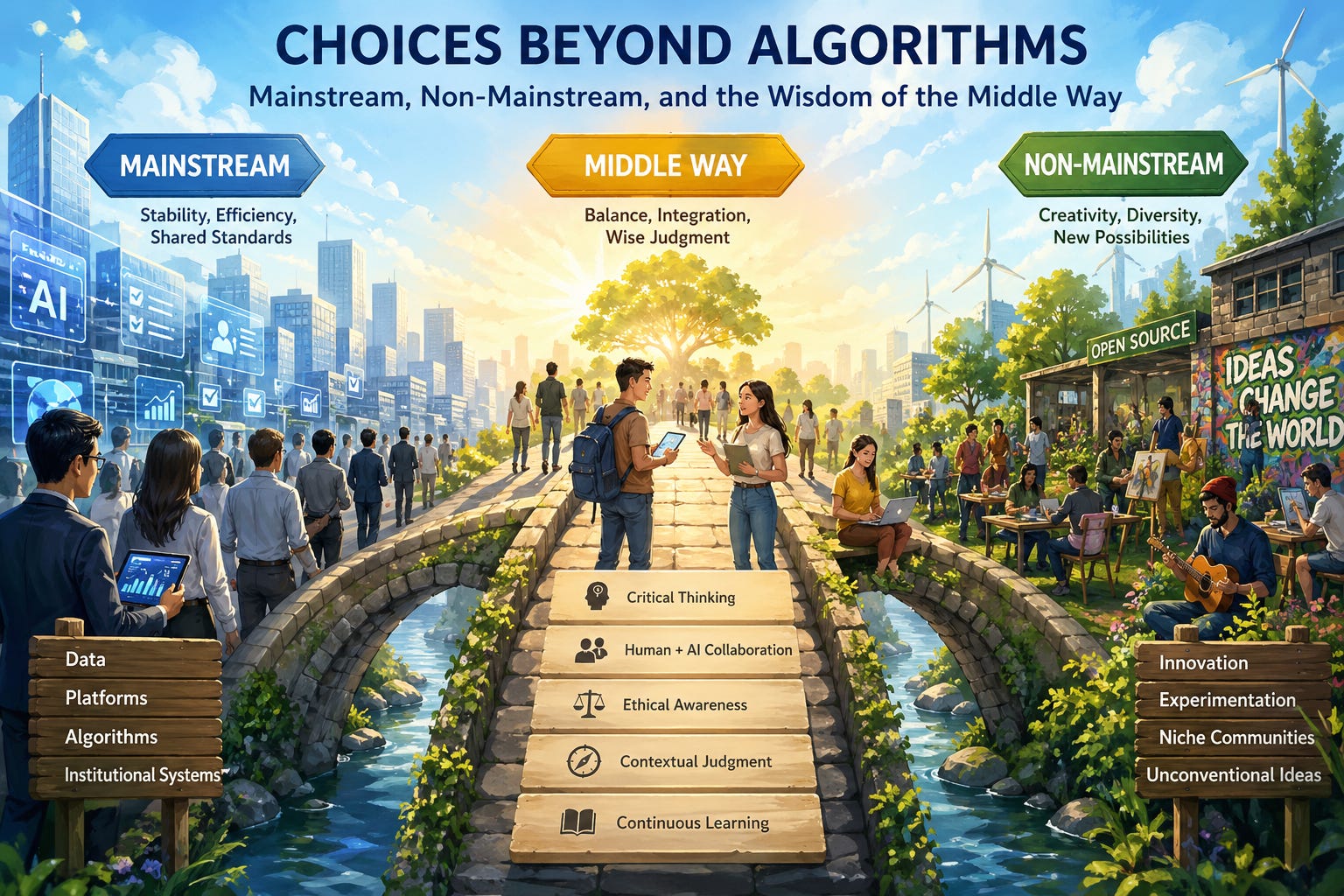
What is the mainstream? It is not merely the path followed by the majority, but the invisible standard shaped by the convergence of technology, capital, and institutions in a given era. In today’s AI-driven world, the mainstream is embodied in large platform companies, massive datasets, and automated decision-making systems. Consider the hiring process: many organizations now rely on AI-based resume screening tools to enhance efficiency. In doing so, they privilege certain patterns—specific universities, career trajectories, or keywords. What appears to be objectivity often becomes a reinforcement of selectively defined criteria.
The non-mainstream exists outside these established standards. Yet it is not simply a realm of exclusion; it is also a space of experimentation and untapped potential. For example, developers without traditional degrees but with proven skills in open-source communities were once easily overlooked. Today, their contributions—documented on platforms like GitHub—serve as alternative credentials, allowing them to emerge as highly valued talent. This illustrates that the non-mainstream is not “less important,” but rather “not yet mainstreamed.”
Another vivid example appears in the way we consume content. In the past, broadcasters and publishers largely determined what counted as mainstream. Today, AI-driven recommendation systems personalize that notion. On platforms like YouTube, widely popular content is amplified, but niche interests are also continuously surfaced. For one individual, meditation videos become the mainstream; for another, gaming streams dominate. In this sense, the boundary between mainstream and non-mainstream is no longer fixed—it is reconstructed at the level of the individual.
However, this transformation carries risks. Algorithms tend to reinforce existing preferences, which can accelerate the spread of misinformation or extreme viewpoints. Health-related falsehoods or conspiracy-driven content, once confined to the margins, can gain traction through repeated exposure and eventually function as “de facto mainstream” within certain communities. This reminds us that the non-mainstream does not always lead to innovation; it can also deepen social fragmentation.
At this point, the importance of the Middle Way emerges. The Middle Way is not a passive compromise or a simple midpoint. It is an active form of wisdom—one that understands divergent perspectives and reconfigures them in context. In the adoption of AI, for instance, fully automated decision-making may represent a mainstream approach, while rejecting AI altogether reflects a non-mainstream stance. A Middle Way approach would integrate both: maintaining human oversight in AI systems. In healthcare, AI-assisted diagnosis combined with final judgment by physicians exemplifies this balanced model, achieving both accuracy and accountability.
Education offers a similar landscape. Many institutions are rapidly adopting AI-powered grading systems and personalized learning tools—hallmarks of the mainstream. Meanwhile, traditional discussion-based or writing-intensive methods are increasingly marginalized. A Middle Way approach would not discard either. Instead, it would encourage students to use AI to generate initial drafts, while requiring them to critically evaluate and refine those outputs. In doing so, technology and human reasoning are not opposed, but integrated.
In organizational strategy, the tension among mainstream, non-mainstream, and the Middle Way is equally pronounced. The widespread adoption of AI reflects a mainstream impulse. Yet attempts to replace all human roles with AI often fail. Conversely, resisting AI adoption entirely can erode competitiveness. A practical Middle Way is evident in customer service models that deploy AI chatbots for initial interactions, while routing complex issues to human agents—balancing efficiency with empathy.
At the individual level, these dynamics are no less significant. A researcher who blindly follows the latest AI trends embodies a mainstream orientation, while one who clings exclusively to traditional methodologies risks becoming isolated. The Middle Way, by contrast, involves understanding emerging technologies, critically assessing them, and applying them judiciously within one’s field. This is not a static choice, but an ongoing process of learning and discernment.
Ultimately, the central question of the AI era is not “Which side should we take?” but “How do we maintain balance?” The mainstream offers direction but risks uniformity; the non-mainstream fosters creativity but carries uncertainty. The Middle Way seeks an optimal synthesis. It is not a fixed state, but a dynamic process of continuous adjustment in response to a changing environment.
Looking ahead, neither the mainstream nor the non-mainstream alone can shape a sustainable future. It is through the interplay of the mainstream’s stability, the non-mainstream’s creativity, and the integrative power of the Middle Way that a healthy AI ecosystem can emerge. AI itself does not provide answers; rather, it complicates the questions. And the answers ultimately depend on how deeply and wisely we, as humans, are willing to think. +++
{Solti}
April 29, 2026

Young Choi, PhD is a Professor at Regent University bringing a rare combination of technical expertise and creative spirit to everything he does. A scholar in AI, cybersecurity, and network & telecommunications service management, he has published 38 books including AI and cybersecurity area books, over 200 refereed articles, and over 20 book chapters. Beyond the academy, Dr. Choi is a passionate poet, essayist, and wooden block engraving artist whose reflective writing invites readers to rediscover life’s beauty in quiet contemplation. He lives under the motto: “Study hard and give generously without holding back! (열심히 공부해서 아낌없이 남주자 !)”
Published books: https://www.amazon.com/stores/Young-Choi/author/B0DMZ5S6R7?ref=ap_rdr&shoppingPortalEnabled=true