

Executive Summary
Compared with many Asian countries whose principal rivers originate in distant upstream states, South Korea enjoys a relatively high degree of hydrological autonomy because most of its major water systems are located within the Korean Peninsula. Most major rivers serving South Korea, including the Nakdong, Geum, and Yeongsan, are managed primarily within South Korean territory, while the Han and Imjin systems involve important inter-Korean watershed considerations. This article argues that these natural conditions have shaped resilient water-resource management, climate adaptation, and infrastructure development, strengthening national resilience, food and water security, and the stability of global supply chains while minimizing many of the transboundary water challenges faced by neighboring countries. By examining the Korean Peninsula from a geo-economic and global supply chains perspective, the article demonstrates how favorable environmental endowments, combined with long-term adaptation, can become enduring national capabilities and offers broader insights for building climate-resilient societies in an era of increasing environmental uncertainty.
Keywords: Korean Peninsula; Strategic Environmental Advantage; Hydrological Autonomy; Climate Resilience; Global Supply Chains
1. Introduction
“동해물과 백두산이 마르고 닳도록 하느님이 보우하사 우리나라 만세.”
“Until the East Sea’s waters and Mount Baekdu wear away, God protect our nation forever.”
The opening line of the Korean national anthem (애국가) captures more than patriotic sentiment. It reflects Korea’s enduring relationship with its geography—its seas, mountains, climate, and natural environment—which have shaped the nation’s identity, resilience, and survival across centuries. Long before modern discussions of sustainability, climate resilience, and national security emerged, the anthem symbolically recognized that the Korean Peninsula’s natural landscape forms the enduring foundation upon which the nation stands.
Today, this enduring relationship between geography and national survival has become more relevant than ever. Record-breaking heat waves across Europe and Asia, increasingly frequent floods and prolonged droughts, and destructive earthquakes highlight the growing vulnerability of nations to natural hazards and the urgent need for greater resilience (IPCC, 2023). As climate change intensifies the frequency and severity of extreme weather events, governments face mounting challenges in protecting lives, securing water and food resources, maintaining critical infrastructure, and sustaining global supply chains (Field et al., 2014). These developments underscore that geography and climate are not merely environmental conditions but fundamental determinants of national resilience, economic competitiveness, and long-term sustainable development.
Among the world’s nations, the Korean Peninsula presents a distinctive geographical case. Situated between the Eurasian continent and the Pacific Ocean, the peninsula experiences the combined influence of continental and maritime climate systems, producing four distinct seasons characterized by severe winter cold, summer heat waves, seasonal monsoon rains (장마), typhoons, and periodic droughts. Its mountainous terrain, extensive coastline, and self-contained river systems have historically required continuous adaptation while simultaneously providing important strategic advantages. One of Korea’s most remarkable geographical characteristics is its hydrological autonomy: the country’s major rivers originate and terminate within the peninsula, allowing nationally coordinated management of water resources without the transboundary water disputes that affect many neighboring Asian countries whose rivers cross multiple national borders.
This article argues that the Korean Peninsula’s unique combination of geography, climate, and hydrology constitutes a Strategic Environmental Advantage that has contributed significantly to South Korea’s national resilience. The article examines how Korea has transformed environmental conditions from natural constraints into enduring national capabilities that strengthen water security, agricultural productivity, infrastructure development, disaster preparedness, and global supply-chain reliability. From a geo-economic perspective, the peninsula’s environmental endowments function not merely as natural assets but as strategic capital supporting long-term national competitiveness.
By integrating insights from geography, climate science, geo-economics, and global supply chains management, this study demonstrates that enduring national competitiveness emerges from the interaction between favorable environmental endowments and a nation’s long-term capacity to adapt, innovate, and build resilient institutions (Folke, 2006). In an era of accelerating climate uncertainty and geopolitical disruption, the Korean experience illustrates that sustainable national strength is achieved not by overcoming geography, but by understanding, protecting, and strategically leveraging its enduring advantages.
Scope and Terminology. In this article, the term Korean Peninsula refers to the broader geographical and environmental space encompassing both North Korea and South Korea, including its climate systems, mountains, coastlines, watersheds, and river basins. When the discussion concerns reforestation, environmental governance, water-resource management, infrastructure development, industrialization, economic growth, and global supply-chain participation, however, the analysis refers primarily to South Korea, officially the Republic of Korea, unless otherwise stated. The article therefore does not assume that the entire peninsula operates under a unified political, institutional, or water-governance framework.
2. Unique Geographical Advantages of the Korean Peninsula
The Korean Peninsula’s strategic environmental advantage arises from the interaction of its geographical location, climatic diversity, hydrological characteristics, and natural resource endowments. Together, these interrelated features have shaped the environmental foundation for South Korea’s long-term resilience and sustainable development.
2.1 A Peninsula at the Crossroads of Continental and Maritime Systems
The Korean Peninsula occupies a strategically significant position between the Eurasian continent and the Pacific Ocean, exposing it to both continental and maritime climatic influences. Cold, dry air masses from Siberia produce harsh winters, while warm, humid air from surrounding seas contributes to hot summers and seasonal monsoon rains (장마). This interaction creates four distinct seasons and a wide range of environmental conditions that require continuous adaptation. At the same time, Korea’s extensive coastline provides access to abundant marine resources and maritime trade routes, allowing the nation to integrate continental resilience with ocean-based economic opportunities.
South Korea has developed national adaptation policies, climate-risk assessment processes, sectoral planning mechanisms, and institutional coordination to address heat waves, flooding, drought, coastal risks, ecosystem pressures, and other climate vulnerabilities. These measures demonstrate how environmental exposure has been accompanied by deliberate governmental investment in adaptation capacity, although significant vulnerabilities remain (Republic of Korea, 2023). This dynamic environment has also encouraged long-term investments in forecasting systems, resilient infrastructure, transportation networks, and adaptive planning. Over time, repeated exposure to diverse climatic conditions has strengthened South Korea’s institutional capacity to anticipate environmental change, coordinate responses, and reduce disruptions to economic and social activities (Republic of Korea, 2023).
2.2 Hydrological Autonomy and Integrated Water Governance
One of the Korean Peninsula’s most distinctive geographical characteristics is that its major river systems originate and terminate within the peninsula. Most major rivers serving South Korea, including the Nakdong, Geum, and Yeongsan, are managed primarily within South Korean territory, while the Han and Imjin systems include important inter-Korean watershed connections. Unlike many Asian countries that depend heavily on rivers originating in distant upstream states, South Korea has experienced relatively limited transboundary water conflict. Although several river systems cross or connect North and South Korea and have occasionally raised concerns over dam operations, flooding, water releases, and information sharing, they have not produced sustained or large-scale interstate water disputes despite decades of political and military tension. This relative hydrological autonomy allows South Korea to coordinate most reservoirs, irrigation, flood control, drinking-water provision, and ecosystem management through its national governance system, while recognizing that inter-Korean watersheds still require communication, monitoring, and potential cooperation.
This hydrological autonomy stands in marked contrast to countries dependent on international river systems such as the Mekong, Brahmaputra, Indus, and Salween, where upstream developments frequently create geopolitical tensions over water allocation and river management. Korea’s self-contained watershed has therefore become an important strategic asset, supporting climate resilience, agricultural productivity, urban development, energy security, and reliable industrial water supplies essential for advanced manufacturing and global supply chains (Christopher & Peck, 2004).
Figure 1
Environmental Foundations of the Korean Peninsula
Note. Source: Developed by the authors. AI tools assisted in refining the conceptual visual; all content, interpretation, and final presentation were reviewed and approved by the authors.
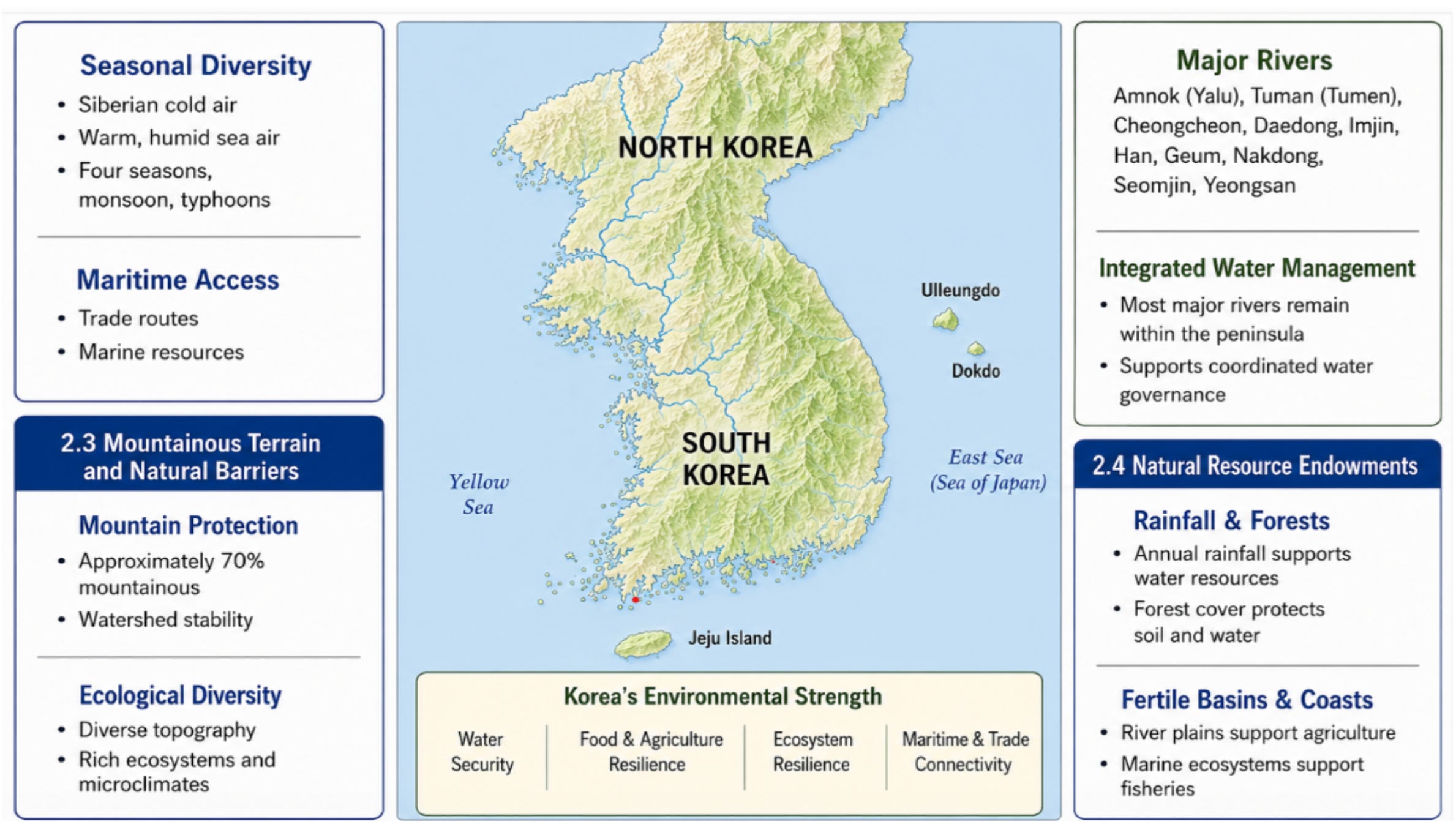
Figure 1 illustrates the Korean Peninsula’s environmental foundations through four interrelated geographical characteristics: its position at the crossroads of continental and maritime systems, hydrological autonomy supported by major river networks, mountainous terrain and natural barriers, and natural resource endowments associated with rainfall, forests, fertile basins, and extensive coastlines. Their interaction strengthens water security, agricultural resilience, ecosystem stability, maritime connectivity, and adaptive capacity under climatic and environmental uncertainty. These geographical advantages belong to the peninsula as a whole, although South Korea has developed its own institutions, infrastructure, technologies, and governance systems to convert them into economic performance and national competitiveness. The figure therefore emphasizes that enduring resilience emerges from the combination of natural foundations and sustained human stewardship.
2.3 Climate Variability as a Catalyst for Systemic Capability Development
The Korean Peninsula experiences recurring environmental stresses, including severe winter cold, summer heat waves, monsoon flooding, typhoons, and periodic droughts. These conditions have required governments, industries, and communities to develop integrated approaches to disaster preparedness, infrastructure design, agricultural planning, water management, and public health. Korea has consequently built increasingly interconnected systems that strengthen forecasting, emergency response, resource allocation, institutional coordination, and long-term adaptation (Ministry of Government Legislation, 2023; Republic of Korea, 2023; Yoon, 2014).
Over time, these accumulated responses have contributed to a broader Systemic Climate Adaptation Ecosystem that combines scientific knowledge, engineering capabilities, digital technologies, institutional coordination, and citizen participation. This ecosystem extends beyond immediate disaster management by developing enduring national capabilities that strengthen resilience, support economic competitiveness, and provide a foundation for sustainable development in an increasingly uncertain global climate (UNDRR, 2023). At the same time, South Korea’s formal adaptation framework recognizes that exposure to heat, intense rainfall, drought, coastal change, and ecosystem disruption remains substantial; institutional capacity can reduce vulnerability, but it cannot eliminate environmental risk (Republic of Korea, 2023).
Geography is not destiny alone—it is strategic capital
when nature’s advantages are recognized and sustained.
3. Geo-Economic and Global Supply-Chain Implications
The Korean Peninsula’s environmental characteristics extend beyond the natural setting to influence water security, agricultural productivity, industrial continuity, maritime trade, and national competitiveness. Hydrological autonomy, climate diversity, mountainous terrain, forest systems, extensive coastlines, and strategic location interact to create geo-economic advantages that support both domestic resilience and global supply-chain participation.
These advantages do not operate automatically. Their strategic value depends on infrastructure, technology, governance, institutional coordination, and sustained adaptation. The following four subsections explain how Korea’s environmental foundations contribute to resource security, economic adaptability, ecological resilience, and global connectivity.
Figure 2
From Environmental Foundations to Geo-Economic and Global Supply Chain Outcomes
Note. Source: Developed by the authors with AI-assisted visual refinement.
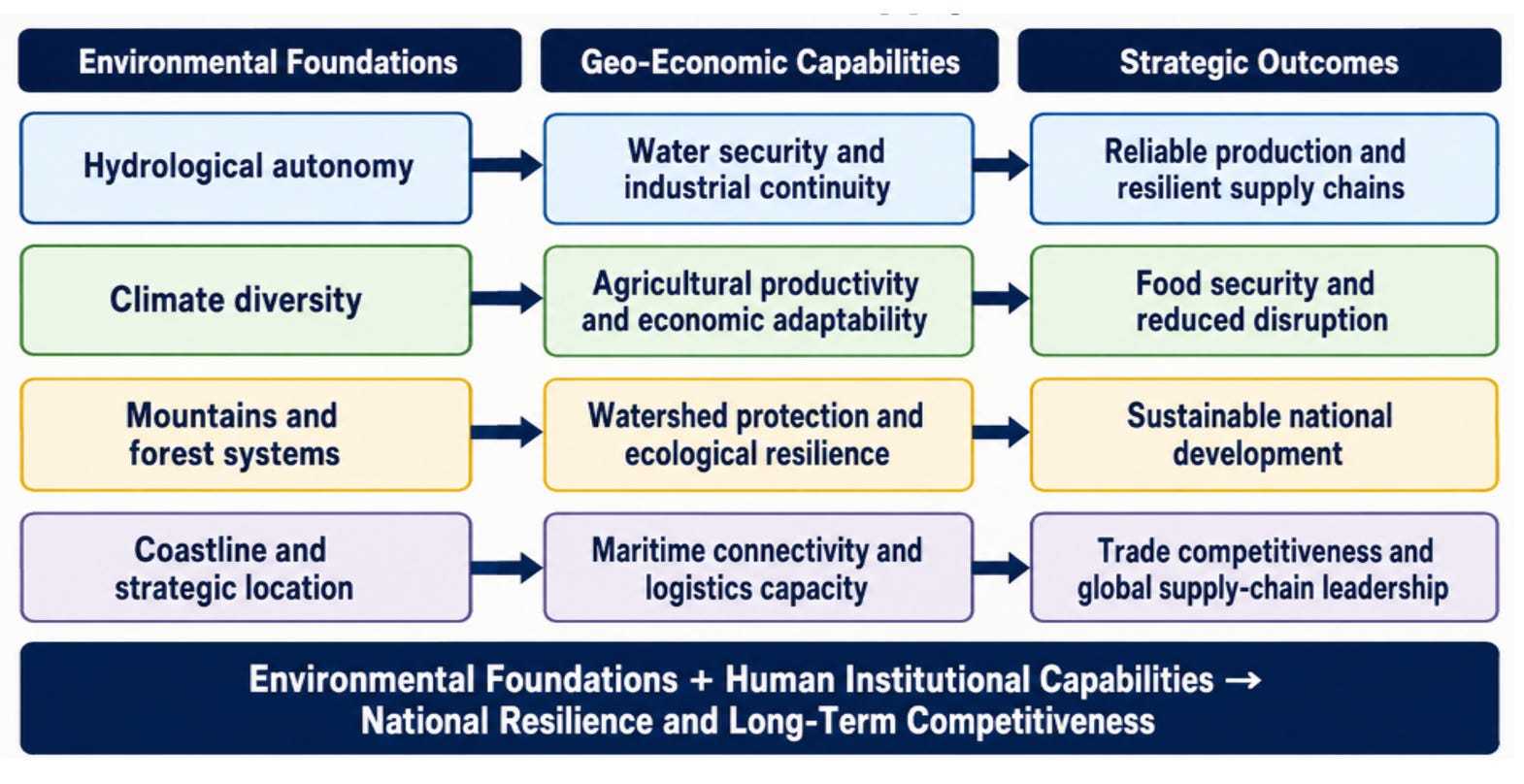
Figure 2 presents an integrated framework showing how the Korean Peninsula’s key environmental foundations are translated into geo-economic capabilities and then into broader strategic outcomes. Specifically, the figure links hydrological autonomy to water security and industrial continuity, climate diversity to agricultural productivity and economic adaptability, mountains and forest systems to watershed protection and ecological resilience, and coastline and strategic location to maritime connectivity and logistics capacity. These pathways collectively lead to strategic outcomes such as reliable production, resilient supply chains, food security, sustainable national development, and trade competitiveness. The figure’s central message is that environmental foundations, when combined with human institutional capabilities, contribute directly to national resilience and long-term competitiveness.
3.1 Hydrological Autonomy, Water Security, and Industrial Continuity
Water is an essential resource for households, agriculture, energy generation, urban development, and industrial production. Most major rivers serving South Korea—including the Nakdong, Geum, and Yeongsan—are located primarily within South Korean territory, while the Han and Imjin basins involve inter-Korean watershed considerations. This autonomy is not complete because inter-Korean watersheds still require monitoring, communication, and potential cooperation. Even so, it reduces some uncertainties associated with upstream diversion, dam operations, competing water demands, and limited transboundary coordination (AghaKouchak et al., 2026).
Reliable water infrastructure supports agricultural productivity, urban growth, and industrial continuity. It is especially important for water-dependent activities such as semiconductor and advanced manufacturing, although production security also depends on reservoirs, treatment facilities, recycling systems, distribution networks, energy availability, and effective governance. South Korea’s largely domestically managed water system therefore represents a strategic resource that strengthens national resilience, production stability, and supply-chain reliability (Christopher & Peck, 2004).
3.2 Climate Diversity, Agriculture, and Economic Adaptability
The Korean Peninsula’s four distinct seasons create environmental diversity that supports agriculture, forestry, fisheries, tourism, and other seasonal economic activities. Winter conditions may suppress certain pests and interrupt some disease cycles, while summer warmth and seasonal rainfall support major growing periods. Spring and autumn provide important transitional periods for planting, harvesting, and crop adjustment. These conditions support differentiated agricultural production, although heat waves, frost, concentrated rainfall, typhoons, and droughts continue to create substantial risks (OECD, 2018).
Korea’s climatic variability has also encouraged innovation in forecasting, irrigation, agricultural technology, construction, transportation, and infrastructure management. Repeated adaptation to seasonal and extreme-weather conditions has strengthened the ability of firms, communities, and public institutions to maintain production and recover from disruption. Climate diversity therefore contributes to economic flexibility and agricultural resilience, but its benefits depend on continuing technological, institutional, and farm-level adaptation (OECD, 2021; Republic of Korea, 2023).
3.3 Mountainous Terrain, Forest Systems, and Ecological Resilience
Korea’s mountainous terrain and restored forest systems contribute to watershed protection, erosion control, biodiversity, carbon storage, and the moderation of environmental risks. South Korea’s national-scale forestation program demonstrates how long-term public policy, scientific management, and community participation can strengthen the ecological value of natural terrain and support sustainable development (Lee et al., 2018).
Mountains and forests also shape settlement, transportation, infrastructure, and land use. They provide important ecological protection but can constrain construction, reduce usable land, and increase vulnerability to landslides and localized flooding. Their strategic value therefore depends on careful infrastructure planning, forest management, watershed protection, and continued investment in disaster preparedness.
3.4 Maritime Connectivity, Strategic Location, and National Competitiveness
The Korean Peninsula’s extensive coastline and position between the Eurasian continent and the Pacific Ocean provide direct access to major Northeast Asian and global shipping networks. Numerous ports, proximity to China and Japan, and connections with Southeast Asian maritime routes have supported fisheries, shipbuilding, logistics services, export-oriented industrialization, and international trade. These geographical conditions strengthen Korea’s role as a regional production, transportation, and supply-chain hub (Ducruet et al., 2009).
Geography alone does not guarantee competitiveness, but it provides a durable foundation for port development, logistics infrastructure, manufacturing concentration, trade connectivity, and regional integration. When combined with effective institutions, advanced technology, industrial capabilities, and adaptive governance, Korea’s environmental endowments function as strategic capital that supports national resilience, export continuity, and global supply-chain competitiveness. This interaction between natural foundations and human capabilities provides the central explanation for Korea’s enduring strategic environmental advantage.
Environmental advantage strengthens resilience,
and resilience sustains national competitiveness.
4. Conclusion
The Korean Peninsula demonstrates that geography remains a fundamental determinant of national resilience and long-term competitiveness, as its strategic location between continental and maritime climate systems, four distinct seasons, relative hydrological autonomy, mountainous terrain, and extensive coastlines collectively support water security, agricultural productivity, maritime commerce, and resilient global supply chains. The Korean experience shows that climate variability can function not only as a source of vulnerability but also as a stimulus for institutional learning, infrastructure development, and adaptive capability. While the peninsula-wide environment provides the natural setting examined in this article, most examples of institutional adaptation, reforestation, industrial development, and economic resilience refer specifically to South Korea, whose achievements cannot be explained by geography alone. A subsequent article will therefore develop a Human Control Ecosystem Architecture from a geo-economic perspective, explaining how leadership, governance, technological innovation, institutional coordination, industries, and citizens transform natural advantages into sustained national capability, economic prosperity, and global leadership.
References
AghaKouchak, A., Hjelmstad, A., Khodkar, K., de Oliveira, D., Aleisa, E., Alexander, A. C., Feldman, D. L., Khujanazarov, T., Madani, K., Mirchi, A., Placht, D., & Najib, D. (2026). Transboundary water conflicts, cooperation, and pathways forward. Proceedings of the National Academy of Sciences, 123(6), e2537439123. https://doi.org/10.1073/pnas.2537439123
Christopher, M., & Peck, H. (2004). Building the resilient supply chain. The International Journal of Logistics Management, 15(2), 1–14. https://doi.org/10.1108/09574090410700275
Ducruet, C., Lee, S. W., & Roussin, S. (2009). Local strength and global weakness: A maritime network perspective on South Korea as Northeast Asia’s logistics hub. KMI International Journal of Maritime Affairs and Fisheries, 1(1), 32–50.
Field, C. B., Barros, V. R., Dokken, D. J., Mach, K. J., Mastrandrea, M. D., Bilir, T. E., Chatterjee, M., Ebi, K. L., Estrada, Y. O., Genova, R. C., Girma, B., Kissel, E. S., Levy, A. N., MacCracken, S., Mastrandrea, P. R., & White, L. L. (Eds.). (2014). Climate change 2014: Impacts, adaptation, and vulnerability. Part A: Global and sectoral aspects. Contribution of Working Group II to the Fifth Assessment Report of the Intergovernmental Panel on Climate Change. Cambridge University Press.
Folke, C. (2006). Resilience: The emergence of a perspective for social–ecological systems analyses. Global Environmental Change, 16(3), 253–267. https://doi.org/10.1016/j.gloenvcha.2006.04.002
Intergovernmental Panel on Climate Change (IPCC). (2023). Climate change 2023: Synthesis report. Contribution of Working Groups I, II and III to the Sixth Assessment Report of the Intergovernmental Panel on Climate Change (Core Writing Team, H. Lee, & J. Romero, Eds.). IPCC.
Lee, J., Lim, C. H., Kim, G. S., Markandya, A., Chowdhury, S., Kim, S. J., Lee, W. K., & Son, Y. (2018). Economic viability of the national-scale forestation program: The case of success in the Republic of Korea. Ecosystem Services, 29,40–46.
Ministry of Government Legislation. (2023). Framework Act on the Management of Disasters and Safety (Act No. 19432). Republic of Korea.
OECD. (2018). Innovation, agricultural productivity and sustainability in Korea. OECD Food and Agricultural Reviews. OECD Publishing.
OECD. (2021). Strengthening climate resilience: Guidance for governments and development co-operation. OECD Publishing. https://doi.org/10.1787/4b08b7be-en
Republic of Korea. (2023). The Republic of Korea’s adaptation communication. United Nations Framework Convention on Climate Change.
United Nations Office for Disaster Risk Reduction. (2023). Global assessment report on disaster risk reduction 2023.UNDRR.
Yoon, D. K. (2014). Disaster policies and emergency management in Korea. In N. Kapucu & K. T. Liou (Eds.), Disaster and development (pp. 149–164). Springer. https://doi.org/10.1007/978-3-319-04468-2_9
About the Authors

Distinguished Professor, Dr. Paul Hong (Editor in Chief) — University of Toledo
Paul C. Hong is a Distinguished University Professor of Information Systems and Supply Chain Management and an affiliated faculty member of the Asian Studies Program at the University of Toledo. His research focuses on global supply chains strategy, national competitiveness, geo-economics, resilience, and sustainable development, integrating geography, institutional capability, and technological innovation. He has published extensively in leading international journals on supply chain management, strategic leadership, and national capability development. His recent work examines how natural environmental advantages and human institutional systems interact to strengthen national resilience and long-term global competitiveness.

Mingu Kim
Principal Researcher, Centre for Advancement of Water and Wastewater Technologies, Fleming College, Lindsay, Canada
Mingu Kim is a Principal Researcher at the Centre for Advancement of Water and Wastewater Technologies, Fleming College. He earned his Ph.D. in Environmental Engineering from Western University, Canada. His research specializes in sustainable and energy-efficient wastewater and solid waste treatment, greenhouse gas emission reduction, sewer corrosion mitigation, water resource management, and microplastic pollution control. He has published extensively in engineering and environmental science journals, advancing innovative technologies for climate resilience and sustainable environmental management. His expertise contributes valuable scientific insights into the environmental systems and water-resource sustainability that underpin resilient national development.
© K-Global Scholars and Professionals Forum. All rights reserved. July 2026
Original Article :

Suggested Citation: Paul C. Hong and Mingu Kim (July 30, 2026). Climate, Geography, and National Resilience: The Korean Peninsula’s Strategic Environmental Advantage. K-GSP Forum. pp. 1–11.
논문 요약
「기후, 지리, 그리고 국가 회복력: 한반도의 전략적 환경 우위」
Paul C. Hong은 미국 University of Toledo의 Distinguished University Professor로서 공급망관리, 글로벌 경영, 국가경쟁력 분야를 연구해 온 학자이다. Mingu Kim은 캐나다 Fleming College의 Centre for Advancement of Water and Wastewater Technologies에서 Principal Researcher로 재직하며 수질, 환경시스템, 지속가능성과 관련된 주제를 연구하고 있다.
이 글은 한반도의 지리·기후·수문학적 조건이 단순한 자연환경을 넘어 한국의 국가 회복력과 장기 발전을 뒷받침하는 전략적 자산임을 설명한다. 저자들은 오늘날 기후변화, 폭염, 홍수, 가뭄, 태풍, 공급망 교란이 심화되는 시대에 국가의 지속가능한 경쟁력은 기술이나 제도만이 아니라 지리적 토대와 그것을 활용하는 능력에서 나온다고 본다. 특히 한반도는 대륙과 해양이 만나는 위치, 사계절이 뚜렷한 기후, 산지가 많은 지형, 긴 해안선, 그리고 반도 내부에서 발원하고 종결되는 하천체계라는 독특한 조건을 지니고 있으며, 이러한 요소들이 한국의 생존과 발전에 오랫동안 중요한 기반이 되어 왔다고 주장한다.
논문은 먼저 한반도의 고유한 지리적 장점을 네 가지 차원에서 설명한다. 첫째, 한반도는 유라시아 대륙과 태평양 사이에 놓여 있어 대륙성 기후와 해양성 기후가 교차하며, 이로 인해 사계절, 장마, 계절풍, 태풍 등 다양한 기후 경험이 축적되었다. 둘째, 낙동강·금강·영산강 등 남한의 주요 하천은 대부분 남한의 관리체계 안에 있으며, 한강과 임진강 수계에는 남북한 간 유역 관리 문제가 존재한다. 그럼에도 한국은 먼 상류 국가에 의존하는 여러 아시아 국가에 비해 비교적 높은 수준의 수자원 관리 자율성을 지니고 있다. 셋째, 산지가 많은 지형은 외부 충격을 완화하고 유역을 보호하며 생태적 다양성을 유지하는 데 기여한다. 넷째, 해안선과 해양 접근성은 수산자원과 해상 교통, 대외무역의 기반이 되며, 이는 한반도의 환경적 특성이 단순한 제약이 아니라 전략적 가능성임을 보여 준다.
이어 저자들은 이러한 자연적 특성이 경제와 공급망 차원에서 어떻게 “지경학적 우위(geo-economic advantage)”로 전환되는지를 분석한다. 수자원 관리 자율성은 안정적인 물 공급을 가능하게 하여 농업, 산업, 가정용 수요를 충족시키고 반도체, 배터리, 조선, 바이오 등 물 의존도가 높은 산업의 경쟁력을 뒷받침한다. 계절 변화와 기후 다양성은 다품종 농업, 수자원 재충전, 해충 억제, 관광과 계절 산업 발전에 기여하며, 기후 스트레스에 반복적으로 대응해 온 경험은 재난 대응, 예측 시스템, 인프라 설계, 공공 보건, 자원 배분 등에서 한국의 제도적 역량을 강화해 왔다. 또한 긴 해안선과 동북아 해상 교통로에 대한 접근성은 무역 연결성과 물류 효율성을 높여 한국이 글로벌 공급망의 핵심 거점으로 기능하도록 만든다.
결론적으로 이 논문은 지리를 단순한 배경이 아니라 장기적 번영을 낳는 “전략적 자본”으로 보아야 한다고 강조한다. 한국의 국가 회복력은 자연적 이점 그 자체만으로 설명되지 않지만, 분명한 것은 이러한 환경적 토대가 물 안보, 식량 생산성, 산업 안정성, 물류 연결성, 재난 대응력의 기반을 제공해 왔다는 점이다. 저자들은 앞으로의 과제는 이러한 자연적 우위를 정부, 제도, 기술, 산업, 시민사회가 어떻게 효과적으로 조직하고 조정하느냐에 달려 있다고 본다. 따라서 이 글은 한반도의 기후와 지리를 한국 발전의 배경으로만 보지 않고, 미래의 국가 경쟁력과 지속가능성을 설명하는 핵심 조건으로 재해석한 점에서 중요한 의미를 지닌다.
Reading this article was both enlightening and thought-provoking. It challenged me to look beyond the usual economic and political explanations for national success and consider how deeply climate and geography influence the course of history. I found myself reflecting on how factors we often take for granted can shape the destiny of entire nations.
What impressed me most was the author's ability to connect broad historical patterns with today's global challenges. The article not only explains why some nations have prospered while others have struggled, but also encourages readers to think about resilience, long-term vision, and the importance of adapting to a changing world.
Personally, this article broadened my perspective on national development and reminded me that lasting prosperity requires more than abundant resources or strong leadership. It requires wisdom, preparation, and the ability to respond to changing circumstances. I truly enjoyed reading this article and appreciate the author's insightful analysis. It has given me a great deal to reflect on.
I had the opportunity and good fortune to work as an expatriate in Europe and the United States for 12 years. This experience allowed me to naturally compare Korea with other countries.
When I was a student, I learned that approximately 70% of Korea’s land is mountainous. At the time, I thought this was a disadvantage for the country in terms of land utilization. However, after experiencing life abroad, I quickly realized that my perception was wrong.
As Korea’s industries developed, the country’s mountainous terrain actually provided many advantages. Because Korea has so many mountains, it has abundant water resources needed for both industry and daily life. Korean companies have also naturally developed advanced tunneling technologies, enabling them to achieve outstanding results in competition with construction companies from around the world. I understand that many of Korea’s tunnels are among the most beautiful in the world and that they are often completed in remarkably short periods of time.
With the development of transportation infrastructure, many of Korea’s mountains have become valuable natural attractions, drawing tourists from around the world. Korea’s mountainous landscape now provides vast areas of green space, among the most extensive in the world, offering places for people across the country to rest and enjoy nature.
I believe that the Korean people’s ability to turn challenges and crises into opportunities is one of the key forces that has made Korea what it is today.