

EXECUTIVE SUMMARY
In the AI era, where information is abundant and instantly accessible, the challenge of learning shifts from acquiring knowledge to developing deep understanding and judgment. Effective learning now depends on active engagement, critical reflection, and continuous practice, rather than passive consumption of AI-generated outputs. To remain adaptable and relevant, individuals must cultivate a constructive, lifelong learning mindset that emphasizes curiosity, synthesis, and intentional skill-building.
Keywords: Constructive Learning; Lifelong Learning; AI Literacy; Critical Thinking; Deliberate Practice
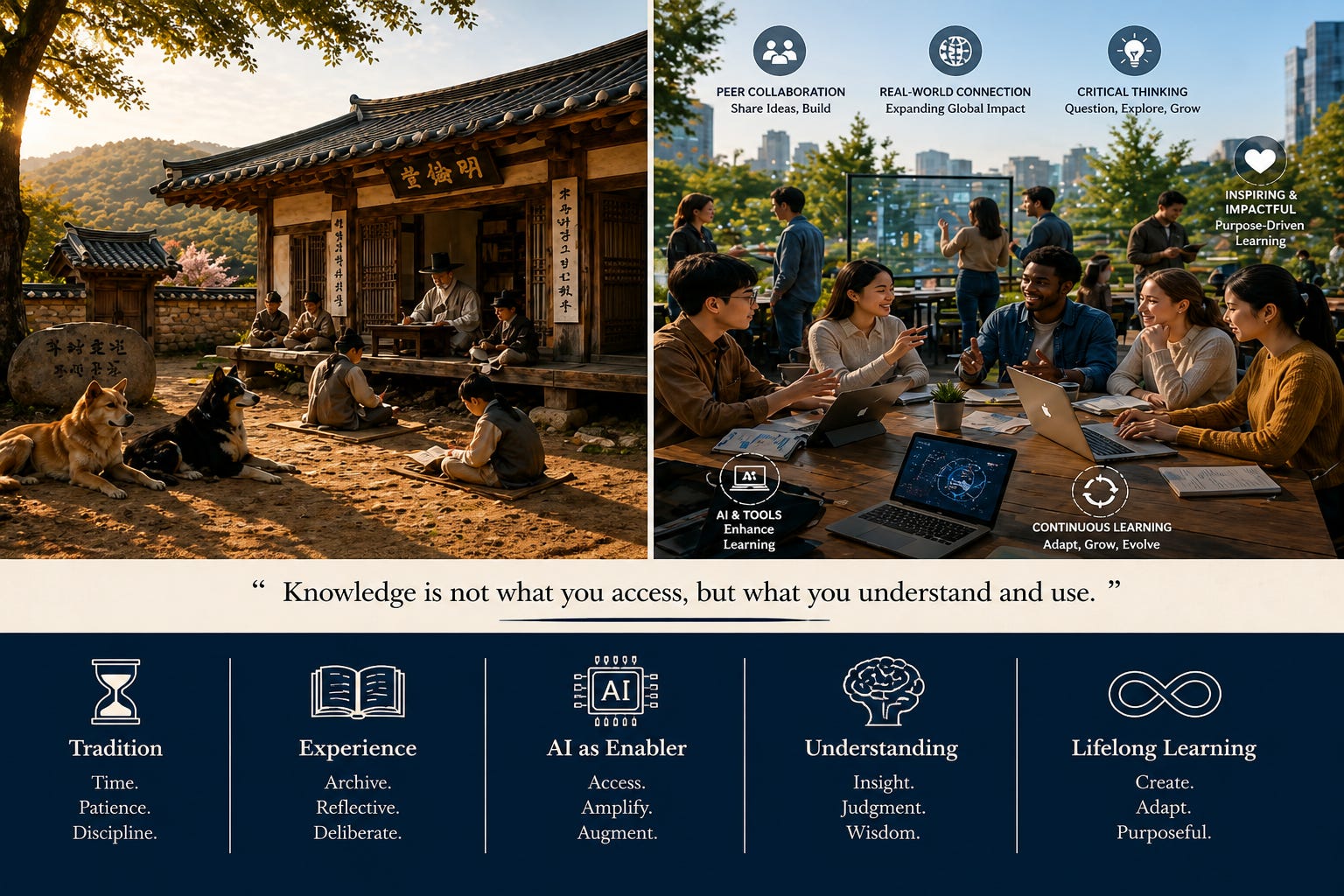
Figure 1. Learning Model: Korean Village School vs. AI Interactive Learning
Contrasts traditional immersion in Korean village schools with AI-enabled interactive learning. Emphasizes that meaningful learning comes from understanding, not just access.
1. INTRODUCTION
In Korean proverbs, the word “dog” (개) is often used not literally, but figuratively to refer to a person within someone’s close circle — such as a servant, follower, subordinate, or trusted associate. For example, the proverb “정승의 개가 죽으면 사람이 모이나 정승이 죽으면 사람이 뜸하다” (When the prime minister’s dog dies, many people gather; when the prime minister dies, few attend) uses “dog” to symbolize a favored subordinate, revealing how social attention often follows power rather than genuine respect. Likewise, “서당개 3년이면 풍월을 읆는다” (Even a dog that stays at a village school for three years can recite poetry) portrays the “dog” as a figure of low status, emphasizing that prolonged exposure and persistence can lead to learning — even for those not expected to succeed.
These proverbs illustrate a broader insight: learning and social value are shaped not only by inherent ability, but by environment, association, and sustained engagement over time. This perspective aligns with foundational theories of experiential learning, where knowledge emerges through interaction with environment and reflection over time (Dewey, 1938), as well as with the notion of tacit knowledge, which develops through practice and cannot be fully articulated or transferred through information alone (Polanyi, 1966). This insight is particularly relevant in the age of artificial intelligence. The rapid development of AI has transformed how individuals access and interact with knowledge. Information that once required years of study can now be retrieved in seconds, and AI systems can generate essays, solve complex problems, and simulate expert reasoning. While these capabilities expand access and efficiency, they also introduce a critical risk: the erosion of active learning. When answers are readily available, the temptation is to bypass reflection, effort, and internalization.
Figure 2. Constructive Learning in the AI Era
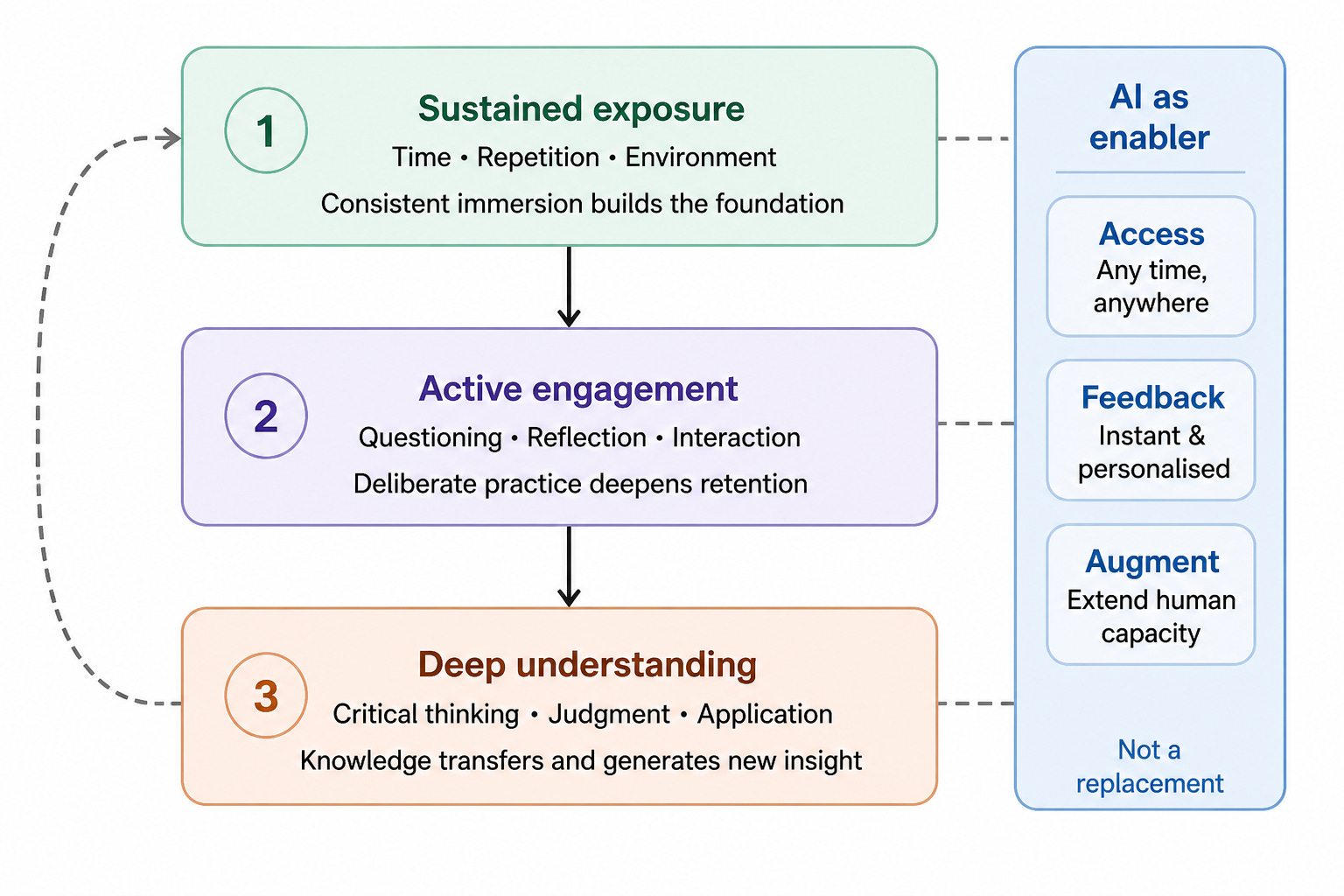
Figure 2 illustrates a three-stage model of constructive learning in the AI era, showing how meaningful understanding develops through a structured progression from sustained exposure to active engagement and ultimately deep understanding. The model emphasizes that learning begins with consistent immersion — time, repetition, and environment — which builds the cognitive foundation. This is followed by active engagement through questioning, reflection, and interaction, where deliberate practice strengthens retention and transforms information into usable knowledge. The final stage, deep understanding, highlights the development of critical thinking, judgment, and application, enabling knowledge transfer and the generation of new insights. Alongside these stages, AI is positioned as an enabler — providing access, personalized feedback, and augmentation of human capability — while explicitly not serving as a replacement for the human processes required for genuine learning.
Sustained exposure provides the foundation for learning through time, repetition, and immersion in an environment. The body and mind require cumulative encounters with material to build somatic memory, conceptual scaffolding, and fluency. However, understanding emerges only through active engagement — questioning, reflection, and interaction — which transforms passive familiarity into structured knowledge. Through deliberate retrieval, dialogue, and reflection, learners consolidate and reorganize information, enabling deeper comprehension. This process ultimately leads to deep understanding, where knowledge transcends its original context and allows for evaluation, adaptation, and creative application.
Artificial intelligence functions as an enabling layer that enhances access, supports sustained exposure, and provides personalized feedback during active engagement, while extending the reach of expert judgment. Yet it does not replace the temporal, embodied, and human-centered processes required for meaningful learning. This shift raises a fundamental question: what does it mean to learn in an age where knowledge is instantly accessible? The answer lies not in abandoning traditional practices, but in reinterpreting them — recognizing that the core function of education is to cultivate the ability to understand, evaluate, and apply knowledge in complex and uncertain contexts. This paper argues that “sitting for learning” — remaining present, attentive, and engaged over time — remains essential in the AI era, and that constructive, lifelong learning depends on actively integrating human cognition with technological support.
AI finds what matters; learning makes it matter.
2. “SITTING FOR LEARNING”: A CROSS-CULTURAL PERSPECTIVE
Across cultures and historical periods, learning has consistently been associated with discipline, continuity, and sustained engagement. The act of “sitting” symbolizes more than physical posture; it represents a commitment to remain with ideas long enough for them to develop into genuine understanding.
2.1 European and Jewish Traditions
In the European intellectual tradition, learning has long been embedded in structured institutions that prioritize depth over immediacy. From classical philosophy to modern universities, students are expected to engage closely with texts, arguments, and evidence. Contemporary perspectives on higher education emphasize the integration of inquiry, engagement, and critical reflection, encouraging learners to participate actively in the construction of knowledge (UNESCO, 2021; Biesta, 2020). A similar commitment to sustained engagement can be found in Jewish educational traditions, particularly in yeshiva study. Here, learning is grounded in dialogue, repetition, and rigorous analysis. Rather than passively receiving information, students engage in an interactive and iterative process, often through debate and collaborative interpretation. Texts are revisited multiple times, with each encounter offering the possibility of deeper insight.
These traditions exemplify the principle of “sitting for learning” through several shared features. First, they recognize that time is essential for deep understanding. Second, they frame learning as an active and often communal process. Third, they emphasize that knowledge emerges through repeated interaction rather than immediate acquisition. These principles stand in sharp contrast to the immediacy of AI-generated information, underscoring the enduring importance of intellectual patience and sustained engagement. In this sense, “sitting” represents not merely a physical act, but a disciplined commitment to remain with ideas long enough for meaningful understanding to emerge.
2.2 Chinese and Korean Traditions
In East Asian contexts, learning has traditionally been linked to self-cultivation, discipline, and moral development. Influenced by Confucian philosophy, education emphasizes persistence, repetition, and respect for knowledge. Mastery is achieved through gradual internalization rather than rapid acquisition.
In Korea, historical educational settings such as the 서당 (seodang) embodied these values. Students engaged in continuous recitation and study, reinforcing the idea that learning is a long-term process shaped by consistent exposure. The emphasis was not on speed or efficiency, but on depth and character formation.
These traditions reinforce a critical insight: learning is not simply cognitive, but developmental. It involves shaping habits, attitudes, and ways of thinking that evolve over time. In the context of AI, this perspective highlights the limitations of instant knowledge and the enduring importance of patience and persistence. Learning requires time in contact with the material. Not passive time — simply being near a subject does not guarantee learning — but cumulative, repeated encounters that allow the nervous system, memory, and conceptual frameworks to gradually reorganize around new knowledge. Sustained exposure is what creates the substrate on which everything else is built.
3. ENDURING LEARNING CONDITIONS AND CONTEXTS IN THE AI ERA
Learning in the AI era must be understood not simply as access to information, but as a structured process shaped by enduring human conditions. Domains such as athletics, music, art, and professional expertise persist because they rely on conditions that cannot be fully digitized or compressed, including embodiment, situated experience, and human-to-human judgment. These conditions highlight that learning remains grounded in time, repetition, and lived context, even as AI expands access to information. This reinforces the view that meaningful learning is experiential, contextual, and embodied rather than purely informational (Dewey, 1938; Polanyi, 1966).
Building on this foundation, the Nexus framework conceptualizes learning as a cumulative process linking sustained exposure, active engagement, and deep understanding. Rather than replacing human learning processes, AI operates as an enabling layer that enhances access and feedback while leaving intact the temporal, embodied, and social dimensions that define meaningful learning. The following sections examine these stages in relation to the three enduring conditions.
3.1 Embodied Practice and Sustained Exposure
Sustained exposure — through time, repetition, and environment — forms the foundational stage of learning. Cognitive processes such as memory consolidation, fluency, and situational encoding require repeated encounters over time, often across sleep cycles and varied contexts. Repetition gradually shifts processing from effortful to automatic, freeing cognitive capacity for higher-order reasoning, while environmental context shapes how knowledge is encoded and later retrieved.
This stage corresponds to embodied practice, where learning is grounded in somatic memory and lived experience. As noted in the analytical framework, years of training produce forms of knowledge that cannot be replicated digitally, including fine-grained motor skills, tolerance for error, and adaptive micro-adjustments. AI significantly expands access to sustained exposure through personalized content and adaptive feedback, but it does not eliminate the temporal and biological constraints of learning. This perception is further complicated by the hidden human labor embedded in AI systems, where value generation often depends on unseen forms of human contribution (Muldoon et al., 2024). The risk lies in confusing exposure with passive consumption, as familiarity without active processing does not produce durable understanding. Thus, sustained exposure remains an irreducible foundation that cannot be compressed without loss of depth.
3.2 Situated Experience and Active Engagement
Beyond exposure, learning advances through active engagement, where knowledge is constructed through interaction, reflection, and context. Engagement transforms information into structured understanding by requiring learners to interpret, apply, and test ideas within real or simulated environments. Such transformation reflects constructivist principles of learning, where meaning is actively constructed rather than passively received (Dewey, 1938). This process aligns with situated experience, where meaning emerges from context, risk, and the irreducible nature of practice.
As highlighted in the analytical framework, live presence and shared risk introduce elements that cannot be replicated through static or retrospective content. Performance, competition, and real-time interaction generate uncertainty and vulnerability, which are essential for deep learning. Similarly, the process of formation — whether through apprenticeship, struggle, or prolonged practice — is constitutive of expertise rather than merely instrumental. AI can simulate scenarios and enhance interaction, but it cannot fully reproduce the experiential conditions under which meaning is formed. As a result, active engagement remains dependent on contexts that require participation, risk, and sustained involvement.
Table 1. Stages of Constructive Learning and Their Irreducible Human Conditions
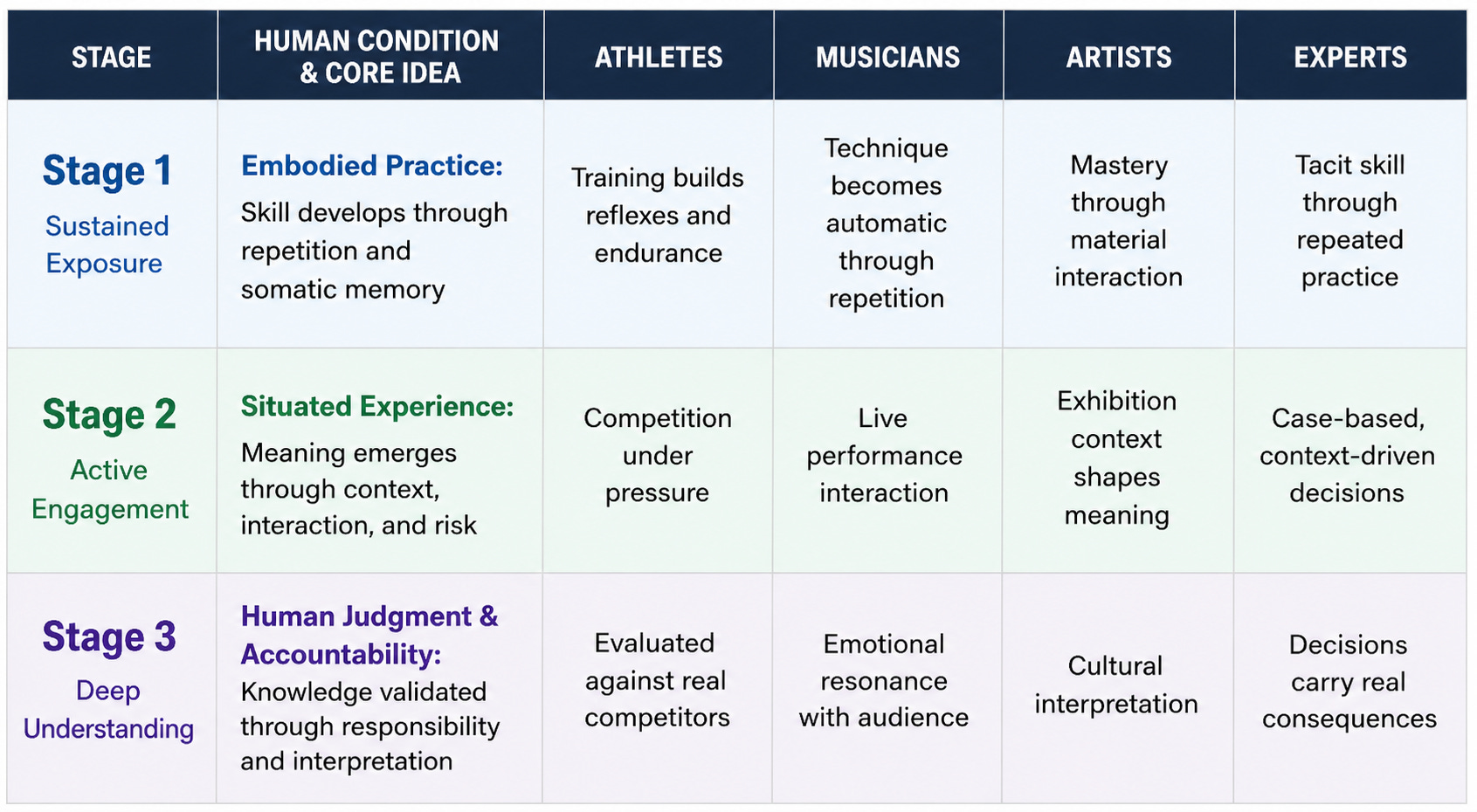
Note: Table 1 maps the three stages of constructive learning to their corresponding irreducible human conditions across key domains — athletes, musicians, and artists. The first condition, Embodied Practice, establishes that genuine skill cannot be downloaded or shortcut: it is forged through somatic memory and physical repetition, whether an athlete’s trained reflexes, a musician’s automatic technique, or an artist’s hand–eye mastery. The second condition, Situated Experience, recognizes that meaning only emerges in real, high-stakes contexts — the pressure of competition, the unrepeatable energy of a live performance, the physical presence of an exhibition — none of which can be compressed or simulated. The third condition, Human Judgment, asserts that true expertise is ultimately validated by other humans: a win only counts against real opponents, a performance succeeds only when it resonates emotionally with listeners, and artistic meaning lives or dies in cultural reception. Together, the three conditions argue that learning is irreducibly embodied, contextual, and socially accountable — qualities that resist automation precisely because they depend on being human.
3.3 Human Judgment, Accountability, and Deep Understanding
The highest stage of learning involves the development of deep understanding, where individuals can evaluate, adapt, and generate knowledge independently. This stage is defined by human judgment and accountability, where learning is validated through interpretation, responsibility, and social recognition. Unlike earlier stages, which focus on acquisition and processing, this stage requires the capacity to make decisions under uncertainty and to bear the consequences of those decisions.
As emphasized in the analytical framework, many domains ultimately depend on human-to-human stakes: athletes compete against rivals, musicians perform for listeners, artists communicate meaning to audiences, and professionals make decisions that carry ethical and practical consequences. AI systems can generate outputs and provide recommendations, but they cannot assume responsibility, experience vulnerability, or fully participate in human judgment. They also lack the tacit and context-dependent knowledge that characterizes human expertise (Polanyi, 1966), as well as the capacity for ethical responsibility emphasized in contemporary AI governance debates (Birch, 2024; Floridi, 2023). Consequently, the role of education shifts from transmitting information to cultivating judgment — the ability to interpret, evaluate, and act in complex contexts. In this light, institutions such as universities remain essential as environments that support sustained, reflective, and accountable learning. “Sitting for learning” — remaining present, attentive, and engaged over time — continues to define constructive, lifelong learning in the AI era, ensuring that human cognition and responsibility remain central even as technological capabilities expand. Recent AI-era scholarship reinforces that while artificial intelligence expands access to knowledge, meaningful learning remains grounded in human engagement, embodied practice, and judgment (Mollick, 2024; Narayanan & Kapoor, 2024; Floridi, 2023).
In the AI era, access is universal, but understanding remains earned.
4. PRACTICING CONSTRUCTIVE, LIFELONG LEARNING IN THE AI ERA
If sustained learning remains essential, the question becomes how it can be practiced effectively in a rapidly evolving, technology-rich environment. The answer lies not in rejecting new tools, but in integrating traditional principles of deep learning with the capabilities of modern AI systems.
4.1 Active Engagement with AI
To benefit from AI without becoming dependent on it, learners must adopt an active, critical, and reflective approach. Constructivist theory, as articulated by Jean Piaget (1972), emphasizes that knowledge is not passively received but actively constructed through interaction and interpretation.
In this context, AI should be approached not as an authority, but as a partner in inquiry. Several practical strategies can support this shift. First, learners should interrogate AI-generated outputs by questioning underlying assumptions, limitations, and potential biases. Second, comparative analysis — examining multiple responses or perspectives — can deepen understanding and reveal nuance. Third, explain-back methods, in which learners articulate ideas in their own words without assistance, help reinforce comprehension and identify gaps in knowledge. Through these practices, AI becomes not merely a source of answers, but a catalyst for deeper thinking and intellectual engagement.
4.2 Designing Lifelong Learning Environments
Sustained learning also depends on the environments in which it takes place. It requires intentional structures that support focus, continuity, and reflection over time. The concept of the reflective practitioner, developed by Donald Schön (1983), highlights the importance of learning through ongoing self-assessment and adaptation.
Effective learning environments share several key characteristics. They incorporate consistent routines that encourage regular engagement rather than sporadic effort. They prioritize curated inputs, ensuring exposure to high-quality ideas and credible sources. They include reflective practices, allowing time for synthesis, evaluation, and deeper understanding. Finally, they foster collaborative learning, where interaction with diverse perspectives challenges assumptions and expands insight. By intentionally cultivating these conditions, individuals can sustain meaningful intellectual growth. In an AI-driven world, lifelong learning is not simply a matter of access to information, but of how one engages with, reflects on, and builds upon that information over time.
5. CONCLUSION
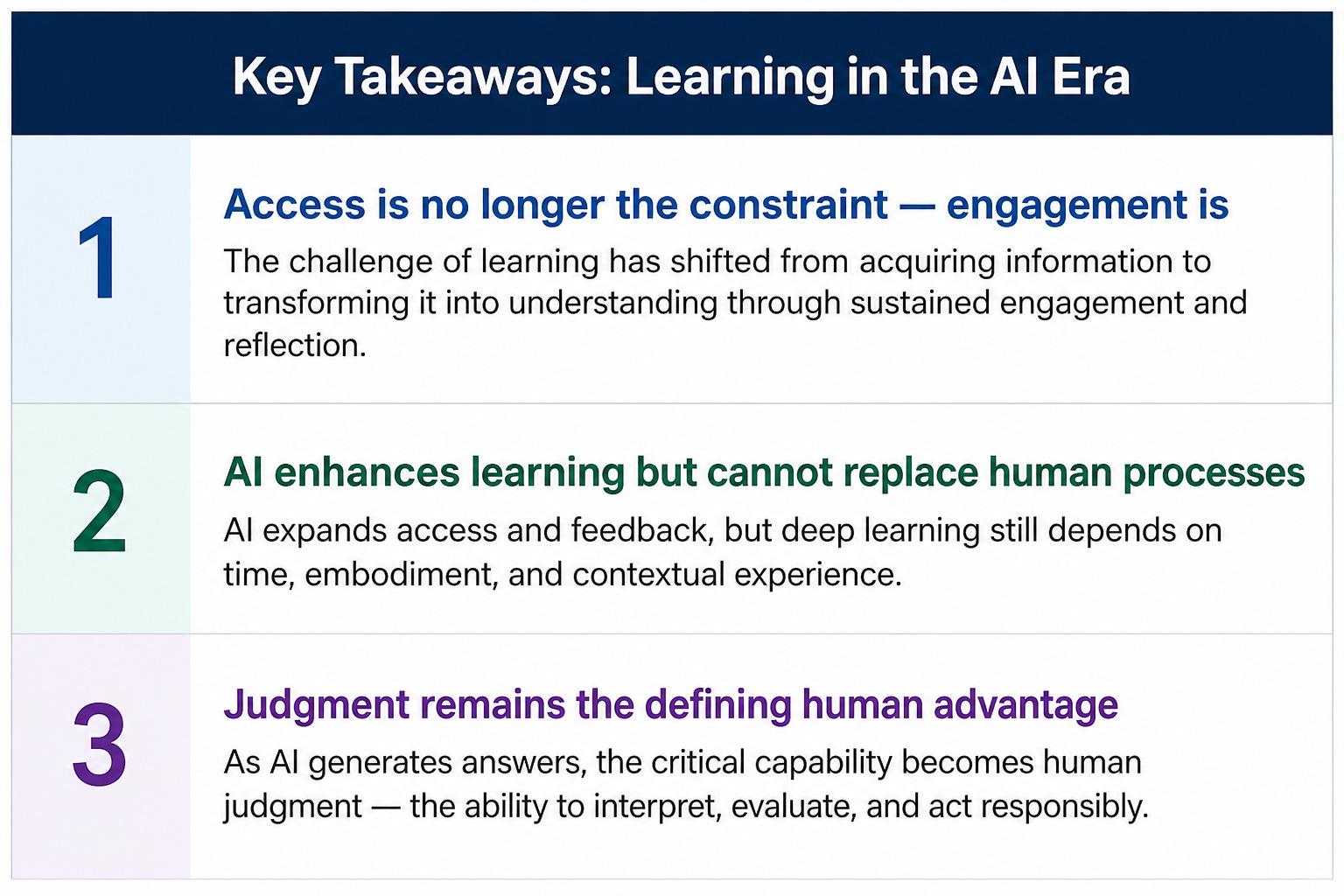
In the AI era, the value of learning is no longer defined by access to information but by the ability to engage with it deeply, think critically, and apply it responsibly. The enduring practice of sustained, attentive learning remains essential as a discipline of reflection and intellectual presence — qualities that AI cannot replace but can amplify when used effectively. Rather than rendering traditional learning obsolete, AI reinforces the need for constructive, lifelong learning habits that integrate sustained inquiry with technological tools. Those who adopt this approach will be best positioned to guide, interpret, and evolve with AI. In this sense, the future of learning will not be defined by how fast knowledge is accessed, but by how deeply it is engaged and responsibly applied.
References
Biesta, G. (2020). The risk of ourselves in education: Qualification, socialization, and subjectification revisited. Educational Theory, 70(1), 89–104.
Birch, J. (2024). The edge of sentience: Risk and precaution in humans, other animals, and AI. Oxford University Press.
Dewey, J. (1938). Experience and education. Macmillan.
Floridi, L. (2023). The ethics of artificial intelligence: Principles, challenges, and opportunities. Oxford University Press.
Mollick, E. (2024). Co-intelligence: Living and working with AI. Portfolio.
Muldoon, J., Graham, M., & Cant, C. (2024). Feeding the machine: The hidden human labour powering AI. Canongate.
Narayanan, A., & Kapoor, S. (2024). AI snake oil: What artificial intelligence can do, what it can’t, and how to tell the difference. Princeton University Press.
Polanyi, M. (1966). The tacit dimension. Doubleday.
UNESCO. (2021). Reimagining our futures together: A new social contract for education. UNESCO Publishing.
Original Document:

ABOUT THE AUTHOR

Paul C. Hong is a Distinguished University Professor and Chair of Information Systems and Supply Chain Management at the University of Toledo. His work focuses on leadership, governance, and decision-making in the AI era, integrating strategy, technology, and institutional trust. He has published extensively in leading academic journals and writes on how individuals and organizations navigate complexity, disruption, and global transformation.
© K-Global Scholars and Professionals Forum. All rights reserved. Content published in the K-GSP Forum may not be reproduced, distributed, or transmitted in any form without prior written permission from the K-GSP Forum, except for brief quotations with full attribution.