
Artificial intelligence (AI) is no longer merely a technological innovation; it is fundamentally transforming how humans think, work, learn, and create culture. While the Industrial Revolution replaced human physical labor with machines, the AI revolution is now replacing portions of human cognitive work. Writing, translation, image generation, music composition, data analysis, and even advisory decision-making are increasingly being performed with the assistance of AI systems. In this rapidly changing environment, a fundamental question naturally arises: What, then, is the role of human beings?
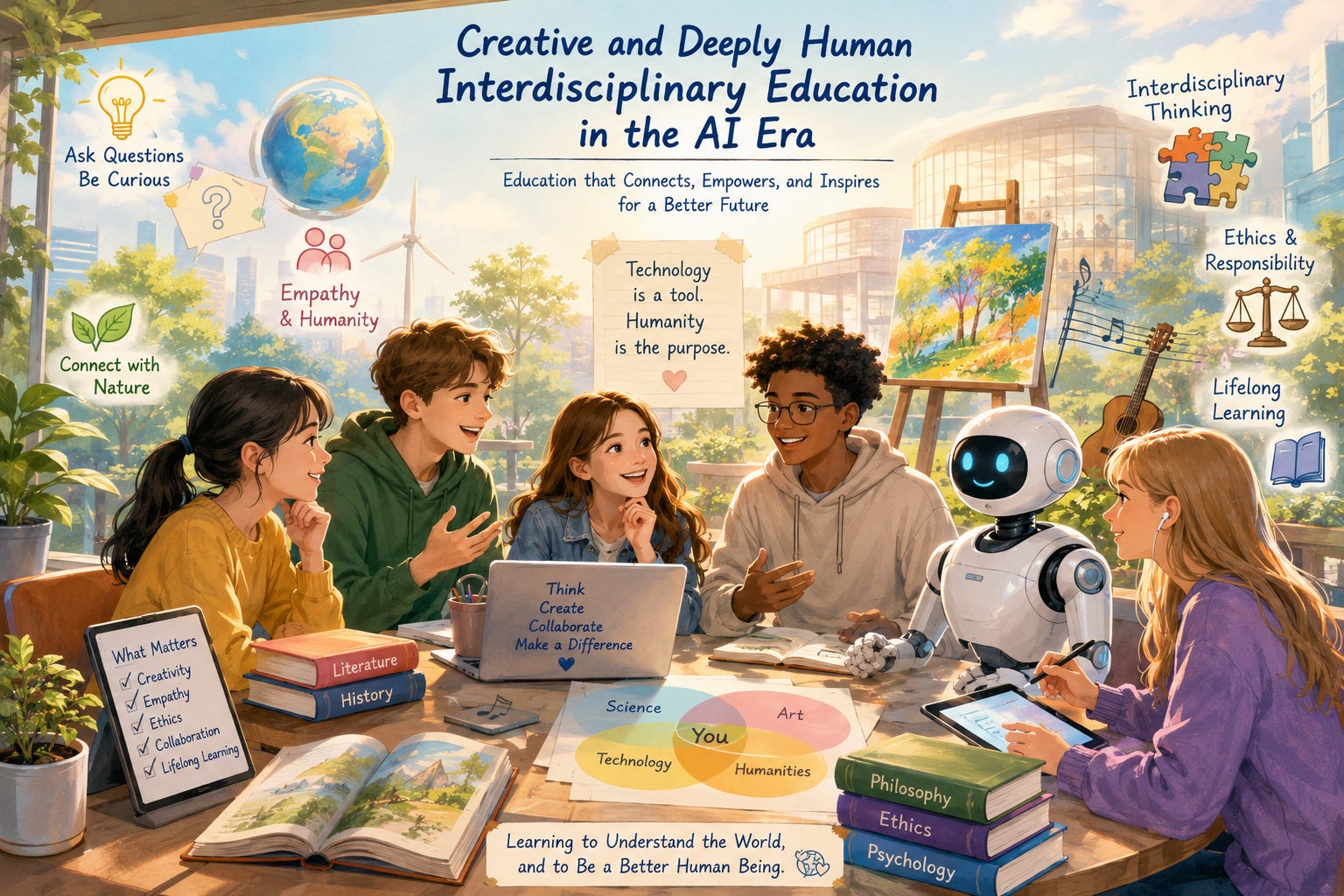
This question is reshaping the future of education. Memorization and repetitive calculation—once central to traditional schooling—are now tasks that AI performs faster and more accurately than humans. Therefore, education in the AI era must move beyond simple knowledge transmission. It must cultivate uniquely human capacities such as creativity, empathy, ethical judgment, integrative thinking, and the ability to explore meaning in life. In other words, education in the AI age must become more deeply human while also becoming more interdisciplinary, connecting diverse fields of knowledge.
In the AI Era, the Ability to Ask Questions Matters More than Knowledge
Traditional education has long emphasized the ability to memorize and reproduce correct answers. However, today, students can instantly access nearly all forms of information through smartphones and AI systems. What matters now is not how much one knows, but the ability to ask meaningful questions.
Creative questions are the starting point of discovery. Steve Jobs believed that innovation emerges at the intersection of technology and the liberal arts, and Albert Einstein famously stated that imagination is more important than knowledge. AI generates answers based on existing data, but humans can create entirely new questions that have never been asked before. Therefore, future education must encourage curiosity and independent inquiry rather than passive reception of information.
Interdisciplinary Education Is Essential for Solving Future Problems
Modern societal challenges cannot be solved within the boundaries of a single discipline. Issues such as climate change, cybersecurity threats, AI ethics, and global health crises require the integration of science, technology, economics, philosophy, politics, and psychology.
For example, designing an AI-based healthcare system requires not only computer science but also medicine, ethics, law, and psychology. Thus, future education must move beyond producing “specialists in a single field” and instead cultivate individuals who can connect multiple domains of knowledge. This is the core principle of interdisciplinary education.
Human Emotion and Empathy Will Become Even More Important
AI can analyze data, but it cannot genuinely feel human suffering. The fear of a patient, the anxiety of a student, the loneliness of an elderly person, and the emotional impact of art cannot be fully captured by algorithms alone.
Therefore, emotional intelligence and empathy must become central components of education. Literature, music, visual arts, and philosophy are not merely cultural supplements; they are essential tools for preserving humanity. Human society ultimately exists through relationships, and these relationships are grounded in emotional understanding.
The Value of the Arts and Humanities Will Be Reaffirmed
Many assume that only STEM fields matter in the AI era. However, the opposite is increasingly true: the humanities and arts are becoming more important than ever. As AI takes over technical tasks, uniquely human capacities such as imagination, interpretation, and cultural insight become more valuable.
A poem, a piece of music, or a philosophical reflection can reveal dimensions of human existence that data alone cannot capture. Historically, the greatest minds of the Renaissance combined science and art. Leonardo da Vinci was both an artist and a scientist, and Benjamin Franklin was an inventor, philosopher, and statesman. Future education must once again embrace this integrated model of human development.
Ethical Education Is Essential in the AI Era
As AI systems become more powerful, ethical concerns become more urgent. Issues such as misinformation, deepfakes, privacy violations, algorithmic bias, and job displacement are not merely technical problems—they are moral ones.
Education in the AI era must therefore address not only what can be created, but what should be created. Students must learn responsibility in technology use and understand its social consequences. Without ethics, technological progress can lead to social instability and harm.
Lifelong Learning Will Become the New Norm
In the past, education often ended with formal schooling. In the AI era, however, rapid technological change makes lifelong learning essential. Knowledge becomes outdated quickly, and individuals must continuously update their skills.
Universities are likely to evolve into lifelong learning platforms rather than institutions limited to degree programs. Online courses, AI tutors, and virtual reality-based education will enable people to learn anytime and anywhere. Learning will no longer be confined by age or stage of life.
Creativity Will Be the Most Important Human Competency
AI is highly effective at combining existing data, but it still struggles to generate entirely new cultural and conceptual frameworks. Thus, creativity becomes the most important human capability in the future society.
Creativity is not limited to artistic expression. It includes the ability to solve problems in novel ways, connect diverse ideas, and think beyond conventional boundaries. Education must therefore encourage experimentation, curiosity, and a willingness to fail and learn.
Education Will Shift from Competition to Collaboration
Industrial-age education was largely based on competition and standardized testing. However, in the AI era, collaboration becomes far more important than individual competition, as complex problems require collective intelligence.
Future education must emphasize teamwork, global cooperation, and cross-cultural communication. AI will further accelerate international collaboration, making it essential for students to understand diverse perspectives and work effectively across boundaries.
Education Must Restore the Connection Between Humans and Nature
As digital technologies advance, humans are becoming increasingly disconnected from nature. Extended time spent in virtual environments can lead to mental fatigue, stress, and isolation.
Therefore, education must also include experiences that reconnect individuals with nature, reflection, meditation, and slow, mindful learning. Nature plays a crucial role in restoring creativity and psychological balance. In an AI-driven world, inner equilibrium becomes more important than ever.
Ultimately, Education Is About Becoming Human
The essence of education is not merely to prepare for employment, but to help individuals discover the meaning of their lives and their role in society.
AI may serve as a powerful tool, but it cannot define the purpose of human existence. Education in the future must therefore integrate technical competence with philosophical reflection, ethical responsibility, and humanistic understanding.
Education in the AI era cannot be reduced to digital literacy or technical training alone. On the contrary, as technology advances, the importance of deeply human education becomes even more evident. The future demands individuals who are not only capable of using AI effectively but also able to think creatively, empathize with others, and act with ethical responsibility.
Thus, education must evolve into a truly interdisciplinary system that integrates science and the humanities, technology and the arts, logic and emotion. At the same time, it must cultivate inner reflection, empathy, and a sense of shared human responsibility.
Ultimately, the greatest competence in the AI era is not the ability to compute faster than machines, but the ability to think, feel, love, and create in profoundly human ways. The true goal of future education is to cultivate such deeply human beings. +++
{Solti}
May 18, 2026

Young Choi, PhD is a Professor at Regent University bringing a rare combination of technical expertise and creative spirit to everything he does. A scholar in AI, cybersecurity, and network & telecommunications service management, he has published 38 books including AI and cybersecurity area books, over 200 refereed articles, and over 20 book chapters. Beyond the academy, Dr. Choi is a passionate poet, essayist, and wooden block laser engraving artist whose reflective writing invites readers to rediscover life’s beauty in quiet contemplation(靜觀). He lives under the motto: “Study hard and give generously without holding back! (열심히 공부해서 아낌없이 남주자 !: 열공아남)”
Published books: https://www.amazon.com/stores/Young-Choi/author/B0DMZ5S6R7?ref=ap_rdr&shoppingPortalEnabled=true