
A Day to Remember: Twenty-Five Senryu
Poet’s Note:
Senryu (pronounced SEN-ree-oo; plural: senryu) is a humorous and satirical form of poetry often regarded as a comic counterpart to the more refined and understated haiku. Haiku originated in the seventeenth century from haikai no renga (or renga), an earlier Japanese tradition of collaborative linked-verse poetry. Senryu, by comparison, emerged in the mid-eighteenth century as a means of personal expression among ordinary people, particularly members of the growing merchant class. Reflecting its popular origins, many early senryu appeared in print without identifying their authors.
The term senryu comes from the pen name of Karai Hachiemon (1718–1790), better known as Karai Senryu (川柳, meaning “river willow”). In addition to serving as a government official in the Asakusa district of Edo (modern-day Tokyo), he was an accomplished poet and editor. In 1765, working with Goryoken Kayu, he published the first volume of the Willow Barrel (Haifū Yanagidaru, 1765–1838) collection. It featured 756 winning poems chosen from earlier maeku awase, or poetry contests that produced approximately 10,000 verses between 1757 and 1765. The publication eventually grew into a series of 167 volumes.
Traditional Japanese senryu, like haiku, follows a three-line 5-7-5 pattern based on Japanese sound units known as morae. Contemporary English-language haiku published in professional haiku journals tend to contain approximately 11 syllables. Haiku typically emphasizes elegance, subtlety, and compression. Senryu, with its greater emphasis on human behavior, humor, satire, and narrative situations, can accommodate a somewhat higher syllable count.
hurrying to the airport—
lucky socks
left behind
*
airport—
moving walkway
too crowded to walk
*
airport security
checking my passport
again
*
airport—
the officer’s harmless question:
who travels with me
*
tour bus naps—
heads nod
differently
*
this foreign tour—
one more group photo
before moving on
*
crowded cathedral
summertime visitors
elbow to elbow
*
Buddhist temple—
the scramble for the best spot
to greet sunrise
*
public restroom line—
one traveler yields
to the next
*
airport bathroom—
almost leaving behind
my laptop
*
summertime Paris—
tourists everywhere
smiles and sighs
*
literary tour
following Basho’s footsteps
by taxi
*
Korean with round eyes—
a second look shows
they are altered
*
Koreans—
missing Korea in America
America in Korea
*
a day to remember—
on the road
pulled over twice
*
charging my phone—
first thing to do
at work
*
hard to decline
the kind offer—
“summarize this email”
*
automatic door
almost always
un-automatic
*
(knock knock)
“Housekeeping!”
“You can keep it!”
*
the whole world
turning dark
Microsoft outage
*
annual review—
he rates himself
too highly
*
bloated ego—
ChatGPT applauds
its own revision
*
romance novel—
turning the last page
alone again
*
retiree’s morning
watching a roadrunner
mock a coyote
*
forty-two years later
his once-shy bride
growing vocal
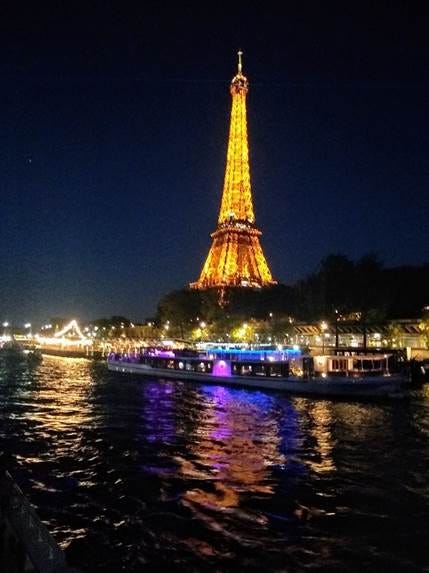
The Eiffel Tower in Paris at night. Photo by John J. Han, June 2025. The tower looked beautiful from the Seine River, and its dazzling light show drew applause from tourists around the world.
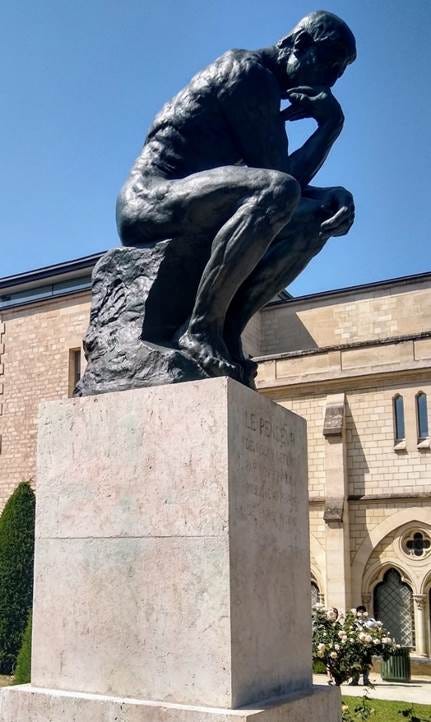
There is a time to celebrate and a time to reflect. Rodin’s The Thinker at the Rodin Museum in Paris. Photo by John J. Han, June 2025.
About the Author
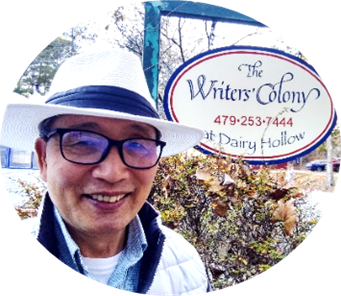
Professor of English and Creative Writing and Associate Dean of the School of Humanities and Theology, Missouri Baptist University
John J. Han (PhD, University of Nebraska-Lincoln) is the author, editor, co-editor, or translator of 38 books published by Rodopi, Peter Lang, McFarland, Bloomsbury Academic, and other presses. His forthcoming book, Echoes from the Hills: Critical Essays on Ozarks Literature, co-edited with C. Clark Triplett, will be published by the University of Arkansas Press in early 2027. His scholarly work includes hundreds of articles, along with more than 3,000 poems, mostly haiku, appearing in journals and anthologies around the world. He is in his 28th year as a full-time faculty member at Missouri Baptist University, where he has taught since 1999. He has also taught at Kansas State University, the University of Nebraska–Lincoln, Nebraska Wesleyan University, and Washington University in St. Louis. He has served as a visiting scholar at Georgia College & State University and the University of Ljubljana in Slovenia.
© K-Global Scholars and Professionals Forum. All rights reserved. Content published in the K-GSP Forum may not be reproduced, distributed, or transmitted in any form without prior written permission from the K-GSP Forum, except for brief quotations with full attribution.