

“Don’t Even Look at Them” and Other Haibun
Poet’s Note:
The Haiku Society of America defines a haibun as “a terse, relatively short prose poem in the haikai style, usually including both lightly humorous and more serious elements, and typically ending with a haiku.” (Haiku Society of America: Haiku Definitions. https://www.hsa-haiku.org/hsa-definitions.html) Some of the haibun in this post are what I call “intertextual haibun,” which incorporate quotations or references drawn from written or oral sources. I use the term intertextual because these sources enter into dialogue with the prose and haiku. They serve three functions: as epigraphs that inspire a piece, as central subjects for reflection, and as references that inform or deepen the narrative.
#1: The Pressure for Success
“How unusually beautiful the forest was in the morning without anyone walking through it but him, column after column of spruce, a vast hall with a blue-green vault.” —Hermann Hesse, Beneath the Wheel
One likely reason Hesse’s Beneath the Wheel (Unterm Rad, 1906) continues to resonate with Korean readers lies in its portrayal of the psychological toll of academic pressure. Living in a society marked by intense competition, many readers understand the sharp divide between success and failure. In Hesse’s coming-of-age novel, Hans Giebenrath—an intelligent but emotionally sensitive boy—passes a highly competitive examination and enters a theological seminary. He becomes a hero in his village, and even his verbally harsh father expresses pride in him. At the seminary, however, Hans finds the academic environment rigid and stifling. Unable to adapt, he eventually leaves the school and returns to his village, where he becomes an apprentice mechanic. One night, after drinking with coworkers, Hans is found dead in a river. Although the novel does not state that he committed suicide, his life by that point has been drained of direction and meaning, underscoring Hesse’s critique of an education system that crushes individuality in the pursuit of success.
class reunion—
worst student
now the best dresser
#2: The Portrait of a Wandering Soul
“Every human being has his soul, he can’t mix it with any other. Two human beings can meet, they can talk with one another, they can be close together. But their souls are like flowers, each rooted to its place.” —Hermann Hesse, Knulp
Knulp: Three Tales from the Life of Knulp (1915) is typical of Hermann Hesse in its portrayal of a solitary man with wanderlust and romantic yearnings. He resembles Goldmund in Narcissus and Goldmund in his sensuality and free-spirited nature. He attracts women and fathers a child whose mother dies in childbirth, though he does not assume a conventional paternal role. Although carefree in spirit, he often envies those who live stable lives with family and security. Eventually afflicted with lung disease, he grows weaker. Near the end of his life, he experiences a mystical dialogue with God, who reassures him that each person has a distinct path and that his wandering life, too, has meaning.
alone on a sickbed—
the refrigerator’s
hum
#3: Who Will Stand by You?
In matters of faith, God, the Buddha, or other objects of worship can serve as humanity’s most trusted sources of support. On an interpersonal level, however, a harder question emerges: who can truly offer steady support in times of need? Growing older often reveals that unconditional loyalty is rare. Close friends may betray us, relatives may prove selfish, children may grow distant, and even spouses may fall short of our expectations. Parents are often seen as the most reliable sources of unconditional care, yet even parental devotion can be compromised by self-interest. Recognizing these realities suggests the importance of learning to stand on one’s own, emotionally and financially, rather than relying entirely on others for security.
they rise again
in the wind-swept field
bent stalks
#4: Money Matters
“Money—the word stung George like a whip whenever she said it; it struck him as shameless, disgusting, offensive.” —Karel Čapek’s “Money”
Čapek’s “Money” (Peníze), first published in Czech in 1921, appears in his short story collection Painful Tales. The story is, indeed, painful: a man is caught between his two sisters, Růžena and Tylda, who each face money troubles. Růžena is a spendthrift and has left her husband, while Tylda is married to a man whose business is failing. The sisters dislike each other and try to manipulate their brother for financial support, but he refuses to help them.
Čapek’s story shows how money can strain family relationships. Siblings can become estranged over financial issues—whether in Europe, Asia, or the United States. The story reminds readers of the importance of living within your means and saving money—even if it’s just $100 a month. While money isn’t everything, having little can make life miserable.
parking lot
a quarter on asphalt
lifted carefully
#5: The Poor Among Us
“And many a time afterwards, in the course of his life, shuddered at seeing how much inhumanity there is in man, how much savage coarseness is concealed beneath delicate, refined worldliness.” —Nikolai Gogol’s “The Overcoat”
Literary naturalism emerged in Russia decades before it became prominent in Europe and the United States. In the mid-nineteenth century, Russian novelists such as Nikolai Gogol, Ivan Turgenev, and Fyodor Dostoyevsky focused on the harsher aspects of life. Gogol’s well-known story “The Overcoat” (Shinel, 1842) illustrates this vividly. Its protagonist, Akaky Akakievich, is a poor and socially isolated government clerk whose job consists of copying documents. Mocked by his colleagues for his shabby clothing, he resolves to buy a new overcoat. After saving enough money, he purchases one, but it is stolen by robbers that very night. Akaky catches a fever, dies, and is buried unheralded. His colleagues learn of his death days later, and he is quickly replaced by another clerk. This tragic end echoes the poverty and desperation depicted in Dostoyevsky’s Crime and Punishment (1866). Such stories serve as stark reminders of the hardships endured by the lower classes, hardships that remain relevant today.
childhood returns in my dream—
lining up
for free U.S. corn
#6: The Shame of Being Left Behind
“I felt a shiver run through me; for I knew then what a lamentably thick wall had grown up between us.” — Lu Xun’s “My Old Home”
Lu Xun’s short story “My Old Home” (故鄕, 1921) resonates deeply with anyone who grew up in a rural area and later left in search of better opportunities. Set in the Chinese countryside, it depicts the reunion of two childhood playmates. Juntu (閏土) remained in the village, a poor peasant struggling under an oppressive government, while the narrator returns after twenty years, anticipating their meeting. Juntu now calls him “master,” saying, “I was a child then and didn’t understand [the class difference]” (trans. Hsien-yi and Gladys Yang). The narrator is saddened by how their once-familiar bond has been transformed by time and circumstance.
I was born and raised in a farming village in South Korea and left home at fifteen to attend high school in the provincial capital. Many of my classmates remained, unable to pursue further education due to poverty. During visits home in high school or college, I often sensed envy in their eyes. Feeling superior, I failed to understand their struggles. Now, in the waning years of my life, I feel remorse for my earlier arrogance and hope that they have found happiness in their own ways.
staying loyal to land—
my dirt-poor friend
now a millionaire
#7: The Divide as Wide as an Ocean
“Oh, there is a loneliness which befalls me now and then and it is something more than death.” —Pearl S. Buck’s Letter from Peking
In Pearl Buck’s novel Letter from Peking (1957), Elizabeth, an American woman, marries Gerald MacLeod despite her mother’s opposition. He is the son of an American father and a Chinese mother. Elizabeth believes in the power of love to transcend racial barriers. The couple lives happily in Peking (Beijing) until the Communist takeover of China in 1949. A university president, Gerald sends Elizabeth and their son, Rennie, to the United States for safety. His emotional attachment to China is too deep to leave it behind. Through letters, he reassures them of his enduring love. Gradually, however, his tone changes, suggesting his suffering under the Communist regime.
Having lived in China for decades, Buck understood the emotional and cultural complexities of interracial marriage. When Elizabeth first dates Gerald, she hopes he will behave like a white man so that her mother might accept him as one of their own. Ironically, Elizabeth still measures Gerald against white American standards.
In his teenage years, Rennie struggles with his own identity. Elizabeth insists that a white woman would marry him if she truly loved him, just as she once married Gerald. She challenges the idea of racial purity and questions the morality of white Europeans displacing Native Americans from their land. Yet when Rennie argues that interracial marriage is easier said than done, Elizabeth has little more to offer. Her silence suggests that love alone may not be enough to bridge a deep cultural divide, one that become as vast as the ocean separating them.
all-Korean tour
the freedom of speaking
our mother tongue
#8: The Story of China
“Revolution is not a bad thing,” thought Ah Q. “Finish off the whole lot of them . . . curse them! . . . I would like to go over to the revolutionaries myself.” —Lu Xun’s The True Story of Ah Q
Lu Xun’s The True Story of Ah Q (1921) was a recommended book in the general education program at my university in 1975. However, it took me more than fifty years to read it. As a professor of English, I tend to read Asian literature only when I have spare time. The novella is interesting in that it portrays Chinese society around the time of the 1911 Revolution, which toppled the Qing dynasty.
The story focuses on Ah Q, a man from the lowest social class who endures repeated humiliation and is executed at the end after being implicated in a robbery. Early in the novella, a landlord surnamed Zhao slaps Ah Q for boasting that he shares the Zhao family name. According to the landlord, a lowly person such as Ah Q has no right to claim the same surname.
Homeless and rootless, Ah Q survives by working for villagers as needed—harvesting crops, pounding rice, rowing boats, or doing other chores. When there is no work for him, he is either forgotten or ridiculed by the community. He is physically abused by stronger people but in turn torments those weaker than himself. He represents China a century ago, and Lu Xun wrote the novella as a wake-up call to his country. Impressively, that country has since risen to become one of the most powerful in the world.
bullied at school—
he gets mad
at his dog
#9: Airport “Karens”
Over the weekend, I watched several videos of women being arrested for disruptive behavior at airports. Some caused disturbances inside airplanes, while others argued with restaurant staff or employees at airline ticket counters. In one video, a woman reclined her seat, which was not appreciated by the passenger behind her. She screamed, “I have the right to keep my seat back!”
Having flown for decades, I find these episodes disheartening. Some of the people appeared emotionally troubled, while others seemed to lack social grace and the ability to tolerate minor inconveniences in public settings. Come to think of it, airline passengers are all “in the same boat” during a flight.
eight-hour flight—
keeping myself sane
with sitcom reruns
#10: A Grand Tour of England
As a professor of English, I had never visited England until May 2026, when I traveled with my university’s Chorale & Choral Society for a week. Although my specialty is American literature, I took numerous British literature courses as a student and have taught many British texts over the years, so it seemed only fitting to visit England at least once. Touring the country for a week proved ideal—not too long and not too short—and I appreciated being able to follow the group without having to plan the itinerary myself.
During our stay, we visited nearly a dozen places, including London, Salisbury, Stonehenge, Bath, Bristol, Wells, Coventry, Stratford-upon-Avon, and Oxford. Fortunately, England is much smaller than France and Germany, which I visited in 2025, making travel from one destination to another relatively convenient. Among the European countries I have visited, England struck me as especially peaceful, pastoral, and uncrowded. At times, I even wondered why I had never considered pursuing my graduate studies in the United Kingdom before moving to the United States in 1988. Of course, in those days, America was widely considered the ultimate destination, while the UK was perceived as a fading power.
the countryside
more fields
unfolding green
#11: The Lingering Power of the United Kingdom
During our week-long trip to England in May 2026, I once spoke with our tour guide, a gentle Englishman, about my first impressions of the country. I commented that, compared with many continental Europeans, the English people seemed polite and friendly. He agreed. I also expressed my fascination with the fact that, despite the United Kingdom’s long colonial history, many former colonies voluntarily participate in the Commonwealth—not only Canada and Australia, but also countries such as India and Pakistan. He suggested that British influence expanded largely through commerce and trade rather than outright military conquest. It was a somewhat convincing perspective, though the history of the British Empire was also marked by numerous military campaigns. I further mentioned that abolitionism emerged as a significant movement in the U.K., reflecting another complex dimension of British history.
During the trip, I noticed many students from South Asia and the Middle East in Oxford and other cities, which seemed to reflect the continuing appeal of British education and culture. It became clear to me that the legacy of British colonialism remains complex and multifaceted.
resenting U.S. policies
yet he visits
America
#12: Pickpockets in Oxford
Unlike in France, Italy, and other countries crowded with foreign tourists, I did not see any public signs warning against pickpockets in England, even in London, until I arrived in Oxford. Right in front of the Weston Library, near several colleges of the University of Oxford, I noticed a sign cautioning visitors about “Bag-Dippers.” The term was new to me, but its meaning was clear. It felt somewhat ironic to encounter such a warning in a place where some of the brightest students in the world pursue their education.
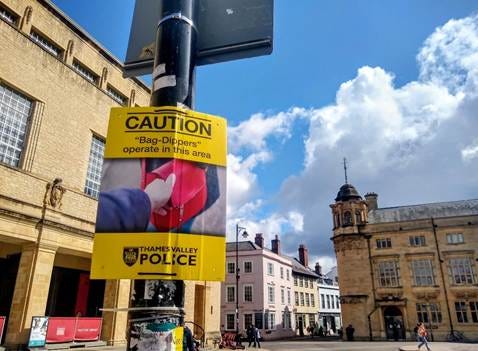
A sign warning against pickpockets in Oxford. Photo by John J. Han, May 13, 2026.
Oxford warning—
a young man curses
the cab driver
#13: Household Yards in England
Passing through residential areas of England, I noticed that many homes appeared more modest than their American counterparts. Their yards also seemed smaller and often contained less grass than those I am used to seeing in the United States. In many cases, front yards were covered with pavement, gravel, or decorative stones rather than lawns. I found these landscapes appealing because they appeared to require less time, money, and effort to maintain than the larger lawns common in many American neighborhoods. It also made me wonder who first came up with the idea of covering so much residential land with grass.
dim morning light
my neighbor manicures
his lawn
#14: The Fatal Attraction
In this age of instant online fame, some people are driven to take the best possible photos for social media. This impulse is not limited to the young; even those in their fifties seem to be drawn to it. Such a preoccupation can be dangerous. At scenic cliffside locations, some visitors venture beyond safe boundaries, often falling hundreds of feet as they attempt to capture the perfect angle. When they post their photos online, they receive likes that make them feel rewarded. But one must ask whether such moments of digital approval are worth the risk to human life. Some—perhaps many—of those who click “like” may not even attend their funeral.
someone’s selfie
I see only
the scenery
#15: A Sigh of Relief
As part of an overseas tour group for four years, I have tried not to be late for departure time. Often our group leaves the hotel at 7:00 a.m. Two years ago, we left a hotel in Kusadasi, western Turkey, at 3:00 a.m. to reach the Greek island of Patmos on time. The need to keep up with the group, with all my belongings, and not be a burden by being late has become a psychological strain.
Last night, I had a dream in which I hurried out of the hotel without my bag—and especially without my favorite brown suit. By the time I realized it, my group and I were hours away, and there was no going back. After waking up, I heaved a long sigh of relief.
tour bus delayed—
the last border welcomed
with applause

The island of Patmos, Greece, where the Apostle John wrote the Book of Revelation. Although the island belongs to Greece, it is much closer to Turkey than mainland Greece. In this photo, the roofs of the houses are painted white, a measure against the intense sunlight. The color also harmonizes with the sea’s hues, thereby representing one of the two colors of the Greek national flag. Photo by John J. Han, May 2024.
#16: Remembering a Famous Novelist
One day in the early 1980s, when I was working as an editor at a publishing house in Seoul, our editorial office hosted a distinguished novelist from the United States, Richard E. Kim (1932-2009). Born as Eun Kook Kim (김은국, 金恩國) in Hamhung, South Hamgyeong Province, he moved to the United States as a student in 1955. At the time of his visit, he was serving as a visiting professor at Seoul National University and was also collaborating with our company on a project.
My desk was close to that of the editor-in-chief, which allowed me to overhear parts of his conversation and observe his demeanor. He spoke softly in English, and his facial expression struck me as reserved and somewhat melancholic. Although he had lived in the United States for less than thirty years, he did not appear particularly “Korean” in demeanor, except for his facial features.
Later, when I read his novels, I noticed a similar tone running through his fiction: restrained and sorrowful.
signing her book—
Gwendolyn Brooks’ sad eyes
meet mine
#17: Memories Are All I Shall Have
I am not too old to indulge in memories. With the passing of several close elderly relatives since 2023, I no longer feel as strong a desire to visit Korea as before. However, I still crave the excitement of landing at Incheon International Airport, boarding an express bus bound for my native province, savoring seafood from the Yellow Sea, and visiting the rice fields and clan cemetery where my ancestors are buried.
On my way to Korea, I usually stay in Japan, where I have visited many places connected to literature and culture. Some of them still linger in my memory: Tokyo, Kyoto, Enoshima, Matsuyama, Shizuoka, Kamakura, Onomichi, and others. Haiku monuments, small ice cream shops, ubiquitous convenience stores, winding mountain paths, and the blue waters of inland seas and the Pacific—all live in my heart.
I know that at some point, my visits to Japan and Korea will come to an end. That thought brings deep sadness. My heart aches.
sorting through photos
I recall the shirt
back in Korea
#18: Skin Bleaching
In May 2026, I first heard about how some South Korean women lighten their skin so that they can look whiter. There was a YouTube report on the arrival of North Korean women soccer players in South Korea for a game against a local team. Some viewers commented that those North Korean women, with no plastic surgery or skin bleaching, look like “real Koreans.” Years earlier, I had read about how some South and Southeast Asian prostitutes with fairer skin were priced higher than those who were darker-skinned. All this obsession with white skin seems based on the idea that white skin is better than “colored” skin, although there is no one in this world who is not “colored.” In the 1800s, when Koreans saw white people for the first time, they were shocked by the ghostly pale skin of those foreigners. Times have changed.
Korean billboard—
a young man poses
with blond hair
#19: A Session of Interrogation
I have only three Korean American friends, whom I meet once a month for a meal. Yesterday, one of them and I had lunch with a man from my native province. As a lifelong martial artist, he came across as straightforward, honest, and humorous. However, he asked me several personal questions that most Americans would not ask someone they had just met. He seemed determined to find out who I was, and the conversation soon felt like an interview. I answered briefly, trying to remain pleasant and agreeable. At one point, he criticized my choice of food, saying it was unhealthy. With a smile, my friend explained that I eat such food only when dining out, as an occasional treat.
joy and pain—
talking with
a fellow immigrant
#20: Koreans in Europe
A disturbing video showed a British girl, who appeared to be about twelve years old, taunting Asians on the street while her friends laughed along. In the same video, two young Korean women were mocked by several young men on a street in Germany. As they passed, the men made demeaning remarks, looked back, and laughed together. They seemed to assume that the women were Chinese. Many Koreans commented on the video. Some said they had lived in England for years without experiencing racial incidents, while others reported similar encounters. Several commenters who had lived in Australia said they had faced even worse treatment. The United States is not perfect, but experiences like these remind me how much I appreciate living in a country where diversity is protected by law and, for the most part, accepted in everyday life.
a long flight over—
the immigration officer says,
“Welcome home!”
#21: Time to Simplify Life
For more than a quarter century, beginning in my early forties, I enjoyed attending conferences across the country—in Massachusetts, Virginia, California, Mississippi, Arkansas, Georgia, Tennessee, Kentucky, and other states. For a dozen years, I also attended annual conferences held throughout Japan, including those in Tokyo, Kyoto, Hiroshima, and Sapporo. I no longer attend the conference in Japan and plan to minimize my participation in conferences in the United States as well. Traveling to Japan had an added benefit: I could continue to Korea afterward to visit family and friends.
Domestic conferences have become more challenging. I can still handle the driving itself, but the logistics surrounding a conference now seem overwhelming: reserving a rental car and hotel room, making sure I do not speed, finding gas stations, saving receipts for reimbursement, locating unfamiliar hotels and meeting sites, returning the rental car, and managing the many other details involved in the trip. These are the kinds of tasks that once seemed routine and manageable when I was younger.
My plan is to attend only two regional conferences in the Ozarks each year. I know the routes well. I know where to stay. I know many of the people I am likely to see there.
pulling over
at the same overlook
Ozark wind
#22: Creative and Academic Envy
Creative jealousy is a well-documented phenomenon. Norman Mailer and Gore Vidal were famous rivals, as were Leo Tolstoy and Ivan Turgenev. Ernest Hemingway’s disdain for John Steinbeck is well known, while William Faulkner openly criticized Hemingway’s prose style. Creative writers understand how difficult it is to create something from nothing that will attract critical and public attention. Yet writers are human. At times, they succumb to the temptation to disparage their peers out of envy, especially when another author’s success seems to overshadow their own accomplishments.
Academic envy may be less visible than creative jealousy, but it is hardly unknown. Scholars tend to respect one another because they understand the dedication required for academic achievement. Publications, promotions, and professional recognition often come at the cost of years of research and personal sacrifice. Nevertheless, academics can become envious of colleagues whose careers advance more rapidly than their own. Such feelings may arise particularly when someone once regarded as an equal achieves greater distinction or status. In these moments, it is easy to overlook the hard work and persistence behind another person’s success.
Writers and academics are often quick to recognize envy in others. When that happens, they should remember that they are not responsible for others’ jealousy. Success earned through hard work and perseverance needs no apology. Nevertheless, humility remains one of the best safeguards against provoking resentment. By treating others with respect and avoiding self-promotion, successful people can enjoy their achievements without creating unnecessary rivals.
book signing—
her line longer
than mine
#23: Under the Blanket
Older adults often hear that the safest place in the world is their home, a sentiment that suggests travel can present a variety of challenges. Things that can affect one’s well-being may happen on the road, especially overseas: anxiety from being in unfamiliar surroundings, physical exhaustion, crowded places, disruptions to daily routines, the fear of losing a passport or wallet, and countless other stresses. Some people even take the saying a step further, claiming that the safest place in the world is under one’s blanket. In response to a YouTube post, one viewer quipped that if you are so worried about being on the road, you should be careful not to suffocate under the blanket.
Although I don’t intend to hide under a blanket, I can certainly appreciate the wisdom of staying home whenever possible. Home offers familiarity, safe food, routine, and a measure of control that travel often cannot. The farther we venture from home, the more likely we are to encounter the unexpected. That is why, as I grow older, I find comfort not in seeing more of the world but in simply being at home.
mailbox—
the slick travel brochure
bound for recycling
#24: A Relatable Path
While reading literature, we often encounter narrators or characters whose experiences remind us of our own. Because literature grows out of lived experience, readers naturally recognize aspects of themselves in the lives of others. Shirley Geok-lin Lim’s Among the White Moon Faces (1996) reminded me of my own journey as an Asian who came to the United States to pursue advanced degrees in English and eventually secured a full-time university teaching position. Like me, Lim arrived in America for graduate study rather than as an immigrant. Born and raised as a Chinese Malaysian, she received a British education before coming to the United States as a Fulbright scholar. Gifted in literature and creative writing, she seemed well prepared for academic success. Yet she was often treated as someone uncertain of her own identity, and some of her professors dismissed her interest in Asian American literature as a marginal and unworthy field. Rather than confronting them directly, she quietly persevered until her scholarship and creative work earned widespread recognition. One cannot help but wonder what those who had once dismissed her thought as her reputation continued to grow.
“professor of English”—
one more person thinks
I teach ESL
#25: Self-Expressive vs. Tactful
In her memoir Among the White Moon Faces (1996), Shirley Geok-lin Lim recounts an episode from her early teaching career. One day, a close colleague, apparently a senior faculty member or supervisor, called her into his office to express concern about her habit of speaking her mind during departmental meetings. He warned that her forthrightness was damaging her professional relationships: “[W]hen you disagreed with Elena, you made her angry. She bears grudges, you know, so you’ve made an enemy. I always ask myself who will be upset with what I say before I say anything” (194). Lim’s unspoken response to this advice was simply, “The culture of conformity” (194).
Having served as a middle manager in an academic unit for the past twenty-one years, I find myself siding more with Lim’s colleague than with Lim. Honest disagreement is essential to academic life, but there is a difference between expressing one’s views and expressing them tactfully. Over the years, I have seen capable professors alienate colleagues and administrators by voicing strong opinions without considering how or when they were delivered. Tact is not the same as conformity; rather, it is the ability to advance one’s ideas without creating resentment. Heated departmental meetings rarely produce the best decisions, and some meetings accomplish little beyond hardening positions. In the long run, thoughtful diplomacy often proves more effective than blunt candor.
faculty meeting—
veteran professors
say nothing
#26: A Familiar Dream
At dawn on July 11, 2026, I had a series of dreams before waking up. It began on the Mississippi River in Hannibal, Missouri. The water looked cleaner than usual, and I happened to be wading in the river. The bottom felt shallow. However, pushed by the power of the current, I began to float southward. Soon, I was onshore and walking along a back alley in a neighborhood. At one point, I saw a dozen yellow stamped envelopes. They had been sent to Korea but somehow came back. One of them contained an English dictionary. The sender wanted his sister in Korea to improve her English by studying it. In the house, there were two young ladies, so I asked them why those international mails were undeliverable. They gestured that they had no idea.
After waking, I wondered what the dream meant psychologically. It seemed to confirm that I have always been drawn to water—brooks, rivers, seas, and oceans. It also seemed to reveal my nostalgia for Korea, where I was born and raised. The English dictionary clearly represented my lifelong preoccupation with English. Finally, the returned mail seemed to suggest that Korea is becoming more distant from me as I age.
After this somewhat amateurish analysis, I turned to ChatGPT for its own psychoanalysis. It yielded the following response:
This dream appears to combine themes of transition, identity, and communication across cultures. The Mississippi River may symbolize the flow of time and life circumstances, with the current carrying you southward suggesting a sense of being moved by forces beyond your control while still finding your way to solid ground. The returned letters and English dictionary may represent unfinished connections, memories of Korea, or a desire to bridge past and present through language and understanding. The unanswered question about why the mail could not be delivered may reflect a deeper feeling that some messages, relationships, or parts of oneself remain difficult to reach or fully reconcile.
This response was remarkably accurate. It seemed to read my mind even better than I did. People often criticize generative AI, but I have the utmost respect for its ability to help us reflect, interpret, and understand ourselves.
cleaning my office—
a forgotten letter
from my native land
#27: Reality Catching Up
A retired physics professor in Seoul, whom I have known since the mid-1970s, texted me this morning. As a man of science, he rarely reveals his emotions, but this time was different. He wrote that, a couple of years before reaching seventy, some of his friends had died, and his relationships with his siblings had become distant since the passing of his parents. Before reading his latest message, I thought his life was perfect: he was pursuing a bachelor’s degree in Japanese Studies at Korea National Open University mostly for fun; he had a happy married life with a fellow scientist, who had served as a former minister of Korea’s central government; and he often met his high school friends for pool playing. He finally seemed to realize the realities of life. I concurred with him, wishing him continued health.
old family photos—
faces from the past
fading into time
#28: Scattering Ashes at Sea
A Korean YouTuber insisted that sea committal is the best form of funeral. Some liked the idea, but many others expressed opposition for various reasons: the departed soul would shiver in the cold sea; the soul would become a sea ghost; the descendants would be scattered all over like the ashes; the children would feel like orphans because their parents were far away in the ocean; and even the contaminated sea would make sushi less appetizing.
another birthday
revising my will
yet again
#29: How Many Years Are Left? [1]
A Korean man has posted statistics on how many Koreans survive to the ages of 70, 75, 80, 85, and 90. The respective percentages are 80%, 54%, 30%, 15%, and 5%. According to this data, 20% of people die by age 70, but nearly half die by age 75. By age 80, only 30% are still alive. Koreans’ verage lifespan is several years longer than that of Americans, but it is a sobering thought that death becomes more common after people turn 70. Although I have lived in the United States for nearly forty years, my diet has been 70% Korean and 30% American. I hope that this combination serves me well.
lifespan data—
cheese pizza on my plate
broccoli beside it
#30: How Many Years Are Left? [2]
Instead of providing statistics, another Korean man shared his thoughts on when men usually die. He said that many men die in their early sixties and that most die in their mid- or late seventies. According to him, most men do not reach eighty. According to the latest data from South Korea’s Ministry of Culture, Sports and Tourism, the average lifespan of Koreans is 83.7 years. By gender, women live an average of 86.6 years, while men live an average of 80.8 years. Based on these statistics, the man appears to have relied on his subjective observations of the men he has known. Yet, seniors know that many men do die by their seventies.
no reply from a friend—
Google shows
he may still be alive
#31: Don’t Even Look at Them
The Nirvana Sutra includes an intriguing passage about the relationship between monks and nuns. Before the Buddha’s passing, his foremost disciple, Ānanda, asks how monks should conduct themselves when they encounter nuns. The Buddha first advises that it is best not to look at them. When Ānanda asks what monks should do if they do see them, the Buddha replies that they should refrain from speaking with them. Ānanda then asks what they should do if conversation becomes unavoidable. The Buddha concludes that, in such circumstances, they should carefully guard their minds.
In keeping with this teaching, many Buddhist traditions, including those in China and Korea, prescribe rules governing interactions between monks and nuns. Although some of these rules may seem anachronistic today, they reflect a perceptive understanding of human nature and are intended to help both men and women avoid sexual temptation.
he faces walls
while giving lectures—
girls’ high school teacher
#32: Born through the Side
Legend has it that the Buddha, as a holy man, was delivered through the right side of Queen Maya. As soon as he was born, he stood upright and walked in the four directions, with a lotus blossom appearing beneath each step. Pointing to heaven with his right hand and to earth with his left, he declared, “Above the heavens and below the heavens, I alone am the Honored One. The three realms are all filled with suffering; I shall bring them peace” (Chinese: 天上天下 唯我獨尊 三界皆苦 我當安之; Korean: 천상천하 유아독존 삼계개고 아당안지). Ancient Indians must have believed that the birth canal was unclean and therefore an unsuitable passage for the Buddha.
Buddha’s birth from the side—
wondering if the incision
healed okay
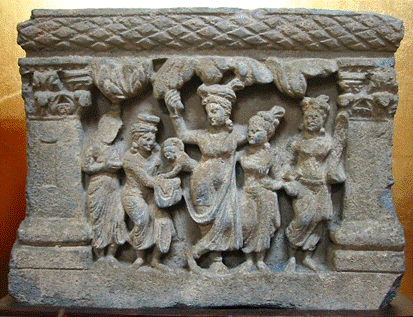
Queen Maya delivers the Buddha from her right side while holding a tree branch.
Credit: The Birth of Siddhartha Gautama. Gandharan relief sculpture, 2nd-3rd century CE, ZenYouMitsu Temple (善養密寺), Tokyo. Photograph by Tttrung, 2005. Wikimedia Commons, GNU Free Documentation License and Creative Commons Attribution-ShareAlike 3.0.
#33: Born through the Sacred Mouth
In the Assalāyana Sutta, the title character and a group of brahmins discuss the alleged superiority of the brahmin class, who claim to be born from the mouth of Brahmā, the divine creator figure in Brahmanical tradition. According to this belief, brahmins possess inherent purity and elevated status by virtue of their birth. The Buddha challenges this claim by arguing that brahmin women, like women of lower social classes, experience the same physical processes of human reproduction: “But Assalāyana, brahmin women are seen menstruating, being pregnant, giving birth, and breastfeeding” (trans. Bhikkhu Sujato). This conversation reflects ancient Indian concerns about bodily purity and its connection to social status and spiritual authority.
a proud man—
he forgets he once
wore a diaper
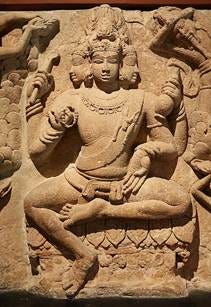
Credit: Brahma Sculpture from the Ceiling of Huchchappayya Gudi Temple, Aihole, Karnataka, 7th century. Photograph by Sailko, 2019. Wikimedia Commons. Licensed under Creative Commons Attribution 3.0 (CC BY 3.0).
#34: Precepts for Buddhist Monks
There are 250 rules for Buddhist monks to follow. The number varies somewhat by region and tradition, but 250 is the standard for mainstream orders in China and Korea. Some of these rules originated in the time of the Buddha himself. When he began a new religious movement separate from Hinduism, there were no established rules governing the new community. However, soon after ordained believers began living together, the need arose to regulate communal life through various rules. Each rule was created in response to a specific incident that necessitated it. Over the years, decades, and centuries, more rules were added as the lives of ordained monks became increasingly complicated.
Some of the rules seem anachronistic (“Do not make a fire outdoors”), while others sound frankly amusing (“Do not tickle another person”). Most, however, reflect a deep insight into human psychology. For example, monks are admonished not to sit alone with a woman in a secluded place. Rules like this are designed to protect the integrity of the monastic community and its members. One rule even sounds as though it were taken from a book of Western etiquette: “Do not speak while food is in your mouth.” All these rules demonstrate a desire to maintain the purity of thought and conduct in everyday life.
250 rules for monks—
we need one about
smartphones
#35: Precepts for Buddhist Nuns
Whereas Buddhist monks are required to follow 250 rules, Buddhist nuns are subject to 348. That is, they have 98 more precepts to follow. It may seem unfair that their monastic life is governed by almost 100 more rules than that of their male counterparts. However, this disparity should be considered in a socio-historical context. In the Buddha’s time, it was a revolutionary idea for women to belong to a monastic sangha. As members of a religious community, they needed to be protected from society while maintaining the community’s integrity and reputation.
While the rules for monks emphasize sexual purity, those for their female counterparts are even more stringent. Among the eight cardinal rules for nuns, three (1, 5, and 6) warn of the dangers posed by the opposite sex: avoid engaging in sexual intercourse; do not caress, with lustful intent, the parts of a lustful man below the armpits or above the knees; and do not meet the gaze of a lustful man, hold his hand or clothing, stand or talk with him in a secluded place, walk together with him, lean against each other, or make an appointment to meet again. There are many more rules concerning personal conduct, including one governing how nuns should clean themselves in the bathroom.
348 rules for nuns—
protection from the eyes
sunglasses hide
#36: The Buddhist Precepts for the Modern Age
The rules for ordained Buddhist monks and nuns serve as valuable guides for upright and harmonious living, and most of them are reasonable and sound deeply insightful. Still, some of them seem out of date. The rules related to begging for food make sense in themselves, but monks and nuns don’t beg for food in regions dominated by Mahayana Buddhism, such as China, Korea, and Japan. The rule requiring bathing less than twice a month also sounds both anachronistic and unhygienic. Obviously, the rule “Do not keep medicine for more than seven days” comes from an era when most medicine was herbal. Modern medicine often requires long-term drugs for treating various illnesses.
remote Korean temple—
monks watch U.S. news
by satellite
#37: What It Means to Be Seventy
By today’s standards, seventy is still part of the autumn of life. However, some changes are inevitable, and those who reach this milestone begin to realize certain things, perhaps for the first time in their lives. First, there is a narrowing circle of friends. It happens naturally. As people age, they may not have the energy to maintain too many friendships. It feels better to have a small number of friends with whom they don’t have to sound agreeable. In other words, they don’t care as much about pleasing people anymore.
Second, long-distance travel becomes an emotional and physical burden. In their younger years, visiting another country made their hearts flutter. No more. They don’t like the idea of being on a plane for more than ten hours, going through multiple checkpoints, and being surrounded by strangers.
Third, they become aware that other people, even their own children, are busy with their own lives. Their children may still be nice to them, but they are reluctant to contact them for fear that they might bother them with trivial news, so they spend more time alone.
Finally, they realize that, despite their current health, their time is running out. They don’t know how or when their lives will end, but they are aware that the moment is coming. This means that every remaining moment should not be wasted on things that are unimportant to them.
evening ocean
as I leave
the waves remain
#38: A Certain Funeral
A friend of mine told me about the funeral of a Korean American woman who died in her mid-nineties. He had given her a ride to a local Korean church for years, so he was close to her. She had three children, two sons and one daughter. Few people attended her funeral, and one son and her only daughter chose not to attend. There were not enough people to carry her coffin, so an associate pastor of the church volunteered to be a pallbearer. It was a sad reminder of how lonely elderly people can become. At the same time, it was a relief to think that she had finally left a world in which she must have felt abandoned and forgotten.
historic cemetery—
most gravestones
lying on the ground
#39: Clinging to One’s Wife
One of the most common complaints from the wives of retired Korean men is how difficult it is to prepare meals for them three times a day. A humorous piece of advice for retired men is not to become “a man of three meals,” who can exhaust his spouse. As a result, some men spend time outside their homes during the day, taking care of their lunch somewhere, preferably by eating a free lunch for seniors.
A less severe but equally annoying problem for senior women is that their retired husbands cling to them like children. At home, they follow their wives around, not knowing how to spend their time alone. Other times, they want to follow their wives when they go out to meet their friends.
Last night, I had a strange dream in which my wife was constantly out of my sight, and I ran hard to catch up with her. I have not retired, and as an independent-minded man, I am determined to maintain my dignity. Yet, deep down, I may have begun to cling to my wife.
retired man—
his wife used to follow him
now he follows her
#40: The Mystery of English
On Substack’s dashboard, I saw a category called “Paid Subscribers,” which referred to those who were paying to read the posts on the website. On second thought, however, the expression made me wonder whether it was the correct term because it sounded as if the subscribers were being paid by someone else. So, I asked ChatGPT which it preferred: “100 paid subscribers” or “100 paying subscribers.” It liked the first one because it was “shorter, more natural, and commonly used to distinguish subscribers who pay from free subscribers.” It added that although “paying subscribers” was also correct, it slightly emphasized the act of currently paying.
When I objected by saying that “paying” is active whereas “paid” is passive, ChatGPT answered, “Yes—I see what you mean. ‘Paid subscribers’ can momentarily sound as if the subscribers themselves are being paid.” Then it said, “I would choose ‘paying subscribers.’”
As I often do, I teased AI by saying, “So, you have changed your mind. :-)”
Below was its reply:
😂 Yes, I did! You caught me. My first answer was based on the conventional publishing/subscription phrase “100 paid subscribers.” But once you pointed out how it sounds to you—as though the 100 subscribers are receiving payment—I reconsidered the wording in context. So my revised recommendation is: 100 paying subscribers. It is simply clearer and avoids that possible ambiguity. You changed my mind. :-)
Then, hours later, it dawned on me that ChatGPT’s original answer might have been correct. Paid subscribers could refer to those who have already paid their fees, whereas paying subscribers could emphasize the ongoing act of paying. My thinking and rethinking left me confused, so I finally decided to go to bed and put the whole matter to rest.
the joy of growing old—
my daily chitchat
with AI
About the Author

Professor of English and Creative Writing and Associate Dean of the School of Humanities and Theology, Missouri Baptist University
John J. Han, PhD, is the author, editor, co-editor, or translator of 36 books. His forthcoming book, Echoes from the Hills: Critical Essays on Ozarks Literature (co-edited with C. Clark Triplett), will be published by the University of Arkansas Press. He has also published more than 3,000 poems, primarily haiku, in a wide range of journals and anthologies. In addition to his long tenure at Missouri Baptist University, he has taught at Kansas State University, the University of Nebraska–Lincoln, Nebraska Wesleyan University, and Washington University in St. Louis. He has also served as a visiting scholar at Georgia College & State University and the University of Ljubljana in Slovenia.
© K-Global Scholars and Professionals Forum. All rights reserved. Content published in the K-GSP Forum may not be reproduced, distributed, or transmitted in any form without prior written permission from the K-GSP Forum, except for brief quotations with full attribution.