
Dying in a Meditative Posture: Five Tales from Korean Buddhism
Poet’s Note:
The Haiku Society of America defines a haibun as “a terse, relatively short prose poem in the haikai style, usually including both lightly humorous and more serious elements, and typically ending with a haiku.” (Haiku Society of America: Haiku Definitions. https://www.hsa-haiku.org/hsa-definitions.html)
#1: Dying in a Meditative Posture
Many Buddhist monks in China and Korea are said to have died in an upright position. Those who attain 坐脫立亡 (dying while sitting or standing) become legendary figures among believers because such a death is traditionally understood to be possible only after many years of spiritual training. One Chinese monk is even said to have died while standing on his head.
A Korean monk named Hyesu died in 1987 after telling his fellow monks that dying while sitting or standing was the best way to go. They teased him, asking whether he would be able to die that way. Holding his cup of tea, he suddenly stopped moving. That was how he died.
Law enforcement officers later investigated his death but found no evidence of foul play. According to Buddhist custom, his body was cremated, and his ashes were scattered on a mountain. Because he had no disciples, his funeral was held without fanfare. Nevertheless, the manner of his death has remained a legend in Korea.
cancer diagnosis
a Zen master gets his chance
to belittle death
#2: Lines Written on the Deathbed
As in China and Japan, many senior Buddhist monks in Korea compose a poem before they die. It is called a Nirvana verse (涅槃頌) or deathbed verse (臨終偈). Almost always, it is written in Chinese, which Korean monks traditionally know well. Like Japan’s jisei (辞世), Korean deathbed poems tend to borrow images from nature and reflect on impermanence, the blurred line between life and death, and the sense of freedom as the entrapped soul leaves the body. The mood is somber but hardly sad. Because such a poem is typically written when a dying monk is surrounded by his disciples, it can sound instructive while also being paradoxical.
Here is the deathbed poem by Seosan Daesa (1560-1604):
千計萬思量
紅爐一點雪
泥牛水上行
大地虛空烈
A thousand plans, ten thousand thoughts—
one snowflake on a blazing furnace.
A clay ox walks across the water;
earth and sky burst into flame.
The poem uses paradoxical images to suggest a mind freed from ordinary distinctions and attachments: countless thoughts disappear like a snowflake on a blazing furnace, while a clay ox walks on water and earth and sky burst into flame. These impossible images reflect the Zen idea that enlightenment lies beyond ordinary logic, including the distinction between life and death.
Like Seosan Daesa, the Venerable Seongcheol (1912-1993) left a four-line deathbed poem:
生平欺狂男女群
彌天罪業過須彌
活陷阿鼻恨萬端
一輪吐紅掛碧山
All my life, I deceived men and women;
my sins fill the heavens, higher than Mount Sumeru.
Cast alive into Avīci Hell, I suffer endless regret;
a red sun hangs above the green mountain.
The first three lines sound intensely confessional, yet the final line reverses them. The image shifts from guilt and punishment to peace and tranquility, as illustrated by the natural scene. Some fundamentalist Christians in Korea feel sorry for him, interpreting his final poem literally rather than recognizing the Zen Buddhist paradox underlying it. The poem almost seems to be delivered with a tongue-in-cheek smile, as if he were playfully turning conventional ideas about death and punishment upside down.
surgery after surgery—
the growing number of
deathbed poems
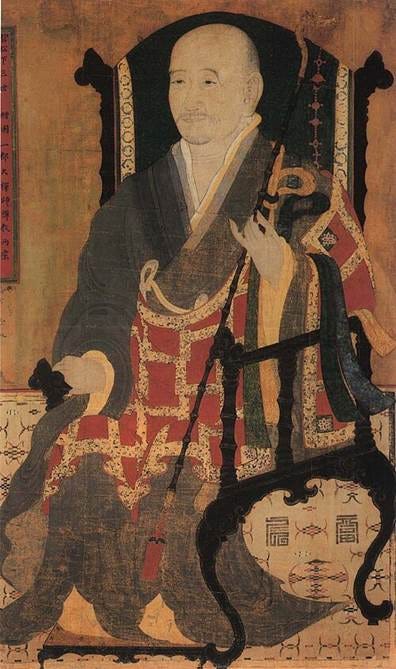
Figure 1: Portrait of Seosan Daesa (Cheongheodang), 1520-1604. Joseon Dynasty, hanging scroll, ink and color on silk, 152.1 × 77.8 cm. National Museum of Korea. Artist unidentified. Photograph from Seosan Buddhism. Public domain.
#3: More Than Words
The famous parable of the Good Samaritan in the Gospel of Luke teaches the importance of love in action. A traveler on the road is found beaten and stripped of his possessions. A priest and a Levite see him, but they pass by “on the other side” (Luke 10:31-32). However, a Samaritan, whom many Jews regarded with hostility, stops to help him, spending his time and resources to care for the wounded man. The priest and the Levite may have wished him well, perhaps even offering a short prayer for him. But it was the Samaritan who offered actual help.
A similar story in a Buddhist context comes from Korea many centuries ago. There was a monk named Daean who lived during the Silla period and was a contemporary of Wonhyo. One day, Wonhyo went to a cave to visit Daean, but Daean was not there. Instead, Wonhyo found a dead raccoon dog and its young pup crying beside it. Wishing for the dead raccoon dog to be reborn in the Pure Land, Wonhyo began reciting the Amitabha Sutra (阿彌陀經). At that moment, Daean returned and asked, “Do you think the pup can understand the sutra?” He then fed the pup some milk he had received while begging for alms and said to Wonhyo, “This is the Amitabha Sutra that the raccoon dog can understand.”
hot U.S. corn—
a delicacy after
the Korean War
#4: Alone with a Mysterious Woman
Gyeongheo (1849-1912) was a monk who helped revive the Seon (Zen) tradition of Korean Buddhism in the modern era. Known for his mu-ae-haeng (無碍行), or “unhindered conduct,” he lived freely without being bound by conventional forms or strict interpretations of Buddhist precepts. Several stories about him have been passed down as examples of his unconventional methods of awakening people to Buddhist truth.
One of them involves a mysterious woman with whom Gyeongheo spent more than ten days alone in his room. While staying at Cheonjangam, he brought a woman whose face was covered into his room and cared for her there, personally bringing her food. The monks and laypeople at the temple became suspicious, accusing him of violating Buddhist precepts and demanding that he be expelled. Just before he was driven out, the door opened and the woman emerged, revealing a body severely disfigured by leprosy. Gyeongheo had not been secretly violating the monastic rules; he had been caring for a woman suffering from leprosy who had nowhere else to go.
He composed the following poem before his death:
心月孤圓
光呑萬像
光境俱忘
復是何物
The mind-moon is solitary and full;
its light swallows the ten thousand forms.
Light and its objects are both forgotten;
what, then, is this?
In the first line, “mind-moon” (心月) is a metaphor for the awakened mind, imagined as a perfectly round, solitary moon. The second line suggests that the distinction between the perceiving mind and the countless things it perceives disappears. The third line deepens this idea: even the distinction between consciousness and the world has vanished. The final question deliberately refuses a conceptual answer, reflecting the Zen understanding that enlightenment cannot be fully defined or grasped through intellectual reasoning.
my shadow
outliving me
at noon
#5: The Relativity of Heaviness: Another Gyeongheo Episode
One evening, Zen master Gyeongheo and his disciple Mangong were walking along a mountain road. As the sun began to set and his legs grew tired, Mangong complained about the weight of the bag of alms he was carrying. When he could no longer take another step, Gyeongheo said, “Let me show you a way to walk faster. Just follow me.”
Before long, they reached a village where people were resting beneath a large shade tree. Gyeongheo noticed a young woman carrying a water jar on her head. Suddenly, like a mischievous child, he ran up to her, grabbed both her ears, and kissed her. The villagers were shocked. Young men grabbed clubs and shouted, “Catch that monk!” Gyeongheo took off running through the village, with Mangong racing after him. Fearing for their lives, the two monks ran toward the mountains until the villagers gradually fell behind. When Gyeongheo could no longer see anyone pursuing them, he stopped beneath a tree and sat down to catch his breath.
Turning to Mangong, Gyeongheo asked, “Well, is it still heavy?” Mangong replied, “When you think you might die, how can you feel the weight?” Gyeongheo nodded. “Exactly. When you no longer think about something as heavy, what can make it heavy?”
late for the train—
I didn’t know I could run
this fast
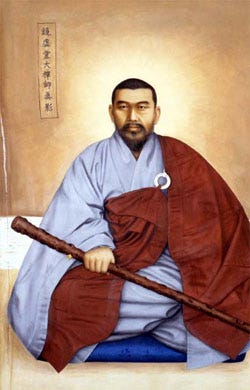
Figure 2: Kyeongheo Seongu (Kyong Ho Seong-Wu), 75th Patriarch. Photograph by unknown author, before 1912. Jogye Order. Public domain.
About the Author

Professor of English and Creative Writing and Associate Dean of the School of Humanities and Theology, Missouri Baptist University
John J. Han, PhD, is the author, editor, co-editor, or translator of 38 books. His forthcoming book, Echoes from the Hills: Critical Essays on Ozarks Literature (co-edited with C. Clark Triplett), will be published by the University of Arkansas Press. He has also published more than 3,000 poems, primarily haiku, in a wide range of journals and anthologies. In addition to his long tenure at Missouri Baptist University, he has taught at Kansas State University, the University of Nebraska–Lincoln, Nebraska Wesleyan University, and Washington University in St. Louis. He has also served as a visiting scholar at Georgia College & State University and the University of Ljubljana in Slovenia.
© K-Global Scholars and Professionals Forum. All rights reserved. Content published in the K-GSP Forum may not be reproduced, distributed, or transmitted in any form without prior written permission from the K-GSP Forum, except for brief quotations with full attribution.