

Facing Finality, Leaving the World: Five Haibun on Death and Dying in The Shepherd of the Hills
Poet’s Note:
The Haiku Society of America defines a haibun as “a terse, relatively short prose poem in the haikai style, usually including both lightly humorous and more serious elements, and typically ending with a haiku.” (Haiku Society of America: Haiku Definitions. https://www.hsa-haiku.org/hsa-definitions.html)
Harold Bell Wright (1872-1944) was an American novelist whose books sold millions of copies during his lifetime. As a popular writer, he produced morally uplifting, pleasant stories that are often marred by sentimentalism, didacticism, eugenic thinking, and a narrow vision of race and class. Some critics of his time criticized his fiction as shallow and formulaic, and he is rarely discussed in American literature classes except in the context of popular fiction. Despite the artistic and philosophical shortcomings of his work, however, it offers intriguing portrayals of American society at the turn of the twentieth century. As a genre, the novel provides panoramic views of an era, a place, and the people who inhabit it, and Wright’s fiction is no exception.
Wright wrote seventeen novels, six of which are set in the Ozarks: That Printer of Udell’s (1903), The Shepherd of the Hills (1907), The Calling of Dan Matthews (1909), The Re-Creation of Brian Kent (1919), God and the Groceryman (1927), and Ma Cinderella (1932). Only the first two novels were written during his residency in the Ozarks; the others were published after he had moved to California and later Arizona. His encounters with local people and customs in the Ozarks provided him with ample material for his fiction, which also serves as an important historical and sociological document.
Reading Wright’s Ozarks fiction also offers an opportunity to explore the universal experience of death and dying. As a keen observer of human life, he depicts different ways people die, how they confront death, and how their passing is remembered by the living. The following five haibun offer snapshots of five characters who encounter death in his fiction. In a sense, these poems approach Wright’s work from the perspective of thanatology, the interdisciplinary study of death, dying, and bereavement.
#1: Maternal Mortality: Maggie, Old Matt’s Daughter
Thanks to modern medicine, pregnancy-related deaths have declined, but childbirth remains a risky event. Severe bleeding and amniotic fluid embolism, for example, can endanger a woman’s life during delivery. Maternal mortality remains much more common in low-income countries.
In Wright’s second Ozarks novel, The Shepherd of the Hills, Old Matt’s daughter, Maggie, dies while giving birth to her son, Pete. Tragically, “Mad Howard,” a young landscape painter from Chicago, impregnates her and then abandons her. Later, he sends her a letter explaining that, despite his love for her, he cannot marry her. She falls into despair but continues to cling to hope until the last moment. Old Matt recalls what she said during childbirth: “She died when Pete was born, and the last thing she said was, ‘He’ll come, Daddy, he’ll sure come’” (ch. 6, “The Story”). Dad Howitt, the mysterious gentleman who comes to the Ozarks and listens to Old Matt’s story, is Howard’s father, a connection revealed near the end of the novel.
motherless child
her photo
smiles at him
#2: Dying with a Contrite Heart: “Mad Howard”
Knowing that his father would not approve of his marriage to an Ozark girl, “Mad Howard” agonizes over her while in Chicago. He becomes “morose and despondent,” showing signs of depression and suicidal thoughts (ch. 41, “The Other Side of the Story”). Years later, he decides to return to the Ozarks, ask Maggie for her forgiveness, and seek her father’s permission to marry her. Upon his arrival, however, he learns that she died during childbirth. He sends a letter to his father, indicating that he will be dead by the time the letter arrives. Believing his son to be dead, Dad Howitt comes to the Ozarks to atone for Mad Howard’s wrongdoing. Although he befriends Old Matt, he does not reveal his identity until later in the novel. He fears Old Matt’s reaction because the mountain man has vowed to kill both Mad Howitt and his father if they are caught. In fact, Mad Howard has not committed suicide. Instead, he has remained in the area, living in the woods and looking after Pete, a boy with an intellectual disability.
Mad Howard eventually dies from a gunshot wound sustained while helping a posse pursue Wash Gibbs, a member of the Bald Knobbers. Before Howard dies, Dad Howitt asks Old Matt to forgive his son, and the mountain man grants forgiveness in the name of God. Dad Howitt, Old Matt, Aunt Mollie, and Pete remain with Howard during his final moments. Smiling at Maggie’s picture hanging on the wall of his cave, Howard sees a vision of her: “Do—do—you—hear? She is calling—she is calling again. Yes—sweetheart—yes, dear. I—I am—com—” (ch. 42, “The Way of the Lower Trail”). Thus, the novel brings about a reconciliation between the Shepherd’s family and Old Matt’s family, as well as a spiritual reunion between Mad Howard and Maggie.
winter afternoon
sunlight brightens
an empty chair
#3: Ready to Go Anytime: Dad Howitt
Some people, even those who have lived past the average life expectancy, fear death. Given the mystery surrounding death, such fear is understandable. Others, however, feel that, having lived a full life, they are ready to leave the world without many regrets. Dad Howitt is one of them. After losing his son and receiving Old Matt’s forgiveness, he feels relieved, as though he could leave the world at any time. The burden he has carried on his shoulders for many years has been lifted, and death no longer frightens him; rather, it represents rest. In his conversation with Pete following Mad Howard’s death, Dad Howitt says that although he does not know when his time will come, he is “ready any time now” (ch. 43, “Poor Pete”). Such a peaceful view of death is not uncommon among older people, especially those who are spiritually inclined or who accept death as part of the life cycle. A good example is the title character of Willa Cather’s Death Comes for the Archbishop (1927), who says with a smile that it is natural to die in old age: “I shall not die of a cold, my son. I shall die of having lived.” Perhaps this is an ideal way for those who have lived a full life to depart from the world—departing with calmness and dignity.
deathbed
all weep except for
the dying
#4: Next Life as a More Desirable World: Pete
While Pete has limited intellectual abilities, he is endowed with a rich imagination. In chapter 43 of the novel, he tells Dad Howitt about “the white hills” in the sky, which he would like to reach as soon as possible. Dad Howitt does not correct him; instead, he applauds his vision. Pete says that people ridicule him for talking about “the white hills, the flower things, the sky things, an’ the moonlight things that play in the mists,” except for Dad Howitt, Old Matt, and Aunt Mollie. These three figures recognize that Pete understands things that others do not. Pete’s passing is briefly mentioned later in the chapter: “The summer passed, and, when the blue gray haze took on the purple touch and all the woods and hills were dressed with cloth of gold, Pete went from the world in which he had never really belonged, nor had been at home.” Those who ridicule Pete regard him as “a dreamer, a fanatic, or a fool,” but Dad Howitt sees him as a young soul with the capacity to “understand.” Not many people in this world, even those who have firm faith in the afterlife, would share Pete’s desire to leave this world early. Yet Pete is an exception. For him, the next life holds an attraction that the earthly world never offered, and his passing seems almost like a homecoming. Despite the difficulties of his earthly existence in the woods, Pete seems to have found contentment in his own imaginative world.
approaching death
his eyes turn toward
distant hills
#5: Death That Brings No Sorrow: Wash Gibbs
In East of Eden (1952), John Steinbeck writes, “It seems to me that if you or I must choose between two courses of thought or action, we should remember our dying and try so to live that our death brings no pleasure on the world.” The passing of most people causes sorrow in their communities. In rare cases, however, someone’s death brings not sorrow but relief, even what Steinbeck calls “pleasure.” Wash Gibbs, a character in The Shepherd of the Hills, is a typical “bad guy” in Wright’s fiction, with no redeeming qualities. One reason Wright’s fiction is often devalued is his reliance on stereotypical characters: some are blameless in both appearance and conduct, while others are portrayed as having no value to society. Our life experience shows that no one is perfect and no one is entirely unredeemable. In this respect, Wright was a romanticist rather than a realist. Some readers are drawn to such unrealistic representations of life because they offer a comforting alternative to the problems they encounter in the real world. Popular writers such as Wright and even John Grisham tend to see themselves primarily as storytellers who write for entertainment rather than as literary writers.
Wash Gibbs’s death in Wright’s novel is gruesome. He is wounded during the conflict between the Baldknobbers and the posse. During the attack on Jim Lane’s cabin, Wash shoots and kills Jim Lane but is wounded by a posse member. Later, his body is discovered in the woods, where buzzards have been feeding on it. Wright describes the discovery as follows: “By the shreds of clothing and the weapons lying near, they knew that the horrid thing, from which as they approached, carrion birds flapped their wings in heavy flight, was all that remained of the giant, Wash Gibbs” (ch. 35). The chapter ends with a brief but significant sentence: “Thus does justice live even in the hills.” Wash’s body, reduced to food for scavenging birds, becomes a fitting end for a man whose crimes have brought suffering to others.
his life sentence—
no one disagrees except
his family
Appendix: Where Harold Bell Wright’s Characters Rest: The Shepherd of the Hills Historic Evergreen Cemetery (An excerpt from a photo essay published in the April 2026 issue of The Right Words: A Magazine of Nonfiction)
When Harold Bell Wright was writing his bestselling novel The Shepherd of the Hills (1907), he drew inspiration from residents of the Ozarks, particularly those living in and around Branson, Missouri. As a relative newcomer to the region, Wright was struck by the hardships of hill life and by what he perceived as its enduring virtues—faith, family loyalty, honor, hard work, integrity, and honesty. It is therefore not surprising that he modeled several of his fictional characters on real individuals he encountered.
Among these were Old Matt and Aunt Mollie (John K. and Molly Ross), Uncle Ike (Levi Morrill), Dad Howitt (Truman S. Powell), and fiddlin’ Jake (Charles A. Vining). The individuals believed to have inspired these characters are buried in the Shepherd of the Hills Historic Evergreen Cemetery, located near Notch along Highway 76. Today, the site lies less than a mile from Silver Dollar City, and traffic along the highway can be heavy despite the cemetery’s otherwise quiet, pastoral setting.
I had intended to visit Evergreen Cemetery for three years but did not have the opportunity until attending the annual conference of the Ozarks Studies Association in Springfield, Missouri, in April 2026. A drive of about forty-five minutes south along Highway 65 brought me to the site. The cemetery was not included in my earlier photo essay book, Harold Bell Wright’s Ozarks: Photos with Notes (Cyberwit, 2023), as I was unaware of it at the time. Visiting the cemetery near sunset in the spring felt quietly significant. It was as if I were encountering the real lives behind Wright’s fictional world—individuals whose stories, though long past, still resonate through the landscape.

The Shepherd of the Hills Historic Evergreen Cemetery lies less than a mile east of Silver Dollar City on Missouri State Highway 76. Composite image based on map data © OpenStreetMap contributors.
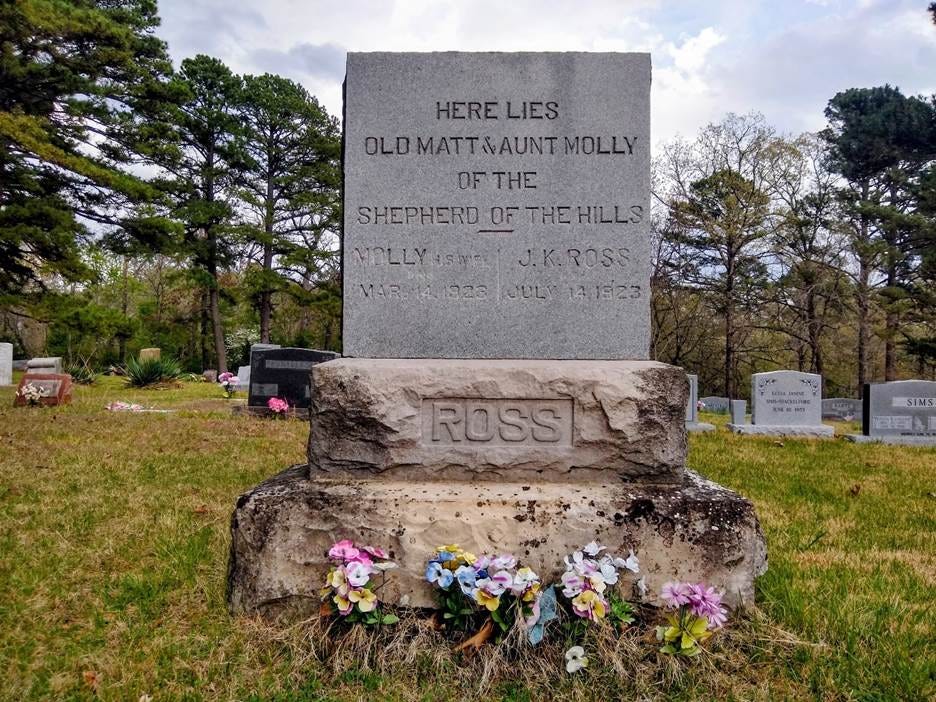
The Ross couple’s gravestone reads, “Here Lies Old Matt & Aunt Molly of The Shepherd of the Hills.” Aunt Molly (spelled “Mollie” in the novel) died on March 14, 1923, and J. K. Ross died on July 14, 1923. Following the publication of Wright’s novel, Old Matt became something of a local celebrity among fans, and his cabin became a popular tourist destination. For several years, he also gave lectures on Wright’s positive influence in the Ozarks.
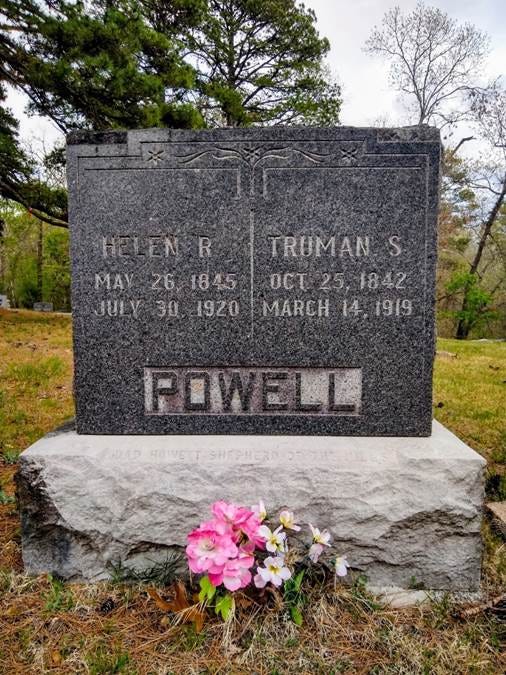
A grave marker for Truman S. Powell (1842-1919), who appears as Dad Howitt in Wright’s novel, and his wife, Helen R. Powell (1845-1920). The namesake of The Shepherd of the Hills, Dad Howitt is a former preacher from Chicago who comes to the Ozarks seeking to atone for his son’s wrongdoing against Old Matt and Aunt Mollie’s daughter, who died while giving birth to his child. His arrival as an educated outsider adds an air of mystery, which gradually unfolds as his identity is revealed. The story ultimately concludes with a reconciliation between the grieving couple and Dad Howitt.
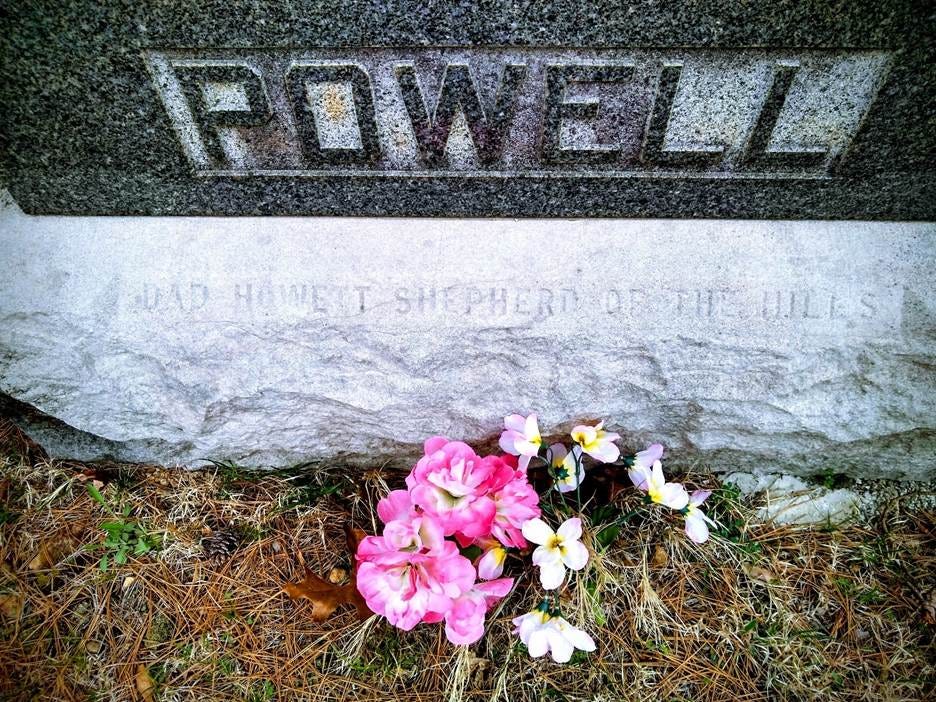
The base of the Powell marker reads, “Dad Howitt Shepherd of the Hills.” In Chapter 38 of the novel, the narrator states,
In sickness or in trouble of any kind the people for miles around had long since come to depend upon the shepherd of Mutton Hollow. The old man [Dad Howitt] turned now to the doctor [who came from Chicago to persuade him to return to Chicago]. “Someone needs me, David. We must go with the boy.”
The word “shepherd” appears almost 100 times in The Shepherd of the Hills. Initially a ranch shepherd in the Ozarks, Dad Howitt becomes a spiritual leader for the hill people.



Other views of the Shepherd of the Hills Evergreen Cemetery.
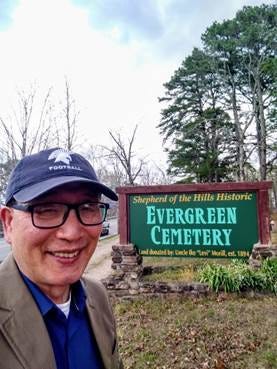
About the Author

Professor of English and Creative Writing and Associate Dean of the School of Humanities and Theology, Missouri Baptist University
John J. Han (PhD, University of Nebraska-Lincoln) is the author, editor, co-editor, or translator of 38 books published by Rodopi, Peter Lang, McFarland, Bloomsbury Academic, and other presses. His forthcoming book, Echoes from the Hills: Critical Essays on Ozarks Literature, co-edited with C. Clark Triplett, will be published by the University of Arkansas Press. He has published hundreds of scholarly articles and more than 3,000 poems, mostly haiku, in journals and anthologies. He is in his 28th year as a full-time faculty member at Missouri Baptist University. He has also taught at Kansas State University, the University of Nebraska–Lincoln, Nebraska Wesleyan University, and Washington University in St. Louis. He has served as a visiting scholar at Georgia College & State University and the University of Ljubljana in Slovenia.
© K-Global Scholars and Professionals Forum. All rights reserved. Content published in the K-GSP Forum may not be reproduced, distributed, or transmitted in any form without prior written permission from the K-GSP Forum, except for brief quotations with full attribution.