

Five More Ways to Have a Pleasant Professorial Career in America: Five Haibun
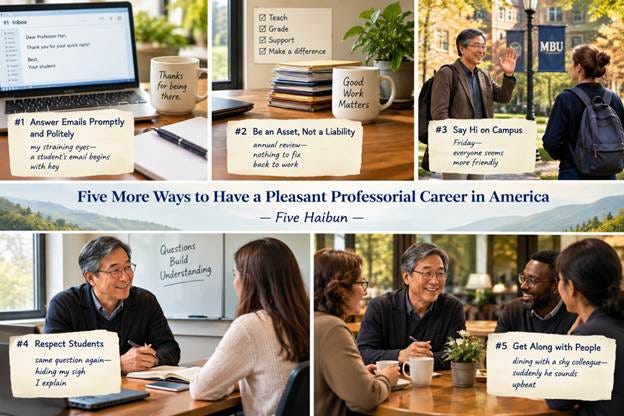
Image credit: Illustration generated with OpenAI’s ChatGPT image-generation tool, 2026.
Poet’s Note:
The Haiku Society of America defines a haibun as “a terse, relatively short prose poem in the haikai style, usually including both lightly humorous and more serious elements, and typically ending with a haiku.” (Haiku Society of America: Haiku Definitions. https://www.hsa-haiku.org/hsa-definitions.html)
My October 2, 2026, K-GSP post, titled “Five Ways to Have a Pleasant Professorial Career in America: Five Haibun,” offered five tips: smile, have a sense of humor, say thank you, say sorry, and avoid negativity. This sequel presents five more ways to enjoy a professorial career. These tips are not directly related to professional accomplishments, which are expected of those who pursue careers in higher education. Rather, they focus on intangible qualities that can make life at a college or university less stressful and more tolerable.
These tips are drawn from my long experience teaching at the college level since the spring of 1986. Over the past four decades, I have taught at several institutions of higher learning and encountered colleagues of many different kinds. Some have taught me valuable lessons through their positive example, while others have seemed to struggle with interpersonal relationships. Of course, colleges and universities differ in their institutional cultures and power dynamics. I recognize that my perspective has been shaped by working at a small, denominationally affiliated private university. Nevertheless, having also taught at research universities for more than ten years, I believe my tips may be worth considering.
#1: Answer Emails Promptly and Politely
In the legal profession, attorneys are often expected to respond to their clients’ emails within 24 business hours. A similar principle applies in academia. My own policy is to respond within an hour, usually within ten minutes. My reasoning is simple: if a message deserves a response, I answer it as soon as possible and move on with my life. I sometimes surprise my students by replying to their emails at 3:00 a.m., just minutes after they send them. As I grow older, I tend to sleep less and prefer not to go to bed with unanswered messages. This habit may sound extreme, but students appreciate my promptness.
Of course, it is possible to overlook an email and forget to respond. Everyone makes mistakes. However, habitually ignoring emails can become a problem and create the unintended impression that you are arrogant or negligent. When all is said and done, a college or university is also an organization with business responsibilities. Although most institutions of higher learning are not-for-profit, they still have financial responsibilities and operate year-round, at least for administrators and staff. A supervisor or colleague who does not receive a timely reply may not confront you about it, but they may begin to form a negative opinion of you. In any organization, it is unwise to give someone a reason to dislike you.
A polite, pleasant tone can go a long way in professional correspondence. When responding to emails from supervisors, colleagues, editors, and students, I usually begin with greetings such as “Dear” and “Hi” and use closings such as “Thanks,” “Sincerely,” “Take care,” and “All the best.” My email signature already includes the word “Thanks,” which saves me a step. Even when there is not much to be thankful for, I find that cordial closing helps maintain good professional relationships. Perhaps the simple word “Thanks” can make the recipient feel appreciated.
During the first week of each semester, I post instructions on how to compose an academic email in my Canvas course shells. My goal is not to demand respect from my students but to help them learn how to communicate politely in writing. I do not lecture them about email etiquette, but at least some of them read the instructions. After all, college is not just about acquiring knowledge; it is also an opportunity to develop communication skills that will serve students well after graduation.
my straining eyes—
a student’s email begins
with hey
#2: Be an Asset, Not a Liability
Professors are intelligent people with strong academic records. From an administrator’s perspective, however, they differ in how much supervision and support they need. Some do their jobs well without requiring much attention from their supervisors. They are dependable, and administrators appreciate them. Others may need occasional intervention for one reason or another. Supervisors are there to support and guide faculty, but they naturally hope that most issues can be resolved without their direct involvement.
One way to maintain that independence is to do your job well: submit grades on time, teach effectively, and treat students and colleagues professionally. As an administrator, I appreciate faculty members who handle their responsibilities without creating unnecessary problems. My approach has been to empower my colleagues and give them as much independence as possible. Fortunately, I have had wonderful colleagues in my unit over the past decade or so. They have been tremendous assets, and I am proud to have worked with them.
annual review—
nothing to fix
back to work
#3: Say Hi on Campus
Over the years, I have known colleagues who are accomplished academics and respected teachers but seem less comfortable interacting with others on campus. They tend to keep to themselves and sometimes fail to respond or make eye contact when someone greets them. They hurry into their offices without exchanging even a few words with colleagues, then close the door. I know everyone is busy, but a brief greeting takes only a few seconds. I doubt they intend to offend anyone. They may simply be shy or uncomfortable in casual social situations.
Still, a college or university is a workplace, and colleagues should display a minimum amount of friendliness. Professors do not need to look cheerful all the time, but acknowledging a colleague’s greeting is a simple courtesy that can make a difference. There is a time for academic seriousness and a time for everyday social interaction. Making a small effort to greet others can go a long way toward being seen as an approachable colleague.
Friday—
everyone seems
more friendly
#4: Respect Students
These days, some students seem to view themselves as customers of a college or university. In extreme cases, they may speak to their professors in much the same way some customers speak to retail workers. Fortunately, such students are rare. They know that the academic relationship is different from a commercial transaction: professors have the authority to evaluate students’ work and assign grades. Of course, most professors do not use their authority to intimidate students but strive to be fair and supportive.
As people with specialized knowledge, professors often find it difficult to understand why students ask questions whose answers are already in the syllabus. It can be tempting to dismiss such questions, but students may benefit from hearing an explanation from their instructors. Even when the relevant information is readily available, a little patience can help.
Respecting students also means creating a professional classroom environment. Professors should make every effort to grade and return assignments before the next assignment is due. Timely feedback helps students track their progress and identify areas for improvement. In class, professors should stay focused on course content while treating differing perspectives with respect, humility, and charity.
same question again—
hiding my sigh
I explain
5. Get Along with People
Some retirees say they are glad they no longer have to deal with people they dislike, especially former colleagues. But how did those colleagues perceive them? No one is perfect, and we are not always aware of how others see us. Every organization has people who are difficult to get along with. That is part of life. People differ in their personalities, and the key is learning how to work with them. We do not have to agree on everything. Our goal is to fulfill our respective responsibilities as effectively as possible.
The Bible encourages us to do our part to maintain peaceful relationships. Romans 12:18 says, “If it is possible, as far as it depends on you, live at peace with everyone” (NIV). Hebrews 12:14 similarly advises, “Make every effort to live in peace with everyone” (NIV). A Buddhist text offers a comparable perspective. The Dhammapada, a collection of Buddhist teachings, observes, “There are those who do not realize that one day we all must die. But those who do realize this settle their quarrels” (6, trans. Acharya Buddharakkhita).
In academia, getting along with others is important for our emotional well-being. Colleagues do not necessarily become friends, although some professional relationships develop into lasting bonds when people share interests, values, or ways of thinking. Regardless of whether such bonds develop, maintaining cordial relationships with colleagues makes it easier to work together.
dining with a shy colleague—
suddenly he sounds
upbeat


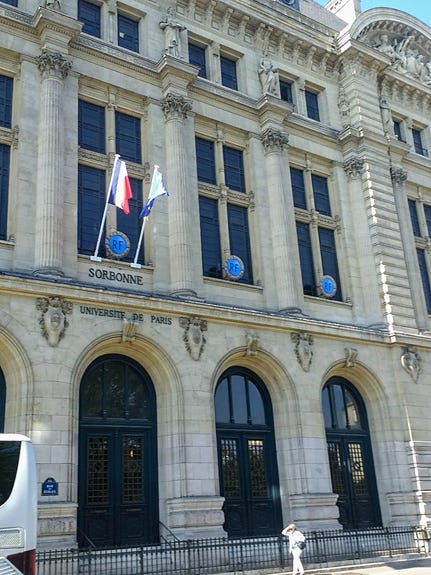
University of Paris, France. Photos by John J. Han, 19 June 2025.
About the Author

Professor of English and Creative Writing and Associate Dean of the School of Humanities and Theology, Missouri Baptist University
John J. Han, PhD, is the author, editor, co-editor, or translator of 38 books published by Rodopi, Peter Lang, McFarland, Bloomsbury Academic, and other presses. He has published hundreds of scholarly articles and more than 3,000 poems, mostly haiku, in journals and anthologies around the world. His forthcoming book, Echoes from the Hills: Critical Essays on Ozarks Literature, co-edited with C. Clark Triplett, will be published by the University of Arkansas Press. He is in his 28th year as a full-time faculty member at Missouri Baptist University, where he has taught since 1999. He has also taught at Kansas State University, the University of Nebraska–Lincoln, Nebraska Wesleyan University, and Washington University in St. Louis. He has served as a visiting scholar at Georgia College & State University and the University of Ljubljana in Slovenia.
© K-Global Scholars and Professionals Forum. All rights reserved. Content published in the K-GSP Forum may not be reproduced, distributed, or transmitted in any form without prior written permission from the K-GSP Forum, except for brief quotations with full attribution.