

Five Ways to Have a Pleasant Professorial Career in America: Five Haibun
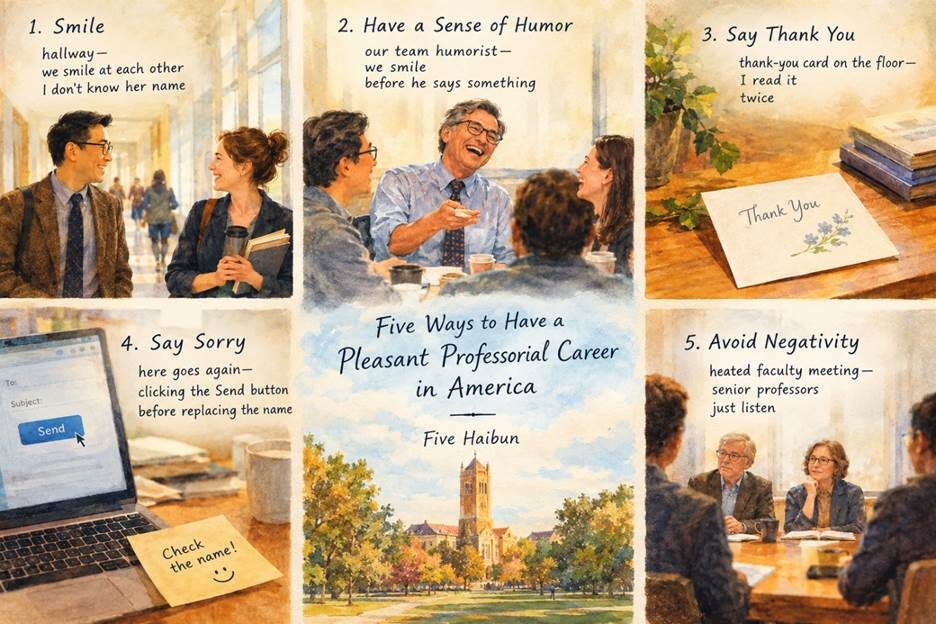
Figure: Five Ways to Have a Pleasant Professorial Career in America—Five Haibun. AI-generated illustration created with OpenAI image generation, 2026.
Poet’s Note:
The Haiku Society of America defines a haibun as “a terse, relatively short prose poem in the haikai style, usually including both lightly humorous and more serious elements, and typically ending with a haiku.” (Haiku Society of America: Haiku Definitions. https://www.hsa-haiku.org/hsa-definitions.html)
In my experience, many Asian professors place a strong emphasis on hard work, professional achievement, and accountability. In general, they do not need much advice on how to become competent and productive academics and researchers, especially those who grew up and worked in Asia, where professional competence alone does not always guarantee success because personal connections can be as important as professional ability. The following five senryu-based haibun address five things that, in my experience, can make professorial life more pleasant and less stressful.
These five tips are based on my own experience of American academic life, first as a graduate teaching assistant and lecturer, then as an adjunct professor, and later as a professor. I began my teaching career in the United States in the spring of 1989, during the second semester of my master’s studies. I have certainly made my share of mistakes, and these tips have grown out of my trials, errors, and experiences along the way. At the twilight of my academic career, I thought that sharing these five lessons with younger scholars might be helpful.
#1: Smile
One of the first things I noticed after coming to the United States was that people smiled—and smiled a lot—even at people they did not know. Perhaps this was partly because I came to Kansas rather than New York City or Boston, where social interactions can seem less personal. Coming from a corporate background marked by considerable stress and accustomed to multitasking, I found this friendliness refreshing. Before long, I learned to smile as well, and it made me feel better.
Fundamentally, most of our colleagues are people we may never have known outside the workplace and may never see again once one of us leaves. Yet exchanging a smile with a colleague can make campus life warmer and less hostile. Professors are often so engrossed in demanding projects or so buried under a heavy stack of papers to grade that they forget to smile. A smile costs nothing, yet it can brighten the day of those who receive it.
hallway—
we smile at each other
I don’t know her name
#2: Have a Sense of Humor
Based on my experience of traveling to more than a dozen countries, I have found the United States to be a country in which humor plays an especially prominent role in everyday life. Every country has its share of humorous people, of course, but in the United States, humor is often an essential part of social interaction. Public speeches commonly begin with a humorous remark, and even some preachers begin their sermons with a light joke. In return, the audience is expected to laugh, even when the joke is not particularly funny. Humor serves as an icebreaker, and laughing together can create a sense of oneness, at least on the surface.
It can be difficult for people who are new to the United States, especially serious scholars, to know how to respond to humor. One thing they may learn is to expect a joke at almost any moment, including when meeting someone for the first time. Another is how to respond to it. A simple, lighthearted response can help put everyone at ease, whereas little or no response can make an otherwise friendly encounter somewhat awkward. Regardless of their positions or occupations, people need moments of lightness in their lives. A sense of humor, or simply a willingness to appreciate and respond to humor, can make a person more likeable than someone who always appears serious or expressionless. In general, having a colleague or supervisee who is overly serious or even grumpy can make the workplace less pleasant.
our team humorist—
we smile
before he speaks
#3: Say Thank You
In some cultures, people may appreciate someone’s kindness in their hearts without expressing their gratitude outwardly. Those who perform an act of kindness may simply assume that their efforts have been appreciated. In the United States, however, people tend to express their appreciation more explicitly, often in writing as well as in person. From an American perspective, expressing gratitude is an important part of maintaining good relationships. A couple of weeks ago, I wrote a recommendation letter for one of my supervisees. Earlier this week, when I opened my office door, I found a thank-you card from her on the floor. Her office is directly across the narrow hallway from mine, close enough that we can communicate by calling each other without even raising our voices. She had already thanked me by email, but this time she gave me a card as well. Not many young people these days take such extra steps to express their appreciation, but she was raised in a family that taught her the value of good manners.
On the other hand, forgetting to say thank you can be a red flag in a collegial relationship. I once had a colleague, a staff member, who emailed me about a new instructor who was not under my supervision. I replied that the instructor did not work in my academic unit and directed him to the appropriate supervisor. Obviously, he had sent the email to the wrong person, but I took the time to provide the information he needed. I never received a thank-you response. If he were to send me a similar request in the future, I would probably hesitate before taking the time to help. A simple “thank you” costs nothing. It takes only a couple of seconds to type the words, but it can make people more willing to help one another.
unexpected thank-you card—
I read it
twice
#4: Say Sorry
Everyone makes mistakes. The only difference is that some people make more mistakes than others. When we make mistakes in the workplace, we often inconvenience someone, even if only momentarily. That person may be our supervisor, colleague, staff member, or even a student. When we make a mistake, it is important to admit it as soon as possible and apologize sincerely.
As a coeditor of an academic book, I sent an email to all the contributors last night asking them to revise their chapters based on the copyeditor’s comments, suggestions, and questions. The message was essentially the same for everyone. I had sent one author a similar email earlier, so I recycled that message, pasted it into the email I was preparing for another author, and clicked the Send button without noticing that I had not changed everything.
Today, I received a reply from the author confirming that he would finish revising his chapter over the weekend. At the end of his message, he added a note: “P. S. Not sure who the ‘Brian ______’ was that you ran into in West Plains, but it wasn’t this one. (Haven’t been there in years. :)” I immediately realized what I had done. I had copied an email addressed to “Steve” and accidentally left in the opening: “I hope this email finds you well. It was great to see you in West Plains a couple of weeks ago.” Of course, I apologized for the confusion. A simple apology can quickly resolve a mistake that might otherwise become unnecessarily awkward.
here goes again—
clicking the Send button
before replacing the name
#5: Avoid Negativity
Life is full of problems, and they will not end until we depart from this world. We persist despite our problems because that is simply the way of life. Sometimes problems need to be dealt with. At other times, however, they cannot be solved, and we are better off learning to live with them, so to speak, grinning and bearing them unless they threaten our lives.
One strategy for maintaining a pleasant work life is to focus on the positive rather than the negative. All colleges and universities, even prestigious and wealthy ones, have their own problems, and it is easy to gripe about one’s workplace. As a long-term professor at a small university, I have always believed that people should not remain in a place that makes them consistently unhappy. If a workplace is truly unbearable, they should consider finding a better place, although a new workplace may look better on the surface while having problems of its own.
On a more personal level, it is prudent to avoid making negative comments about someone’s appearance, weight, quirks, or peculiarities. Such comments may not occur very often in an academic setting, but people sometimes laugh when they hear demeaning remarks about others, including senior administrators and colleagues. Even so, they are likely to become wary of the person making those remarks. They may reason that someone who mocks others may eventually mock them behind their backs. Avoiding unnecessary negativity can help build trust and make collegial relationships more comfortable. The key is to strive to be known as someone who is pleasant rather than unpleasant.
heated faculty meeting—
senior professors
just listen



Christ Church College, Oxford, was founded in 1546 by King Henry VIII. Its alumni include Sir Philip Sidney (1554-86), poet and courtier; Lewis Carroll (1832-98), author of Alice’s Adventures in Wonderland (1865) and Through the Looking-Glass (1871); John Crowe Ransom (1888-1974), scholar and literary critic; and W. H. Auden (1907-73), poet. Photos by John J. Han, 13 May 2026.
About the Author

Professor of English and Creative Writing and Associate Dean of the School of Humanities and Theology, Missouri Baptist University
John J. Han, PhD, is the author, editor, co-editor, or translator of 38 books published by Rodopi, Peter Lang, McFarland, Bloomsbury Academic, and other presses. He has published hundreds of scholarly articles and more than 3,000 poems, mostly haiku, in journals and anthologies around the world. His forthcoming book, Echoes from the Hills: Critical Essays on Ozarks Literature, co-edited with C. Clark Triplett, will be published by the University of Arkansas Press. He is in his 28th year as a full-time faculty member at Missouri Baptist University, where he has taught since 1999. He has also taught at Kansas State University, the University of Nebraska–Lincoln, Nebraska Wesleyan University, and Washington University in St. Louis. He has served as a visiting scholar at Georgia College & State University and the University of Ljubljana in Slovenia.
© K-Global Scholars and Professionals Forum. All rights reserved. Content published in the K-GSP Forum may not be reproduced, distributed, or transmitted in any form without prior written permission from the K-GSP Forum, except for brief quotations with full attribution.
Totally fully agreed. 🥰👍😄