

Five World Masterpieces: Intertextual Haibun
Poet’s Note:
The Haiku Society of America defines a haibun as “a terse, relatively short prose poem in the haikai style, usually including both lightly humorous and more serious elements, and typically ending with a haiku.” (Haiku Society of America: Haiku Definitions. https://www.hsa-haiku.org/hsa-definitions.html) The following haibun are what I call intertextual haibun. While similar in tone to other types of haibun, this form weaves prose and haiku around engagement with other texts—literary, historical, philosophical, or sociological—creating layered meditations on the human condition. Each haibun incorporates a citation drawn from either written or oral sources, hence the term intertextual. These sources serve three functions: as epigraphs that inspire the piece, as central topics for reflection, and as references that inform or deepen the narrative.
#1: The Ramayana: A Journey of Love and Duty
The Ramayana, attributed to the ancient sage Valmiki, is one of India’s great Sanskrit epics. Its 24,000 couplets tell the story of Prince Rama, whose fourteen-year exile takes him from the royal palace into the forest and eventually across the sea to Lanka (present-day Sri Lanka). When the demon king Ravana abducts his beloved wife, Sita, Rama sets out to rescue her, aided by his brother Lakshmana and an army of monkeys. Gods, humans, animals, and demons inhabit this vast world of adventure, danger, love, and supernatural power. Beneath the spectacle of aerial battles and miraculous journeys lies a deeper concern with dharma, the duties that govern family, marriage, leadership, and human conduct.
What is most striking is Sita’s determination to accompany Rama into exile. When he suggests that she remain behind, she insists that life with him in the forest would be better than heaven without him. Her words express an ideal of marital devotion deeply rooted in the epic’s Hindu worldview. Rama, too, embodies ideals of nobility, courage, and responsibility, although his decisions sometimes invite questions about the demands of duty and the cost of moral perfection. The story is more than a heroic rescue. It explores the difficult relationship between love and obligation, personal happiness and social expectations.
After centuries of retelling, Rama and Sita continue to live in the imagination of millions. Perhaps an epic survives not simply because its heroes conquer evil, but because each generation discovers new questions in their journey.
forest path
a young couple
whispering
#2: The Shijing: The Songs of the Human Heart
[…]
“Ah, you forget those days gone by,
When you came nestling to my side!”
—The Book of Songs, “Lament of a Discarded Wife” (trans. William Jennings)
The Shijing (詩經), or Book of Songs, preserves 305 poems collected over centuries of ancient China, from the Western Zhou to the Spring and Autumn periods. More than 2,500 years have passed, yet the voices remain familiar: a wife waiting for her husband, a soldier longing for home, a bride entering an unfamiliar household, a woman grieving a broken promise. Some songs accompanied court ceremonies; others seem to have risen from ordinary lives along the Yellow River. Their authors remain largely unknown, but their feelings have survived.
Reading the translated poems, we hear the loneliness of women whose husbands are away at war, the anxiety of brides leaving their parents, and the quiet longing of lovers separated by distance. In “The Absent Husband,” a woman abandons her basket of gathered plants, unable to think of anything but the man she cannot find. In “The Soldier Sighs for Wife and Home,” a soldier remembers the vows made before leaving. Across the centuries, these anonymous voices seem to speak to one another. The language may be unfamiliar, and translation may obscure some of its music, but longing needs no interpreter.
The Shijing is more than an ancient literary monument or one of the Five Confucian Classics. It is a record of ordinary human affections, preserved in songs that outlived their singers. I think of those unnamed women and men, their joys and disappointments, their hopes entrusted to words. Perhaps poetry endures because the human heart changes so little.
frozen river
under the ice
a leaf turns
#3: Don Quixote: Between Imagination and Reality
“Presently he [Don Quixote] broke out again, as if he were love-stricken in earnest, ‘O Princess Dulcinea, lady of this captive heart, a grievous wrong hast thou done me to drive me forth with scorn, and with inexorable obduracy banish me from the presence of thy beauty. O lady, deign to hold in remembrance this heart, thy vassal, that thus in anguish pines for love of thee.’”
— Miguel de Cervantes’ Don Quixote (trans. John Ormsby)
Don Quixote (Part One in 1605, Part Two in 1615) is both a parody of medieval romances of chivalry and a reflection of the Renaissance spirit. Having devoured countless stories of knights, damsels, and heroic adventures, an aging country gentleman loses his grip on reality and sets out to right the world’s wrongs. His intentions are noble, but his actions are often foolish. Mistaking ordinary windmills for giants and flocks of sheep for opposing armies, he turns everyday encounters into imaginary battles. Cervantes makes us laugh at his delusions while reminding us of the distance between noble intentions and actual deeds.
At his side rides Sancho Panza, a practical peasant whose common sense provides a counterpoint to his master’s extravagant imagination. Although initially attracted by the promise of rewards, Sancho gradually becomes a loyal companion. He sees the world as it is, while Don Quixote sees it as it ought to be. Their conversations reveal an unlikely friendship between two men from different worlds. Beneath the comedy, there is something touching about Sancho’s patience and Don Quixote’s stubborn idealism. Perhaps the knight is foolish, but his desire to defend the helpless and correct injustice is not entirely ridiculous.
Reading about knights, dragons, and distant adventures is enjoyable, but most readers would rather live in the comfort of the twenty-first century. Still, I wonder whether a world without dreamers would be any better. Don Quixote may mistake windmills for giants, but at least he refuses to accept the world as it is.
romance novel—
turning the last page
alone again
#4: Matsuo Basho, The Narrow Road to the Deep North (1702)
In the spring of 1689, Matsuo Basho set out from Edo (present-day Tokyo) with his companion Sora on a journey through the remote northern regions of Japan. Over five months, they traveled nearly 1,500 miles, mostly on foot, visiting places celebrated in the poems of earlier writers, especially Saigyo. For Basho, the journey was both a physical pilgrimage and a passage through literary history. Mountains, temples, villages, and ancient battlefields became occasions for reflection. He carried the voices of earlier poets with him yet sought new images and new expressions of his own. Combining prose and haiku, he transformed a travel diary into a meditation on time, nature, memory, and the impermanence of human life.
Basho did not simply record what he saw. He revised his observations and poems for five years, shaping the journey into a carefully composed literary work. His companion Sora kept a diary of their travels, but Basho’s posthumously published account presented a more contemplative and ascetic traveler. In this blending of experience and artistic imagination, fact and poetry become difficult to separate. The road leads not only through the landscape of northern Japan but also through centuries of literary tradition. Each stopping place becomes a conversation with poets who came before him.
More than three centuries later, Basho’s footsteps remain on the page. Perhaps the deepest journey is not measured by miles but by the silence one carries within.
literary tour
following Basho’s footsteps
by taxi
#5: Tolstoy’s Farewell Letter: Reader Response in Action
“Among other things, I can no longer go on living in the conditions of luxury in which I have lived. I am doing what old men of my age usually do: withdrawing from worldly life to spend their last days in solitude and silence.”
—Leo Tolstoy, from his farewell letter to his wife.
In October 1910, at the age of 82, Leo Tolstoy made a dramatic decision to leave his home at Yasnaya Polyana, where he had lived with his wife, Sofia, and their children. Troubled by years of marital conflict and increasingly troubled by the wealth, privilege, and public attention surrounding him, he sought a quieter life devoted to simplicity and contemplation. Shortly before his departure, he wrote a farewell letter to his wife, explaining his decision and expressing his desire to spend his remaining days in solitude. The letter offers a glimpse into Tolstoy’s inner struggles during the final chapter of his life.
This morning, I saw a short YouTube video posted by a Korean. It was titled “The Shocking Content of Tolstoy’s Last Diary Entry Written at 82,” but the piece was not really “shocking.” At the age of 82, Tolstoy reflects on his life and confesses that wealth and fame have little meaning for him. The biggest pain for him was his marital conflict. Indeed, the couple fought every day. Ironically, they had thirteen children despite their troubled marriage. In his diary, he expressed his regret for not having spent enough time with his children due to his busy work schedule. He concluded that happiness lies in simplicity, God is love, and death is liberation.
As I always do, I browsed the viewer responses. They surprised me. As expected, about one-third of them responded to the entry with charitable hearts. However, the rest sounded cynical. One wrote that Tolstoy could afford to say that a simple life is better because he had already had everything in life. If he were hungry and penniless, he would not say that. Another wrote that he was selfish when he complained about his wife, who bore and nourished so many children while he was basking in the world’s applause for his novels and stories.
These types of personal, experiential responses to a text exemplify reader-response criticism advocated by Stanley Fish, Louise Rosenblatt, and other literary theorists. Readers who have accumulated knowledge about life through their lived experiences respond to the same text according to their own perspectives. Thus, a literary text does not necessarily convey the same meaning to every reader; its meaning emerges through the interaction between the text and its readers.
winter solitude
warm hands around
a teacup
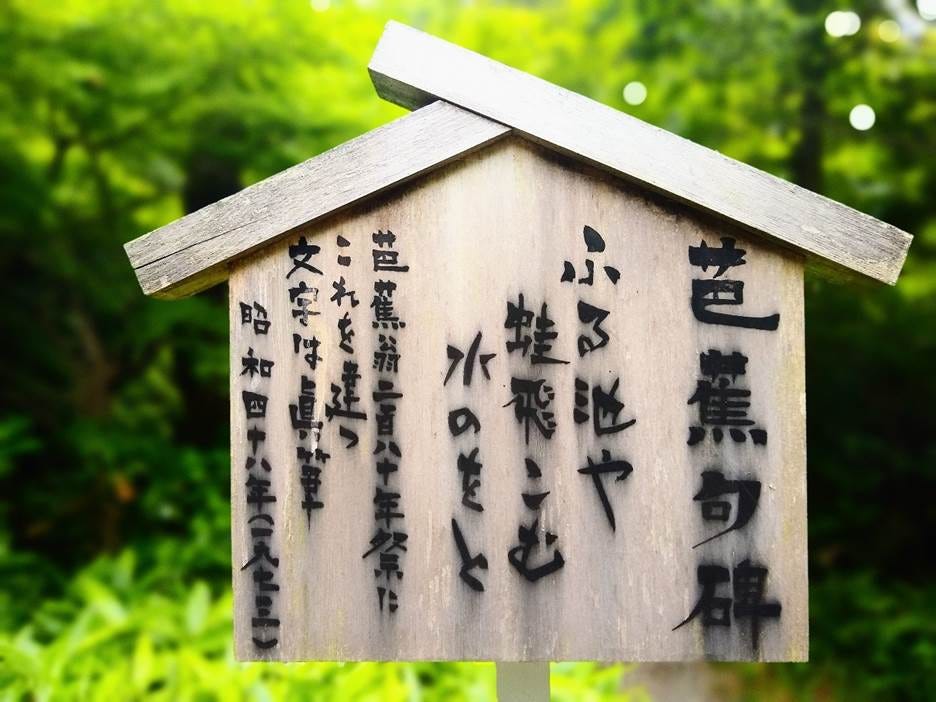
Bashō’s most famous haiku is posted in the garden of his Sekiguchi residence, Tokyo. Photo by John J. Han, 2024.
古池や
蛙飛びこむ
水の音
old pond
a frog jumps into
the sound of the water
—Translated by Jane Reichhold
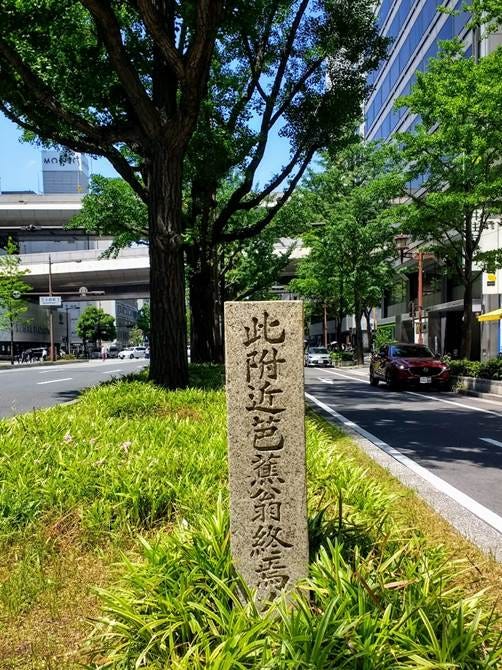
A stone marker in Osaka identifies the approximate site of Matsuo Basho’s death. Photo by John J. Han, 2024.
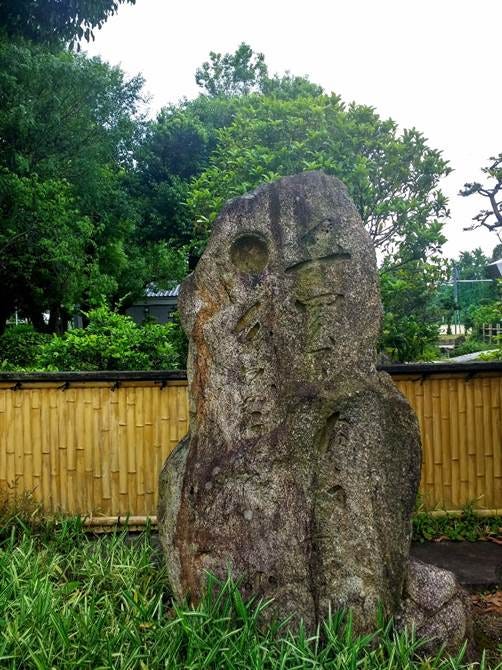
A Basho haiku rock in Osaka. Photo by John J. Han, 2024.
About the Author

Professor of English and Creative Writing and Associate Dean of the School of Humanities and Theology, Missouri Baptist University
John J. Han (PhD, University of Nebraska-Lincoln) is the author, editor, co-editor, or translator of 38 books published by Rodopi, Peter Lang, McFarland, Bloomsbury Academic, and other presses. He has published hundreds of scholarly articles and more than 3,000 poems, mostly haiku, in journals and anthologies around the world. His forthcoming book, Echoes from the Hills: Critical Essays on Ozarks Literature, co-edited with C. Clark Triplett, will be published by the University of Arkansas Press. He is in his 28th year as a full-time faculty member at Missouri Baptist University, where he has taught since 1999. He has also taught at Kansas State University, the University of Nebraska–Lincoln, Nebraska Wesleyan University, and Washington University in St. Louis. He has served as a visiting scholar at Georgia College & State University and the University of Ljubljana in Slovenia.
© K-Global Scholars and Professionals Forum. All rights reserved. Content published in the K-GSP Forum may not be reproduced, distributed, or transmitted in any form without prior written permission from the K-GSP Forum, except for brief quotations with full attribution.