

Life Is Often Fair: Twelve College Football Haibun
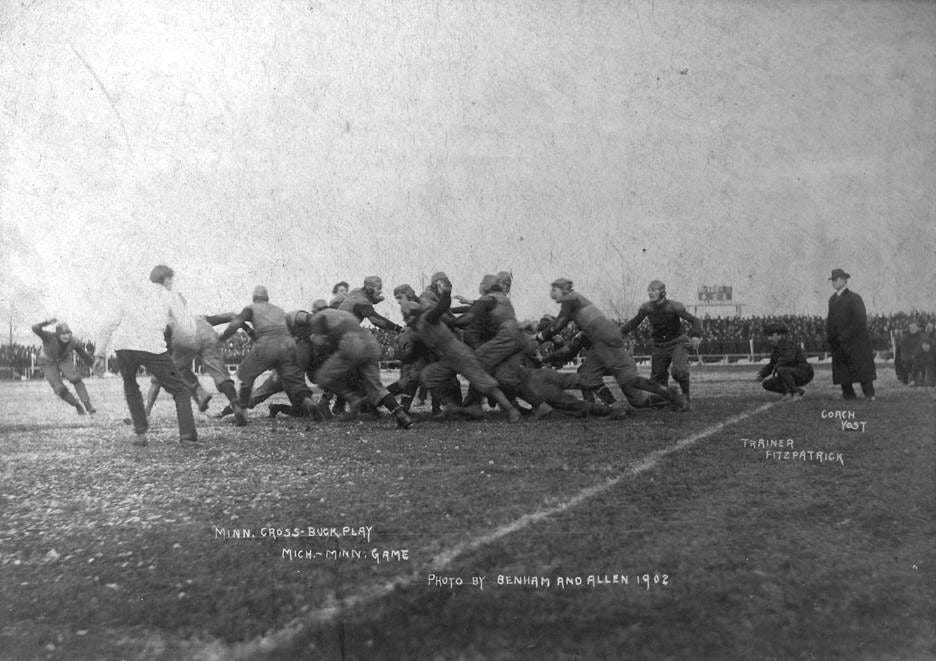
Image credit: Benham and Allen. Minnesota Golden Gophers vs. Michigan Wolverines Football Game, 1902. 1902. Public domain. Wikimedia Commons.
#1: Life Is Often Fair
By the end of Week 2 of the 2026 college football season, four FCS teams had defeated FBS opponents. Given the resources and talent of FBS teams, which are now increasingly run like semi-professional teams, this is an astonishing statistic. Although the better team usually wins a football game, there are always exceptions. In the notorious 2007 Appalachian State vs. Michigan game in Ann Arbor, Appalachian State, the No. 1 FCS team in the nation, defeated Michigan, the No. 5 FBS team, 34 to 32. It remains an unforgettable blemish on the otherwise illustrious history of Wolverine football.
There is a reason we play the game on the football field. Even monkeys can fall from trees. Little guys can beat big guys, which makes life somewhat more tolerable for those who do not belong to the elite.
predicted blowout—
big boys hang their heads
as final whistle blows
#2: Changing Moods Overnight
In this age of impatience, some college football coaches fall from grace after only one or two bad games. Once hailed as heroes, they are suddenly accused of being incompetent after losing a couple of games. The verbal attacks come not only from the media but also from diehard fans whose lives seem to revolve around football. Their favorite team’s success somehow becomes their own.
Having lived in three different states, I have noticed that people’s sports allegiances are often largely accidental. Where they attend school or happen to live can determine which team they support. The irony is that those who have no connection to a particular school or city often have little interest in teams outside their own locality.
new coach in town—
he brings hope
that could be disastrous
#3: Making Millions of Dollars
Thanks to NIL, star college football players can make millions of dollars per year. Big-time programs such as LSU, Texas, Oregon, and Ohio State are estimated to have spent nearly $50 million on their 2026 rosters. Some diehard fans will not mind such spending if their teams win championships. After all, most of them do not pay the NIL money.
As someone who would have to work multiple lifetimes to make what an 18-year-old sports star can make, I am not bitter. Money is important, but it has never been at the top of my priority list. I am happy to work, earn a decent salary, enjoy my travels, write papers and poems, and have a home where I can take a nap in my recliner. Besides, some high-profile sports stars have become penniless because of financial mismanagement.
Having said that, I wonder what it feels like to make millions of dollars every year. How do they handle the money? Do they suddenly have many people being nice to them? On second thought, I would not want attention from people who otherwise would not seek me out.
missing a class reunion—
the rich man now
bankrupt
#4: When It Rains, It Pours
There are some college football games known for their lopsided scores. In 1916, Georgia Tech beat Cumberland, a college in Tennessee, 222 to 0, piling up 1,650 rushing yards and allowing Cumberland no first downs. By my calculation, Georgia Tech averaged seven points once every 3.7 minutes. That remains the widest margin of victory in college football history.
There have been other less lopsided but equally astonishing blowouts. St. Viator College in Illinois, now defunct, beat Lane College, also in Illinois, 205 to 0 in 1916, while King College in Tennessee defeated Lenoir College in North Carolina 206 to 0 in 1922.
Running up the score is now considered discourteous, but some coaches seem to feel pressure to keep scoring to strengthen their teams’ playoff résumés. Humiliating the opponent may sound cruel, but for the fans, it can be fun, at least for a few hours.
Georgia Tech’s 222-0 win
the scorekeeper
the busiest man
#5: Football, a Psychological Chess Game
As a long-time follower of college football, I have always thought that players could benefit from working with sports psychologists. Sports psychologists can help athletes handle success, overcome failure, manage pressure, maintain confidence, and stay focused on their goals. My research indicates that many FBS football programs now provide their athletes with access to sports psychology services. I also feel that coaches should understand the psychology of young players and know how to motivate them so that they can maximize their talents on the field.
Football may look like a simple game of strength and speed, but it is a highly complex and cerebral sport in which a player’s mindset can be nearly as important as physical talent. A player who can remain confident after a mistake, stay humble after a great performance, and maintain concentration under pressure may have an important advantage on the field. One familiar football expression is that players will run through a brick wall for a coach they trust. It would be unwise to collide with a brick wall, but the expression is a vivid hyperbole that illustrates the power of a player’s relationship with a coach.
after winning it all
the smiling coach finds
one thing to fix
#6: Notable Football Rivalries
No, I am not talking about rivalries such as Michigan-Ohio State, Texas-Oklahoma, Alabama-Auburn, and Notre Dame-USC. I am talking about rivalries that have the coolest sounding names. For example, Iowa State and Kansas State have a football rivalry called Farmageddon. A playful allusion to the Book of Revelation, the name portrays the matchup between the two land grant universities from the nation’s leading corn- and wheat-producing states as foreboding as an end-time event.
In another rivalry, the University of Minnesota and the University of Nebraska play for the $5 Bits of Broken Chair Trophy, which also has a memorable name. The trophy, which depicts a smashed chair, was first presented to Minnesota in November 2014, when the Gophers defeated the Cornhuskers for the first time in Lincoln since 1960.
Farmageddon—
farmers in the fields
listen on the radio
#7: Winning by Losing
During World War II, Field Marshal Erwin Rommel (1891-1944) of Germany earned respect from some of his Allied enemies for his military strategy and personal courage. When two sides fight, there will usually be a winner and a loser, and some lose with dignity, as Rommel did.
In the world of college football, Tom Osborne is known for his courageous call for a two-point conversion in No. 1 Nebraska’s 1984 Orange Bowl game against No. 5 Miami. He had a chance to kick an extra point, tie the game at 31, and remain in contention for the national championship. However, he decided to try a two-point conversion to claim an outright victory. The attempt failed, and Nebraska lost the game 31 to 30. Tom Osborne nevertheless earned respect for his decision to go for the win. Decades later, some people still talk about the game.
football—
the game of life
measured by yards and kicks
#8: A Double-Edged Sword
One way to extend a drive after using three downs is to go for it on fourth down instead of punting the football. This usually happens when a team has only one or two yards to go for a first down. When successful, it can be a very effective strategy that frustrates the other team and its fans. A team may try it a few times during a game. When unsuccessful, however, fans often complain about the coach’s decision to go for it.
In a very unusual decision against Oklahoma State in 2026, Oregon head coach Dan Lanning decided to go for it on fourth and 7 at the Oklahoma State 43-yard line in the third quarter. Later in the game, with 6:48 remaining, he again decided to go for it, this time on fourth and 8 from Oregon’s own 33-yard line. If either conversion had succeeded, Lanning might have been praised as a brilliant and gutsy coach. Unfortunately, both attempts failed, and Oklahoma State went on to win the contest 39 to 31. After the game, Lanning accepted responsibility for his decisions. Reflecting on the fourth down attempts, he said that it was the “wrong decision on my part.”
go for it!
the bold call from
an armchair coach
#9: The Beauty of Punt Returns
One way to score six points in a football game is to return a punt for a touchdown. It is usually difficult to run all the way to the goal line, but it can become easy depending on the returner’s skill and the positions of the opposing players. The catch, momentary hesitation, holes he sees, and hard run can all be dramatic. The movement can look like a scene from a movie.
Whenever I watch a successful punt return, I feel sorry for the opposing players chasing the returner. They know he is out of reach, but I am sure their coaches have taught them never to give up on a returner. The most exciting moment comes when the returner breaks into the open field and clearly runs faster than the opposing players pursuing him.
Returning a punt for a touchdown is usually followed by raucous screams from the stadium as the fans erupt in euphoria.
a star punt returner
shifting right shifting left
defenders confused
#10: Interesting Team Nicknames
Many college football teams have nicknames based on animals. Of course, they tend to choose animals with positive associations, such as tigers and eagles. Few teams would want to be associated with animals such as monkeys, gorillas, hyenas, and bats.
One interesting nickname is the Leathernecks of Western Illinois University. “Leatherneck” is a slang term for a member of the U.S. Marine Corps. Western Illinois received permission to use the term in 1927, making it the only public university in America with the Fighting Leathernecks nickname. Although perhaps unintended, the word “leather” also suggests toughness. In recent decades, Western Illinois has not won a national championship, but at least its name stands out.
Likewise, the nickname “Hoosiers” effectively reflects the rural character and history of Indiana. After several difficult seasons, Indiana came seemingly out of nowhere under head coach Curt Cignetti and won its first national championship in January 2026, completing a 16 and 0 season. Cignetti took over over a program that had gone 2 and 10 two seasons before his arrival. His remarkable turnaround demonstrates how quickly the fortunes of a college football program can change. Many highly paid football coaches are now under pressure to prove themselves, as Cignetti did.
Adrian Maples football team—
the players must be
good poets too
#11: Lessons from the Game of Football
The commercialization of college football is a concern, but the game also plays many positive roles for players, institutions, alumni, and communities at large. Football Saturdays offer opportunities to have fun, from tailgating to the game itself. They also provide a chance to relieve stress and set aside life’s problems for a few hours.
One thing I love about the United States is the ample opportunity for children to participate in various sports from an early age. Through sports, they learn the virtues of teamwork, resilience, respect for others, and adherence to rules. They learn to push themselves while also honoring their opponents, as demonstrated by the handshake and, at some schools, prayer with opponents after the game. After all, life is not all about competing with classmates for higher grades or trying to get ahead of others in social status. Sports can teach us that competition and cooperation can coexist.
scoreboard forgotten—
winners and losers
exit together
#12: Almost There
A fast running back breaking multiple tackles and crossing the goal line is a beautiful sight to behold. It shows the player’s toughness and speed. As he runs, the whole stadium erupts, shaking the ground and sky and even startling the birds overhead. According to the rules, however, the player must maintain possession of the football as he crosses the goal line to score a touchdown.
Unfortunately, carried away by excitement, runners sometimes drop the football too early, thereby nullifying their effort and disappointing their fans. What a waste of an opportunity to add six points to the scoreboard! In the Hebrew Bible, Ecclesiastes says that there is a time for everything: “a time to be born and a time to die, / a time to plant and a time to uproot” (3:2 NIV). In football, there is a time to run, and there is a time to celebrate.
nullified touchdown—
crowd on its feet
then a sigh
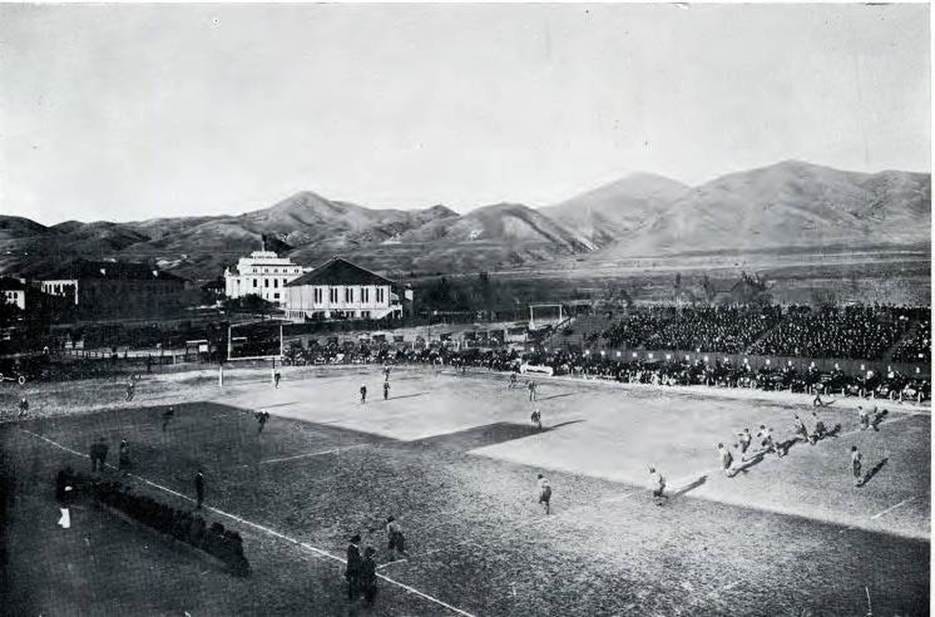
Image credit: University of Utah. Utah vs. Colorado Football Game, 1916. Utonian, 1918. Public domain. Wikimedia Commons.
About the Author

Professor of English and Creative Writing and Associate Dean of the School of Humanities and Theology, Missouri Baptist University
John J. Han, PhD, is the author, editor, co-editor, or translator of 38 books. His forthcoming book, Echoes from the Hills: Critical Essays on Ozarks Literature (co-edited with C. Clark Triplett), will be published by the University of Arkansas Press. He has also published more than 3,000 poems, primarily haiku, in a wide range of journals and anthologies. In addition to his long tenure at Missouri Baptist University, he has taught at Kansas State University, the University of Nebraska–Lincoln, Nebraska Wesleyan University, and Washington University in St. Louis. He has also served as a visiting scholar at Georgia College & State University and the University of Ljubljana in Slovenia.
© K-Global Scholars and Professionals Forum. All rights reserved. Content published in the K-GSP Forum may not be reproduced, distributed, or transmitted in any form without prior written permission from the K-GSP Forum, except for brief quotations with full attribution.