

Ten Ways to Become a Safer Driver: Ten Haibun
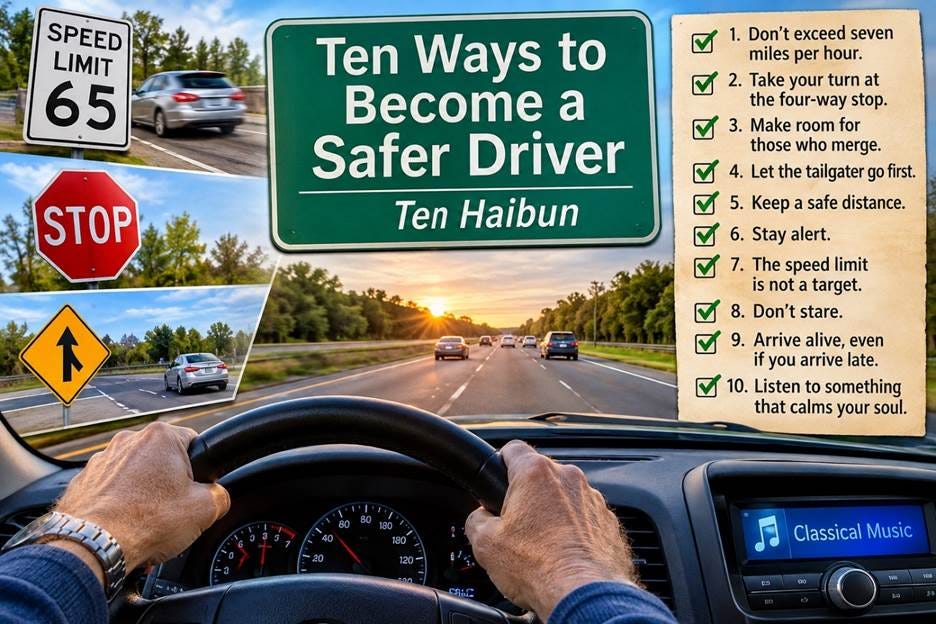
Image credit: Illustration generated with OpenAI’s ChatGPT image-generation tool, 2026.
Poet’s Note:
The Haiku Society of America defines a haibun as “a terse, relatively short prose poem in the haikai style, usually including both lightly humorous and more serious elements, and typically ending with a haiku.” (Haiku Society of America: Haiku Definitions. https://www.hsa-haiku.org/hsa-definitions.html)
I learned to drive in the spring of 1989, during my second semester at Kansas State University. I enrolled in a driving school in Manhattan, Kansas, where I learned under the direction of Mr. Cooper. The arrangement was simple: complete the course, receive a certificate, and exchange it for a driver’s license. It was money well spent because many of the things I learned during those lessons have stayed with me over the years.
Mr. Cooper emphasized defensive driving. For example, before merging onto a road, I was taught to look both ways twice to make sure no cars were approaching. He also taught me to come to a complete stop at a stop sign without letting the front of my car creep even a few inches beyond it. If the car behind me pulled too close at a stop sign, I was supposed to move forward slightly. When stopping behind another vehicle, however, I was supposed to leave enough room to see its rear tires. My instructor was a senior citizen with a balding head, so he has probably passed away by now. Bless his soul!
Over the years, I have witnessed many traffic accidents caused by careless driving. Some accidents happen through no fault of the careful drivers involved. They are simply unavoidable. The goal is to prevent accidents whenever possible. Careless driving can come at a high cost in terms of both insurance premiums and human lives. Although I consider myself a generally careful driver, I have had my share of careless moments behind the wheel. Many accidents happen because drivers are in a hurry or become inattentive. As I grow older, I feel less inclined to rush, which has helped me become a slower and more cautious driver.
The following ten tips are common-sense reminders that drivers sometimes forget. They are not meant to be driving lessons. Rather, they are lighthearted observations intended to make readers nod in agreement and perhaps think twice the next time they get behind the wheel.
#1: Don’t drive more than seven miles per hour over the speed limit
My seven-mile-per-hour rule is primarily a safety measure. When there are no cars immediately ahead of or behind me, I generally drive at the posted speed limit, allowing myself no more than five miles per hour over it when conditions permit. When the driver behind me starts tailgating, I resist the temptation to speed up just to accommodate that driver. Instead, I maintain a safe and reasonable speed and, when possible, move into another lane to let the impatient driver pass.
I also avoid exceeding seven miles per hour over the posted speed limit because I dread the extreme disappointment of receiving a speeding ticket. A ticket would affect not only my insurance premiums but also my reputation as a responsible citizen. My seven-mile-per-hour rule is not absolute, but it has served me well.
tailgating driver
with his fingers
he taps the wheel
#2: Take your turn at the four-way stop sign
One of the basic rules of driving is to come to a full stop at a four-way stop sign and proceed in order of arrival. One thing I learned from Mr. Cooper in 1989 was that if two cars stopped at the same time, the one on the right should proceed first. This rule may sound too basic to discuss, but some drivers do not follow it because they are not observant enough to know which cars arrived at the intersection first. A collision can happen when neither driver is paying attention to the other. Those who ignore the four-way stop sign are often in a hurry. In rarer cases, they bully their way through, disrespecting other drivers who are trying to get somewhere, too.
When my car and the car on my right arrive at the same time and the other driver seems hurried, I gesture for the driver to proceed first. That is safer than debating with myself about who arrived first or trying to beat the other driver to the intersection. If the driver on my right yields to me, I express my appreciation by holding up my hand or bowing my head. After all, civility is a virtue in public places, and showing consideration for strangers makes life more pleasant.
four-way stop
everyone is nice
nobody moves
#3: Often make room for those trying to merge
Drivers on a main road have the right of way, and those entering it must yield. That is the law. However, during rush hour, traffic often crawls or even comes to a standstill for a few seconds at a time. In such situations, waiting for the right moment to merge can be nerve-racking. Sometimes, it is simply courteous to let another car merge. It costs nothing. Allowing more than one driver to merge might annoy those behind you, but making room for others can often brighten someone’s day.
After all, driving habits reveal a lot about a person’s personality. Sitting in the passenger seat of someone else’s car gives you an opportunity to observe the driver’s ability to empathize with others, show consideration for others, and demonstrate emotional maturity. If someone is nice to you but unkind toward other people, that can be a red flag. At some point, that person may not be so nice to you, either.
letting one car in
the driver does not
wave at me
#4: If people tailgate you, let them go first
Impatient drivers do not appreciate slow drivers. That is understandable, but following another vehicle too closely is illegal. In Missouri, tailgating is classified as a Class C misdemeanor, which can carry a fine of up to $750 and a jail sentence of up to 15 days. It is a serious offense that some drivers do not seem to know.
Drivers who are followed closely by an aggressive motorist should remain composed and avoid stopping suddenly to show their annoyance. Doing so can aggravate an already bad situation. More importantly, you never know who the tailgater is, and it is unwise to anger someone you do not know. In the worst-case scenario, it is better to let the other driver go first by moving into a slower lane when safe. In residential areas, if there is a safe place to pull over, you can let the other driver pass before merging back into traffic.
as I move aside
he zooms by
a tailgating driver
#5: Keep a safe distance from the car ahead
Tailgating is dangerous, but even well-intentioned drivers may fail to maintain a safe distance from the vehicle ahead. There is a reason the three-second rule exists: maintaining a safe distance gives you enough time to react if something unexpected happens in the car ahead. Many of the car accidents I have seen on YouTube involve drivers who fail to keep a safe distance from the vehicles in front of them.
In the age of cell phones, some collisions are also caused by using phones while driving. It is tempting to check a new message, but it can wait until you get out of the car. In Missouri, it is illegal to hold or support a cell phone or other electronic communication device with any part of your body while driving. The law also prohibits manually reading or sending text-based messages, although certain hands-free uses are permitted. Many other states also restrict handheld cell phone use while driving. It is better to be safe than sorry.
on the road
my phone lights up
I look straight ahead
#6: Observe the surroundings and stay alert
Driving in public places is not a leisurely activity. It requires constant attention to the road and other drivers. Anything can happen, and the goal is to drive safely and arrive at your destination without an accident. One important thing to remember while driving is to observe not only the traffic ahead but also the area around your vehicle by using your side and rearview mirrors, checking your blind spots before changing lanes, and listening for unusual sounds. This does not mean constantly turning your head. It simply means staying aware of what is happening around you. A fire truck may approach from behind with its siren sounding. A police car with its lights flashing may be responding to an emergency. A vehicle in your blind spot may suddenly move into your lane. Paying attention to these things can help you avoid a dangerous situation.
drivers slow down
behind us
a police car
#7: The speed limit is not a driving target
I remember a question from a driver’s test years ago. The tricky question asked whether we should always drive at the posted speed limit. It might be tempting to answer yes, but the correct answer is no. Although the posted speed limit is a legal limit, it does not mean that driving at that speed is always appropriate. Drivers are expected to adjust their speed according to road conditions. Heavy rain or snow, fog, and construction zones may require them to slow down.
lost out of town
the morning fog
hides the speed limit
#8: Don’t stare at those who drive unsafely
YouTube shows many instances of road rage involving drivers who cannot control themselves. Sadly, their apparent purpose is to harm others simply because they feel offended. Staying safe on the road means maintaining composure, following traffic rules, and being courteous to fellow drivers. One thing that can antagonize other drivers is staring at them. As noted earlier, you never know who they are, so it is safer to mind your own business. Law enforcement is there to handle aggressive drivers.
road rage on YouTube
one kicks a tire
the other brings a bat
#9: Arrive alive even if you arrive late
Many countries display slogans along highways to remind drivers that safety should be their number one concern on the road. These include “Arrive Late, Arrive Alive,” “It Is Better to Arrive Late Than Not at All,” and “Better Late Than Never.” They may be clichés, but they serve as useful reminders that can save lives. When we are in a hurry, we often feel the need to arrive at our destination as early as possible. One way to avoid this pressure is to leave five minutes early. When all is said and done, arriving alive should be the primary goal.
late for a housewarming
plenty of time
to say goodbye
#10: Listen to something that calms your soul
One thing that can help drivers stay composed is listening to soothing music, such as the kind played on a classical music station. I also listen to chants while driving, which helps calm me down. I have seen some drivers blare loud music, with vibrations that can be felt in neighboring cars. They may be safe drivers, but playing music that loudly is a public nuisance. It is like playing loud music in an apartment in the middle of the night without considering the neighbors’ need for peace and quiet. Playing loud music may also be illegal, depending on the municipality. More importantly, it can prevent drivers from hearing sounds they need to notice, such as sirens.
at the red light
his loud music shakes
my seat
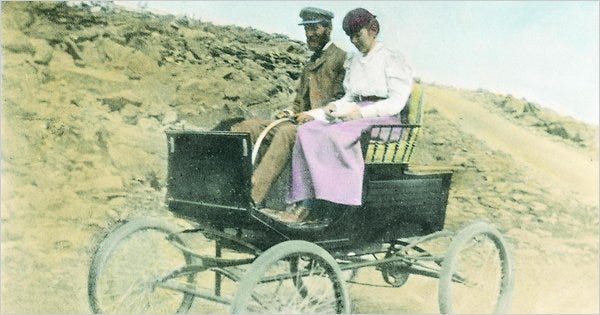
Driving to the Top of Mount Washington, 1899. Photographer unknown. Public domain, via Wikimedia Commons.
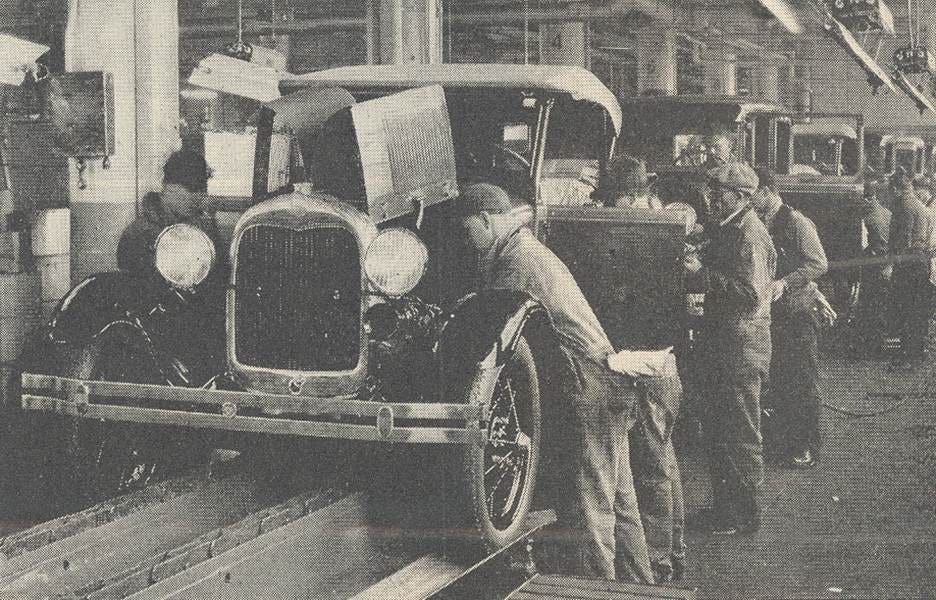
Ford Motor Company Assembly Line, 1928. Photographer unknown. Public domain, via Wikimedia Commons.
About the Author

Professor of English and Creative Writing and Associate Dean of the School of Humanities and Theology, Missouri Baptist University
John J. Han, PhD, is the author, editor, co-editor, or translator of 38 books published by Rodopi, Peter Lang, McFarland, Bloomsbury Academic, and other presses. He has published hundreds of scholarly articles and more than 3,000 poems, mostly haiku, in journals and anthologies around the world. His forthcoming book, Echoes from the Hills: Critical Essays on Ozarks Literature, co-edited with C. Clark Triplett, will be published by the University of Arkansas Press. He is in his 28th year as a full-time faculty member at Missouri Baptist University, where he has taught since 1999. He has also taught at Kansas State University, the University of Nebraska–Lincoln, Nebraska Wesleyan University, and Washington University in St. Louis. He has served as a visiting scholar at Georgia College & State University and the University of Ljubljana in Slovenia.
© K-Global Scholars and Professionals Forum. All rights reserved. Content published in the K-GSP Forum may not be reproduced, distributed, or transmitted in any form without prior written permission from the K-GSP Forum, except for brief quotations with full attribution.