
Traveling the Ozarks: Five Haibun
Poet’s Note:
The Haiku Society of America defines a haibun as “a terse, relatively short prose poem in the haikai style, usually including both lightly humorous and more serious elements, and typically ending with a haiku.” (Haiku Society of America: Haiku Definitions. https://www.hsa-haiku.org/hsa-definitions.html)
The Overlook That’s No Longer Scenic
For more than twenty years, I have had a ritual while traveling on Missouri’s Interstate 44: stopping at the Scenic Outlook on Highway 63 north of Rolla. It is located thirteen miles from Rolla, three miles past the small community of Vichy. The overlook once provided a wide view of rolling hills to the north and wooded forests to the west. Visiting the place at sunset in autumn offered a particularly beautiful sight. I typically stayed there for about thirty minutes, resting and contemplating.
On my way to West Plains, Missouri, on September 17, 2026, I decided to visit the overlook again. By the time I reached St. James, the western sky had become cloudy, and soon a drizzle began. When I reached Rolla, however, the rain had stopped, so I turned north toward the overlook. As I grow older, I often feel that I may not have another opportunity to visit certain places, which makes me more likely to make such a split-second decision.
After I pulled into the familiar overlook, I got out of the car, intending to take pictures of the northern vista. To my surprise, the view was completely blocked by a dense stand of newly planted trees. There was no way to get through them to see the landscape beyond. There must have been an ecological reason for planting the trees, but the result was that the overlook no longer offered much of a scenic view.
Disappointed, I turned around and drove to the other side of the overlook, where the landscape to the west was unblocked. I got out, took several photographs, and then left.
It was a relief to have taken many photographs of the northern view before the trees were planted. Yet the experience reminded me once again that familiar places do not remain the same. Over the years, I have come to understand nonconstancy in many forms, and my visit to the overlook added another example. The new landscape makes me less likely to return, but perhaps that is part of the lesson: even places that seem permanent are changing while we are away.
my childhood riverbanks
remain the same…
autumn dream
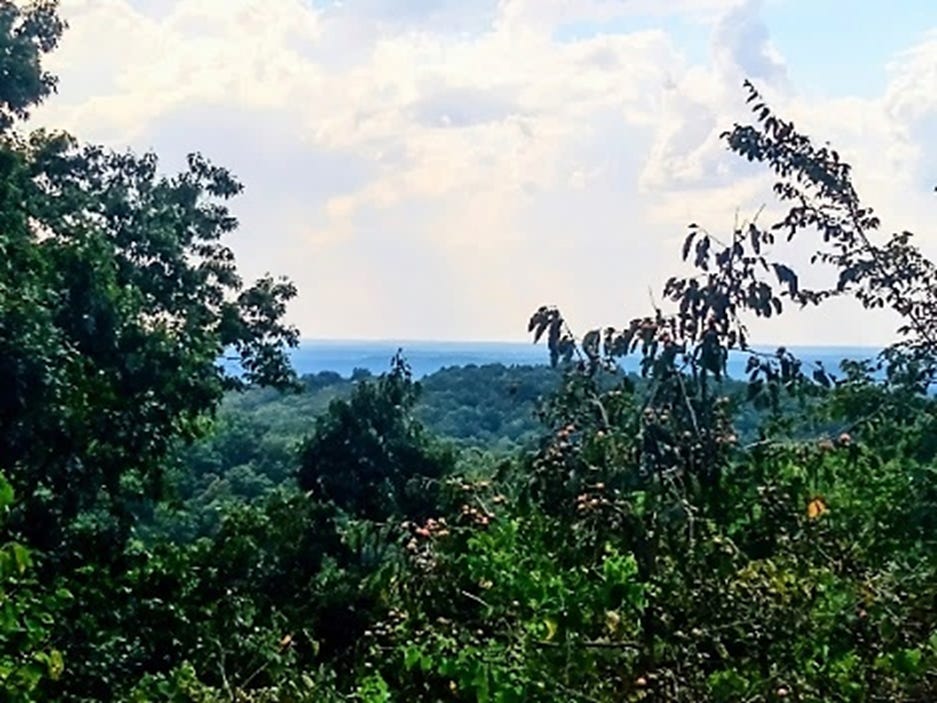
The Scenic Outlook, thirteen miles north of Rolla, Missouri, offers an early autumn view of rolling hills beyond the wooded forests. Photo by John J. Han, Sept. 17, 2026.
Good Moms vs. Bad Moms
Every September, I visit West Plains, Missouri, to attend the annual Ozarks Studies Symposium. One of my routines during my stay is to eat at the same Chinese buffet. This year, two waitresses recognized me even though they had not seen me for a year. I remembered seeing them there for at least three years in a row.
While eating, I noticed one of them wearing a T-shirt with a slogan printed across it: “Good Moms Say Bad Words.” My first reaction was to burst out laughing. In addition to the clever contrast between “good” and “bad,” the slogan simply sounded funny. Then, for the rest of the day, I kept thinking about what it meant. After racking my brain, I concluded that it meant something like, “Well-intentioned moms often use bad words for educational purposes.” I could not think of many other possibilities, including “By nature, good moms say bad words,” which did not make much sense.
As I often do, I turned to ChatGPT for its insight, asking, “Interpret this statement: ‘Good Moms Say Bad Words.’” It explained that “being a good mother does not require being perfectly well behaved or never using profanity.” According to this interpretation, the sentence could be rewritten as “Even good moms say bad words.”
On the one hand, that interpretation made sense. On the other hand, it seemed somewhat forced to me. The word “even” was not in the original sentence. Without it, the slogan seemed to make a much stronger, and perhaps stranger, claim: good moms say bad words. The more I thought about the slogan, the less amusing it became. Perhaps some things are funnier when we simply laugh at them rather than try to figure out their exact meaning.
car sticker for tailgaters:
I’m Retired
Go Around Me
The Lady Who Likes West Plains, MO
At the Chinese restaurant mentioned above, I approached the register to pay my check. The young woman behind the counter looked familiar to me, too. This restaurant seemed to have several loyal employees. When I asked her if she was born in West Plains, she said she was from Mountain Home, Arkansas. When I asked whether she liked West Plains, she said it was “not bad,” adding something like, “Not everyone here is smart.”
She was wearing a lip piercing. I did not understand why people chose to wear such things, which seemed to me inconvenient to manage, but I recognized that it was a form of self-expression. She reminded me of a young woman who had served me at a Thai restaurant in Eureka Springs, Arkansas, more than ten years ago. That woman was from the Missouri Bootheel area and was working in Eureka Springs, but she wanted to move to Hawaii or somewhere far away. I remember that she wore jeans with several holes in them, another apparent form of self-expression.
I was glad that the young woman at the Chinese restaurant seemed content with her life in the Ozarks. Unlike the woman I had met in Eureka Springs, she did not seem to be dreaming of getting away.
small mountain city
two strangers talk about
their faraway homes
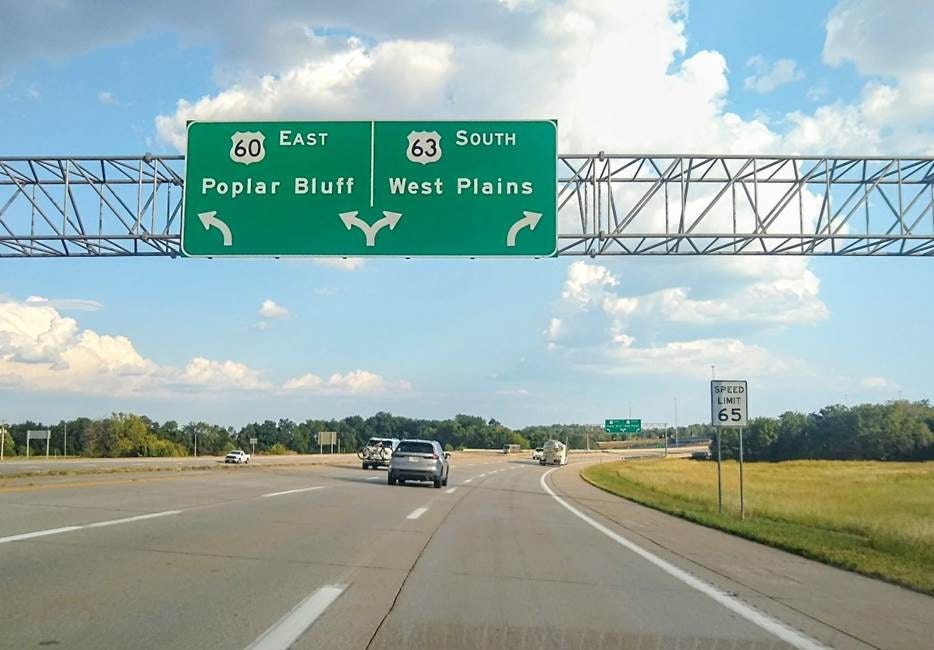
Visiting West Plains often feels like returning home, where the pace of life is slower and people smile. The only difference is that people speak English rather than Korean. Photo by John J. Han, Sept. 17, 2026.
Birds of a Feather
Some Chinese food induces sleep, but it is often irresistible to me, especially when I travel out of town. The West Plains Chinese restaurant I patronize whenever I am in town is one of the better ones I have visited in many different states.
When I enter the restaurant, the staffers are often curious about me. When they catch a moment, they ask me, “Are you Chinese?” I shake my head from side to side and say, “Wo-shi hanguoren” (I am Korean). Based on my response, they assume I am fluent in Chinese and continue their conversation in Chinese, which leaves me bewildered. Because older-generation Koreans learned written Chinese from early childhood, we can sometimes communicate in writing, but the pronunciations of most words are different. For example, the word for America, 美國, is pronounced meiguo in Chinese, whereas Koreans pronounce it miguk. Still, our interactions are pleasant, and we somehow manage to communicate.
Relations among Chinese, Koreans, and Japanese have not always been friendly in Asia, but in the United States, we can feel a sense of kinship as fellow immigrants. In a way, we are in this together. Sometimes we can communicate what we think without speaking at all. A smile, a gesture, or a nod is enough.
In September 2026, the Chinese cashier even gave me a $2 discount when it was time to pay. In response, I added another dollar to the tip. I hope the restaurant continues to prosper, and I look forward to visiting it again next year.
Chinese waitress—
she says I look more Chinese
than Korean
The Country of Fun
As someone who has visited more than a dozen countries, I find the United States the most fun place. Here, people seem to seek fun throughout the year by watching or attending sporting events, decorating their houses, having parties, hunting, boating, or fishing. There is so much fun that life can hardly be boring. Unsurprisingly, I find America a country of humor as well. As a reader of world literature, I find American novels and short stories particularly entertaining.
My perception of America as a fun place was confirmed by an article on the Ozark Radio News website. In the September 23, 2026, edition of the News, there was an article entitled “Willow Springs Chamber Recognizes Three Officers for Their Involvement in the 5K.” It read in part, “The Willow Springs community has a lot to be proud of when it comes to its local law enforcement officers, and the recent I Ran From the Cops 5K & Walk was a wonderful example of that community connection.” I didn’t know exactly what the event was about.
A few paragraphs later, the article stated, “Officer Barnhouse brought his own brand of fun to the event by driving the course, interacting with runners and ‘chasing’ participants down in his vehicle. His presence along the route added another element of excitement […].” Now I understood what the event was about: police officers pretended to chase the participants for fun!
the day after Halloween—
my neighbor decorating
for Christmas
About the Author

Professor of English and Creative Writing and Associate Dean of the School of Humanities and Theology, Missouri Baptist University
John J. Han, PhD, is the author, editor, co-editor, or translator of 38 books. His forthcoming book, Echoes from the Hills: Critical Essays on Ozarks Literature (co-edited with C. Clark Triplett), will be published by the University of Arkansas Press. He has also published more than 3,000 poems, primarily haiku, in a wide range of journals and anthologies. In addition to his long tenure at Missouri Baptist University, he has taught at Kansas State University, the University of Nebraska–Lincoln, Nebraska Wesleyan University, and Washington University in St. Louis. He has also served as a visiting scholar at Georgia College & State University and the University of Ljubljana in Slovenia.
© K-Global Scholars and Professionals Forum. All rights reserved. Content published in the K-GSP Forum may not be reproduced, distributed, or transmitted in any form without prior written permission from the K-GSP Forum, except for brief quotations with full attribution.