

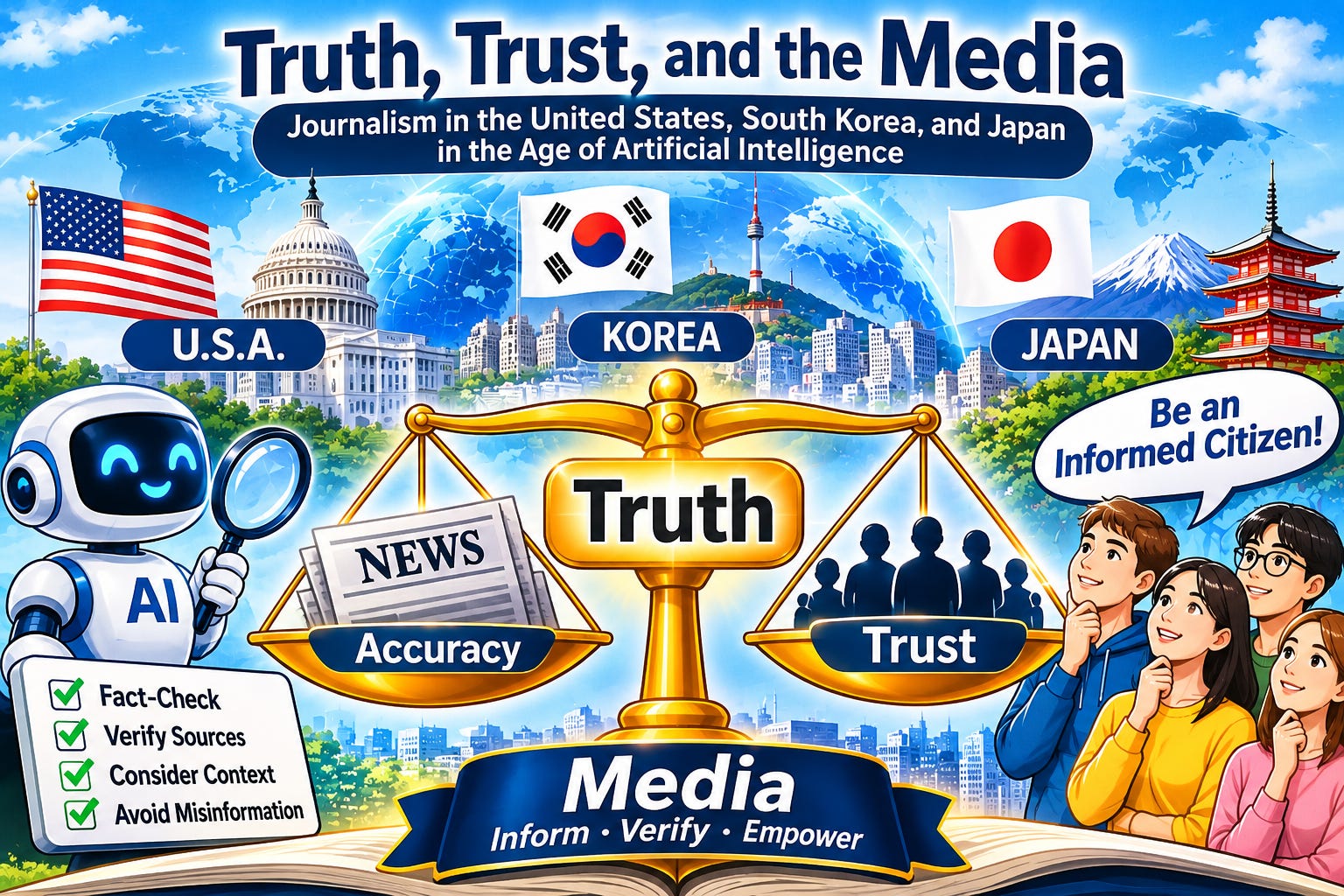
Image credit: Illustration generated with OpenAI’s ChatGPT image-generation tool with the author’s idea, 2026
Truth, Trust, and the Media
Journalism in the United States, Korea, and Japan in the Age of Artificial Intelligence
Abstract
The media play an essential role in democratic societies by informing citizens, monitoring political and economic power, and providing a foundation for public debate. Yet the relationship between journalism, truth, and public trust has become increasingly complicated. The United States, Korea, and Japan offer three particularly interesting cases for examining this challenge. Although all three countries maintain democratic institutions and constitutionally protected freedoms of expression, their media systems have developed under different political histories, institutional arrangements, journalistic traditions, and patterns of public communication.
This essay examines the characteristics, strengths, and challenges of journalism in the three countries, focusing on political polarization, commercial pressures, institutional dependence, news verification, and the growing influence of artificial intelligence. It distinguishes freedom of the press from journalistic accuracy and public trust, emphasizing that these concepts are related but cannot be used interchangeably. Drawing on comparative media research, international press freedom assessments, and digital news research, the essay argues that no national media system has a monopoly on truth. The central responsibility of journalism is not simply to report events quickly or defend a particular political position, but to establish facts, provide context, disclose sources, correct errors, and hold powerful institutions accountable.
The essay also proposes a practical framework for evaluating news credibility in the AI era. Ultimately, a healthy democracy requires not only independent journalism but also informed citizens who can distinguish facts from opinions, evidence from interpretation, and genuine information from artificially generated deception.
Keywords: Journalism, Media Credibility, Freedom of the Press, Truthfulness, United States, Korea, Japan, Political Polarization, Artificial Intelligence, Deepfakes, Media Literacy, Democracy
When Information Is Everywhere, Where Is the Truth?
We live in an extraordinary age of information. A person sitting in Virginia can read a newspaper published in Seoul, watch a television broadcast from Tokyo, follow a political debate in Washington, and receive breaking news from almost anywhere in the world within seconds. A smartphone has become a newspaper, television station, radio, library, and international communication center combined. Yet there is an uncomfortable paradox: the more information we receive, the more difficult it can become to determine what is true.
A news headline may be accurate but incomplete. A photograph may be genuine but presented in a misleading context. A political speech may be quoted correctly while its central meaning is distorted through selective editing. A video may appear convincing even though it was generated by artificial intelligence. And a news organization may publish a factually correct report while emphasizing only those facts that support its preferred interpretation.
These problems raise an important question: Can citizens trust the media to tell them the truth, or must they increasingly learn to verify the truth for themselves?
Journalism has traditionally served three essential democratic functions: informing the public, scrutinizing those who exercise power, and providing a forum for competing ideas. These responsibilities are particularly important in democratic societies, where citizens depend on reliable information to evaluate government policies, participate in elections, and make decisions affecting their communities.
The United States, Korea, and Japan provide an illuminating comparison. They share important democratic institutions and economic connections, but their journalism has developed through different historical experiences. American journalism has a strong tradition of adversarial reporting and a highly competitive commercial media market. Korean journalism emerged from a difficult history of authoritarian control and democratization, developing a politically active and digitally connected news environment. Japanese journalism has traditionally relied heavily on established newspapers, broadcasters, and institutional reporting relationships.
These differences do not automatically make one country’s journalism more truthful than another’s. Rather, they demonstrate that the pursuit of truth depends on institutional independence, professional standards, economic incentives, political culture, and the willingness of journalists and citizens to question information.
In the age of generative AI, this responsibility has become even more important. The challenge is no longer simply finding information. It is determining whether information deserves to be believed.
The Three Media Systems: Different Histories, Different Pressures
American Journalism: Freedom, Competition, and Political Polarization
The American media system has developed around a strong constitutional tradition of freedom of expression and a competitive private media market. The First Amendment to the U.S. Constitution protects freedom of speech and of the press, establishing an important legal foundation for independent journalism. American journalism has also developed a tradition of investigative reporting. Newspapers, television networks, and digital publications investigate government misconduct, corporate wrongdoing, corruption, and abuses of public authority. The press is often described as the Fourth Estate because of its responsibility to scrutinize the executive, legislative, and judicial branches.
The American media landscape, however, is not politically or economically neutral. Major organizations such as The New York Times, The Washington Post, The Wall Street Journal, CNN, Fox News, and MSNBC operate with different editorial traditions, audiences, and approaches to political reporting. This diversity can be a democratic strength. Citizens can compare different interpretations of the same event and examine competing arguments. Yet diversity can also produce fragmented information environments in which people increasingly select news that confirms their existing political beliefs.
Political polarization creates a particularly difficult challenge. When news organizations emphasize political conflict, controversy, and ideological disagreement, audiences may begin to interpret factual reporting through partisan identities. The same economic policy, court decision, immigration issue, or international conflict can be presented through substantially different narratives. The problem is not necessarily that every organization publishes false information. A more subtle problem occurs when accurate information is selectively presented, important context is omitted, or commentary is blended with factual reporting.
The 2026 Reuters Institute Digital News Report provides a particularly important indication of this problem. Only 25% of surveyed Americans said they trusted most news most of the time, a five-percentage-point decline from the previous year. The report also identified substantial differences in trust across political groups (Egan et al., 2026). This finding should not be interpreted as proof that 75% of American news reports are inaccurate. It measures public perceptions of news trust, not the percentage of truthful or untruthful articles.
Another challenge is the economic structure of American journalism. Large media companies compete for subscriptions, advertising, and audience attention. Meanwhile, local newspapers have experienced substantial financial difficulties, leaving some communities with fewer independent sources of local information. Reporters Without Borders (RSF, 2026) identifies media ownership concentration, pressure on journalists, and the decline of local news as important concerns in the United States. Its 2026 World Press Freedom Index placed the United States 64th among 180 countries and territories. The American experience therefore illustrates an important distinction: constitutional protection provides an essential foundation for journalism, but it does not automatically guarantee editorial independence, factual accuracy, or public confidence.
Korean Journalism: Democratization, Political Divisions, and Digital News Culture
Korean journalism has a particularly interesting historical background because its development is closely connected to the country’s democratization. During periods of authoritarian government, journalists and media organizations experienced political pressure, censorship, and restrictions on reporting. The democratic transition of the late 1980s created greater opportunities for independent journalism and expanded the public’s access to diverse political perspectives.
Since then, Korea has developed a highly active media environment, including national newspapers, public and commercial broadcasters, internet news portals, independent digital publications, and social media platforms. Major newspapers such as Chosun Ilbo, JoongAng Ilbo, and Dong-A Ilbo are generally associated with conservative editorial traditions, while Hankyoreh and Kyunghyang Shinmun are generally associated with progressive editorial traditions. These descriptions are broad tendencies rather than complete representations of every article or journalist.
The relationship between political parties and the press has become an important subject of academic research. Kwak (2022), in his examination of the Korean press, discusses how progressive-conservative divisions and relationships between political parties and media organizations have influenced journalistic practices. This phenomenon is sometimes described through the concept of political parallelism: media organizations and political groups can develop relationships that reflect broader ideological divisions in society.
The result is that a political event may receive sharply different interpretations depending on the newspaper, broadcaster, or digital channel covering it. For example, consider a hypothetical government investigation involving a senior political official. One news organization may emphasize the seriousness of the allegations and the need for accountability. Another may focus on the reliability of the evidence, procedural fairness, or the possibility of political motivation. A third may concentrate on the government’s institutional response. All three perspectives can contain legitimate questions. However, the public may receive an incomplete understanding if the media present allegations as established facts or dismiss evidence simply because it originates from a political opponent.
Korea’s digital media environment adds another dimension. Naver and other online portals have played an important role in news distribution, while YouTube, short-form video platforms, and online communities increasingly influence public discussion. According to the Reuters Institute’s 2026 report, portal-based news consumption in Korea is declining, while news consumption through online video platforms, particularly short-form content, is increasing. The report also identifies relatively high use of AI chatbots for news among Korean respondents (Lee et al., 2026).
This transition creates both opportunities and risks. On the positive side, digital platforms allow independent journalists and smaller organizations to reach audiences without depending entirely on traditional media companies. Citizens can also access original speeches, government documents, and alternative interpretations. On the negative side, political commentary can be presented as investigative journalism, personal speculation can circulate as established fact, and emotionally charged content can spread rapidly without adequate verification.
Korea’s 2026 Reuters Institute survey reported that 30% of respondents trusted most news most of the time, compared with the global average of 37% (Egan et al., 2026). This finding deserves attention because Korea has a sophisticated digital infrastructure and a highly connected population. Access to information, however, does not necessarily produce confidence in information. Kwak’s (2022) analysis is particularly relevant here: the challenge is not merely expanding the number of media outlets but strengthening the independence and professional responsibility of journalism across political divisions.
Japanese Journalism: Institutional Stability, Traditional Media, and the Challenge of Independent Reporting
Japanese journalism has developed through a different historical and institutional process. For decades, newspapers and broadcasting organizations have played a central role in Japanese public life. Major newspapers include Yomiuri Shimbun, Asahi Shimbun, Mainichi Shimbun, and Nikkei. NHK, Japan’s public broadcaster, has also maintained an important position in national news and public information.
Japanese journalism is often associated with careful language, established editorial practices, and extensive use of official sources. Such practices can help journalists avoid premature conclusions, particularly when reporting on complex political, economic, and international developments. However, a professional appearance and cautious reporting style should not automatically be equated with complete independence.
One of the most important institutional characteristics of Japanese journalism is the kisha club system, commonly translated as the reporters’ club system. These clubs provide designated journalists with access to government ministries, political institutions, police organizations, and other official sources. They can facilitate regular briefings and information exchange, but they can also create barriers for freelance journalists, foreign correspondents, and smaller independent publications. Buchmeier (2024) examines this relationship in detail, explaining how institutional connections between mainstream media and political authorities can create tensions involving journalistic independence, self-censorship, and economic interests.
The issue is not that all journalists participating in these clubs lack independence. Rather, the institutional arrangement may influence who receives information, which questions are asked, and how aggressively official statements are challenged. For example, when a government announces a new national security policy, journalists with established access to government officials may receive information efficiently. Nevertheless, independent reporting also requires examining the policy’s assumptions, potential consequences, financial costs, and possible effects on civil liberties. A report that accurately reproduces an official announcement may be factually correct while still failing to provide sufficient public scrutiny.
RSF’s 2026 assessment identifies political pressure, media concentration, institutional restrictions on access, and self-censorship as continuing challenges for Japanese journalism. Japan ranked 62nd among 180 countries in the 2026 World Press Freedom Index (RSF, 2026). Japan’s digital transition is also changing the traditional media environment. The Reuters Institute’s 2026 report describes declining newspaper circulation and increasing competition from social media and video platforms. It reports that total daily newspaper circulation fell to approximately 24 million copies in October 2025, a 6.57% decrease from the previous year (Sawa & Saisho, 2026). The report also describes the growing integration of AI into Japanese newsrooms, including the use of AI to summarize research papers and support the monitoring of information. These developments demonstrate that Japanese journalism, like American and Korean journalism, faces a fundamental question: How can established institutions preserve public confidence while becoming more transparent, independent, and responsive to a rapidly changing information environment?
What Do the Numbers Actually Tell Us?
International comparisons are useful, but they must be interpreted carefully. Two indicators are particularly relevant: public trust in news and freedom of the press.
Public trust in news: 2026
The Reuters Institute’s 2026 Digital News Report provides a common survey framework for comparing public perceptions of news across countries.
Overall trust in news
Percentage saying they trust most news most of the time · 2026
Japan: 41%
Korea: 30%
United States: 25%
Global average: 37%
Source: Egan et al. (2026), Reuters Institute Digital News Report. The figures measure subjective trust, not verified article accuracy.
Japan’s 41% is above the global average of 37%, while Korea’s 30% and the United States’ 25% are below it. The differences invite further investigation, but they do not establish that Japanese journalists produce more accurate reporting than their American or Korean counterparts. Public trust can be influenced by political polarization, institutional confidence, historical experiences, news consumption habits, and the public’s expectations of journalism.
Press freedom: 2026
The RSF World Press Freedom Index provides a different perspective. Its assessment considers five dimensions: political, economic, legal, sociocultural, and safety conditions affecting journalism.
Country 2026 ranking Overall score
Korea 47 69.12
Japan 62 62.90
USA 64 62.61
Source: Reporters Without Borders (2026).
Korea’s 2026 position improved from 61st in 2025 to 47th in 2026. Japan moved from 66th to 62nd, while the United States declined from 57th to 64th. These movements should be understood within the methodology and reporting period of the index. They are not direct measurements of the truthfulness of news articles.
The comparison reveals an important distinction: public trust and press freedom measure different aspects of the media environment. A country may have substantial legal protections for journalism while experiencing declining public confidence. Another may have relatively high public trust while still facing institutional limitations on independent reporting.
Freedom allows journalists to investigate. Professional integrity requires them to verify. Public trust develops when citizens can see that both responsibilities are being fulfilled.
The AI Revolution: When Seeing Is No Longer Believing
Perhaps the most significant challenge facing journalism today is not traditional political bias or commercial competition. It is the transformation of information itself through artificial intelligence. For centuries, journalism relied heavily on photographs, recorded interviews, official documents, eyewitness accounts, and physical evidence. These sources were never perfect, but they provided recognizable methods of verification. Generative AI has changed this environment.
Today, an individual with relatively inexpensive software can produce a convincing photograph of an event that never happened, generate a video showing a public official making statements that were never made, or create an audio recording that imitates the voice of a real person. These technologies create a new category of information risk: synthetic media that appears authentic.
Consider a hypothetical international crisis involving the United States, Korea, and Japan. A video appears on social media showing a senior government official announcing a sudden change in military policy. The video spreads rapidly across all three countries. Television commentators begin discussing its implications, online communities interpret its meaning, and financial markets react to the possibility of a diplomatic confrontation. Several hours later, investigators discover that the video was artificially generated. The damage, however, may already have occurred. Political relationships may have been strained, public anxiety increased, and inaccurate interpretations incorporated into subsequent reporting. This hypothetical example illustrates why AI-generated misinformation is not simply a technological problem. It is also a problem of journalism, national security, international diplomacy, and public trust.
The difference between misinformation and disinformation
Two concepts are especially important.
Misinformation refers to false or inaccurate information distributed without necessarily intending to deceive.
Disinformation refers to false or misleading information deliberately created or distributed to deceive, manipulate, or influence an audience.
The distinction matters because not every person sharing inaccurate information is intentionally participating in a deception campaign. An ordinary citizen may share an AI-generated image believing it to be authentic. A political commentator may repeat an unverified allegation. A news organization may publish a misleading report because it relied on an unreliable source.
However, an organized operation may deliberately create and distribute fabricated material to influence an election, undermine public confidence, damage diplomatic relationships, or intensify social divisions. Journalists must therefore examine not only whether information is accurate but also how it was created, who distributed it, and whether its distribution is part of a coordinated influence operation.
AI can help journalism as well as threaten it
It would be a mistake to regard artificial intelligence exclusively as a threat. AI can help journalists translate foreign-language documents, analyze large collections of public records, identify patterns in financial transactions, summarize scientific publications, and examine large volumes of digital evidence. For example, an American journalist investigating international technology competition may use AI-assisted translation to examine Korean government documents and Japanese corporate reports. A Korean journalist may use automated analysis to compare public procurement records. A Japanese journalist may use AI to organize historical documents and identify inconsistencies in official statements. These capabilities can improve investigative efficiency.
Nevertheless, AI-generated summaries must be checked against original sources. Translation errors, hallucinated references, incomplete datasets, and algorithmic biases can introduce new inaccuracies. The most important principle is that AI should support journalistic investigation rather than replace human responsibility for editorial decisions.
A new standard of verification
News organizations should establish explicit procedures for AI-assisted reporting.
These procedures should include:
Identifying whether photographs, audio, or videos have been altered or artificially generated.
Checking original sources and obtaining independent confirmation.
Disclosing substantial uses of generative AI in the production of news.
Maintaining human editorial oversight of AI-generated material.
Protecting confidential sources and sensitive information.
Correcting AI-related errors promptly and transparently.
Korea’s AI Basic Act, which took effect in January 2026, introduces transparency requirements concerning certain AI-generated outputs and high-impact AI applications. Its practical implications for journalism and content labeling deserve continued examination (Lee et al., 2026). The broader lesson applies equally to the United States and Japan: technological sophistication must be accompanied by ethical responsibility.
A Practical Framework for Evaluating Truth in Journalism
How can ordinary citizens determine whether a news report deserves their confidence? It is unrealistic to expect everyone to become an investigative journalist, a cybersecurity specialist, or a digital forensic analyst. Nevertheless, citizens can develop practical habits that substantially improve their ability to evaluate information.
The following framework proposes seven principles for evaluating news credibility across the United States, Korea, and Japan.
Seven Principles of Truthful Journalism
A practical K-GSP framework for citizens, journalists, and educators
Accuracy: Are the central claims supported by verifiable evidence?
Source Transparency: Can readers identify the original sources and documents?
Context: Does the report explain the background and relevant circumstances?
Fairness: Are relevant perspectives and responses represented fairly?
Independence: Are political, corporate, and financial interests disclosed and managed?
Accountability: Does the organization acknowledge and correct mistakes?
Verifiability: Can readers independently examine the underlying evidence?
These seven principles are consistent with the broader professional responsibilities identified by the Society of Professional Journalists (SPJ, 2014), whose Code of Ethics emphasizes seeking truth, minimizing harm, acting independently, and being accountable and transparent. The SPJ code also emphasizes the importance of verifying information before publication, providing context, identifying sources, distinguishing advocacy and commentary from news, and correcting errors promptly (SPJ, 2014).
Applying the framework: One event, three countries
Imagine that a major international semiconductor company announces a large investment in the United States, Korea, or Japan. The announcement becomes a major political and economic story.
An effective reader should ask:
Question What should be verified?
Is the investment confirmed? Company announcement and regulatory filings
How much money is involved? Original financial documents
How many jobs will be created? Company projections and independent analysis
Is government funding involved? Official budget and subsidy records
Are there environmental concerns? Environmental assessments and local records
What are the international implications? Independent expert analysis and trade data
Are competing interpretations included? Responses from relevant stakeholders
This approach helps readers distinguish a company’s announcement from an independently verified economic outcome. For example, a headline claiming that an investment will create 10,000 jobs may be based on a company’s long-term projection. It should not be interpreted as evidence that 10,000 permanent jobs already exist. The difference between a projection and an accomplished result is not a minor journalistic detail. It is a fundamental distinction between what is expected and what has actually happened.
The importance of reading beyond one national perspective
When an international event affects all three countries, readers should compare reporting from multiple sources. For example, consider a new U.S. semiconductor export policy affecting Korean and Japanese companies. An American publication may emphasize national security and technological competition. A Korean publication may focus on the effects on domestic semiconductor manufacturers and exports. A Japanese publication may examine supply-chain resilience and industrial policy.
These perspectives are not necessarily contradictory. Each country may be emphasizing a different part of the same international issue. A complete understanding requires integrating the three perspectives and checking their claims against original government announcements, corporate filings, trade statistics, and independent research. This is one of the most valuable applications of comparative journalism.
The Responsibility of Journalism and the Responsibility of Citizens
The responsibility for truthful information cannot rest entirely on journalists. Journalists have professional obligations, but citizens also have responsibilities as consumers and distributors of information. In the traditional media environment, newspapers and broadcasters controlled much of the information presented to the public. Today, individuals can become publishers through social media, blogs, podcasts, and video platforms.
A person who shares an unverified allegation with thousands of followers participates in the information ecosystem, even if that person does not consider themselves a journalist. This creates a new form of civic responsibility.
The five habits of an informed news reader
Pause before sharing. A surprising headline or emotionally powerful video deserves additional examination before it is distributed.
Read beyond the headline. Headlines are designed to attract attention, but the full article may contain qualifications, limitations, or information that changes the interpretation.
Check the original source. Whenever possible, examine government documents, court decisions, official statistics, research papers, and complete recordings rather than relying exclusively on secondary summaries.
Compare different perspectives. Reading American, Korean, and Japanese reporting on the same event can reveal differences in emphasis, assumptions, and omitted information.
Distinguish fact from interpretation. An established event, a journalist’s explanation, an expert’s prediction, and an individual’s political opinion are different categories of information.
These habits are particularly important for younger generations, who increasingly encounter news through video platforms, influencers, and AI-assisted search systems. Education should therefore move beyond teaching students how to find information. It should teach them how to evaluate evidence, recognize uncertainty, and make responsible judgments. This is where media literacy, information literacy, digital literacy, and AI literacy become interconnected.
Toward a More Trustworthy Media Environment: What Can the Three Countries Learn from One Another?
The United States, Korea, and Japan have different experiences from which they can learn.
American journalism demonstrates the importance of constitutional protections, investigative reporting, and competition among independent news organizations. Its experience also illustrates the dangers of political polarization, concentrated media ownership, and declining local journalism.
Korean journalism demonstrates the importance of democratic transformation, active public participation, and digital innovation. Its experience also highlights the need to strengthen professional independence and reduce the influence of political divisions on news reporting.
Japanese journalism demonstrates the value of established professional institutions, systematic reporting practices, and institutional continuity. Its experience also illustrates why access to official information must be accompanied by independent investigation and openness to alternative voices.
There is no reason for these countries to adopt identical media systems. Their historical experiences and social institutions are different. Nevertheless, they share several important responsibilities.
First, governments must respect the independence of journalism. Public authorities should not use political, economic, or legal pressure to silence legitimate criticism.
Second, media organizations must strengthen professional accountability. Editorial independence should not become an excuse for inaccurate reporting, undisclosed conflicts of interest, or the selective presentation of evidence.
Third, technology companies must take responsibility for the information environment they help create. Recommendation algorithms, automated content generation, and AI-based information services should be developed with transparency and appropriate safeguards.
Fourth, universities should strengthen media and AI literacy. Students should learn to investigate claims, evaluate sources, interpret statistics, recognize manipulated media, and distinguish evidence from opinion.
Fifth, citizens should recognize that freedom of expression includes the responsibility to use information thoughtfully. Sharing information is easy; establishing its accuracy requires intellectual discipline.
These responsibilities are especially important for the three countries because they are connected through international trade, advanced technology, semiconductor supply chains, cybersecurity cooperation, and regional security.
A misleading report about one country’s foreign policy can affect public perceptions in the other two countries. An inaccurate report about military cooperation can create unnecessary diplomatic tension. A fabricated statement attributed to a national leader can spread through social media before official clarification becomes available. Consequently, truthful journalism is not simply a domestic concern. It is also an essential component of international cooperation and regional stability.
Truth Is More Important Than the Comfort of Agreement
There is an old human temptation to believe information that confirms what we already think and reject information that challenges our assumptions. Journalism can reinforce this tendency, particularly when political identity becomes more important than factual accuracy. Citizens may begin to select media organizations not because those organizations consistently provide reliable evidence, but because their reporting makes audiences feel comfortable with their existing beliefs. This is a serious challenge for democracy.
A newspaper that always agrees with us is not necessarily a reliable newspaper. A television commentator who expresses our political opinions is not necessarily an independent journalist. An AI system that produces a convincing explanation is not necessarily providing a truthful answer. The same principle applies to national media systems. The United States, Korea, and Japan each have valuable journalistic traditions, but none is free from political, economic, institutional, or technological pressures.
The central issue is not whether journalists share our political preferences. It is whether they are willing to investigate facts, question powerful institutions, present inconvenient evidence, acknowledge uncertainty, and correct their mistakes. The arrival of artificial intelligence makes this responsibility even more urgent. Machines can generate information, imitate human voices, create convincing images, and produce sophisticated arguments. Yet the ability to generate a convincing narrative is not the same as the ability to establish truth.
Perhaps the most important lesson is that technological progress must be accompanied by intellectual maturity and ethical responsibility. A democratic society needs journalists who are independent, media organizations that are accountable, technology companies that are responsible, and citizens who are willing to think critically.
Ultimately, the purpose of journalism is not to make people believe what journalists believe. It is to provide the evidence and context that allow people to reach informed conclusions for themselves.
A free press must have the courage to question power. A truthful press must have the courage to question itself. And a wise society must have the courage to question what it wants to believe.
In the age of artificial intelligence, perhaps the greatest measure of human intelligence is not how much information we can produce or consume, but how carefully we distinguish truth from deception, knowledge from opinion, and wisdom from the mere appearance of certainty.
References
Buchmeier, Y. (2024). Media politics in Japan: News journalism between interdependence, integrity, and influence. Publizistik, 69, 495–526. https://doi.org/10.1007/s11616-024-00858-3
Egan, J., Robertson, C. T., Ross Arguedas, A., Newman, N., Nielsen, R. K., Mukherjee, M., & Fletcher, R. (2026). Reuters Institute digital news report 2026. Reuters Institute for the Study of Journalism, University of Oxford. https://doi.org/10.60625/risj-4vgf-s811
Kwak, K.-S. (2022). The press. In J. Han (Ed.), The Oxford handbook of South Korean politics (pp. 408–422). Oxford University Press. https://doi.org/10.1093/oxfordhb/9780192894045.013.26
Reporters Without Borders. (2026a). 2026 World Press Freedom Index: Japan. https://rsf.org/en/country/japan
Reporters Without Borders. (2026b). 2026 World Press Freedom Index: South Korea. https://rsf.org/en/country/south-korea
Reporters Without Borders. (2026c). 2026 World Press Freedom Index: United States. https://rsf.org/en/country/united-states
Society of Professional Journalists. (2014). SPJ code of ethics. https://www.spj.org/spj-code-of-ethics/
Sawa, Y., & Saisho, R. (2026). Japan. In J. Egan et al., Reuters Institute digital news report 2026. Reuters Institute for the Study of Journalism. https://reutersinstitute.politics.ox.ac.uk/digital-news-report/2026/japan
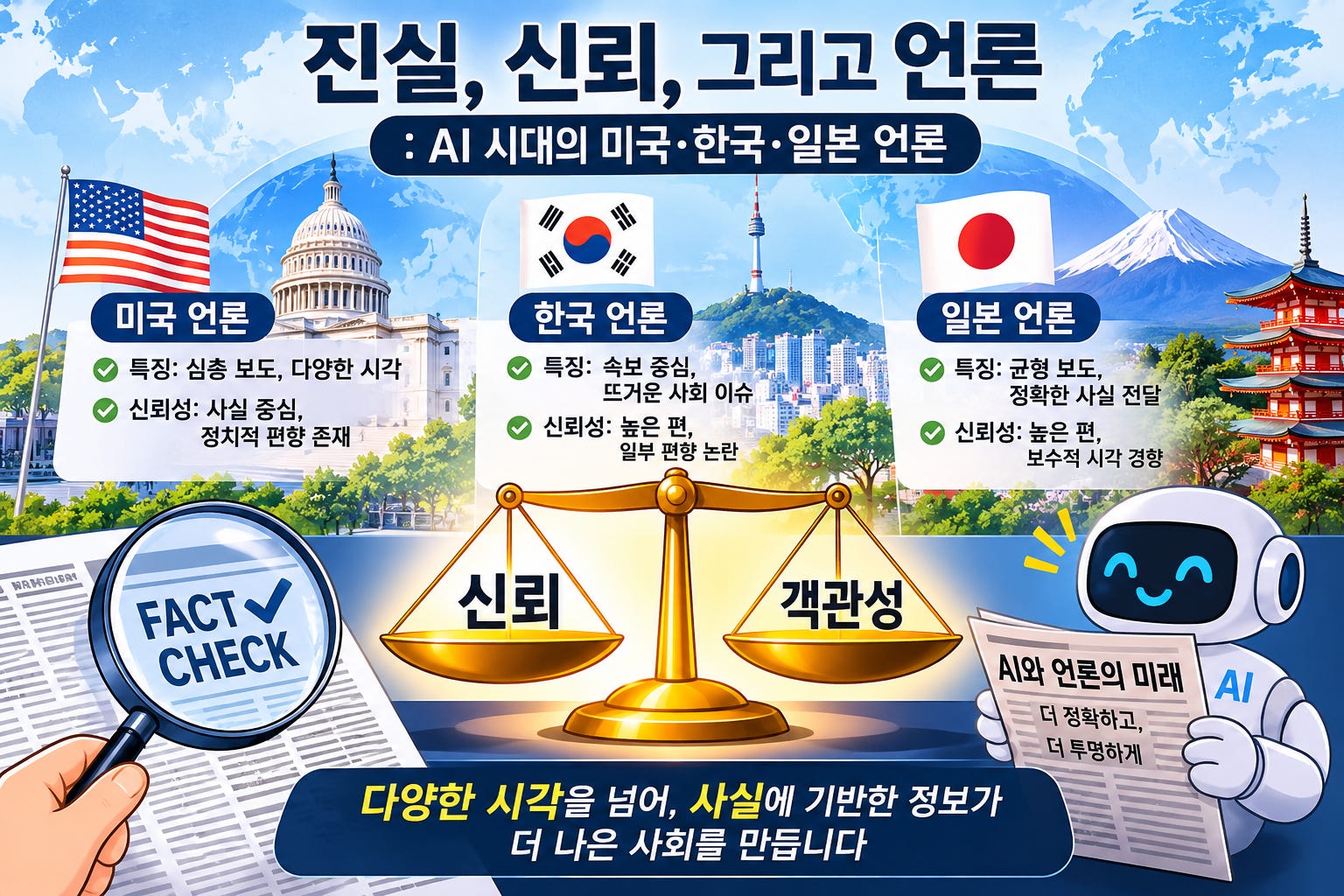
Image credit: Illustration generated with OpenAI’s ChatGPT image-generation tool with the author’s idea, 2026
진실, 신뢰, 그리고 언론
인공지능 시대의 미국·한국·일본의 저널리즘
초록
언론은 민주주의 사회에서 시민에게 정보를 제공하고, 정치·경제 권력을 감시하며, 공론 형성의 기반을 마련하는 중요한 역할을 수행한다. 그러나 언론과 진실, 그리고 대중의 신뢰 사이의 관계는 갈수록 복잡해지고 있다. 미국, 한국, 일본은 이러한 문제를 살펴보기에 매우 흥미로운 비교 사례다. 세 나라는 모두 민주주의 제도와 표현의 자유를 보장하는 헌법적 기반을 갖추고 있지만, 정치적 역사, 제도적 구조, 언론의 취재 관행, 사회적 의사소통 방식에 따라 서로 다른 언론 환경을 발전시켜 왔다.
본 수필은 미국, 한국, 일본 언론의 특징과 강점, 그리고 주요 과제를 비교하면서 정치적 양극화, 상업적 압력, 제도적 의존성, 뉴스 검증, 인공지능의 영향력 확대에 주목한다. 특히 언론의 자유, 보도의 정확성, 대중의 신뢰는 서로 관련되어 있지만 동일한 개념은 아니라는 점을 강조한다. 비교 언론 연구, 국제 언론 자유 평가, 디지털 뉴스 연구를 바탕으로 어느 한 국가의 언론도 진실을 독점할 수 없다는 점을 논증한다. 언론의 핵심적인 책임은 단순히 사건을 신속하게 보도하거나 특정 정치적 입장을 옹호하는 것이 아니다. 사실을 확인하고, 맥락을 제공하며, 정보의 출처를 공개하고, 오류를 정정하며, 권력기관에 책임을 묻는 데 있다.
또한 AI 시대에 뉴스의 신뢰성을 평가하기 위한 실용적인 틀을 제시한다. 궁극적으로 건강한 민주주의를 위해서는 독립적인 언론뿐 아니라 사실과 의견, 증거와 해석, 진실한 정보와 인위적으로 만들어진 허위정보를 구별할 수 있는 시민이 필요하다.
핵심어: 언론, 미디어 신뢰성, 언론의 자유, 진실성, 미국, 한국, 일본, 정치적 양극화, 인공지능, 딥페이크, 미디어 리터러시, 민주주의
정보는 어디에나 있는데, 진실은 어디에 있는가?
우리는 정보가 넘쳐나는 놀라운 시대에 살고 있다. 버지니아에 앉아 있는 사람이 서울에서 발행된 신문을 읽고, 도쿄의 텔레비전 방송을 시청하며, 워싱턴에서 벌어지는 정치적 논쟁을 따라가고, 세계 어느 곳에서 발생한 속보도 몇 초 만에 접할 수 있다. 스마트폰 하나가 신문이자 텔레비전이며, 라디오이자 도서관이고, 국제적인 의사소통 수단이 되었다. 그러나 불편한 역설이 존재한다. 정보를 더 많이 접할수록 무엇이 진실인지 판단하기가 오히려 어려워지고 있다는 사실이다.
뉴스 제목은 정확할 수 있지만 불완전할 수 있다. 사진은 진짜일 수 있지만 오해를 불러일으키는 맥락에서 제시될 수 있다. 정치인의 연설은 정확하게 인용되었더라도 선택적인 편집을 통해 핵심 의미가 왜곡될 수 있다. 실제처럼 보이는 동영상이 인공지능으로 생성된 가짜 영상일 수도 있다. 또한 언론사가 사실에 부합하는 기사를 보도하면서도 자신들이 선호하는 해석을 뒷받침하는 사실만 강조할 수도 있다. 이러한 문제는 중요한 질문을 제기한다.
시민은 언론이 진실을 전달한다고 믿을 수 있는가? 아니면 이제 스스로 진실을 검증하는 방법을 배워야 하는가?
전통적으로 언론은 민주주의 사회에서 세 가지 핵심 기능을 수행해 왔다. 시민에게 정보를 제공하고, 권력을 행사하는 주체들을 감시하며, 서로 다른 생각과 주장이 경쟁할 수 있는 공론의 장을 제공하는 것이다. 이러한 책임은 민주주의 사회에서 특히 중요하다. 시민은 정부 정책을 평가하고, 선거에 참여하며, 공동체에 영향을 미치는 결정을 내리기 위해 신뢰할 수 있는 정보에 의존하기 때문이다.
미국, 한국, 일본은 이러한 문제를 비교하기에 매우 의미 있는 사례다. 세 나라는 중요한 민주주의 제도를 공유하지만, 언론은 서로 다른 역사적 경험 속에서 발전해 왔다. 미국 언론은 대립적이고 독립적인 권력 감시 보도 전통과 경쟁적인 민간 언론시장을 발전시켜 왔다. 한국 언론은 권위주의적 통제와 민주화라는 어려운 역사 속에서 성장하여 정치적 참여가 활발하고 디지털 연결성이 높은 뉴스 환경을 형성했다. 일본 언론은 전통적으로 주요 신문과 방송사, 제도화된 취재 관계에 크게 의존하는 보도 체계를 발전시켜 왔다.
이러한 차이가 어느 한 나라의 언론을 다른 나라보다 더 진실하게 만드는 것은 아니다. 오히려 진실을 추구하는 언론의 책임은 제도적 독립성, 전문적인 보도 기준, 경제적 유인, 정치문화, 그리고 언론인과 시민이 정보를 얼마나 기꺼이 의심하고 검증하는가에 달려 있다는 사실을 보여준다. 생성형 AI 시대에 이러한 책임은 더욱 중요해졌다. 이제 문제는 단순히 정보를 찾는 것이 아니다. 그 정보가 믿을 만한 가치가 있는지를 판단하는 것이다.
세 나라의 언론 체계: 서로 다른 역사, 서로 다른 압력
미국 언론: 언론의 자유, 시장 경쟁, 그리고 정치적 양극화
미국의 언론 체계는 표현의 자유를 강력하게 보호하는 헌법적 전통과 경쟁적인 민간 언론시장을 중심으로 발전해 왔다. 미국 수정헌법 제1조는 언론과 표현의 자유를 보호하며, 독립적인 언론 활동을 위한 중요한 법적 기반을 제공한다. 미국 언론은 탐사보도 전통도 발전시켜 왔다. 신문, 텔레비전 방송사, 디지털 언론은 정부의 비리, 기업의 부정행위, 부패, 공권력 남용 등을 조사한다. 언론은 행정부, 입법부, 사법부를 감시하는 역할을 수행한다는 의미에서 흔히 ‘제4부(The Fourth Estate)’라고 불린다.
그러나 미국 언론시장은 정치적으로나 경제적으로 중립적인 공간이 아니다. 《뉴욕타임스(The New York Times)》, 《워싱턴포스트(The Washington Post)》, 《월스트리트저널(The Wall Street Journal)》, CNN, 폭스뉴스(Fox News), MSNBC 등 주요 언론사는 서로 다른 편집 전통과 독자층, 정치적 보도 방식을 가지고 있다. 이러한 다양성은 민주주의의 장점이 될 수 있다. 시민은 서로 다른 해석을 비교하고 상충하는 주장을 검토할 수 있기 때문이다. 그러나 다양성은 동시에 정보 환경의 분절을 초래할 수도 있다. 사람들은 자신의 기존 정치적 신념을 확인해 주는 뉴스만 선택적으로 소비하기 시작할 수 있다. 정치적 양극화는 특히 어려운 과제다. 언론이 정치적 갈등과 논쟁, 이념적 대립을 강조하면 독자는 사실 보도조차 정파적 정체성을 통해 해석할 수 있다. 동일한 경제정책, 법원의 판결, 이민 문제 또는 국제분쟁이 상당히 다른 서사로 전달될 수 있다.
문제는 모든 언론사가 반드시 허위정보를 보도한다는 데 있지 않다. 더욱 미묘한 문제는 정확한 정보를 선택적으로 제시하고, 중요한 맥락을 생략하거나, 논평과 사실 보도의 경계를 흐리는 데 있다. 2026년 로이터저널리즘연구소의 디지털 뉴스 보고서는 이러한 문제를 보여주는 중요한 자료다. 미국 응답자 가운데 대부분의 뉴스를 대부분의 시간에 신뢰한다고 답한 비율은 25%였으며, 이는 전년보다 5%포인트 하락한 수치다. 보고서는 정치적 성향에 따른 뉴스 신뢰도의 상당한 차이도 지적했다(Egan et al., 2026). 이 결과를 미국 뉴스의 75%가 부정확하다는 증거로 해석해서는 안 된다. 이 수치는 실제 뉴스의 진실성을 측정한 것이 아니라 뉴스에 대한 대중의 주관적인 신뢰 수준을 나타낸다.
미국 언론의 또 다른 과제는 경제적 구조다. 대형 언론기업들은 구독료, 광고, 독자의 관심을 확보하기 위해 경쟁한다. 한편 지역 신문들은 심각한 재정적 어려움을 겪어 왔으며, 그 결과 일부 지역에서는 독립적인 지역 정보의 공급원이 줄어들고 있다. 국경없는기자회(RSF, 2026)는 미국에서 언론 소유의 집중, 언론인에 대한 압력, 지역 언론의 쇠퇴를 중요한 문제로 지적한다. 2026년 세계언론자유지수에서 미국은 180개 국가 및 지역 가운데 64위를 기록했다. 따라서 미국의 경험은 중요한 차이를 보여준다. 헌법적 보호는 언론을 위한 필수적인 기반이지만, 그것만으로 편집의 독립성, 보도의 정확성, 대중의 신뢰가 자동으로 보장되는 것은 아니다.
한국 언론: 민주화, 정치적 분열, 그리고 디지털 뉴스 문화
한국 언론은 민주화와 밀접하게 연결된 특별한 역사적 배경을 가지고 있다. 권위주의 정부 시기에는 언론인과 언론기관이 정치적 압력과 검열, 보도 제한을 경험했다. 1980년대 후반의 민주화 전환은 독립적인 언론 활동을 확대하고 국민이 다양한 정치적 관점에 접근할 수 있는 기회를 넓혔다. 그 이후 한국은 전국 단위 신문, 공영 및 민영 방송, 인터넷 뉴스 포털, 독립 디지털 언론, 소셜미디어 플랫폼 등을 포함하는 활발한 언론 환경을 발전시켜 왔다. 조선일보, 중앙일보, 동아일보 등 주요 신문은 일반적으로 보수적 편집 전통과 연관되어 있으며, 한겨레와 경향신문은 대체로 진보적 편집 전통과 연관되어 있다. 그러나 이러한 구분은 전반적인 경향을 설명하는 것이며, 모든 기사나 기자의 입장을 완전히 대변하는 것은 아니다.
정당과 언론의 관계는 한국 언론 연구에서 중요한 주제다. 곽경수(Kwak, 2022)는 한국 언론을 분석하면서 진보와 보수의 정치적 분열, 그리고 정당과 언론기관 사이의 관계가 언론 활동에 어떤 영향을 미치는지 논의했다. 이러한 현상은 때때로 ‘정치적 병행성(Political Parallelism)’이라는 개념으로 설명된다. 이는 언론기관과 정치집단의 관계가 사회 전반의 이념적 분열을 반영할 수 있다는 의미다. 그 결과 하나의 정치적 사건도 어느 신문, 방송사, 디지털 채널이 보도하느냐에 따라 크게 다른 해석으로 전달될 수 있다.
예를 들어 고위 정치인이 연루된 정부 조사가 있다고 가정해 보자. 어떤 언론은 혐의의 심각성과 책임 규명의 필요성을 강조할 수 있다. 다른 언론은 증거의 신뢰성, 절차적 공정성, 정치적 의도의 가능성에 주목할 수 있다. 또 다른 언론은 정부의 제도적 대응에 초점을 맞출 수 있다. 세 가지 관점 모두 정당한 질문을 포함할 수 있다. 그러나 언론이 의혹을 확정된 사실처럼 보도하거나 정치적 반대편에서 나온 증거라는 이유로 이를 무시한다면 국민은 사건을 불완전하게 이해하게 된다.
한국의 디지털 미디어 환경은 또 다른 차원을 더한다. 네이버와 기타 온라인 포털은 뉴스 유통에서 중요한 역할을 해 왔으며, 유튜브와 짧은 동영상 플랫폼, 온라인 커뮤니티도 공론 형성에 점점 더 큰 영향을 미치고 있다. 로이터저널리즘연구소의 2026년 보고서에 따르면 한국에서는 포털을 통한 뉴스 소비가 감소하는 반면, 온라인 동영상 플랫폼, 특히 짧은 동영상을 통한 뉴스 소비가 증가하고 있다. 또한 한국 응답자들의 AI 챗봇을 통한 뉴스 이용도 상대적으로 높은 것으로 나타났다(Lee et al., 2026). 이러한 변화는 기회와 위험을 동시에 제공한다.
긍정적인 측면에서 디지털 플랫폼은 독립 언론인과 소규모 언론기관이 기존 대형 언론사에 전적으로 의존하지 않고도 독자에게 접근할 수 있게 한다. 시민 역시 원본 연설문, 정부 문서, 다양한 해석에 접근할 수 있다. 반면 정치적 논평이 탐사보도로 제시되거나 개인의 추측이 확정된 사실처럼 유통될 수 있다. 감정적으로 자극적인 콘텐츠는 충분한 검증 없이 빠르게 확산될 수도 있다.
한국의 2026년 로이터저널리즘연구소 조사에서는 대부분의 뉴스를 대부분의 시간에 신뢰한다고 응답한 비율이 30%로 나타났다. 이는 세계 평균인 37%보다 낮은 수준이다(Egan et al., 2026). 이 결과는 한국이 발전된 디지털 인프라와 높은 인터넷 연결성을 갖추고 있다는 점에서 특히 주목할 만하다. 정보에 접근할 수 있다는 사실이 반드시 정보에 대한 신뢰로 이어지는 것은 아니다. 곽경수(2022)의 분석은 여기서 중요한 의미를 갖는다. 문제는 단순히 언론 매체의 수를 늘리는 것이 아니라 정치적 분열을 넘어 언론의 독립성과 전문적 책임을 강화하는 것이다.
일본 언론: 제도적 안정성, 전통 언론, 그리고 독립적 취재의 과제
일본 언론은 미국이나 한국과는 다른 역사적·제도적 과정을 거쳐 발전했다. 수십 년 동안 신문과 방송은 일본 국민의 일상생활에서 중요한 정보 전달 역할을 수행해 왔다. 주요 신문으로는 요미우리신문, 아사히신문, 마이니치신문, 니혼게이자이신문 등이 있다. 일본의 공영방송 NHK 역시 국가적인 뉴스와 공공정보 전달에서 중요한 위치를 차지하고 있다.
일본 언론은 신중한 표현, 정형화된 편집 관행, 공식 정보원의 폭넓은 활용과 관련되는 경우가 많다. 이러한 관행은 특히 복잡한 정치·경제·국제 문제를 보도할 때 성급한 결론을 피하는 데 도움이 될 수 있다. 그러나 전문적으로 보이는 외형과 신중한 보도 방식이 완전한 독립성을 자동으로 의미하지는 않는다.
일본 언론의 가장 중요한 제도적 특징 가운데 하나는 ‘기자클럽(Kisha Club)’ 제도다. 기자클럽은 지정된 언론사 기자들이 정부 부처, 정치기관, 경찰 조직 및 기타 공식 기관을 담당하면서 취재 공간과 정보 접근 기회를 공유하는 제도다. 정례 브리핑과 정보 교환을 촉진할 수 있지만, 프리랜서 기자와 외국 특파원, 소규모 독립 언론의 접근을 제한하는 장벽이 될 수도 있다. Buchmeier(2024)는 이러한 관계를 자세히 분석하면서 주류 언론과 정치권력 사이의 제도적 연결이 언론의 독립성, 자기검열, 경제적 이해관계와 관련된 긴장을 초래할 수 있다고 설명한다. 기자클럽에 참여하는 모든 언론인이 독립성을 잃는다는 의미는 아니다. 오히려 이러한 제도적 구조가 누가 정보를 얻는지, 어떤 질문을 하는지, 공식 발표에 얼마나 적극적으로 의문을 제기하는지에 영향을 줄 수 있다는 점이 중요하다.
예를 들어 정부가 새로운 국가안보정책을 발표했다고 가정해 보자. 정부와 지속적인 취재 관계를 맺고 있는 기자들은 정보를 효율적으로 확보할 수 있다. 그러나 독립적인 보도를 위해서는 정책의 전제, 잠재적인 결과, 재정적 비용, 시민의 자유에 미칠 수 있는 영향까지 검토해야 한다.정부의 공식 발표를 정확하게 전달한 기사는 사실에 부합할 수 있다. 그러나 그것만으로 국민에게 충분한 감시와 검증의 기능을 제공했다고 볼 수는 없다.
국경없는기자회(RSF, 2026)는 일본 언론의 지속적인 과제로 정치적 압력, 언론시장 집중, 정보 접근의 제도적 제약, 자기검열 등을 지적한다. 일본은 2026년 세계언론자유지수에서 180개 국가 및 지역 가운데 62위를 기록했다. 일본의 디지털 전환 역시 전통적인 언론 환경을 변화시키고 있다. 로이터저널리즘연구소의 2026년 보고서는 신문 발행 부수 감소와 소셜미디어 및 동영상 플랫폼의 경쟁 심화를 설명한다. 2025년 10월 일본의 일일 신문 발행 부수는 약 2,400만 부로, 전년보다 6.57% 감소한 것으로 보고되었다(Sawa & Saisho, 2026).이 보고서는 또한 연구논문 요약과 정보 모니터링을 지원하는 등 일본 뉴스룸에서 AI 활용이 확대되고 있다고 설명한다.
이러한 변화는 일본 언론도 미국과 한국 언론처럼 근본적인 질문에 직면해 있음을 보여준다. 기존 언론기관은 급변하는 정보 환경 속에서 어떻게 대중의 신뢰를 유지하면서 더욱 투명하고 독립적이며 사회의 요구에 민감하게 대응할 수 있을까?
실제 수치는 무엇을 말해 주는가?
국제 비교는 유용하지만 신중하게 해석해야 한다. 특히 뉴스에 대한 대중의 신뢰와 언론의 자유라는 두 가지 지표가 중요하다.
뉴스에 대한 대중의 신뢰: 2026년
로이터저널리즘연구소의 2026년 디지털 뉴스 보고서는 여러 국가의 뉴스 신뢰도를 동일한 조사 체계를 통해 비교할 수 있는 자료를 제공한다.
뉴스에 대한 전반적인 신뢰도
2026년 · 대부분의 뉴스를 대부분의 시간에 신뢰한다고 응답한 비율
일본 41%
한국 30%
미국 25%
세계 평균 37%
출처: Egan et al. (2026), Reuters Institute Digital News Report. 이 수치는 주관적 신뢰도를 측정하며, 개별 기사의 정확성을 검증한 비율이 아니다.
일본의 뉴스 신뢰도는 41%로 세계 평균인 37%보다 높다. 반면 한국은 30%, 미국은 25%로 세계 평균보다 낮다. 이러한 차이는 추가적인 연구를 요구하지만, 일본 언론인이 미국이나 한국 언론인보다 더 정확한 보도를 생산한다는 사실을 입증하는 것은 아니다. 대중의 신뢰도에는 정치적 양극화, 제도에 대한 신뢰, 역사적 경험, 뉴스 소비 습관, 언론에 대한 사회적 기대 등이 영향을 미칠 수 있다.
언론의 자유: 2026년
국경없는기자회의 세계언론자유지수는 다른 관점의 정보를 제공한다. 이 지수는 정치적, 경제적, 법적, 사회문화적 환경과 언론인의 안전이라는 다섯 가지 영역을 고려한다.
국가 2026년 세계 순위 종합 점수
한국 47위 69.12
일본 62위 62.90
미국 64위 62.61
출처: Reporters Without Borders (2026).
한국은 2025년 61위에서 2026년 47위로 상승했다. 일본은 66위에서 62위로 상승했으며, 미국은 57위에서 64위로 하락했다. 이러한 변화는 지수의 평가 방법과 해당 연도의 조사 기간을 고려하여 이해해야 한다. 이 순위는 개별 뉴스 기사의 진실성을 직접 측정한 결과가 아니다. 이 비교는 중요한 차이를 보여준다. 대중의 뉴스 신뢰도와 언론 자유는 서로 다른 측면을 측정한다. 한 국가는 언론 활동을 위한 상당한 법적 보호를 제공하면서도 대중의 신뢰가 낮아질 수 있다. 다른 국가는 상대적으로 높은 대중의 신뢰를 유지하면서도 독립적인 취재에 제도적 제약이 존재할 수 있다.
언론의 자유는 기자가 조사할 수 있도록 한다. 전문적 진실성은 기자가 검증하도록 요구한다. 국민의 신뢰는 시민이 그 두 가지 책임이 제대로 이행되고 있음을 확인할 때 형성된다.
AI 혁명: 이제 눈으로 보는 것만으로는 믿을 수 없는 시대
오늘날 언론이 직면한 가장 중요한 과제는 전통적인 정치적 편향이나 상업적 경쟁만이 아니다. 인공지능을 통해 정보 자체가 만들어지고 변형되는 방식이 근본적으로 달라지고 있다는 점이다. 수세기 동안 언론은 사진, 녹음된 인터뷰, 공식 문서, 목격자의 증언, 물리적 증거에 크게 의존해 왔다. 이러한 자료가 완벽했던 것은 아니지만, 검증할 수 있는 방법을 제공했다.
그러나 생성형 AI는 이러한 환경을 변화시켰다. 오늘날 개인도 비교적 저렴한 소프트웨어를 이용하여 실제로 발생하지 않은 사건의 사진을 만들고, 공직자가 한 적이 없는 발언을 하는 것처럼 보이는 동영상을 제작하며, 실제 인물의 목소리를 모방한 음성 녹음을 생성할 수 있다. 이러한 기술은 새로운 정보 위험을 만들어 낸다. 바로 진짜처럼 보이지만 인위적으로 합성된 미디어다.
가령 미국, 한국, 일본이 관련된 국제적 위기가 발생했다고 가정해 보자. 한 고위 정부 관계자가 군사정책의 갑작스러운 변경을 발표하는 동영상이 소셜미디어에 등장한다. 이 영상은 세 나라에 빠르게 확산된다. 텔레비전 해설자들은 그 의미를 논의하기 시작하고, 온라인 커뮤니티는 그 내용을 해석하며, 금융시장은 외교적 대립 가능성에 반응한다. 몇 시간이 지난 뒤 조사 결과 그 동영상이 인공지능으로 생성된 가짜 영상이라는 사실이 밝혀진다. 그러나 이미 피해가 발생했을 수 있다. 정치적 관계가 악화되고, 대중의 불안이 증가하며, 부정확한 해석이 후속 보도에 반영되었을 수 있기 때문이다. 이 가상의 사례는 AI로 생성된 허위정보가 단순한 기술 문제가 아님을 보여준다. 이는 언론, 국가안보, 국제외교, 대중의 신뢰와 관련된 문제이기도 하다.
허위정보와 의도적 허위조작정보의 차이
두 가지 개념을 이해하는 것이 중요하다. 허위정보(Misinformation)는 반드시 속이려는 의도 없이 유포되는 거짓 또는 부정확한 정보를 의미한다. 의도적 허위조작정보(Disinformation)는 사람들을 속이거나 조종하고 특정한 영향을 미치기 위해 의도적으로 만들어지거나 유포되는 거짓 또는 오해를 유발하는 정보를 의미한다. 이러한 구분은 중요하다. 부정확한 정보를 공유하는 모든 사람이 의도적으로 기만 행위에 참여하는 것은 아니기 때문이다.
일반 시민은 AI로 생성된 이미지가 진짜라고 믿고 공유할 수 있다. 정치 논평가는 확인되지 않은 의혹을 반복할 수 있다. 언론사는 신뢰할 수 없는 정보원에 의존하여 오해를 유발하는 기사를 보도할 수도 있다. 그러나 조직적인 정보 조작 활동은 선거에 영향을 미치거나, 정부에 대한 신뢰를 약화시키거나, 외교관계를 훼손하거나, 사회적 분열을 심화시키기 위해 조작된 자료를 의도적으로 제작하고 유포할 수 있다. 따라서 언론인은 정보가 정확한지만 살펴보아서는 안 된다. 정보가 어떻게 만들어졌는지, 누가 유포했는지, 조직적인 영향력 행사 활동의 일부인지도 검토해야 한다.
AI는 언론을 위협할 뿐 아니라 발전시킬 수도 있다
인공지능을 오직 위협으로만 보는 것도 잘못이다. AI는 언론인이 외국어 문서를 번역하고, 방대한 공공기록을 분석하며, 금융거래의 패턴을 찾아내고, 과학 논문을 요약하며, 대량의 디지털 증거를 조사하는 데 도움을 줄 수 있다. 예를 들어 국제 기술 경쟁을 조사하는 미국 기자는 AI 기반 번역을 활용하여 한국 정부 문서와 일본 기업 보고서를 분석할 수 있다. 한국 기자는 공공조달 기록을 자동으로 분석할 수 있다. 일본 기자는 AI를 활용하여 역사적 문서를 정리하고 공식 발표의 불일치를 찾아낼 수 있다. 이러한 기능은 탐사보도의 효율성을 높일 수 있다.
그러나 AI가 생성한 요약은 반드시 원본 자료와 대조해야 한다. 번역 오류, 환각 현상, 불완전한 데이터, 알고리즘의 편향은 새로운 부정확성을 초래할 수 있기 때문이다. 가장 중요한 원칙은 AI가 언론의 조사 활동을 지원해야지, 보도에 대한 인간의 책임을 대신해서는 안 된다는 것이다.
새로운 검증 기준
언론사는 AI를 활용한 보도를 위해 명확한 절차를 마련해야 한다.
사진, 음성, 동영상이 변형되거나 인위적으로 생성되었는지 확인한다.
원본 출처를 확인하고 독립적인 추가 검증을 실시한다.
뉴스 제작에 생성형 AI를 상당한 수준으로 활용한 경우 이를 투명하게 공개한다.
AI가 생성한 자료에 대해 인간 편집자의 감독을 유지한다.
비밀 취재원과 민감한 정보를 보호한다.
AI와 관련된 오류를 신속하고 투명하게 정정한다.
2026년 1월 시행된 한국의 인공지능 기본법은 특정 AI 생성 결과물과 고영향 AI 활용에 관한 투명성 의무를 도입했다. 언론과 콘텐츠 표시 측면에서 이 법이 실제로 미칠 영향은 지속적으로 검토할 필요가 있다(Lee et al., 2026). 더 넓은 교훈은 미국과 일본에도 동일하게 적용된다. 기술적 정교함에는 반드시 윤리적 책임이 동반되어야 한다.
언론의 진실성을 평가하기 위한 실용적 틀
일반 시민은 뉴스 보도가 믿을 만한지 어떻게 판단할 수 있을까? 모든 사람에게 탐사보도 기자, 사이버보안 전문가, 디지털 포렌식 분석가가 되라고 기대하는 것은 현실적이지 않다. 그러나 시민은 정보의 신뢰성을 평가하는 능력을 크게 향상시킬 수 있는 실용적인 습관을 기를 수 있다.
다음은 미국, 한국, 일본의 언론 보도를 평가하기 위해 제안하는 일곱 가지 원칙이다.
진실한 언론을 위한 7가지 원칙
시민, 언론인, 교육자를 위한 K-GSP 실용 평가 체계
정확성 (Accuracy): 핵심 주장이 검증 가능한 증거에 의해 뒷받침되는가?
출처의 투명성 (Source Transparency): 독자가 원래의 정보 출처와 문서를 확인할 수 있는가?
맥락의 충실성 (Context): 보도가 배경과 관련 상황을 충분히 설명하는가?
공정성 (Fairness): 관련된 다양한 관점과 반론을 공정하게 다루는가?
독립성 (Independence): 정치적·기업적·재정적 이해관계로부터 독립적인가?
책임성 (Accountability): 잘못된 보도를 인정하고 정정하는가?
검증 가능성 (Verifiability): 독자가 근거가 되는 증거를 독립적으로 조사할 수 있는가?
이 일곱 가지 원칙은 미국 전문언론인협회(Society of Professional Journalists, SPJ, 2014)가 제시한 광범위한 언론 윤리의 책임과 일치한다. SPJ 윤리강령은 진실 추구, 피해 최소화, 독립적 행동, 책임성과 투명성을 강조한다. 또한 보도 전에 정보를 검증하고, 충분한 맥락을 제공하며, 정보원을 명시하고, 옹호 활동 및 논평과 뉴스 보도를 구분하며, 오류를 신속하게 정정할 것을 강조한다(SPJ, 2014).
평가 체계의 실제 적용: 동일한 사건, 세 나라의 보도
한 국제 반도체 기업이 미국, 한국 또는 일본에 대규모 투자를 발표했다고 가정해 보자. 이 발표가 중요한 정치·경제 뉴스로 다루어진다. 독자는 다음과 같은 질문을 해야 한다.
검증 질문 확인해야 할 자료
투자가 확정되었는가? 기업 발표 및 규제기관 제출 자료
투자 금액은 얼마인가? 원본 재무 문서
일자리는 얼마나 창출되는가? 기업의 전망과 독립적인 분석
정부 지원금이 포함되어 있는가? 공식 예산 및 보조금 자료
환경 문제는 없는가? 환경영향평가 및 지역 자료
국제적인 파급효과는 무엇인가? 독립적인 전문가 분석과 무역 통계
서로 다른 해석이 포함되어 있는가? 관련 이해당사자의 의견과 반론
이러한 접근은 기업의 발표와 독립적으로 검증된 경제적 성과를 구분하는 데 도움이 된다. 예를 들어 투자로 일자리 1만 개가 창출될 것이라는 제목의 기사가 기업의 장기 전망에 근거할 수 있다. 이를 이미 정규직 일자리 1만 개가 실제로 존재한다는 증거로 해석해서는 안 된다. 예상과 실제 달성 결과의 차이는 사소한 언론 보도의 문제가 아니다. 그것은 기대되는 것과 실제로 발생한 것을 구분하는 근본적인 문제다.
하나의 국가적 관점을 넘어 다양한 관점에서 읽기
국제적인 사건이 세 나라 모두에 영향을 미칠 때는 여러 언론의 보도를 비교해야 한다. 예를 들어 한국과 일본 기업에 영향을 미치는 새로운 미국 반도체 수출정책을 생각해 보자. 미국 언론은 국가안보와 기술 경쟁을 강조할 수 있다. 한국 언론은 국내 반도체 기업과 수출에 미치는 영향을 중점적으로 다룰 수 있다. 일본 언론은 공급망의 회복력과 산업정책을 분석할 수 있다. 이러한 관점들이 반드시 서로 모순되는 것은 아니다. 각국이 동일한 국제적 사건의 서로 다른 측면을 강조하고 있을 수 있기 때문이다.
완전한 이해를 위해서는 세 나라의 관점을 종합하고, 원본 정부 발표, 기업 공시자료, 무역 통계, 독립적인 연구 결과를 통해 주장을 검증해야 한다. 이것은 비교 언론 연구가 제공하는 가장 가치 있는 활용 방법 가운데 하나다.
언론의 책임과 시민의 책임
진실한 정보에 대한 책임을 언론인에게만 맡길 수는 없다. 언론인은 전문적인 책임을 가지고 있지만, 시민 역시 정보의 소비자이자 유통자로서 책임을 가지고 있다. 전통적인 미디어 환경에서는 신문과 방송사가 대중에게 제공되는 정보의 상당 부분을 통제했다. 그러나 오늘날 개인은 소셜미디어, 블로그, 팟캐스트, 동영상 플랫폼을 통해 출판자이자 발행자가 될 수 있다. 자신을 언론인이라고 생각하지 않더라도, 확인되지 않은 의혹을 수천 명의 팔로워에게 공유하는 사람은 정보 생태계에 참여하는 것이다. 이것은 새로운 형태의 시민적 책임을 만들어 낸다.
현명한 뉴스 독자가 실천해야 할 다섯 가지 습관
공유하기 전에 잠시 멈추기: 놀라운 제목이나 감정을 강하게 자극하는 동영상은 다른 사람에게 전달하기 전에 추가로 확인해야 한다.
제목을 넘어 기사 전체 읽기: 제목은 독자의 관심을 끌기 위해 만들어진다. 그러나 기사 전체에는 해석을 바꿀 수 있는 조건, 제한사항, 추가 정보가 포함되어 있을 수 있다.
원본 출처 확인하기: 가능한 경우 정부 문서, 법원 판결, 공식 통계, 연구 논문, 전체 녹화 자료를 확인해야 한다. 2차 요약 자료에만 의존해서는 안 된다.
서로 다른 관점 비교하기: 동일한 사건에 대한 미국, 한국, 일본 언론의 보도를 읽으면 강조점과 전제, 생략된 정보의 차이를 발견할 수 있다.
사실과 해석 구분하기: 이미 확인된 사건, 기자의 설명, 전문가의 예측, 개인의 정치적 의견은 서로 다른 종류의 정보다.
이러한 습관은 동영상 플랫폼, 인플루언서, AI 기반 검색 시스템을 통해 뉴스를 접하는 젊은 세대에게 특히 중요하다. 따라서 교육은 정보를 찾는 방법을 가르치는 수준을 넘어야 한다. 학생들이 증거를 평가하고, 불확실성을 인식하며, 책임 있는 판단을 내리는 방법을 배울 수 있도록 해야 한다. 바로 이 지점에서 미디어 리터러시, 정보 리터러시, 디지털 리터러시, AI 리터러시가 서로 연결된다.
더욱 신뢰할 수 있는 언론 환경을 향하여: 세 나라가 서로에게 배울 점
미국, 한국, 일본은 서로 다른 경험을 가지고 있으며, 각자의 경험에서 배울 점이 있다. 미국 언론은 헌법적 보호, 탐사보도, 독립적인 언론기관 사이의 경쟁이 중요하다는 사실을 보여준다. 동시에 정치적 양극화, 언론 소유의 집중, 지역 언론의 쇠퇴가 초래하는 위험도 보여준다. 한국 언론은 민주적 변화, 적극적인 국민 참여, 디지털 혁신의 중요성을 보여준다. 동시에 전문적 독립성을 강화하고 정치적 분열이 뉴스 보도에 미치는 영향을 줄여야 할 필요성을 강조한다. 일본 언론은 확립된 전문 제도, 체계적인 취재 관행, 제도적 연속성의 가치를 보여준다. 동시에 공식 정보에 대한 접근은 독립적인 조사와 다양한 목소리에 대한 개방성을 동반해야 한다는 점도 보여준다.
이 세 나라가 동일한 언론 체계를 채택해야 할 이유는 없다. 역사적 경험과 사회제도가 서로 다르기 때문이다. 그러나 세 나라에는 공통적으로 중요한 책임이 있다.
첫째, 정부는 언론의 독립성을 존중해야 한다.
공권력은 정당한 비판을 침묵시키기 위해 정치적·경제적·법적 압력을 행사해서는 안 된다.
둘째, 언론기관은 전문적 책임성을 강화해야 한다.
편집의 독립성이 부정확한 보도, 공개되지 않은 이해충돌, 증거의 선택적 제시를 정당화하는 구실이 되어서는 안 된다.
셋째, 기술기업은 자신들이 형성하는 정보 환경에 책임을 져야 한다.
추천 알고리즘, 자동화된 콘텐츠 생성, AI 기반 정보 서비스는 투명성과 적절한 안전장치를 갖추도록 개발되어야 한다.
넷째, 대학은 미디어 및 AI 리터러시 교육을 강화해야 한다.
학생들은 주장을 조사하고, 정보원을 평가하며, 통계를 해석하고, 조작된 미디어를 식별하고, 증거와 의견을 구분하는 방법을 배워야 한다.
다섯째, 시민은 표현의 자유에 정보를 신중하게 활용할 책임이 포함된다는 사실을 인식해야 한다.
정보를 공유하는 것은 쉽지만, 그 정확성을 확인하려면 지적 훈련이 필요하다.
이러한 책임은 세 나라에 특히 중요하다. 미국, 한국, 일본은 국제무역, 첨단기술, 반도체 공급망, 사이버보안 협력, 지역 안보를 통해 긴밀하게 연결되어 있기 때문이다. 한국의 외교정책에 관한 오해를 불러일으키는 보도는 미국과 일본 국민의 인식에도 영향을 미칠 수 있다. 군사협력에 관한 부정확한 보도는 불필요한 외교적 긴장을 조성할 수 있다. 국가 지도자의 발언으로 조작된 가짜 영상은 공식 해명이 나오기 전에 소셜미디어를 통해 확산될 수 있다. 따라서 진실한 언론은 단순한 국내 문제가 아니다. 국제협력과 지역 안정성을 위한 중요한 요소이기도 하다.
진실은 우리가 동의하고 싶은 것보다 중요하다
인간에게는 이미 자신이 믿고 있는 생각을 확인해 주는 정보를 믿고, 자신의 가정에 도전하는 정보는 거부하려는 오래된 유혹이 있다. 특히 정치적 정체성이 사실의 정확성보다 중요해지면 언론은 이러한 경향을 더욱 강화할 수 있다. 시민은 언론이 신뢰할 수 있는 증거를 꾸준히 제공하기 때문이 아니라 자신의 기존 신념에 편안함을 주기 때문에 특정 언론을 선택하기 시작할 수 있다. 이것은 민주주의에 심각한 도전이다.
항상 우리의 의견에 동의하는 신문이 반드시 신뢰할 수 있는 신문은 아니다. 우리의 정치적 견해를 표현하는 텔레비전 논평자가 반드시 독립적인 언론인인 것도 아니다. 설득력 있는 설명을 만들어 내는 AI 시스템이 반드시 진실한 답변을 제공하는 것도 아니다. 국가별 언론 체계에도 같은 원칙이 적용된다. 미국, 한국, 일본은 각각 가치 있는 언론 전통을 가지고 있지만, 어느 나라도 정치적·경제적·제도적·기술적 압력에서 완전히 자유롭지 않다.
핵심 문제는 언론인이 우리의 정치적 선호를 공유하는가가 아니다. 그들이 사실을 조사하고, 권력기관에 의문을 제기하며, 불편한 증거를 제시하고, 불확실성을 인정하며, 자신의 실수를 정정할 의지가 있는가이다. 인공지능의 등장은 이러한 책임을 더욱 시급하게 만들었다. 기계는 정보를 생성하고, 인간의 목소리를 모방하며, 설득력 있는 이미지를 만들고, 정교한 논증을 생산할 수 있다. 그러나 설득력 있는 이야기를 만들어 내는 능력과 진실을 입증하는 능력은 전혀 다르다.
아마도 가장 중요한 교훈은 기술의 발전에는 지적 성숙과 윤리적 책임이 반드시 동반되어야 한다는 사실일 것이다. 민주주의 사회에는 독립적인 언론인, 책임 있는 언론기관, 윤리적인 기술기업, 그리고 비판적으로 사고할 의지가 있는 시민이 필요하다. 궁극적으로 언론의 목적은 기자들이 믿는 것을 국민에게 믿도록 만드는 것이 아니다. 국민이 스스로 충분한 정보를 바탕으로 결론을 내릴 수 있도록 증거와 맥락을 제공하는 것이다.
자유로운 언론은 권력에 질문할 용기를 가져야 한다. 진실한 언론은 자기 자신에게 질문할 용기를 가져야 한다. 그리고 지혜로운 사회는 자신이 믿고 싶어 하는 것에 질문할 용기를 가져야 한다.
인공지능 시대에 인간 지성의 가장 중요한 척도는 얼마나 많은 정보를 생산하고 소비할 수 있는가가 아닐지도 모른다. 오히려 진실과 기만, 지식과 의견, 지혜와 단순히 확신하는 것처럼 보이는 태도를 얼마나 신중하게 구분할 수 있는가에 달려 있을 것이다.
참고문헌
Buchmeier, Y. (2024). Media politics in Japan: News journalism between interdependence, integrity, and influence. Publizistik, 69, 495–526. https://doi.org/10.1007/s11616-024-00858-3
Egan, J., Robertson, C. T., Ross Arguedas, A., Newman, N., Nielsen, R. K., Mukherjee, M., & Fletcher, R. (2026). Reuters Institute digital news report 2026. Reuters Institute for the Study of Journalism, University of Oxford. https://doi.org/10.60625/risj-4vgf-s811
Kwak, K.-S. (2022). The press. In J. Han (Ed.), The Oxford handbook of South Korean politics (pp. 408–422). Oxford University Press. https://doi.org/10.1093/oxfordhb/9780192894045.013.26
Reporters Without Borders. (2026a). 2026 World Press Freedom Index: Japan. https://rsf.org/en/country/japan
Reporters Without Borders. (2026b). 2026 World Press Freedom Index: South Korea. https://rsf.org/en/country/south-korea
Reporters Without Borders. (2026c). 2026 World Press Freedom Index: United States. https://rsf.org/en/country/united-states
Society of Professional Journalists. (2014). SPJ code of ethics. https://www.spj.org/spj-code-of-ethics/
Sawa, Y., & Saisho, R. (2026). Japan. In J. Egan et al., Reuters Institute digital news report 2026. Reuters Institute for the Study of Journalism. https://reutersinstitute.politics.ox.ac.uk/digital-news-report/2026/japan
About the Author

Prof. Dr. Young Choi (Editor-in-Chief) — Regent University
Full list of his K-GSP columns
Full list of his Books at Amazon.com
Young B. Choi is a Professor in the Department of Engineering & Computer Science at Regent University. He published 38 books with ‘Selected Readings in Cybersecurity’ (2018) (about 800 copies archived globally at university/college libraries around the world) and ‘Cybersecurity Applications and Artificial Intelligence’ (2023) available in seven major world languages. He proposed the world’s first global and universal telecommunications “Service Order Handling (SOH)” Model (T-SOH Model) (1995) with Dr. Adrian Tang. With this innovative research work, he received the IEEE NOMS ’96 Best Paper Award and became the first recipient of the Outstanding Contribution Award of the TeleManagement Forum in 1998. His research areas include Natural Language Processing-focused AI, AI-applied cybersecurity, network and telecom service management, and Korean studies on Gani Choi Rip’s Jeonggwan (정관(靜觀): Quiet Contemplation) philosophy and Shilhak (실학(實學): Practical Learning).
Suggested Citation
Choi, Y. B. (2026). Truth, Trust, and the Media: Journalism in the United States, Korea, and Japan in the Age of Artificial Intelligence. K-GSP Forum.
© K-Global Scholars and Professionals Forum. All rights reserved. 2026. Content published in the K-GSP Forum may not be reproduced, distributed, or transmitted in any form without prior written permission from the K-GSP Forum, except for brief quotations with full attribution.