

Secrecy, Menace, and Moral Ambiguity in the Ozarks: The Novels of Laura McHugh
Abstract
This essay examines Laura McHugh’s The Weight of Blood (2014) and What’s Done in Darkness (2021) as significant examples of contemporary Ozarks crime fiction. Situating McHugh’s work within the broader tradition of Ozarks literature, the essay contrasts her psychologically complex and suspense-driven narratives with the moral and pastoral vision of earlier writers such as Harold Bell Wright. It argues that McHugh portrays the Ozarks as a landscape shaped by secrecy, violence, generational trauma, and moral ambiguity while also exposing the emotional resilience of her characters. Through close readings of both novels, the essay explores McHugh’s use of multiple narrators, regional folklore, family secrets, and isolated rural settings to create suspense and psychological depth. At the same time, it considers the tension between her authentic depictions of Ozark life and her occasional reliance on familiar regional stereotypes. Ultimately, the essay contends that McHugh’s fiction reflects the evolution of Ozarks literature from moral idealism toward psychological realism, demonstrating the region’s continuing vitality as a setting for literary exploration.
Keywords: Laura McHugh; Ozarks literature; Crime fiction; Psychological suspense; Regional stereotypes; Moral ambiguity; Contemporary American fiction
Introduction
The earliest Ozarks novels appeared more than a century ago, with Harold Bell Wright’s That Printer of Udell’s (1903) often cited as the first. Wright followed this work with The Shepherd of the Hills (1907) and several other novels set in the region. His fiction presents the Ozarks as a moral and spiritual landscape where the hills and hollows function as sites of ethical formation. Conflicts are resolved through reflection, communal guidance, and adherence to traditional Christian principles, offering a pastoral and optimistic vision of rural life.
From its earliest stages, Ozarks literature has incorporated regional stereotypes such as hillbillies, moonshining, lack of education, violence, and rural poverty; these elements persist even in the otherwise moral and pastoral fiction of Harold Bell Wright. Such features continued throughout the twentieth century and remain visible in contemporary writing. Crime, violence, and social hardship have also long shaped representations of the region, appearing in works by writers such as Donald Harington and Nancy Allen. However, the success of Daniel Woodrell’s Winter’s Bone (2006)—and its film adaptation—helped crystallize and popularize a bleaker, more concentrated version of these elements, often described as “country noir.” [1]
Laura McHugh’s The Weight of Blood (2014) and What’s Done in Darkness (2021) participate in this darker tradition while emphasizing psychological trauma, family secrets, and moral ambiguity. In both novels, the Ozark landscape becomes more than a backdrop; it reflects the emotional isolation of characters whose lives are shaped by violence, secrecy, and unresolved histories. Yet McHugh’s fiction also raises questions about regional representation, particularly the tension between authentic observation and familiar stereotypes.
Hidden Graves, Hidden Truths: The Weight of Blood
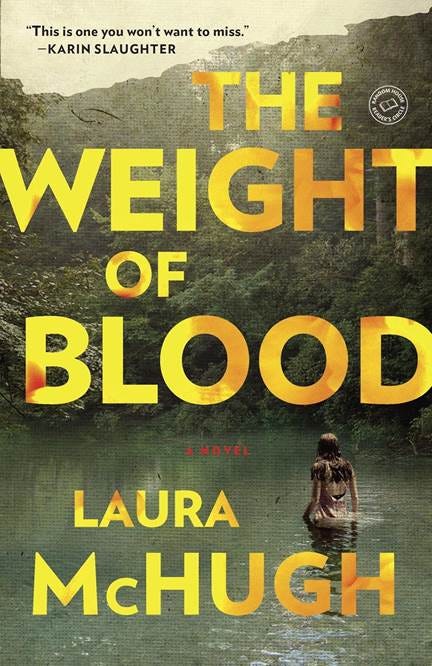
Cover image: The Weight of Blood by Laura McHugh. Image reproduced for purposes of review and commentary.
In The Weight of Blood, small-town tranquility masks generational secrets surrounding the murder of one teenage girl and the disappearance of another. The novel follows Lucy Dane, who investigates the murder of Cheri Stoddard while seeking answers about the disappearance and death of her own mother, Lila. Through Lucy’s investigation, McHugh explores how violence and trauma persist across generations.
McHugh’s familiarity with the Ozarks is evident in her depiction of the region’s physical and emotional hardships. For example, Ransome Crowley
had the posture and skin of someone much older than her fifty years, which she attributed, without bitterness, to a lifetime of hard work and hand-rolled cigarettes. She was so scrawny, I thought at first that she must be seriously ill. That was before I saw how she worked the rows, heaving rocks and yanking weeds with ruthless authority, her gray hair knotted in a heavy bun at the base of her skull. (McHugh, Weight 71)
At the same time, the narrative occasionally relies on regional stereotypes. This tendency is evident in Lucy’s observation: “It was common knowledge that in the hills, with infinite hiding places, bodies disappeared. They were fed to hogs or buried in the woods or dropped in abandoned wells” (13). Such depictions risk reinforcing longstanding stereotypes of Ozark violence and isolation. Another stereotype appears in the portrayal of inbred families: “One table of inbred-looking assholes [...] knocked their drinks on the floor and laughed while I cleaned up their mess. [...] I concentrated on the lousy tips left on the tables and did my best not to look pissed” (77). These moments highlight the tension between McHugh’s credible, experience-based depiction of the region and more sensationalized notions of Ozark life.
Supernatural elements also permeate the narrative, reflecting local beliefs and folklore. Ghosts are treated as real within the story: Cheri’s mother remarks that she “got [Cheri’s] goddamn ghost hanging on,” while Daniel’s mother claims she “gets rid of spirits” (142, 144). These elements reinforce the novel’s themes of memory, trauma, and the lingering presence of past violence, linking the physical landscape of Henbane, a fictional town of just over 700 residents, to its haunted social and emotional terrain (126).
In addition to these supernatural elements, McHugh structures the novel with alternating narrators, including Lucy and her deceased mother Lila. Lucy’s chapters focus on her investigation into Cheri’s murder and the circumstances surrounding her mother’s death, while Lila’s chapters recount her own life, struggles, and eventual demise. Other characters, such as Ransome, contribute additional perspectives, creating a multifaceted narrative that traces patterns of disappearance, violence, and secrecy across generations. Through these shifting viewpoints, McHugh underscores how past traumas reverberate through families and communities, making the investigation as much an exploration of personal reckoning as a pursuit of justice.
Lucy assumes the role of a private detective, pursuing the cases of Cheri and Lila, whose lives serve as bookends to decades of unresolved mysteries. She believes that solving one case may illuminate the other, as both follow similar patterns of disappearance followed by death. This detective framework drives the suspense while revealing Lucy’s emotional investment and desire for closure in the face of family tragedy.
The novel’s setting is grounded in realistic details that capture everyday life in the Ozarks. For example, Daniel drives a rusty old truck and takes night classes at a technical college in Springfield, hoping to save enough money to attend full-time in the fall (118). Fleeting moments of romance are interspersed within the tension-filled narrative: “His hand traced the outline of my hair, my body, not touching but wanting to. Longing softened his voice” (113). These touches of intimacy and humanity offer relief from the darker elements of the story and deepen readers’ connections to the characters.
Finally, McHugh portrays the cruelty of outsiders who lack empathy for the victims. Tourists, fascinated by tragedy, visit the site where Cheri’s body was found and treat it as a spectacle: “One guy came in to ask me which tree it was, the one where they’d found ‘thar retarded girl’s parts’” (106). This scene underscores the dehumanization experienced by victims and critiques the voyeuristic tendencies of those removed from the realities of small-town life.
By blending suspenseful mystery, generational trauma, local folklore, and realistic depictions of rural life, The Weight of Blood presents a complex portrait of the Ozarks, where crime, memory, and human frailty intersect, creating a narrative that is both engaging and emotionally resonant.
Between Faith and Control: What’s Done in Darkness
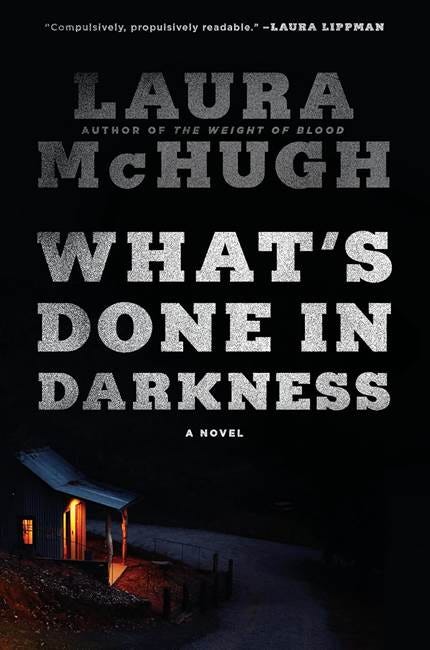
Cover image: What’s in Darkness by Laura McHugh. Image reproduced for purposes of review and commentary.
What’s Done in Darkness centers on the disappearance of a teenage girl from a remote Arkansas farm. Like The Weight of Blood, the novel uses the Ozark landscape to heighten suspense while exploring the vulnerability of young women within isolated communities. In both novels, the rural setting functions almost as a character itself, mirroring contemporary cultural anxieties and shaping the experiences of the young women at the center of the narratives.
Central to the novel are themes of excessive religiosity and a teenager’s rebellion against strict parental control. Like The Weight of Blood, the abduction of a teenage girl drives the plot, forcing characters and readers alike to confront the dangers that lurk beneath the seemingly peaceful rural environment. This parallel reflects McHugh’s interest in how isolated communities, when coupled with rigid social structures, can magnify personal vulnerability and suspense.
The prologue establishes the story and foreshadows the central conflict. Titled “Sarabeth, That Day: Age 17,” it introduces a teenage girl living in a stifling rural environment in Arkansas. Her fundamentalist Christian parents impose strict rules: Sarabeth must wear waist-length hair and ankle-length dresses, refrain from television and social media, demonstrate unquestioning obedience, and prepare to marry a man of their choosing when she turns eighteen. Any act of rebellion is met with physical punishment from her father. Midway through the prologue, Sarabeth prepares to sell produce from her family’s farm along a country road. When a man emerges from a truck wearing a mask, she flees toward a cornfield but is quickly captured, propelling the novel into a suspenseful and morally charged narrative.
Although the prologue captures readers’ attention, it relies heavily on familiar Ozarks stereotypes. Sarabeth’s parents are depicted as ignorant, old-fashioned backwoods figures, while some of her female peers seem to have little ambition beyond marrying and pleasing a husband. For example, early in the novel, Sarabeth hopes to escape her parents’ control by taking classes at a community college when she turns eighteen, but education is not a priority for her mother: “Then, when the course catalog she’d been waiting for finally arrived over the summer, Mama chucked it in the trash. You’ll be too busy taking care of your husband, she’d said” (McHugh, What’s 4; italics in original). In her early childhood, one of Sarabeth’s friends, Retta, “had liked to pair up the dolls and give them weddings and babies” (5).
While such individuals may exist in the region, they are hardly unique to the Ozarks and can be found nationwide. The novel’s portrayal of extreme religious control raises questions about the extent to which its depiction reflects contemporary reality or reinforces familiar cultural assumptions. By foregrounding these familiar stereotypes, the novel underscores cultural and generational conflict, but it does so at the expense of nuance and complexity.
The prologue also stretches verisimilitude in its plot construction. Given the parents’ strict and controlling nature, it seems unlikely that they would allow Sarabeth to sell produce alone and unprotected along a rural road. The lack of supervision conveniently enables the kidnapping, suggesting a plot device rather than a fully believable scenario. While this narrative choice creates immediate suspense, it invites critical scrutiny of the logic underpinning the story’s opening events.
Despite these limitations, the novel remains effective in exploring themes of identity, control, and resilience. It rewards closer attention to characterization and plot development, revealing the emotional struggles beneath its suspenseful surface.
By the novel’s conclusion, Sarabeth reflects on the paradoxical nature of her Ozark upbringing, recalling the beauty of the landscape even as she mourns the oppressive confines of her home: “I had never hated the farm, the sweeping beauty of the land. What I had hated was the loss of myself, the act I was forced to put on, the suffocating dresses and submissive smile” (196). This reflection captures the duality of the Ozarks in McHugh’s work: breathtakingly beautiful yet psychologically constraining, shaping its inhabitants and reinforcing themes of autonomy, rebellion, and resilience.
Conclusion
For more than a century, the Ozarks have provided writers with a landscape through which they explore morality, identity, and human conflict. While Harold Bell Wright presented the region as a place of moral testing and spiritual renewal, Laura McHugh depicts a darker and more ambiguous world shaped by secrecy, trauma, and inherited violence.
McHugh’s novels reveal the Ozarks as both beautiful and troubling—a landscape where family histories, social pressures, and personal choices intersect. Although her fiction often relies on familiar regional stereotypes, her attention to psychological complexity creates a more nuanced portrayal of rural life. The movement from Wright’s moral clarity to McHugh’s naturalistic ambiguity reflects broader changes in American literature while demonstrating the enduring power of the Ozarks as a literary setting. [2]
Notes
[1] In his review of Daniel Woodrell’s Winter’s Bone, David Bowman uses the term “hillbilly noir” in reference to the novel.
[2] An earlier version of this paper was presented at the 6th Annual Meeting of the Ozarks Studies Association (OSA), held in Springfield, Missouri, on April 3, 2026.
Works Cited
Bowman, David. “Hillbilly Noir.” The New York Times, 17 Sept., 2006, https://www.nytimes.com/2006/09/17/books/review/hillbilly-noir.html?searchResultPosition=1. Accessed 27 Mar. 2026.
McHugh, Laura. The Weight of Blood: A Novel. Thorndike Press, 2014.
_______. What’s Done in Darkness: A Novel. Random House, 2021.
About the Author

Professor of English and Creative Writing and Associate Dean of the School of Humanities and Theology, Missouri Baptist University
John J. Han, PhD, is the author, editor, co-editor, or translator of 35 books. His forthcoming book, Echoes from the Hills: Critical Essays on Ozarks Literature (co-edited with C. Clark Triplett), will be published by the University of Arkansas Press. He has also published nearly 3,000 poems in a wide range of journals and anthologies. In addition to his long tenure at Missouri Baptist University, he has taught at Kansas State University, the University of Nebraska–Lincoln, Nebraska Wesleyan University, and Washington University in St. Louis. He has also served as a visiting scholar at Georgia College & State University and the University of Ljubljana in Slovenia.
© K-Global Scholars and Professionals Forum. All rights reserved. Content published in the K-GSP Forum may not be reproduced, distributed, or transmitted in any form without prior written permission from the K-GSP Forum, except for brief quotations with full attribution.