

Executive Summary
This article examines David’s early life in 1 Samuel as a leadership development journey that demonstrates how God prepares leaders through calling, service, adversity, and character formation long before granting them authority. Using the integrated framework of the 5Is (Identity, Interest, Insight, Integrity, Influence) and 5Ps (Purpose, Priority, Perspective, Principles, Power), it traces David’s transformation from shepherd boy to king-in-waiting, highlighting the formative role of humility, patience, courage, and faithful stewardship. The findings suggest that in the AI era, sustainable leadership depends not primarily on position, power, or technical competence, but on the development of character, wisdom, and servant leadership cultivated through life’s preparation process.
Keywords: David; Shepherd Leadership; Leadership Development; Character Formation; Calling
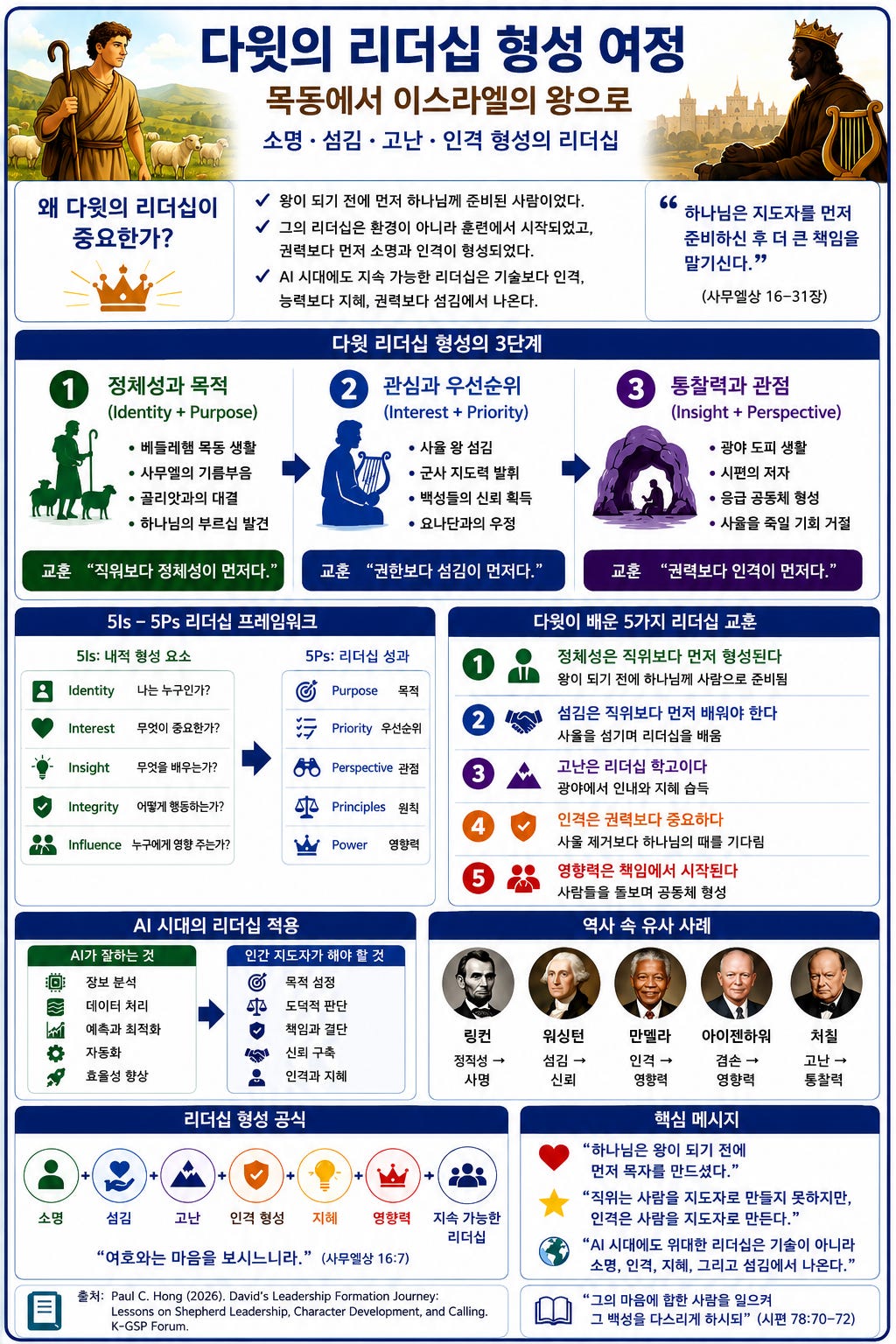
Figure 1. David’s Leadership Development Journey Model
Source: Figure created by the author based on 1 Samuel 16–31 and leadership formation theory. Artificial intelligence was used as a visualization aid to generate the graphic representation; the underlying concepts, framework, and interpretations were developed independently by the author.
1. Introduction
Throughout history, relatively few individuals have exerted influence across as many generations, cultures, and civilizations as David. His enduring significance is reflected not only in religious traditions but also in the continued use of his name by influential leaders, thinkers, explorers, economists, philosophers, and statesmen throughout history. As Israel’s greatest king, military leader, poet, musician, and statesman, David occupies a unique position in leadership history, shaping religious thought, political imagination, and cultural traditions across centuries. The enduring popularity of his name and legacy reflects the remarkable influence of the biblical David on both faith communities and broader human civilization (1 Sam. 16–31; Peterson, 2000).
The significance of David is further underscored by the opening verse of the Gospel of Matthew, which identifies Jesus as “the son of David, the son of Abraham” (Matt. 1:1). This statement highlights Abraham, David, and Jesus Christ as three foundational figures in biblical leadership history, representing calling, stewardship, and servant leadership respectively. Among these figures, David is particularly important because his story reveals how God prepares leaders through service, adversity, delayed promotion, and faithful obedience before entrusting them with authority. Long before David wore a crown, God was shaping his identity, purpose, priorities, wisdom, patience, and character through the formative experiences recorded in 1 Samuel (Sanders, 2007; Peterson, 2000).
Although originally developed for a missional leadership cohort, David’s story offers lessons that extend far beyond religious settings. His experiences address universal leadership challenges involving calling, service, ambition, adversity, resilience, decision-making, authority, and character development. His journey is especially relevant in the AI era because, while artificial intelligence can enhance efficiency, information processing, and analytical capability, it cannot replace uniquely human qualities such as courage, humility, patience, trustworthiness, and moral judgment. Consistent with Winston and Patterson’s (2006) integrative definition of leadership as influencing and serving others toward shared goals, David’s development demonstrates that sustainable leadership depends less on position and power than on the formation of character and wisdom through life’s preparation process.
2. David’s Leadership Development Journey
David’s life in 1 Samuel reveals a progressive process of leadership development that occurred long before he occupied a formal leadership position. Unlike many leadership narratives that begin with authority, David’s story begins in obscurity. His formative years demonstrate how identity, purpose, priorities, wisdom, and perspective are developed through service, adversity, and delayed promotion. The journey from shepherd boy to king-in-waiting illustrates a central leadership principle: God develops the leader before entrusting the leader with greater responsibility.
Table 1 summarizes David’s leadership development journey as a progressive process unfolding throughout 1 Samuel. The table demonstrates how specific contexts and challenges shaped David’s decisions and produced both immediate and long-term outcomes. Beginning with Identity and Purpose, David discovered who God called him to become before receiving public authority. During Interest and Priority, he learned servant leadership through faithful service under Saul and increasing responsibility. Through Early Insight and Perspective, adversity, rejection, and delayed promotion expanded his wisdom and strengthened his character. Collectively, these stages demonstrate that sustainable leadership is not primarily developed through power or position but through preparation, service, and character formation.
Table 1. David’s Leadership Development Journey (1 Samuel)
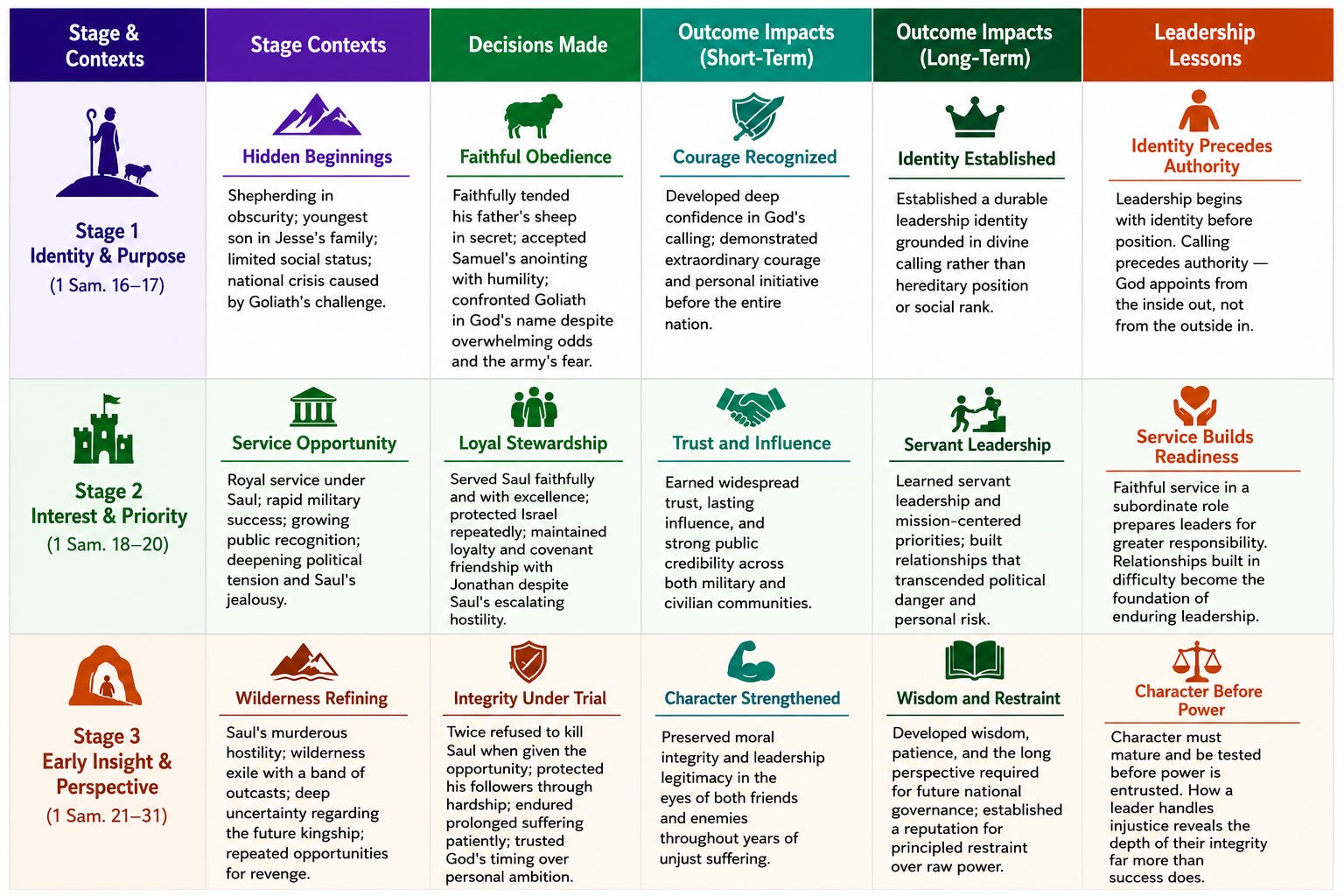
Source: Author’s own.
2.1. Stage One: Identity and Purpose (1 Samuel 16–17)
The first stage of David’s leadership development began during his years as a shepherd in Bethlehem. Unlike many future rulers who were raised in royal courts, David spent his early life caring for sheep in relative obscurity, performing responsibilities that required vigilance, courage, and faithfulness. Although shepherding was viewed as a modest occupation within ancient Israelite society, these ordinary experiences became the training ground for his future leadership. Long before receiving public recognition, David was developing the character, discipline, and responsibility that would later define his leadership.
A pivotal turning point occurred when Samuel anointed David as Israel’s future king and God reminded Samuel that “people look at the outward appearance, but the Lord looks at the heart” (1 Sam. 16:7). David’s subsequent confrontation with Goliath further demonstrated that his confidence was rooted not in military experience but in God’s calling and the lessons learned while protecting his father’s sheep. Through these experiences, David discovered that identity precedes position and that calling comes before authority. The outcome of this stage was direction, as David developed a clear sense of purpose rooted in God’s calling rather than external validation, establishing the foundation for effective leadership.
2.2. Stage Two: Interest and Priority (1 Samuel 18–20)
The second stage of David’s leadership development centered on service, responsibility, and the proper ordering of priorities. Following his victory over Goliath, David entered Saul’s court and quickly gained recognition as a military leader whose success brought public acclaim, increasing responsibility, and growing influence. Yet these achievements also introduced new challenges involving ambition, loyalty, and competing interests. This period became a critical test of whether David would pursue personal advancement or remain committed to God’s larger purpose for Israel.
As David’s popularity increased, Saul became increasingly jealous and hostile toward him, creating circumstances that could have encouraged political maneuvering or self-promotion. Instead, David continued serving faithfully, focusing on protecting Israel and fulfilling his responsibilities rather than accelerating his own rise to power. His covenant friendship with Jonathan further demonstrated the importance of trust, loyalty, and mutual support in leadership development. The outcome of this stage was service, as David learned that leadership is fundamentally about stewardship rather than status and that responsibility, humility, and faithful service must precede authority and influence.
2.3. Stage Three: Early Insight and Perspective (1 Samuel 21–31)
The third stage of David’s leadership development focused on the acquisition of wisdom, perspective, and character through adversity. Although already anointed as Israel’s future king, David spent years as a fugitive fleeing from Saul, living in caves, navigating political uncertainty, and leading a diverse group of followers under difficult circumstances. During this prolonged season of hardship, he experienced rejection, betrayal, fear, disappointment, and uncertainty while learning valuable lessons about human nature and leadership. Rather than becoming bitter or discouraged, David developed patience, resilience, self-control, and a broader perspective that would later prepare him for national leadership.
Perhaps the most significant lesson emerged when David twice had opportunities to kill Saul and accelerate his own path to power, yet chose restraint instead. He understood that legitimate authority should not be seized prematurely and that leadership gained through manipulation often lacks credibility, while leadership received through faithful stewardship creates enduring trust. The wilderness also transformed David from an individual leader into a community builder as he organized, developed, and inspired followers who would later become key leaders within his kingdom. The outcome of this stage was readiness, as wisdom emerged through adversity, character matured through restraint, and David learned that effective leadership involves the responsible stewardship of influence long before the exercise of authority.
God called David to be a good shepherd, and David first learned to be God’s sheep.
3. Translating David’s Leadership Development into Missional Leadership Contexts
David’s leadership development journey offers valuable lessons for churches, mission organizations, educational ministries, humanitarian agencies, non-profit organizations, and community service institutions. Unlike business organizations that often measure success through financial performance, missional organizations focus on service, stewardship, human development, community impact, and long-term transformation, a distinction emphasized by Drucker (1990, 2006). David’s experiences as shepherd, servant, warrior, and future king demonstrate how leaders are prepared for increasing responsibility through calling, faithful service, adversity, and character formation. Ultimately, his story illustrates that sustainable leadership depends less on authority, recognition, or technical competence than on the development of purpose, wisdom, integrity, and mission-centered stewardship.
3.1. Calling and Identity in Missional Leadership
Missional leadership begins with a clear understanding of calling, purpose, and identity. Individuals serving in churches, mission agencies, educational ministries, humanitarian organizations, and non-profit institutions often face challenges that cannot be sustained by compensation, status, or organizational authority alone. Drucker (1990) observed that effective mission-driven organizations are distinguished by clarity of purpose and commitment to values rather than financial incentives. Similarly, effective missional leaders are motivated by a sense of calling that transcends personal advancement and connects their work to a larger mission.
David’s leadership journey began not in a palace but in a pasture, where caring for sheep developed responsibility, courage, dependability, and stewardship long before public leadership opportunities emerged. In much the same way, pastors, missionaries, educators, and community leaders often begin their leadership journeys through small acts of service that gradually shape their character and commitment. A clear sense of identity provides stability during seasons of uncertainty, criticism, limited resources, and delayed outcomes, particularly in missional settings where results are often difficult to measure. David’s story therefore demonstrates that sustainable leadership begins with understanding who one is and why one serves before seeking authority or influence.
3.2. Shepherd Leadership and Service to Others
One of David’s most enduring leadership contributions is the model of shepherd leadership. Before leading soldiers, communities, or a nation, David learned to care for sheep, developing skills such as protection, guidance, vigilance, responsibility, and sacrificial service that later shaped his leadership effectiveness. His experience demonstrates that leadership is not primarily about exercising authority but about caring faithfully for those entrusted to one’s responsibility. This perspective remains highly relevant in missional contexts where pastors, missionaries, educators, and non-profit leaders are called to nurture people, build trust, protect the vulnerable, and promote human flourishing.
Drucker frequently emphasized that people are the most important asset of mission-driven organizations, making leadership fundamentally a responsibility of developing and serving others (Drucker, 1990, 2006). Greenleaf’s (2002) servant leadership framework similarly argues that authentic leadership begins with serving others rather than exercising authority, a principle clearly reflected in David’s shepherding experience. David’s influence expanded because he consistently accepted responsibility for others, focusing on stewardship and service rather than pursuing authority for its own sake. His example illustrates a central principle of missional leadership: responsibility often precedes authority, service frequently precedes influence, and lasting credibility is earned through faithful care for those already entrusted to one’s leadership.
3.3. Adversity, Perseverance, and Ministry Readiness
Missional leadership frequently involves seasons of adversity, uncertainty, and delayed outcomes as churches experience conflict, mission organizations encounter cultural barriers, non-profits face resource constraints, and educators invest years before witnessing the full impact of their efforts. David’s wilderness years provide a powerful model for understanding how adversity contributes to leadership formation and ministry readiness. Although already anointed as Israel’s future king, David spent years living as a fugitive, facing opposition, disappointment, and uncertainty that tested both his character and his faith. Rather than viewing these experiences as interruptions to leadership development, he allowed them to deepen his wisdom, patience, resilience, and perspective.
Many missional leaders face similar challenges when ministries grow slowly, resources remain limited, and personal sacrifices appear unnoticed. Yet adversity often develops qualities such as empathy, emotional maturity, perseverance, and long-term perspective that cannot be acquired through success alone. Drucker (1990, 2006) observed that mission-driven organizations must remain focused on purpose despite changing circumstances and external pressures, a principle reflected in David’s willingness to trust God’s timing rather than prematurely pursue authority. His experience demonstrates that leadership readiness emerges not merely from competence but from the development of wisdom, humility, and character through sustained faithfulness during difficult seasons.
God gave David both victories and valleys, and David learned to trust God’s timing.
4. Leadership Lessons from David for Contemporary Society
Although David’s leadership journey emerged within an ancient historical and religious context, its lessons remain highly relevant for contemporary leaders serving in educational institutions, government agencies, public service organizations, military institutions, corporations, and community organizations. As societies face increasing complexity, uncertainty, and rapid technological change, leadership effectiveness depends not only on technical expertise and organizational capability but also on purpose, legitimacy, wisdom, and character. This relevance becomes even more apparent in the AI era, where technology can expand access to information and analytical capabilities but cannot replace human judgment, ethical reasoning, accountability, or the ability to inspire trust. Consistent with Gardner’s (1990) emphasis on mobilizing people toward meaningful purposes, Weber’s (1947) focus on legitimate authority, Nye’s (2008) concept of contextual intelligence, and Niebuhr’s (1944) call for humility in the exercise of power, David’s story demonstrates that sustainable leadership is ultimately grounded in character, stewardship, and responsible service.
4.1. Purpose and Identity Before Position
One of the most important lessons from David’s life is that leadership begins with identity and purpose before position. David was anointed king while still a shepherd boy and possessed neither formal authority, military rank, wealth, nor political influence at the time. Yet his preparation began long before public recognition arrived because his identity was rooted in purpose rather than status. Similarly, Gardner (1990) argued that effective leadership begins with a clear sense of purpose and the ability to align individuals and institutions around meaningful goals.
This principle remains highly relevant for university presidents, school administrators, elected officials, military officers, and public servants who must lead amid increasing complexity and uncertainty. Educational and public institutions exist not merely to administer programs or grant credentials but to advance knowledge, citizenship, and the common good. In the AI era, technology can improve efficiency and expand capabilities, but it cannot determine institutional missions, societal values, or long-term purposes. David’s example therefore reminds contemporary leaders that sustainable leadership begins when identity, purpose, and values are firmly established before authority is acquired.
4.2. Leadership as Responsibility Rather Than Status
David’s leadership development demonstrates that leadership is fundamentally a responsibility rather than a privilege. Before he governed a nation, he learned to care for sheep, and before he exercised authority, he accepted responsibility for the well-being of others. His influence expanded because he consistently focused on stewardship, service, and the welfare of those entrusted to his care rather than personal advancement. David’s example illustrates that leadership credibility is built through faithful responsibility long before formal authority is acquired.
This lesson aligns closely with Weber’s (1947) concept of legitimate authority and with Kouzes and Posner’s (2023) argument that credibility forms the foundation of effective leadership. David’s legitimacy emerged not from his title but from actions that consistently demonstrated integrity, accountability, restraint, and concern for others. Likewise, government officials, educational leaders, military officers, and public administrators strengthen institutional trust when they exercise authority as a public responsibility rather than a personal entitlement. As technological capabilities continue to expand in the AI era, effective leaders must recognize that authority carries an even greater obligation to serve others wisely, ethically, and responsibly.
4.3. Adversity Develops Leadership Readiness
Perhaps the most enduring lesson from David’s leadership journey is that adversity often serves as a preparation ground for future responsibility. Although designated as Israel’s future king, David spent years facing uncertainty, opposition, disappointment, and hardship that became the very process through which leadership maturity emerged. Through these experiences, he developed patience, resilience, judgment, and the ability to lead under conditions of uncertainty. Tournier (1963/2013) observed that mature leadership requires balancing strength and humility, and David’s wilderness years became a training ground for developing both qualities.
David demonstrated courage in confronting danger and leading followers, yet he also exercised restraint, patience, and humility when opportunities arose to advance himself prematurely. His experience illustrates what Nye (2008) describes as contextual intelligence, the capacity to understand changing circumstances and adapt leadership behavior accordingly, while also reflecting Niebuhr’s (1944) emphasis on humility and moral responsibility in the exercise of power. David repeatedly refused opportunities to seize authority before the proper time, demonstrating that possessing power and being prepared to use it responsibly are not the same thing. In the AI era, where leaders have access to unprecedented information and technological capabilities, his story reminds us that sustainable leadership depends not only on competence but also on the wisdom, humility, character, and judgment required to steward authority responsibly.
5. Discussion: Leadership Formation in an Age of Artificial Intelligence
David’s leadership journey demonstrates that leadership development is fundamentally a process of formation rather than merely the acquisition of authority, knowledge, or technical competence. While contemporary organizations often evaluate leaders based on visible performance and measurable outcomes, David’s experiences as shepherd, servant, warrior, and future king reveal that sustainable leadership emerges through the gradual development of identity, stewardship, wisdom, and character. Peterson (2000) emphasizes perseverance and faithful obedience during extended periods of preparation, while Tournier (2013) highlights the role of weakness and continual growth in leadership maturity. In an era increasingly shaped by artificial intelligence, David’s story provides a timeless reminder that technology may amplify capability, but it cannot replace the human qualities that make leadership trustworthy and effective.
5.1. Leadership Formation Precedes Leadership Performance
Modern societies often celebrate achievements while overlooking the developmental processes that make those achievements possible. David’s years as a shepherd, servant, and fugitive were not interruptions to leadership development; they were the leadership development process itself. Maxwell (2005) similarly argues that growth in character and influence precedes advancement in position.
Organizations understandably invest in competencies, technical expertise, and measurable outcomes. Yet David’s experience suggests that leadership formation deserves equal attention because integrity, emotional maturity, resilience, and self-discipline often determine whether authority is exercised responsibly. Sustainable leadership therefore depends not only on what leaders accomplish but also on who they become during the journey toward greater responsibility.
5.2. Human Qualities Become More Important as Technology Advances
A common assumption is that technological progress reduces the importance of human judgment. David’s story suggests the opposite. As influence and capability increase, the need for wisdom, restraint, ethical responsibility, and sound judgment becomes even greater. Access to information or power does not automatically produce wise decisions.
Mollick (2024) argues that the future of work increasingly depends on effective collaboration between human judgment and artificial intelligence. While AI can generate insights and improve efficiency, leaders remain responsible for defining purpose, building trust, exercising ethical judgment, and balancing competing interests. Consequently, the future of leadership will depend not only on technological literacy but also on wisdom, character, emotional intelligence, transparency, and accountability.
5.3. Leadership Development Requires Intentional Practice
David did not become a capable leader through a single event. His readiness emerged gradually through repeated opportunities to practice responsibility, courage, restraint, service, and perseverance. Leadership development occurred through daily choices rather than isolated moments of success.
Yukl (2013) similarly argues that leadership develops through experience, reflection, and continuous learning. In the AI era, leaders must intentionally cultivate habits of learning, self-assessment, and character development alongside technological competence. Table 2 illustrates that this pattern extends beyond David to influential leaders across history. Whether in faith communities, educational institutions, public service organizations, or corporations, sustainable leadership emerges from the long-term formation of purpose, legitimacy, integrity, resilience, and sound judgment rather than from position or power alone.
Table 2. Leadership Formation Lessons for the AI Era
Source: Developed by the author based on 1 Samuel and available relevant examples.
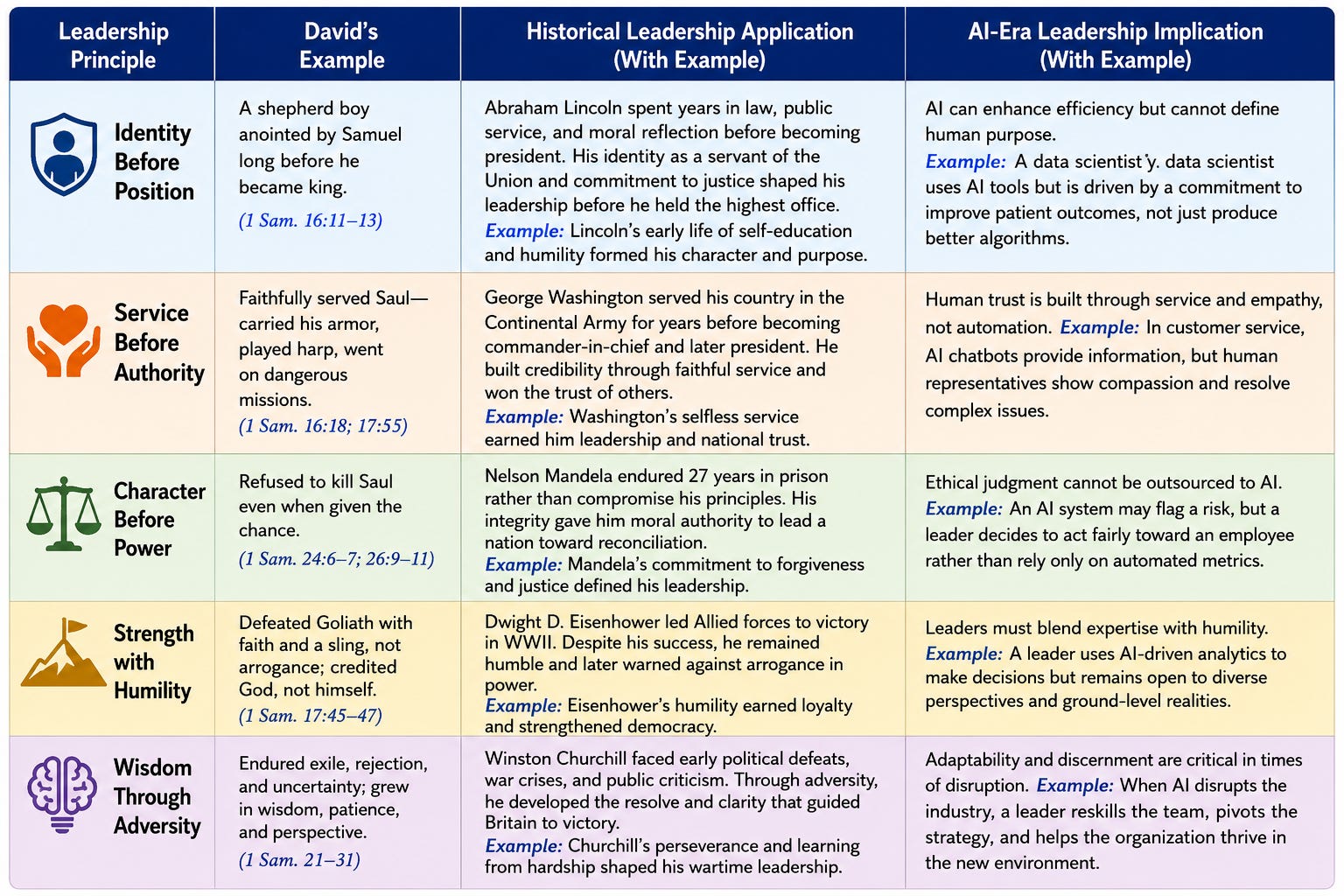
Table 2 extends David’s leadership journey by linking biblical leadership principles with historical examples and their relevance for the AI era. The five principles, Identity Before Position, Service Before Authority, Character Before Power, Strength with Humility, and Wisdom Through Adversity, demonstrate that enduring leadership is formed through preparation, service, integrity, humility, and perseverance rather than through position or power alone. Historical leaders such as Abraham Lincoln, George Washington, Nelson Mandela, Dwight D. Eisenhower, and Winston Churchill illustrate that these principles have shaped effective leadership across diverse societies, institutions, and historical periods.
The table also highlights a timeless lesson: leaders are developed before they are entrusted with greater authority. David’s experiences show that identity precedes position, service precedes authority, character precedes power, humility strengthens influence, and adversity develops wisdom, lessons that remain relevant across churches, educational institutions, governments, military organizations, and public service agencies. In the AI era, while technology can enhance efficiency and decision-making, sustainable leadership will continue to depend on uniquely human qualities such as purpose, ethical judgment, trustworthiness, humility, courage, and contextual intelligence.
Just as bones are strengthened by pressure, leaders are strengthened by perseverance.
5. Conclusion
David’s leadership journey demonstrates that effective leadership is formed long before leadership authority is granted. Through calling, shepherd leadership, and adversity, he developed the purpose, legitimacy, wisdom, and character necessary to lead at increasingly larger levels of responsibility. Viewed through the perspectives of Gardner, Weber, Nye, and Niebuhr, David’s story shows that sustainable leadership depends upon purpose before position, responsibility before privilege, and wisdom before power.
These lessons are even more relevant in the age of artificial intelligence. While AI can expand human capabilities through information, analysis, and decision support, it cannot replace purpose, moral judgment, humility, trustworthiness, or contextual wisdom. As technology becomes more powerful, the qualities that distinguish great leaders will increasingly depend not on the authority they hold or the tools they possess, but on the character, wisdom, and responsibility they develop through a lifetime of preparation and service.
References
Gardner, J. W. (1990). On leadership. Free Press.
Greenleaf, R. K. (2002). Servant leadership: A journey into the nature of legitimate power and greatness (25th anniversary ed.). Paulist Press. (Original work published 1977)
The Holy Bible, New International Version. (2011). Zondervan. (Original work published 1978)
Kouzes, J. M., & Posner, B. Z. (2023). The leadership challenge: How to make extraordinary things happen in organizations (7th ed.). Wiley.
Maxwell, J. C. (2018). Developing the leader within you 2.0. HarperCollins.
Mollick, E. (2024). Co-intelligence: Living and working with AI. Portfolio.
Niebuhr, R. (1944). The children of light and the children of darkness: A vindication of democracy and a critique of its traditional defense. Charles Scribner’s Sons.
Nye, J. S. (2008). The powers to lead. Oxford University Press.
Peterson, E. H. (2000). A long obedience in the same direction: Discipleship in an instant society (Rev. ed.). InterVarsity Press. (Original work published 1980)
Tournier, P. (2013). The strong and the weak. Wipf & Stock. (Original work published 1963)
Weber, M. (1947). The theory of social and economic organization. Free Press. (Original work published 1922)
Winston, B. E., & Patterson, K. (2006). An integrative definition of leadership. International Journal of Leadership Studies, 1(2), 6–66.
Yukl, G. (2013). Leadership in organizations (8th ed.). Pearson.
About the Author

Distinguished Professor, Dr. Paul Hong (Editor in Chief) — University of Toledo
Paul C. Hong is Distinguished University Professor at the University of Toledo. Drawing on more than four decades of leadership and missional service and three decades of scholarship in leadership and supply chain management, his research examines how individuals, organizations, and societies develop the capabilities necessary for resilience, adaptation, and long-term impact. His recent work integrates history, management, philosophy, and faith-based narratives to explore leadership formation through the development of identity and purpose, interests and priorities, insight and perspective, integrity and principles, and influence through stewardship, qualities that remain essential in the age of artificial intelligence.
Original Source:

Citation: Hong, P. C. (2026, July 9). David’s leadership formation journey: Lessons on shepherd leadership, character development, and calling. K-GSP Forum, pp. 1–12.
© K-Global Scholars and Professionals Forum. All rights reserved. Content published in the K-GSP Forum may not be reproduced, distributed, or transmitted in any form without prior written permission from the K-GSP Forum, except for brief quotations with full attribution.