

Executive Summary
This article examines David’s leadership transformation journey from kingdom builder to a man after God’s own heart, exploring how success, failure, repentance, and divine grace shaped his development as Israel’s most influential king. Extending the Legacy Trap Framework, it considers how a leader may move beyond self-protection, personal achievement, and the misuse of power through repentance, character formation, institutional stewardship, and responsible succession. Using the integrated 5Is–5Ps framework, the study analyzes David’s progression through kingdom building, leadership crises, personal restoration, covenant stewardship, and legacy formation.
Keywords: David; Leadership Transformation; Legacy Trap; Character Formation; Repentance and Restoration; Leadership Stewardship
1. Introduction
Success reveals what a leader can build; failure reveals who that leader has truly become. This article extends the Legacy Trap Framework (Hong, 2026) by shifting the focus from how successful leaders drift toward misuse of power and institutional decline to how leaders may respond to failure through repentance, character transformation, stewardship, and responsible succession. The first half of life is often devoted to discovering identity, acquiring skills, building relationships, pursuing opportunities, and preparing for greater responsibility, while the second half increasingly tests whether achievement can mature into transformation, stewardship, and legacy. The central questions therefore shift from “How do I succeed?” to “How do I respond when success exposes my weaknesses?” and from “How do I gain influence?” to “What will remain after failure, repentance, and restoration?” This developmental progression is consistent with Erikson’s (1982) understanding of identity formation and later-life integration, Bennis’s (2009) view of leadership as a lifelong process of becoming, and Collins’s (2026) emphasis on self-knowledge, meaning, and the responsible use of accumulated influence.
A previous discussion of the Legacy Trap (Hong, 2026) examined how leaders may gradually shift from institutional stewardship toward personal recognition, symbolic achievement, concentrated power, and concern for how history will remember them. David’s life provides a complementary perspective because it demonstrates both the danger of this trap and the possibility of transformation after failure. At the height of his success, David misused authority, attempted to conceal wrongdoing, and experienced consequences that damaged his family and kingdom; yet his willingness to accept correction, repent, endure discipline, rebuild stewardship, and prepare a successor prevented failure from becoming the final definition of his leadership. His story therefore extends the Legacy Trap discussion by asking not only how leaders decline, but also how they may recover moral direction and leave a legacy that continues serving future generations.
Few figures embody this journey more powerfully than David, Israel’s greatest king and the biblical figure described as “a man after God’s own heart” (1 Samuel 13:14; Acts 13:22). This designation does not imply moral perfection, because David’s life included adultery, deception, abuse of power, family dysfunction, and painful political consequences; instead, it points to the orientation of his heart as he sought God’s will, responded to correction, repented when confronted, accepted discipline, and repeatedly returned to God through humility, faith, and obedience. If 1 Samuel shows how God developed David before leadership, 2 Samuel and 1 Kings show how God transformed him through leadership itself. His reign included military victory, national unification, Jerusalem’s establishment as the capital, the arrival of the Ark, covenant promise, family crisis, rebellion, restoration, and succession, demonstrating how achievement, failure, repentance, and grace together shaped his character and legacy.
This article examines David’s transformation from kingdom builder to a man after God’s own heart through the integrated 5Is–5Ps framework: Identity–Purpose, Interest–Priority, Insight–Perspective, Integrity–Principles, and Influence–Power. Drawing on major events in 2 Samuel and 1 Kings 1–2, it shows how leadership maturity develops through achievement, failure, discipline, restoration, stewardship, and the responsible transfer of influence to future generations. This emphasis on transformation beyond positional authority is consistent with Burns’s (1978) distinction between transactional and transformational leadership and Heifetz’s (1994) understanding of adaptive leadership as learning through difficult challenges. The five dimensions operate throughout David’s life, but their emphasis shifts over time: Identity–Purpose and Interest–Priority are most visible during kingdom building, Insight–Perspective becomes central through failure and restoration, and Integrity–Principles and Influence–Power become increasingly prominent in later stewardship and succession. David’s life therefore offers a constructive response to the Legacy Trap by showing that enduring leadership emerges when achievement is disciplined by repentance, power is redirected toward stewardship, and influence is responsibly entrusted to future generations.
2. Stage One: Kingdom Building and Covenant Leadership (2 Samuel 1–10)
Although all five 5Is–5Ps dimensions were present throughout David’s reign, the first stage is most clearly characterized by Identity–Purpose and Interest–Priority, as his calling as God’s anointed king was translated into national unity, political stability, military security, religious renewal, covenant faithfulness, and service to future generations.
2.1 Saul’s Death and the Unification of Israel
David’s kingship began not through political ambition but through patient waiting for God’s timing, even though Samuel had anointed him years earlier and opportunities arose to seize the throne by force. After Saul’s death, David lamented Saul and Jonathan, accepted kingship over Judah at Hebron, and refrained from immediately attacking the northern tribes that remained loyal to Ish-bosheth. His patience, diplomacy, and restraint demonstrated that leadership legitimacy is built through trust, service, and divine calling rather than formal authority or personal ambition alone (Bennis, 2009). Over time, David’s military competence, political wisdom, and growing public trust enabled him to unite all twelve tribes under one kingdom. The elders of Israel recognized his long-standing service and invited him to become king over the entire nation, transforming a loose tribal confederation into a more cohesive political community. David’s authority endured because faithful service, proven leadership, and God’s providential timing prepared both the leader and the nation for unification.
2.2 Bringing the Ark of God to Jerusalem
After establishing Jerusalem as the capital of the united kingdom, David made its spiritual identity a central priority by bringing the Ark of God into the city. Because the Ark represented God’s covenant presence, David understood that lasting national unity required more than military power, administrative order, or political authority. By relocating the Ark, he sought to unite Israel geographically, politically, and spiritually around a shared covenant relationship with God. The procession into Jerusalem revealed a leader who placed God’s authority above his own royal prestige. David’s joyful dancing before the Ark expressed humility, gratitude, and wholehearted worship, even at the risk of appearing undignified, reflecting Nouwen’s (1989) view of leadership as a movement from power toward servanthood. The event demonstrated that David’s legitimacy rested not only on political achievement, but also on worship, stewardship, and submission to God’s sovereignty.
Figure 1
David’s Leadership Transformation Journey
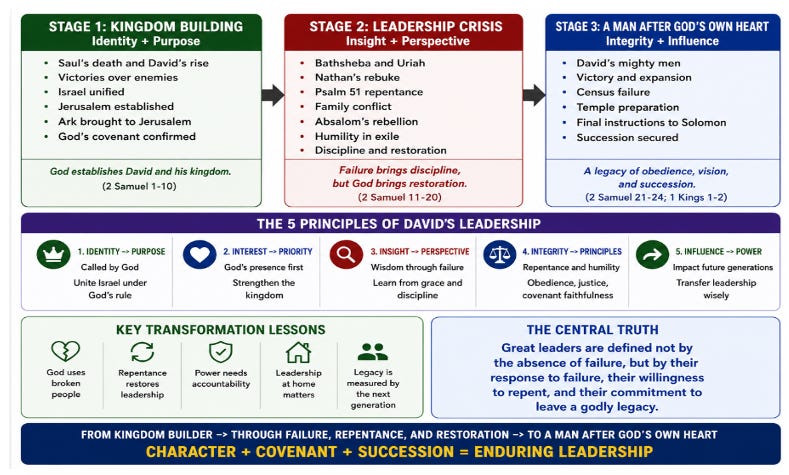
Note. Source: Author-developed framework based on 2 Samuel, 1 Kings, and leadership literature. AI-assisted visualization was used for graphic presentation only; the conceptual framework and interpretation are the author’s.
2.3 The Davidic Covenant: Messianic Promises
The defining event of David’s reign occurred in 2 Samuel 7, when his desire to build a permanent temple was met by God’s promise to establish his house, kingdom, and throne forever. This covenant moved David’s leadership beyond military success and national governance by placing his reign within God’s long-term redemptive purpose. It also expanded his horizon from serving one generation to participating in a promise associated with the future Messiah, reflecting the kind of long-range leadership vision described by Greenstein (2009).
At the same time, David faced difficult leadership tensions within his own administration, especially through Joab, whose military ability and loyalty were repeatedly compromised by impulsive violence and political recklessness. Joab’s killings of Abner, Absalom, and Amasa created crises that conflicted with David’s moral preferences and threatened national unity, yet removing such a powerful and effective commander carried serious political costs. David’s experience illustrates Niebuhr’s (1932) observation that leaders often pursue moral purposes within institutions shaped by competing interests, power struggles, and imperfect choices. He was required to preserve national stability and organizational cohesion while bearing the consequences of Joab’s actions and his own limited political leverage. This tension demonstrates that leadership requires not only vision and achievement but also patience, judgment, and the wisdom to navigate morally difficult relationships within complex systems.
Success may build a kingdom; repentance builds a legacy.
3. Stage Two: Leadership Failure, Discipline, and Restoration (2 Samuel 11–20)
Although identity, purpose, interest, and priority remained active, David’s failures and restoration brought Insight–Perspective to the foreground as success, power, temptation, and reduced accountability drew him toward the Legacy Trap. The resulting family crisis and public suffering exposed the consequences of distorted priorities, while discipline, repentance, and restoration deepened his moral perspective, spiritual maturity, and understanding of covenant stewardship.
3.1 Bathsheba Incident and Nathan’s Rebuke
David’s greatest leadership failure occurred at the height of national success, when military victories, political stability, and public recognition had greatly expanded his influence. During this period of prosperity, he committed adultery with Bathsheba and arranged the death of her husband, Uriah, to conceal his wrongdoing. These actions revealed profound failures of integrity, stewardship, and the responsible use of power. Ludwig and Longenecker (1993) describe this pattern as the “Bathsheba Syndrome,” in which achievement, authority, and reduced accountability create conditions for self-deception and ethical collapse. David’s actions also illustrate the central dynamic of the Legacy Trap: accumulated success and authority weakened accountability, while the protection of position and reputation began to outweigh truth, justice, and responsible stewardship.
God confronted David through the prophet Nathan, whose parable exposed both the seriousness of his sin and the danger of leaders becoming insulated from correction. David did not deny responsibility or shift blame but confessed, “I have sinned against the Lord,” (NIV, 2011) while Psalms 32 and 51 reflect his brokenness, repentance, and spiritual renewal. Although the consequences of his actions remained, the episode taught him that restoration begins not with preserving image or authority, but with humility, confession, and renewed dependence on God’s grace. His response illustrates the difference between remaining trapped in self-protection and beginning ethical recovery, showing that genuine repentance can open the way toward restored stewardship and renewed leadership legitimacy.
3.2 Disorder within David’s House
Nathan’s warning that “the sword will never depart from your house” became painfully visible as turmoil spread through David’s family. Amnon’s assault of Tamar exposed serious failures of justice and protection within the royal household, while David’s inability to respond decisively deepened resentment and led Absalom to kill Amnon in revenge. What began as David’s personal moral failure gradually expanded into a wider family and political crisis, revealing the sharp contrast between stability in the kingdom and disorder within his own household.
The conflict eventually escalated into Absalom’s rebellion, forcing David to flee Jerusalem and endure humiliation, uncertainty, and loss. Even after Absalom’s death, succession tensions continued through Adonijah’s attempt to seize the throne. These events taught David that achievements in governance, military affairs, or organizational leadership cannot compensate for neglected relationships and unresolved conflict within one’s closest circle of responsibility. His experience supports Schein and Schein’s (2021) argument that enduring leadership depends on trust, openness, and healthy relationships rather than formal authority alone, while also demonstrating that leadership failure rarely remains private: unresolved misconduct at the center of authority can spread through families, institutions, and succession systems.
3.3 Rebellion, Discipline, and Restoration
Absalom’s rebellion became the greatest political crisis of David’s reign and one of the most painful chapters of his leadership journey. Years earlier, David had fled from Saul as an innocent servant, but he now fled Jerusalem as a disciplined king confronting the consequences of his own failures. Absalom’s popularity and political maneuvering threatened both David’s authority and the stability of the nation, while David’s love for his son conflicted with his duty as king. The crisis reflects Niebuhr’s (1932) observation that political leaders often face competing moral obligations and Heifetz’s (1994) view that adaptive leadership develops through painful confrontation with difficult realities.
Throughout the rebellion, David demonstrated humility, patience, and submission to God’s sovereignty. He left the Ark in Jerusalem, refused to retaliate against Shimei, and resisted efforts to manipulate circumstances for his own advantage. Although the rebellion ended with his restoration to the throne, David did not escape the consequences of his failure; instead, the experience deepened his understanding of authority, suffering, dependence, and stewardship. He gradually moved beyond the Legacy Trap by relinquishing self-justification, accepting discipline, and submitting his authority to purposes greater than personal survival. His experience shows that enduring leadership rests not merely on recovering power, but on allowing failure to produce humility, accountability, and renewed faithfulness.
4. Stage Three: Leadership Legacy and Succession (2 Samuel 21–24; 1 Kings 1–2)
As David entered the final stage of his reign, all five dimensions continued to interact, but Integrity–Principles and Influence–Power became especially prominent through repentance, leader development, institutional stewardship, and succession. His later years illustrate a movement from personal accomplishment toward stewardship across generations, consistent with the Legacy Trap argument that enduring leaders should be evaluated by the institutions, relationships, people, and succession systems they leave behind (Hong, 2026; Bennis, 2009; Burns, 1978).
4.1 David’s Mighty Men and Organizational Leadership
David’s kingdom was built not by one leader alone but through the courage and loyalty of the group known as David’s Mighty Men, many of whom shared hardship, danger, and uncertainty with him during his years as a fugitive. Their long-term commitment reflected David’s ability to build trust, inspire sacrifice, and unite diverse people around a common purpose. They also demonstrate a central principle of organizational leadership: great leaders multiply leadership by developing followers who can exercise initiative, make decisions, and contribute independently to collective success. In the language of institutional stewardship, David’s enduring influence came not from concentrating power in himself but from preparing capable people to carry responsibility beyond his personal presence, resembling Kearns Goodwin’s (2005) account of Abraham Lincoln’s leadership of talented individuals toward a shared national purpose.
Table 1
David’s Leadership Transformation (2 Samuel–1 Kings 2)
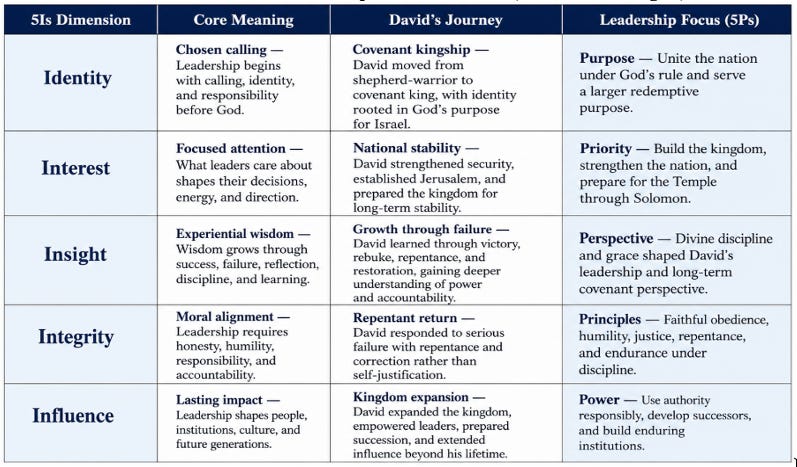
Note. Source: Author’s framework, integrating the 5Is (Identity, Interest, Insight, Integrity, Influence) and 5Ps (Purpose, Priority, Perspective, Principles, Power) dimensions of David’s leadership journey.
Table 1 presents David’s leadership transformation through the integrated 5Is–5Ps framework, showing how personal formation and leadership stewardship developed together across his reign. His Influence–Power extended beyond military and political achievement to leader development, institutional continuity, Solomon’s succession, and the enduring Messianic promise, revealing transformation as a lifelong integration of achievement, adversity, character, and legacy.
4.2 Military Successes and the Census Failure
Throughout his reign, David achieved major military victories over the Ammonites, Arameans, Philistines, Moabites, and Edomites, expanding Israel’s territory and strengthening its security. These accomplishments transformed Israel from a vulnerable tribal confederation into a unified and respected regional kingdom. His leadership, together with the abilities of his commanders and soldiers, brought stability, influence, and prosperity that earlier generations had not achieved. Yet Willard (1998) warns that spiritual formation is endangered when confidence shifts from dependence on God to trust in visible accomplishments.
One of David’s final failures therefore emerged at the height of national success, when he ordered a census of Israel’s fighting men. The census represented a late-life return to the logic of the Legacy Trap because visible strength, numerical measurement, and national capacity began to displace dependence, restraint, and covenant responsibility. Although Joab questioned the command and the resulting judgment exposed the limits of military and political power, David repented, accepted responsibility, and submitted himself to divine correction. His successes and failures reveal that leaders never become permanently immune to the Legacy Trap; leadership transformation requires continuing self-examination, inward character formation, accountability, and the responsible use of authority within imperfect political and organizational systems.
4.3 Final Words and Succession to Solomon
David’s final leadership responsibility was succession planning, an essential but often neglected dimension of effective leadership. As his life neared its end, he recognized that the kingdom’s future depended not only on past achievements but also on a stable transfer of authority to the next generation. Despite political tensions and competing claims, he secured Solomon’s succession and prepared him to continue the mission, including the future construction of the Temple. By relinquishing control and preparing a successor, David demonstrated that mature leadership preserves institutional continuity beyond the tenure of one individual (Bennis, 2009).
Succession provided the clearest evidence that David’s final legacy was no longer defined solely by what he personally controlled or completed. He accepted that another leader would build the Temple and carry the mission forward, demonstrating that faithful stewardship sometimes requires leaving important work unfinished and entrusting it to the next generation. His final words emphasized obedience to God above military success, political power, or personal accomplishment, as he instructed Solomon to uphold the covenant and govern with wisdom and justice. David’s influence therefore extended beyond his lifetime, showing that leadership escapes the Legacy Trap when power is no longer used to preserve personal prominence but is faithfully entrusted to future generations.
4.4 From the Legacy Trap to Enduring Stewardship
David’s life illustrates both the danger of the Legacy Trap and the possibility of transformation beyond it. At the height of success, he misused power, concealed wrongdoing, neglected accountability, and experienced consequences that spread through his family and kingdom. Yet his story did not end with personal decline because he accepted prophetic correction, confessed his failure, endured discipline, rebuilt his understanding of stewardship, developed other leaders, and prepared Solomon for succession. David’s enduring legacy therefore rests not on the absence of failure or the preservation of personal reputation, but on the redirection of power from self-protection toward repentance, covenant faithfulness, institutional continuity, and service to future generations.
God remembers not the crown we wear, but the heart we cultivate.
5. Conclusion
David’s life reveals that success can build a kingdom, but only repentance, discipline, and faithful stewardship can create a legacy that endures across generations. His misuse of power demonstrates the danger of the Legacy Trap, while his willingness to accept correction and return to God shows that failure need not become the final definition of leadership. His transformation through family crisis, political rebellion, restoration, leader development, and succession demonstrates that identity, purpose, priorities, integrity, and influence are tested most deeply after power has been gained. The final measure of leadership is therefore not how much authority one accumulates or how prominently one is remembered, but what kind of person one becomes, what institutions and people one strengthens, and what future one prepares for others. David’s greatest legacy was not simply the kingdom he ruled, but the heart he cultivated before God, the responsibility he entrusted to the next generation, and the Messianic promise fulfilled in Jesus Christ.
References
Bennis, W. G. (2009). On becoming a leader (4th ed.). Basic Books.
Burns, J. M. (1978). Leadership. Harper & Row.
Collins, J. (2026). What to make of a life: Cliffs, fog, fire and the self-knowledge imperative. Harper Edge.
Erikson, E. H. (1982). The life cycle completed. W. W. Norton.
Greenstein, F. I. (2009). The presidential difference: Leadership style from FDR to Barack Obama (3rd ed.). Princeton University Press.
Heifetz, R. A. (1994). Leadership without easy answers. Belknap Press of Harvard University Press.
Hong, P. C. (2026, August 11). Legacy traps in politics: Lessons on purpose, character, and legacy. K-GSP Forum, 1–12.
The Holy Bible, New International Version. (2011). Zondervan.
Kearns Goodwin, D. (2005). Team of rivals: The political genius of Abraham Lincoln. Simon & Schuster.
Ludwig, D. C., & Longenecker, C. O. (1993). The Bathsheba syndrome: The ethical failure of successful leaders. Journal of Business Ethics, 12(4), 265–273.
Niebuhr, R. (1932). Moral man and immoral society: A study in ethics and politics. Charles Scribner’s Sons.
Nouwen, H. J. M. (1989). In the name of Jesus: Reflections on Christian leadership. Crossroad.
Schein, E. H., & Schein, P. A. (2021). Humble leadership: The power of relationships, openness, and trust. Berrett-Koehler.
Willard, D. (1998). The divine conspiracy: Rediscovering our hidden life in God. Harper San Francisco.
About the Author

Distinguished Professor, Dr. Paul Hong (Editor in Chief) — University of Toledo
Paul C. Hong is Distinguished University Professor at the University of Toledo. Drawing on more than four decades of leadership and missional service and three decades of scholarship in leadership and supply chain management, his research examines how individuals, organizations, and societies develop the capabilities necessary for resilience, adaptation, and long-term impact. His recent work integrates history, management, philosophy, and faith-based narratives to explore leadership formation through the development of identity and purpose, interests and priorities, insight and perspective, integrity and principles, and influence through stewardship—qualities that remain essential in the age of artificial intelligence.
K-GSP Forum · Leadership & Governance Research · August 2026 · All rights reserved
Original Article:

Suggested Citation: Paul C. Hong (2026, August 13). David’s Leadership Transformation Journey. K-GSP Forum, 1–10.
다윗의 리더십 변혁 여정
폴 C. 홍(Paul C. Hong)은 미국 톨레도대학교의 석좌교수로, 리더십과 공급망 관리에 대한 오랜 연구와 선교적 봉사 경험을 바탕으로 개인과 조직이 어떻게 정체성, 목적, 통찰, 성품, 영향력을 발전시키는지를 탐구해 왔다. 이 글은 다윗의 생애를 단순한 성공담이나 영웅 이야기로 보지 않고, 성공과 실패, 회개와 징계, 회복과 계승을 통하여 한 지도자가 어떻게 변화되는지를 분석한다. 다윗이 “하나님의 마음에 합한 사람”으로 불린 것은 도덕적으로 완전했기 때문이 아니라, 실패한 뒤에도 변명하지 않고 하나님께 돌아가며 자신의 삶을 다시 하나님의 목적에 맞추려 했기 때문이다. 따라서 다윗의 진정한 위대함은 왕국의 크기나 군사적 업적보다, 권력을 소유한 이후에도 회개하고 배우며 자신의 영향력을 다음 세대를 위해 책임 있게 사용한 데 있다.
다윗의 리더십 여정은 세 단계로 전개된다. 첫 단계는 사울의 죽음 이후 헤브론에서 왕이 되고, 이스라엘 열두 지파를 통합하며, 예루살렘을 수도로 세우고, 언약궤를 옮겨 온 왕국 건설의 시기이다. 그는 왕위를 강제로 빼앗지 않고 하나님의 때를 기다렸으며, 정치적 통합뿐 아니라 하나님의 임재와 언약을 중심으로 국가의 영적 기초를 세우려 했다. 또한 다윗 언약을 통하여 자신의 통치가 한 세대의 정치적 성공을 넘어 장차 메시아적 약속과 연결된다는 사실을 깨달았다. 이 시기의 핵심은 정체성에서 목적이 나오고, 관심이 우선순위를 결정한다는 점이며, 다윗은 목자에서 언약의 왕으로 성장하면서 개인적 생존보다 국가의 통합, 예배, 안보와 미래 세대의 준비를 우선시하였다.
두 번째 단계는 성공의 절정에서 찾아온 리더십 위기이다. 다윗은 밧세바와의 간음과 우리아의 죽음을 통하여 권력, 욕망, 자기기만이 결합될 때 성공한 지도자도 얼마나 심각하게 무너질 수 있는지를 보여 주었다. 그러나 나단의 책망을 받은 뒤 책임을 회피하지 않고 죄를 인정했으며, 시편 32편과 51편에서 드러나듯 회개와 은혜를 통하여 회복의 길로 들어갔다. 그럼에도 그의 죄는 암논과 다말의 비극, 압살롬의 반란, 가족의 분열과 정치적 혼란이라는 오랜 결과를 남겼다. 이 과정을 통해 다윗은 공적 성공이 가정과 관계의 건강을 보장하지 않으며, 진정한 지도력은 실패가 없는 상태가 아니라 실패에 어떻게 반응하고, 징계를 받아들이며, 다시 올바른 방향으로 돌아가는가에 의해 평가된다는 사실을 배웠다.
마지막 단계에서 다윗의 관심은 정복과 확장에서 성품, 유산, 후계자 준비로 이동했다. 그는 용사들과 지도자들을 세워 자신의 영향력을 조직 전체로 확장했고, 말년의 인구조사 실패를 통해 여전히 교만과 자기 의존의 위험에 노출되어 있음을 드러냈지만 다시 회개하고 하나님의 주권을 인정했다. 무엇보다 솔로몬에게 왕권을 넘기고 성전 건축을 준비함으로써, 성숙한 지도자는 모든 일을 자신이 완성하려 하지 않고 사명과 권한을 다음 세대에 책임 있게 이양해야 함을 보여 주었다. 글의 5Is–5Ps 틀은 이러한 변화를 정체성–목적, 관심–우선순위, 통찰–관점, 성실성–원칙, 영향력–권력으로 설명하며, 리더십은 단순히 권력을 얻는 과정이 아니라 그 권력을 하나님의 뜻, 공동체의 유익, 그리고 미래 세대를 위해 바르게 사용하는 과정임을 강조한다. 결국 다윗의 삶은 위대한 지도자는 자신이 세운 왕국보다 하나님 앞에서 형성된 마음과 다음 세대에 남긴 신실한 유산으로 기억된다는 사실을 가르친다.