

In today’s AI-driven media environment—where algorithms amplify signals, audiences interpret events in real time, and digital records persist—allegations move faster than verification, and denials often arrive misaligned with truth.
Under conditions of permanent visibility, what appears to be a single statement is rarely just communication. It is a moment of leadership under pressure, where timing, method, and disclosure shape whether credibility is strengthened or quietly eroded.

On April 9, 2026, First Lady Melania Trump delivered a rare public statement from the White House denying any personal relationship with Jeffrey Epstein. She stated that she had never been friends with Epstein, that he did not introduce her to Donald Trump, and that she had no knowledge of his crimes. The statement acknowledged limited past correspondence while rejecting any deeper connection and was delivered without questions from reporters. It came at a moment when the Epstein story had largely receded from public attention, making the timing as notable as the content. This example is not offered to assess the case itself, but to illustrate a broader leadership challenge: how public figures design responses when visibility is high, information is incomplete, and credibility is at stake.
In such moments, the problem lies not in the statement itself, but in how it is conceived and delivered. Denials are not merely acts of communication; they are tests of leadership — decisions about timing, method, and disclosure made under conditions of uncertainty and scrutiny.
From Reaction to Design: The Calibrated Disclosure Framework
The Calibrated Disclosure Framework centers on three interdependent decisions: when to respond, how to communicate, and how much to disclose. Most leaders react—shaped by media pressure, legal caution, or urgency. Effective leaders design their response. Leaders treat what appears to be a single statement as a coordinated act of judgment in which timing, method, and disclosure must be aligned under pressure. This article introduces calibrated disclosure as a governance discipline for managing credibility under conditions of uncertainty and scrutiny. Different combinations of timing and disclosure quality create recognizable response patterns that determine whether leaders strengthen credibility when timing, method, and disclosure quality reinforce one another.
Figure 1 illustrates how timing and disclosure quality interact to produce distinct credibility outcomes. When response timing and response quality are aligned, leaders stabilize trust; when misaligned, credibility deteriorates rapidly. This interaction can be visualized as a simple but powerful structure: credibility depends on the alignment between timing and disclosure quality.
FIGURE 1. The Calibrated Disclosure Matrix
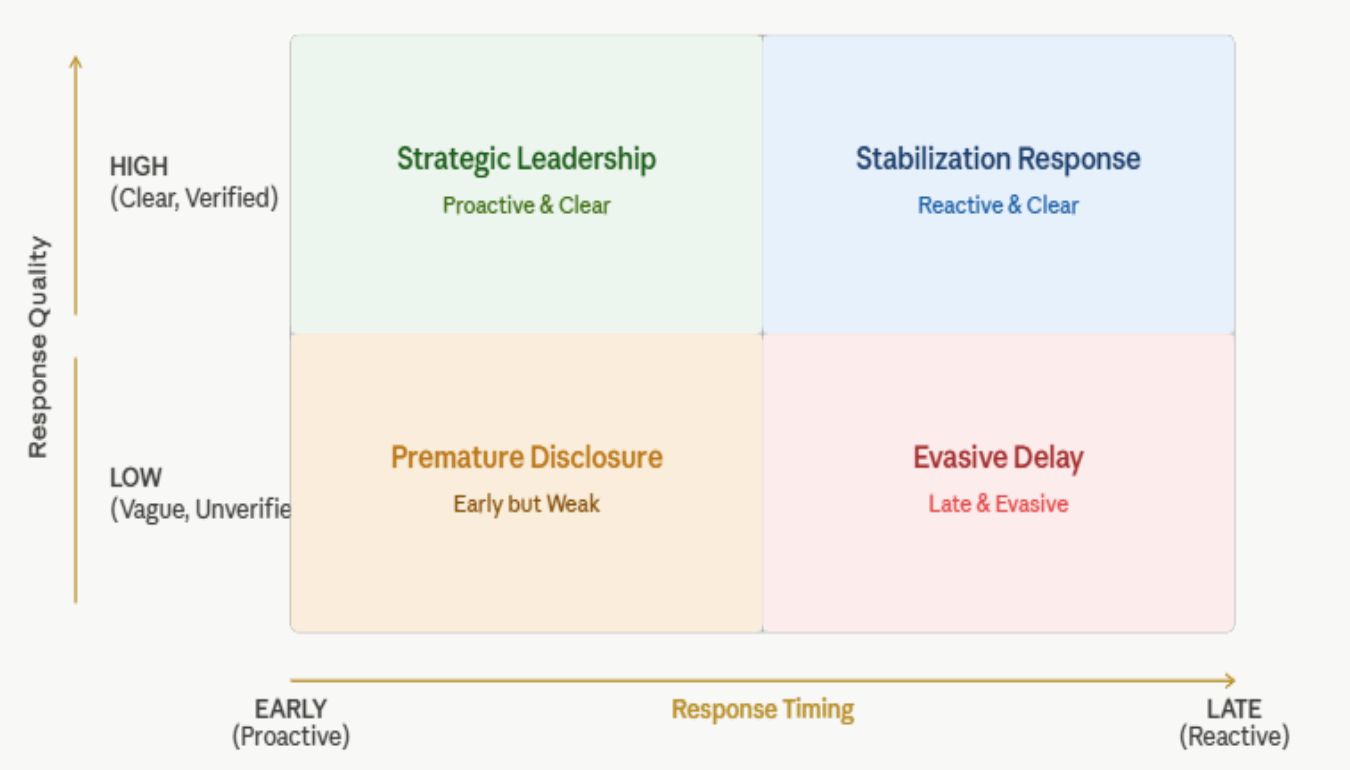
The matrix reveals a central insight: speed or transparency alone do not determine credibility, but by their alignment. Leaders can still fail when they deliver high-quality disclosure at the wrong time, while timely but weak statements accelerate distrust.
Balancing Risk, Timing, and Control in High-Stakes Denials
Every denial creates a tension between restraint and transparency. Saying less minimizes risk; saying more strengthens clarity. Most leaders default to restraint under pressure but containment is different from credibility.
Timing intensifies this tension. Leaders often mistake speed for strength. Leaders risk reversal when they issue premature denial: delayed responses allow speculation to harden. Effective leadership lies in calibrated timing—neither immediate nor passive but deliberate and verified. Method completes the equation. Clarity, consistency, and tone determine whether a denial reinforces trust or redirects scrutiny. Defensive language and fragmented messaging often amplify the crisis rather than resolve it.
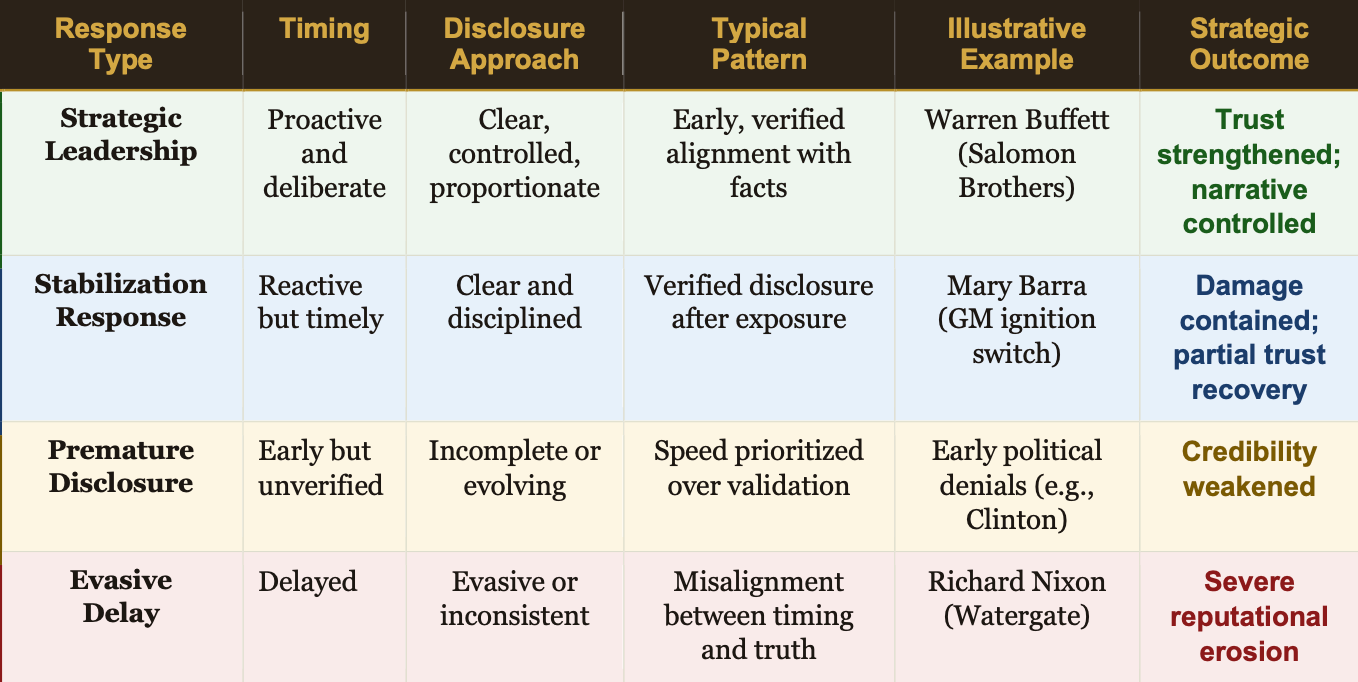
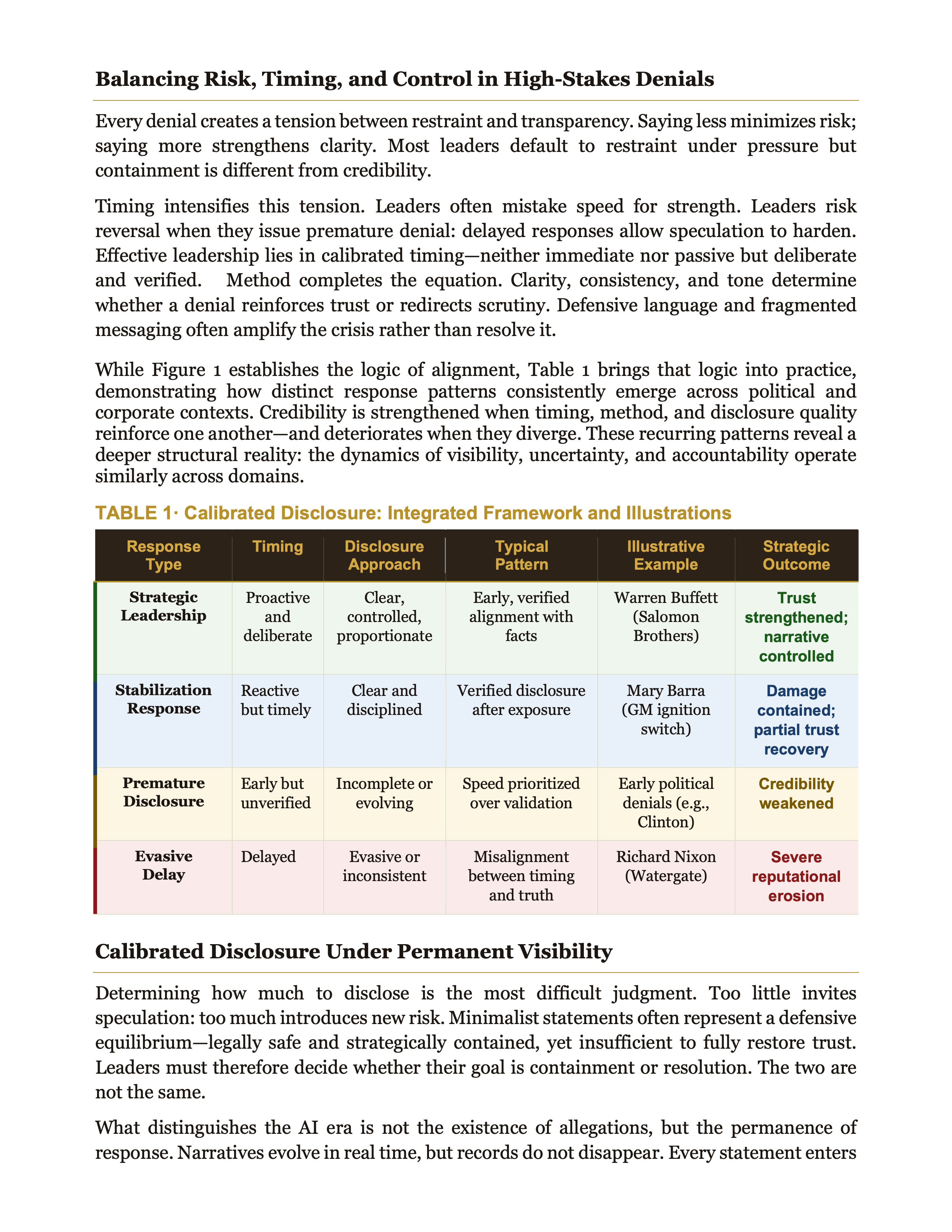
While Figure 1 establishes the logic of alignment, Table 1 brings that logic into practice, demonstrating how distinct response patterns consistently emerge across political and corporate contexts. Credibility is strengthened when timing, method, and disclosure quality reinforce one another—and deteriorates when they diverge. These recurring patterns reveal a deeper structural reality: the dynamics of visibility, uncertainty, and accountability operate similarly across domains.
TABLE 1 · Calibrated Disclosure: Integrated Framework and Illustrations
Calibrated Disclosure Under Permanent Visibility
Determining how much to disclose is the most difficult judgment. Too little invites speculation: too much introduces new risk. Minimalist statements often represent a defensive equilibrium—legally safe and strategically contained, yet insufficient to fully restore trust. Leaders must therefore decide whether their goal is containment or resolution. The two are not the same.
What distinguishes the AI era is not the existence of allegations, but the permanence of response. Narratives evolve in real time, but records do not disappear. Every statement enters an enduring digital archive. Under these conditions, the test of leadership is not whether one denies an allegation, but whether the response reflects discipline under pressure. Leaders build credibility when they align responses with verifiable truth, preserve institutional integrity, and minimize unintended escalation. When leaders fail to align these elements, they trigger either overreaction or erosion of trust.
“Credibility is neither asserted nor controlled—it is built, moment by moment, through responses that endure both time and scrutiny.”
Conclusion
In an era of permanent visibility, denial is no longer a moment, it is a sequence of decisions under pressure. Stakeholders judge leaders not by whether they respond, but by whether their response reflects discipline, coherence, and alignment with truth. Under the spotlight, credibility cannot be claimed—it must be built, one decision at a time.
Denial, in this sense, is not a reflex but a structured act of leadership. Its effectiveness depends on the alignment of timing, truth, method, and disclosure. When these elements reinforce one another, credibility is strengthened; when they diverge, even accurate statements lose their force.
Across political and corporate contexts, the pattern is consistent: what leaders say—and how and when they say it—shapes credibility. In an environment defined by constant visibility and immediate judgment, leaders reveal their capability in how they manage pressure. Under the spotlight, credibility endures only when responses withstand both time and scrutiny.

Distinguished Professor, Dr. Paul Hong — University of Toledo
Paul Hong, PhD, CMA is a Distinguished University Professor and Chair of Information Systems and Supply Chain Management at the University of Toledo’s Neff College of Business. A certified management accountant and Fulbright-Nehru scholar, he teaches operations management, global supply chain strategy, and new product development across undergraduate, MBA, EMBA, and doctoral programs. He has supervised 25+ doctoral dissertations, published in premier journals including the Journal of Operations Management, and authored six scholarly books with Springer and Taylor & Francis.
Original print:
© K-Global Schoalrs and Professionals Forum. All rights reserved. Content published in the K-GSP Forum may not be reproduced, distributed, or transmitted in any form without prior written permission from the K-GSP Forum, except for brief quotations with full attribution.
Thank you for sharing this insightful piece on leadership.
It made me reflect on how dangerous denial can be, especially for those in positions of responsibility.
What stood out most is that the greatest risk is not ignorance, but knowing the truth and choosing to ignore it.
The idea that power and visibility can deepen denial is both sobering and very real.
It also highlights how easily organizations can become shaped by silence and filtered truth.
True leadership, then, seems to begin with the courage to face uncomfortable reality.
It reminds me that honesty is not just a virtue, but a necessity for sound judgment.
Thank you again—this is a message every leader needs to hear.