

EXECUTIVE SUMMARY
In the AI era, sustainable advantage no longer comes from content ownership but from designing mechanisms that convert human engagement into economic and institutional value. This study introduces the Nexus Business Model as a unifying framework linking experience to outcomes across physical, digital, and hybrid contexts. Drawing on cases such as Kyobo Book Centre and Barnes & Noble, it shows that durable advantage lies in value-conversion architectures that align engagement, trust, and monetization, with implications beyond retail to platforms, cultural institutions, and AI ecosystems.
Keywords: Nexus Business Model, AI Era, Value Conversion, Cultural Retail, Business Sustainability

Figure 1. Experiential Bookstore Environments in the AI Era
Source: Unsplash (Christopher Stites)
Note: The figure illustrates contemporary bookstore environments that emphasize spatial design, prolonged engagement, and experiential browsing. These spaces highlight how physical retail shifts from transactional exchange to experiential interaction, aligning with the Nexus concept of engagement-to-value conversion.
1. INTRODUCTION
On a quiet afternoon in a large bookstore, a visitor stands between towering shelves, flipping through a book they did not search for, did not expect, and may never buy. Nearby, another customer scans a barcode with a smartphone, instantly accessing summaries, reviews, and algorithmic recommendations generated by artificial intelligence. In that moment, two worlds coexist: one driven by human curiosity and serendipity, the other by machine-generated efficiency and prediction — highlighting a fundamental shift in how value is perceived. Not in access to information, but in how it is experienced and interpreted in context.
The rapid advancement of artificial intelligence is transforming not only how knowledge is accessed but also how value is created, mediated, and captured. AI systems increasingly generate summaries, recommendations, and decisions at scale, reducing the marginal value of information and reshaping the economics of attention, while raising the risk of a “Turing trap” in which automation substitutes for, rather than augments, human capability (Brynjolfsson, 2022). At the same time, emerging research emphasizes co-intelligence, where human–AI collaboration enhances rather than replaces human judgment (Mollick, 2024), even as many systems create the illusion of value without delivering meaningful outcomes (Narayanan & Kapoor, 2024). In this context, traditional business models based on scarcity or content control become unstable, underscoring the need for Nexus Business Models that convert human engagement into economic, social, and institutional value.
2. NEXUS BUSINESS MODEL IN THE AI ERA
2.1 Concept of the Nexus Business Model
The Nexus Business Model refers to a mechanism through which organizations convert human engagement — such as attention, curiosity, and identity — into economic and strategic value. In the AI era, where information is abundant and algorithmically mediated, traditional models based on content ownership or distribution lose their competitive edge (Brynjolfsson, 2022; Narayanan & Kapoor, 2024). Instead, sustainability depends on how effectively organizations structure and channel engagement.
Crucially, engagement alone does not ensure viability. While AI systems generate unprecedented levels of attention, this does not automatically translate into revenue, loyalty, or institutional influence (Narayanan & Kapoor, 2024; Muldoon et al., 2024). The Nexus functions as a bridge between experience and outcomes, enabling organizations to convert engagement into measurable value — as even highly engaging environments may otherwise fail to achieve economic sustainability.
The Nexus Business Model differs from existing frameworks such as platform theory and open innovation. Platform theory emphasizes the orchestration of interactions and network effects (Parker et al., 2016), while open innovation focuses on knowledge flows across organizational boundaries (Chesbrough, 2020). Whereas platforms generate engagement and open innovation expands knowledge flows, the Nexus framework explains the critical intermediate step: how these inputs are structured into sustainable value.
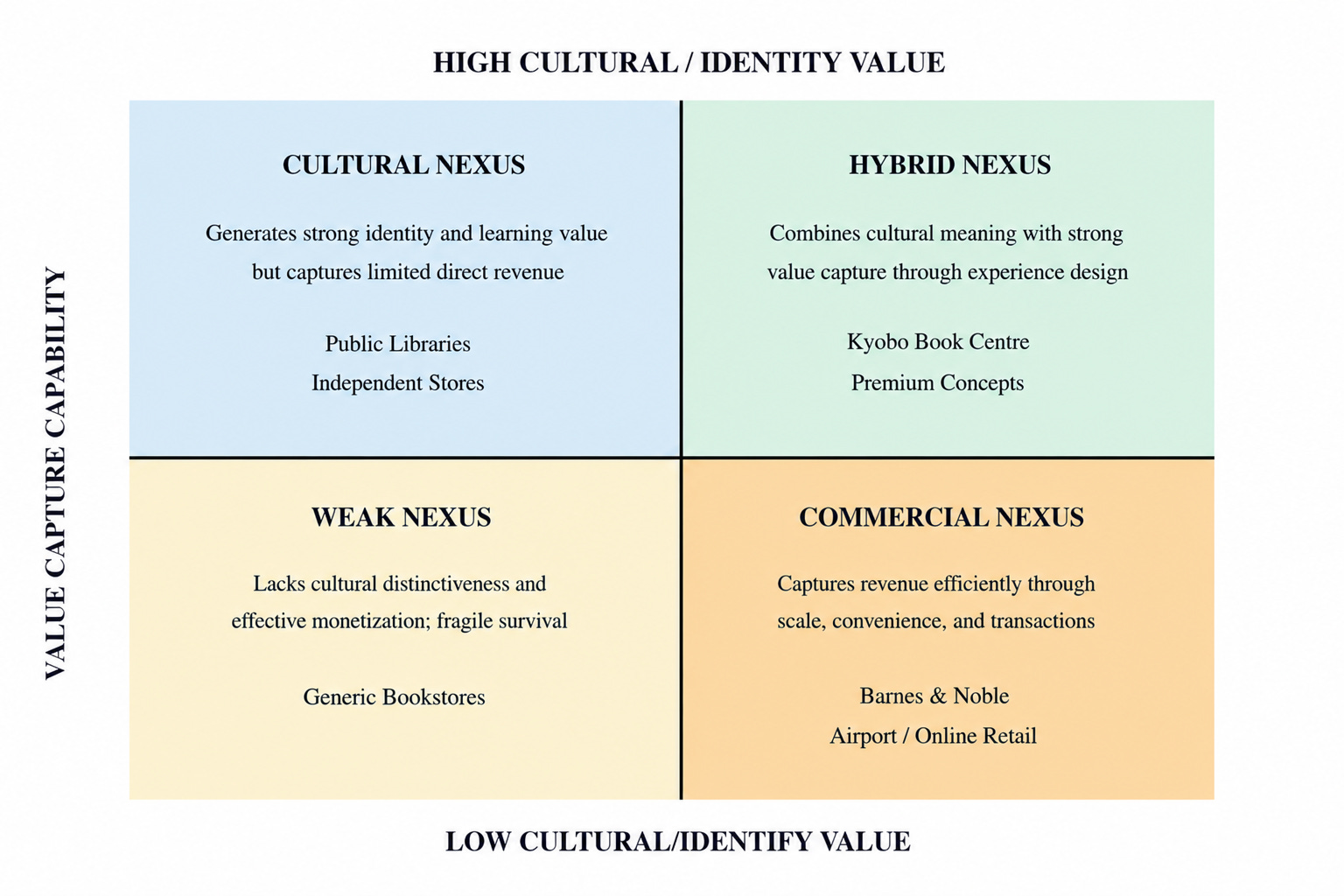
Figure 2. Bookstore / Publisher Nexus Matrix
Note: The matrix maps bookstore models along two dimensions—cultural/identity value (Y-axis) and direct value capture (X-axis). It highlights four Nexus configurations (cultural, hybrid, commercial, and weak), illustrating how alignment between engagement and monetization drives sustainability in the AI era.
2.2 Types of Nexus Mechanisms
Nexus mechanisms can be categorized based on how they translate engagement into value, reflecting different strategic pathways for sustainability in the AI era. The commercial Nexus focuses on direct monetization, converting customer presence into transactions through retail design, complementary services, and consumption-driven experiences. In contrast, the cultural or subsidy Nexus operates indirectly by transforming symbolic and social value — such as cultural legitimacy, public trust, and identity — into financial support through institutional backing or long-term brand effects (Floridi, 2023).
The curatorial Nexus leverages human expertise, judgment, and taste to create differentiated experiences that foster deeper engagement and loyalty, serving as a counterbalance to algorithm-driven recommendation systems and reinforcing the importance of human–AI complementarity (Mollick, 2024). Meanwhile, the platform Nexus converts engagement into data-driven value within digital ecosystems, where user interactions generate feedback loops that enhance personalization, retention, and scalability (Parker et al., 2016). Together, these mechanisms demonstrate that there is no single path to sustainability; rather, organizations must design configurations that effectively align engagement with appropriate modes of value conversion.
2.3 Nexus and Business Model Transformation
The introduction of the Nexus Business Model redefines the foundations of business strategy in the AI era by shifting attention from products and services to mechanisms of value conversion. Traditional frameworks assume relatively stable demand structures and limited access to information, emphasizing value creation and capture through offerings. However, as AI reduces the marginal value of information and standardizes access, competitive advantage increasingly depends on how effectively organizations design systems that transform engagement into economic outcomes (Brynjolfsson, 2022).
This transformation implies that sustainability is less about what organizations produce and more about how they orchestrate interactions, experiences, and relationships. Firms that fail to develop strong Nexus mechanisms may generate high levels of attention but struggle to convert it into economic viability, whereas those that align engagement with value conversion — through commercial, cultural, or hybrid configurations — can achieve resilience and long-term growth. As contemporary debates on AI emphasize, the central challenge lies not only in advancing technological capability but in ensuring its responsible integration into human-centered systems (Floridi, 2023; Birch, 2024; Olson, 2024).
In the AI era, value is not created by content alone, but by how effectively human engagement is converted into economic meaning.
3. CASE ANALYSIS: BOOKSTORE TRANSFORMATION
3.1 Case I: Kyobo Book Centre
Kyobo Book Centre in Korea represents a distinctive model in which the bookstore operates as a cultural and intellectual space rather than a purely commercial retail outlet. Its large-scale, open environment encourages prolonged engagement, allowing visitors to browse and read freely without immediate pressure to purchase. Flagship locations, such as the Gwanghwamun store, reportedly attract tens of thousands of daily visitors, positioning the bookstore as a major urban cultural destination. This approach enhances the bookstore’s role as a site of identity formation, learning, and public cultural participation, aligning with the growing importance of experiential and meaning-based value in an AI-mediated economy (Floridi, 2023).
The primary Nexus mechanism in this case is a cultural/subsidy Nexus, where the symbolic and experiential value generated by the bookstore contributes indirectly to the broader ecosystem of Kyobo Life Insurance. While the bookstore may not prioritize short-term profitability compared to conventional retail formats, its cultural legitimacy strengthens brand trust and long-term customer relationships. This indirect value conversion aligns with broader arguments that economic sustainability can emerge from institutional trust and social legitimacy rather than immediate transactions (Birch, 2024). Secondary commercial activities, such as stationery and lifestyle goods, provide supplementary revenue, but the overall sustainability of the model depends on effective alignment between cultural value and institutional support.
3.2 Case II: Barnes & Noble
Barnes & Noble exemplifies a commercially driven transformation that repositions the bookstore as an experience-oriented retail environment. Following a period of decline due to digital competition, the company restructured its operations by decentralizing store management and enhancing localized curation. Since its acquisition in 2019, Barnes & Noble has resumed expansion, opening dozens of new stores annually in recent years, reversing a long-term contraction trend and signaling renewed growth in physical retail (Milliot, 2024).
The dominant Nexus mechanism here is commercial, converting customer engagement directly into revenue through book sales, cafés, and complementary products, while a strong curatorial Nexus reinforces differentiation by emphasizing human judgment in contrast to algorithmic recommendations (Mollick, 2024). This dual mechanism allows Barnes & Noble to balance profitability with experiential value, demonstrating how physical retail can remain competitive by integrating commerce with curated engagement. In contrast to digital platforms that primarily capture engagement through data extraction, Barnes & Noble converts engagement into immediate economic outcomes through designed in-store experiences (Parker et al., 2016).
3.3 Comparative Analysis and Implications
The comparison between Kyobo Book Centre and Barnes & Noble reveals two distinct but viable Nexus configurations in the AI era. Kyobo prioritizes cultural value and long-term engagement, relying on indirect monetization through institutional linkage, whereas Barnes & Noble emphasizes efficient conversion of engagement into immediate revenue. Despite their contrasting approaches, both cases demonstrate that sustainability depends on aligning human engagement with an effective Nexus mechanism.
Kyobo achieves resilience through cultural legitimacy and cross-subsidization, while Barnes & Noble does so through commercial efficiency and experiential retail design. This distinction reflects a broader shift in the AI era, where the central challenge is not generating engagement but converting it into meaningful outcomes (Narayanan & Kapoor, 2024; Muldoon et al., 2024). The analysis suggests that multiple pathways to viability exist, but all require a coherent and well-designed mechanism for transforming engagement into economic and strategic outcomes (Chesbrough, 2020; Olson, 2024).
4. THE NEXUS BUSINESS MODEL IN OTHER CONTEXTS
4.1 Nexus in Platform and Digital Ecosystems
In digital platform industries, the Nexus Business Model operates by converting user engagement into data-driven and network-based value. Companies such as Netflix and Spotify exemplify this approach by leveraging user interactions — viewing, listening, and preferences — to refine recommendation systems and enhance user retention. The dominant Nexus mechanism in these contexts is a platform Nexus, where engagement is transformed into data that drives subscription revenue and ecosystem growth (Parker et al., 2016). Unlike traditional models that depend on content ownership, these platforms derive advantage from their ability to orchestrate and monetize user behavior at scale.
4.2 Nexus in Experience and Service Industries
In experience-based industries, the Nexus Business Model transforms customer presence and interaction into premium value by designing environments where engagement extends beyond the core product. Companies such as Starbucks and Disney exemplify this approach, using “third-place” positioning, storytelling, and immersive spaces to create differentiated experiences where value is generated through emotional connection and context rather than the product alone. A commercial-curatorial Nexus converts experiential engagement into direct spending and brand loyalty, demonstrating that sustained advantage depends on orchestrating interactions that translate engagement into economic outcomes.
Table 1. Nexus Business Model Across Contexts
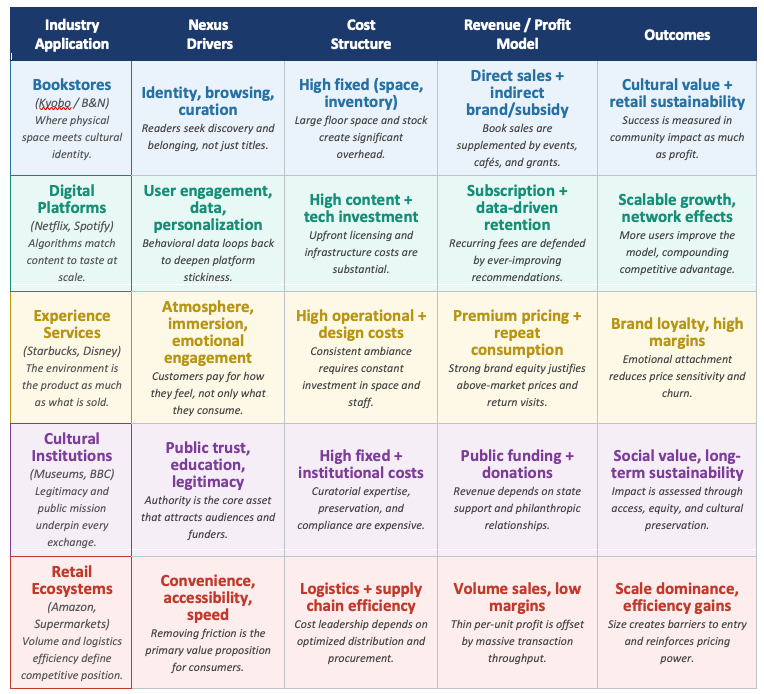
Note: Bold text denotes the primary nexus mechanism; italicised text provides a one-line interpretive note for each dimension. Row colours distinguish industry sectors.
4.3 Nexus in Cultural and Institutional Contexts
In cultural and institutional sectors, the Nexus Business Model often operates through indirect mechanisms that convert symbolic value into long-term support and legitimacy. Organizations such as The Metropolitan Museum of Art and public broadcasting entities like the BBC generate cultural, educational, and social value that is not immediately monetized through transactions. Instead, their engagement with audiences strengthens public trust, institutional relevance, and funding support. The Nexus mechanism in these cases is predominantly cultural or subsidy-based, where engagement translates into donations, public funding, or institutional backing.
Sustainable advantage no longer comes from what firms offer, but from how they design the Nexus between experience and outcomes.
5. CONCLUSION
The AI era has shifted competitive advantage from content ownership to the design of effective value-conversion mechanisms. This study shows that organizations such as Kyobo Book Centre and Barnes & Noble remain viable not by resisting digital disruption, but by redefining how human engagement is transformed into economic and strategic outcomes. The Nexus Business Model offers a unifying framework to understand this shift across cultural, commercial, and institutional contexts, emphasizing that sustainability depends on aligning engagement with meaningful value capture.
The central challenge of the AI era is not generating attention, but converting it into lasting value. Organizations that fail to design effective Nexus mechanisms may achieve visibility without viability, while those that integrate human experience with structured value conversion can achieve resilience and long-term growth. The future will not belong to those who control information, but to those who design the systems that turn human meaning into sustainable value.
References
Birch, J. (2024). The edge of sentience: Risk and precaution in humans, other animals, and AI. Oxford University Press.
Brynjolfsson, E. (2022). The Turing trap: The promise & peril of human-like artificial intelligence. Dædalus, 151(2), 272–287.
Chesbrough, H. (2020). Open innovation results: Going beyond the hype and getting down to business. Oxford University Press.
Floridi, L. (2023). The ethics of artificial intelligence: Principles, challenges, and opportunities. Oxford University Press.
Milliot, J. (2024, January 10). Following a successful 2023, B&N aims to open 50 stores in 2024. Publishers Weekly.https://www.publishersweekly.com/pw/by-topic/industry-news/bookselling/article/94063-following-a-successful-2023-b-n-will-open-50-stores-in-2024.html
Mollick, E. (2024). Co-intelligence: Living and working with AI. Portfolio.
Muldoon, J., Graham, M., & Cant, C. (2024). Feeding the machine: The hidden human labour powering AI. Canongate.
Narayanan, A., & Kapoor, S. (2024). AI snake oil: What artificial intelligence can do, what it can’t, and how to tell the difference. Princeton University Press.
Olson, P. (2024). Supremacy: AI, ChatGPT, and the race that will change the world. St. Martin’s Press.
Parker, G. G., Van Alstyne, M. W., & Choudary, S. P. (2016). Platform revolution: How networked markets are transforming the economy and how to make them work for you. W. W. Norton & Company.
Original Document:

ABOUT THE AUTHOR

Paul C. Hong is a Distinguished University Professor and Chair of Information Systems and Supply Chain Management at the University of Toledo. His work focuses on leadership, governance, and decision-making in the AI era, integrating strategy, technology, and institutional trust. He has published extensively in leading academic journals and writes on how individuals and organizations navigate complexity, disruption, and global transformation.
© K-Global Scholars and Professionals Forum. All rights reserved. Content published in the K-GSP Forum may not be reproduced, distributed, or transmitted in any form without prior written permission from the K-GSP Forum, except for brief quotations with full attribution.