

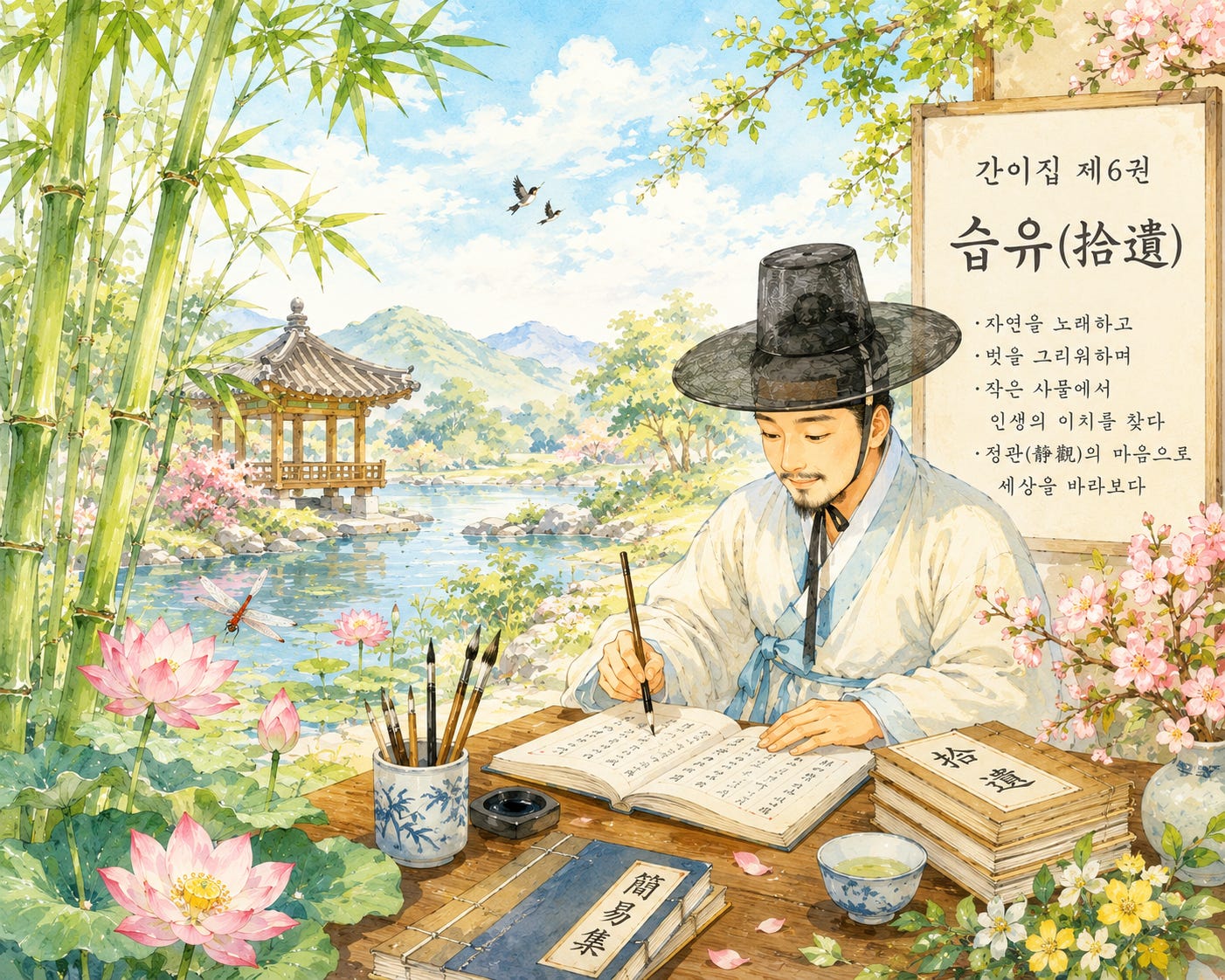
Some books tell stories of great events, while others celebrate remarkable heroes. Yet there are times when a single flower, a bamboo stalk swaying in the wind, or a brief remembrance of an old friend can touch our hearts more deeply than any grand tale. Reading the Supplementary Writings (Seupyu, 拾遺) in Volume 6 of The Gani Collection, I experienced precisely that kind of quiet inspiration.
The term Seupyu (습유) literally means “gathering what has been left behind” or “collecting overlooked pieces.” At first, I assumed this section was merely an appendix containing writings omitted from the main collection. However, as I continued reading, I began to feel that these works revealed Choi Rip’s most sincere and authentic self. They seemed less like literary leftovers and more like treasured fragments of a wise man’s heart.
Unlike many classical texts, this volume contains little political debate or grand historical discussion. Instead, it is filled with reflections on flowers and trees, bamboo and lotus blossoms, quiet pavilions, and cherished friendships. Reading it felt like sitting beside an elderly scholar in a peaceful garden, listening to him share the lessons he had gathered over a lifetime.
The poems about bamboo were particularly memorable. Choi Rip wrote separately about young bamboo, old bamboo, bamboo standing in the rain, and bamboo bending in the wind. To most people, bamboo is simply bamboo. Yet Choi Rip saw something different in each stage and condition.
In young bamboo, he saw hope and growth. In bamboo facing strong winds, he found courage and resilience. In old bamboo, he discovered wisdom gained through the passage of time. His ability to draw such rich meaning from a single plant was both surprising and inspiring. While many of us constantly search for something new, Choi Rip reminds us that profound insights often lie hidden within the familiar.
His poems about lotus flowers also left a lasting impression. Throughout East Asian culture, the lotus has long symbolized purity because it rises clean and beautiful from muddy waters. Choi Rip uses the lotus to reflect on the virtues of integrity and inner nobility. His writings encourage us to maintain clarity of character and moral purpose, even amid the confusion and challenges of life.
Another fascinating aspect of Seupyu is its attention to ordinary objects. Floating duckweed, flower pots, stone kettles, and other everyday items become subjects of poetry. At first, I wondered why such simple things deserved poetic attention. Gradually, however, I understood his intention. Choi Rip believed that nothing in this world is insignificant. Nature, objects, and people all possess their own unique value and meaning.
This perspective offers an important lesson for modern readers. We often focus on what is large, impressive, and visible. We admire fame, success, and extraordinary achievements. Choi Rip, however, discovered truth in a flower blooming quietly by the roadside and wisdom in the sound of the wind through the trees. Reading his poems made me want to slow down and pay closer attention to the world around me.
Another theme that flows throughout Seupyu is the idea of Jeonggwan (靜觀), which may be translated as “contemplative observation.” It is the practice of quietly observing and deeply reflecting. Choi Rip looked at nature and learned about himself. He observed the changing seasons and reflected on the cycle of human life. Before seeking to change the world, he sought first to cultivate his own mind and character.
This message feels especially meaningful today. Modern life is filled with constant activity. We check our phones, read endless streams of news, and react to information without pause. Yet Seupyu gently invites us to stop for a moment. It encourages us to admire a flower, appreciate the shade of a tree, and listen to the quiet voice within ourselves.
When I finished reading the volume, one lesson remained with me above all others: the importance of seeing deeply. Choi Rip found meaning in things that others might overlook. This was the vision of a poet, the insight of a philosopher, and the sensitivity of someone who genuinely loved life.
The Gani Collection, Volume 6: Supplementary Writings is far more than a collection of poems. It is the record of a scholar who sought to understand humanity through nature, discover wisdom through ordinary things, and cultivate inner peace through thoughtful observation. Although more than four centuries have passed since Choi Rip lived, his message remains surprisingly relevant.
Perhaps happiness is not something distant or difficult to attain. Perhaps it begins with the ability to smile while watching a bamboo stalk sway gently in the wind. That, I believe, is one of the most enduring lessons Choi Rip wished to share with future generations. +++
{Solti}
July 2, 2026
작은 것에서 큰 지혜를 발견하다
『간이집』 제6권 「습유」를 읽고
어떤 책은 거대한 사건을 이야기하고, 어떤 책은 위대한 영웅을 이야기한다. 그러나 때로는 작은 꽃 한 송이, 바람에 흔들리는 대나무 한 그루, 그리고 오래된 벗에 대한 짧은 그리움이 우리 마음을 더 깊이 울릴 때가 있다. 『간이집』 제6권 「습유」를 읽으며 나는 바로 그런 감동을 경험했다.
‘습유(拾遺)’라는 말은 원래 빠진 것을 주워 모은다는 뜻이다. 처음에는 본편에 실리지 못한 글들을 모아 놓은 부록 정도로 생각했다. 그러나 읽어 갈수록 오히려 이 글들이 최립이라는 사람의 가장 진솔한 마음을 보여 주는 작품들이 아닐까 하는 생각이 들었다.
이 책에는 화려한 정치 이야기도 없고 거창한 논쟁도 많지 않다. 대신 꽃과 나무, 대나무와 연꽃, 작은 정자와 오래된 벗에 대한 이야기들이 담겨 있다. 마치 한 노학자가 인생의 길을 오래 걸은 뒤 조용한 정원에 앉아 지나온 세월을 돌아보며 들려주는 이야기처럼 느껴진다.
가장 인상 깊었던 것은 대나무를 노래한 연작 시들이었다. 어린 대나무를 노래하고, 늙은 대나무를 노래하며, 비를 맞는 대나무와 바람에 흔들리는 대나무를 각각 따로 바라본다. 현대인의 눈으로 보면 모두 같은 대나무일 뿐이다. 그러나 최립은 그 속에서 서로 다른 삶의 모습을 발견한다.
어린 대나무에서는 성장의 희망을 보고, 바람 속의 대나무에서는 역경을 견디는 용기를 본다. 늙은 대나무에서는 세월이 주는 지혜를 읽어 낸다. 같은 사물을 바라보면서도 이렇게 다양한 의미를 발견할 수 있다는 사실이 놀라웠다. 우리는 늘 새로운 것만 찾으려 하지만, 최립은 익숙한 것 속에서 새로운 깨달음을 찾고 있었다.
연꽃을 노래한 시들도 마음에 오래 남았다. 진흙 속에서 자라지만 깨끗한 꽃을 피우는 연꽃은 오랫동안 동양의 선비들에게 이상적인 인간상을 상징해 왔다. 최립 역시 연꽃을 통해 인간이 지녀야 할 맑은 마음과 품격을 이야기한다. 세상이 아무리 혼란스럽더라도 자신의 중심을 잃지 않는 삶의 자세가 얼마나 중요한지를 다시 생각하게 되었다.
또한 습유에는 작은 사물들을 노래한 작품들이 적지 않다. 떠다니는 부평초, 화분, 돌솥 같은 평범한 사물들이 시의 소재가 된다. 처음에는 왜 이런 것들을 시로 썼을까 의아했다. 그러나 읽다 보니 그 이유를 알게 되었다. 최립은 세상에 하찮은 것이 없다고 생각했던 것이다. 자연도, 사물도, 사람도 모두 저마다의 의미와 가치를 지니고 있었다.
이러한 태도는 오늘날 우리에게도 큰 교훈을 준다. 우리는 너무 자주 크고 화려한 것만 중요하게 여긴다. 유명한 사람, 큰 성공, 눈에 띄는 성과에만 관심을 기울인다. 그러나 최립은 작은 꽃 한 송이와 바람 소리, 그리고 이름 없는 풀잎에서도 삶의 진리를 발견했다. 그의 시를 읽으며 나 역시 주변을 좀 더 천천히 바라보고 싶어졌다.
습유 전체를 흐르는 또 하나의 주제는 ‘정관(靜觀)’이다. 조용히 바라보고 깊이 생각하는 태도이다. 최립은 자연을 보면서 자신을 돌아보았고, 계절의 변화를 보면서 인생의 흐름을 생각했다. 그는 세상을 바꾸기 전에 먼저 자신의 마음을 다스리려고 했다.
오늘날 우리는 너무 바쁘게 살아간다. 스마트폰을 확인하고, 뉴스를 읽고, 끊임없이 새로운 정보에 반응한다. 그러나 『습유』는 우리에게 잠시 멈추라고 말하는 것 같다. 꽃 한 송이를 바라보고, 나무 한 그루의 그림자를 느끼며, 자신의 마음속 목소리에 귀를 기울여 보라고 권한다.
책을 덮고 난 뒤 가장 오래 남은 생각은 ‘깊이 보는 눈’의 중요성이었다. 최립은 남들이 스쳐 지나가는 것들 속에서 의미를 발견했다. 그것이 시인의 눈이었고, 철학자의 눈이었으며, 삶을 사랑하는 사람의 눈이었다.
『간이집』 제6권 「습유」는 단순한 시 모음집이 아니다. 그것은 자연을 통해 인간을 이해하고, 사물을 통해 인생을 배우며, 조용한 관찰을 통해 지혜를 얻으려 했던 한 선비의 마음 기록이다. 수백 년의 시간이 흘렀지만 그가 남긴 메시지는 여전히 유효하다.
행복은 멀리 있는 것이 아닐지도 모른다. 바람에 흔들리는 대나무 한 그루를 바라보며 미소 지을 수 있는 마음, 그것이야말로 최립이 우리에게 전하고 싶었던 삶의 지혜가 아닐까 생각한다. +++
{솔티}
2026년 7월 2일

Prof. Dr. Young Choi (Editor in Chief) — Regent University
Young B. Choi is a Professor in the Department of Engineering & Computer Science at Regent University. He published 38 books with ‘Selected Readings in Cybersecurity’ (2018) (over 800 copies archived globally at university/college libraries around the world) and ‘Cybersecurity Applications and Artificial Intelligence’ (2023) available in seven major world languages. He proposed the world’s first global and universal telecommunications “Service Order Handling (SOH)” Model (T-SOH Model) (1995) with Dr. Adrian Tang. With this innovative research work, he received the IEEE NOMS ’96 Best Paper Award and became the first recipient of the Outstanding Contribution Award of the TeleManagement Forum in 1998. His research areas include Natural Language Processing-focused AI, AI-applied cybersecurity, network and telecom service management, and Korean studies on Gani Choi Rip’s Jeonggwan (靜觀: Quiet Contemplation) philosophy and Shilhak ( 實學: Practical Learning).