
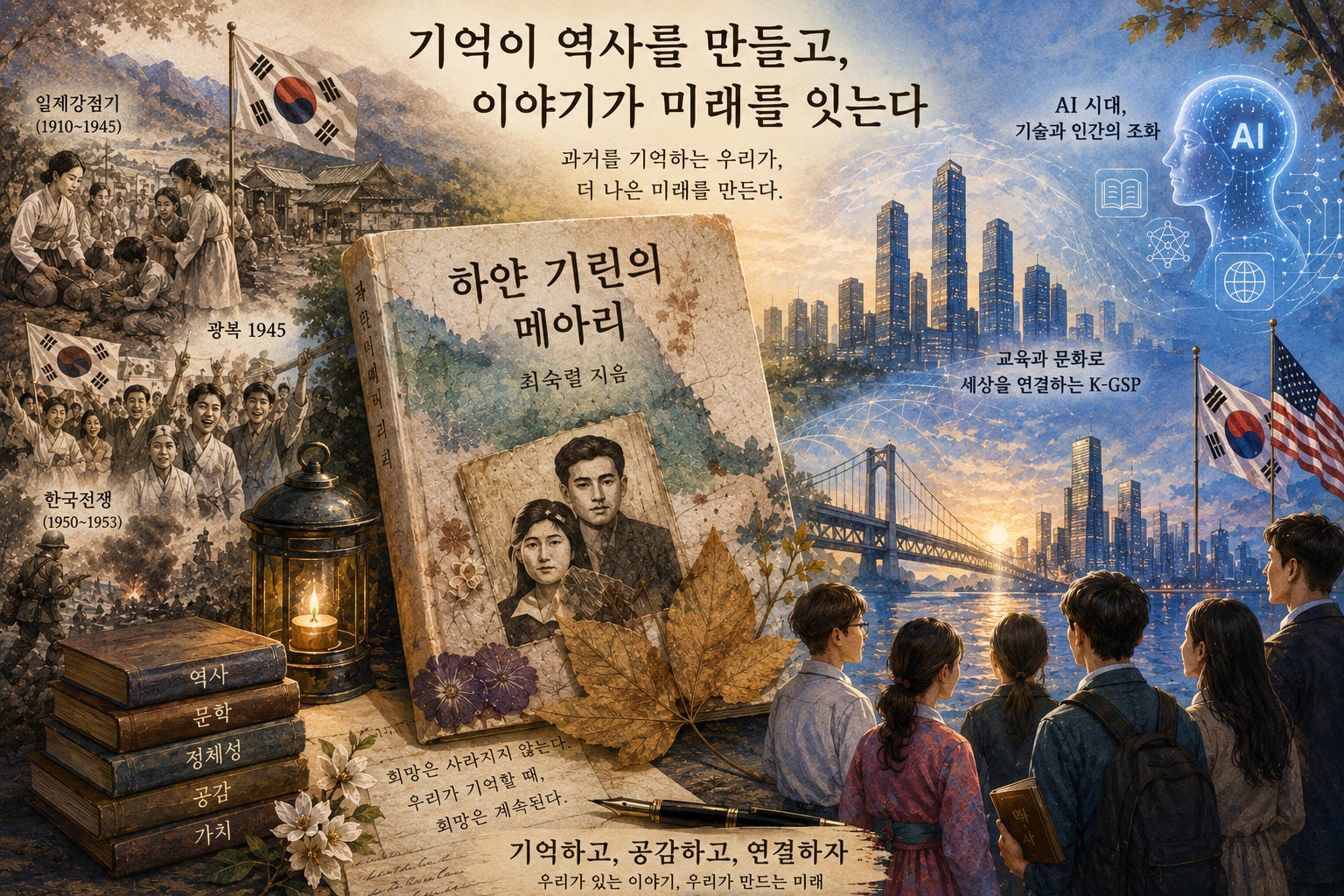
On a recent visit to a community book fair, I came across a well-worn copy of Echoes of the White Giraffe by Korean American author Sook Nyul Choi. A bright orange sticker declared its price: $1.99. The faded cover, decorated with pressed leaves, mountain silhouettes, and the portrait of two young Koreans, suggested that many readers had held this book before me. Yet what it contained was worth far more than its modest price.
Some books entertain us. Others educate us. A few become bridges between generations. Echoes of the White Giraffe belongs to the last category.
As Korean Americans commemorate both America’s 250th anniversary and continue reflecting on Korea’s modern history, novels such as this remind us that freedom, democracy, and peace are never inherited automatically. They are preserved through memory.
The twentieth century transformed Korea more dramatically than perhaps any other nation. Japanese colonial rule, liberation in 1945, ideological conflict, national division, and the Korean War shaped millions of lives. Political events appear in history books as dates and treaties, but literature gives those events faces, voices, hopes, and tears.
Sook Nyul Choi accomplishes something remarkable. Rather than describing history from the perspective of presidents or generals, she tells it through the eyes of ordinary young people struggling to protect their families, dignity, and dreams. Readers discover that history is not merely what governments decide—it is what ordinary citizens endure.
This perspective carries special meaning for Korean Americans.
Many second- and third-generation Korean Americans know Korea primarily through family stories, Korean food, K-pop, Korean dramas, or occasional visits. While these are valuable connections, literature offers something uniquely powerful: empathy. Reading historical fiction allows younger generations to experience, emotionally, what earlier generations experienced personally.
This is especially important in the age of artificial intelligence.
Today’s students can summarize an entire novel in seconds using AI. While summaries efficiently deliver facts, they cannot replace the emotional journey of reading. AI may explain what happened, but literature allows readers to feel why it mattered. Empathy cannot simply be outsourced.
That lesson aligns perfectly with the educational mission of Korean Global Scholars and Professionals (K-GSP). Our community values excellence in science, engineering, medicine, business, law, and technology. Yet technical achievement alone cannot sustain a civilization. Societies also require historical understanding, ethical reflection, compassion, and cultural memory.
Innovation without memory risks becoming directionless.
This is why the humanities remain indispensable even during the AI revolution. Engineers build tomorrow’s technologies. Writers help us remember yesterday’s sacrifices. Both are essential for creating a wiser future.
The symbolism of the “white giraffe” itself invites reflection. A white giraffe is extraordinarily rare. Like hope during periods of national hardship, it appears fragile and almost impossible to find. Yet those who continue searching eventually discover that hope survives even the darkest seasons.
The Korean experience demonstrates this truth repeatedly. From colonial occupation to economic reconstruction, from poverty to becoming one of the world’s leading technology and cultural powers, Korea’s modern history reflects resilience supported by education, perseverance, and faith in future generations.
For Korean Americans, preserving these stories is more than honoring the past—it is preparing future leaders. Young scholars who understand both Korean history and American democratic ideals possess a unique ability to serve as bridges between nations.
Books like Echoes of the White Giraffe remind us that identity is inherited not only through bloodlines but through stories. Every generation must decide whether those stories will fade or continue to inspire.
Perhaps that is why finding this well-used copy at a humble book fair felt meaningful. Its worn pages testify that many readers have already carried its message forward. Now the responsibility passes to us.
In a world increasingly shaped by algorithms, data, and artificial intelligence, the greatest inheritance we can offer the next generation may still be the oldest technology of all—a compelling story that teaches courage, preserves memory, and nurtures hope.
The echoes of the white giraffe have not faded. They continue wherever readers choose to listen. +++
{Solti}
July 5, 2026
하얀 기린의 메아리, 한 민족의 영혼을 지키다
얼마 전 지역 북페어(Book Fair)를 둘러보다가 최숙렬(Sook Nyul Choi)의 소설 하얀 기린의 메아리(Echoes of the White Giraffe) 한 권을 발견했다. 책 표지에는 1달러 99센트라는 작은 가격표가 붙어 있었다. 세월의 흔적이 고스란히 남은 표지는 눌린 꽃잎과 나뭇잎, 산수화 같은 풍경, 그리고 젊은 한국인 남녀의 초상을 담고 있었다. 수많은 독자의 손을 거쳐 온 듯한 이 책은 비록 값은 저렴했지만, 그 안에 담긴 가치는 돈으로 환산할 수 없을 만큼 깊었다.
세상에는 읽는 순간 즐거움을 주는 책이 있다. 또 지식을 전해 주는 책이 있다. 그러나 세대를 이어주고 민족의 기억을 보존하는 책은 그보다 훨씬 드물다. 하얀 기린의 메아리는 바로 그런 책이다.
올해 미국은 건국 250주년을 기념하고 있으며, 한국인들은 여전히 근현대사의 의미를 되새기고 있다. 이러한 시점에서 이 소설은 우리에게 한 가지 중요한 사실을 일깨워 준다. 자유와 민주주의, 그리고 평화는 저절로 주어지는 유산이 아니라 기억을 통해 다음 세대로 전해지는 가치라는 점이다.
20세기의 한국은 세계 어느 나라보다도 격동의 역사를 경험했다. 일제강점기, 광복, 좌우 이념의 대립, 남북 분단, 그리고 한국전쟁은 한 민족의 운명을 송두리째 바꾸어 놓았다. 역사책은 이를 연도와 사건으로 기록하지만, 문학은 그 속에서 살아간 사람들의 눈물과 희망, 두려움과 용기를 우리에게 들려준다.
최숙렬은 대통령이나 장군이 아닌 평범한 소녀와 가족의 시선을 통해 역사를 풀어낸다. 독자는 한 가정의 삶을 따라가면서 역사가 결코 정치 지도자들만의 이야기가 아니라 평범한 시민들의 희생과 선택으로 이루어진 것임을 깨닫게 된다.
이러한 시각은 특히 재미동포 사회에 더욱 큰 의미를 갖는다.
오늘날 많은 2세와 3세 한인들은 한국을 K-팝과 K-드라마, 한식, 그리고 부모님의 추억을 통해 접한다. 물론 그것만으로도 한국과 연결될 수 있다. 그러나 문학은 그보다 더 깊은 경험을 제공한다. 역사소설은 독자로 하여금 조상들이 실제로 살아낸 시대를 마음으로 체험하게 만든다. 이것이야말로 문화적 정체성을 이어주는 가장 강력한 힘이다.
이 점은 인공지능 시대에 더욱 중요해지고 있다.
오늘날 학생들은 AI를 이용하면 몇 초 만에 한 권의 소설을 요약할 수 있다. 줄거리는 쉽게 얻을 수 있지만, 등장인물과 함께 울고 웃으며 성장하는 독서의 경험은 결코 요약으로 대체될 수 없다. AI는 무슨 일이 일어났는지 설명해 줄 수는 있지만, 왜 그것이 인간에게 중요한지까지 대신 느껴 줄 수는 없다. 공감 능력은 외주를 줄 수 없는 인간 고유의 자산이다.
바로 이것이 K-GSP(Korean Global Scholars & Professionals)가 추구하는 가치와도 맞닿아 있다.
우리 공동체는 과학, 공학, 의학, 경영, 법학, 인공지능 등 다양한 분야에서 세계적 경쟁력을 갖춘 전문가들을 배출하고 있다. 그러나 아무리 뛰어난 기술을 개발하더라도 역사와 문화, 윤리와 인간성을 잃는다면 진정한 발전이라 할 수 없다.
기억 없는 혁신은 방향을 잃기 쉽다.
그래서 AI 혁명 시대에도 인문학은 결코 사라질 수 없다. 공학자는 미래를 설계하지만, 문학은 우리가 어디에서 왔는지를 잊지 않도록 도와준다. 이 둘은 서로 경쟁하는 것이 아니라 미래를 함께 만들어 가는 두 축이다.
소설 제목에 등장하는 ‘하얀 기린’ 역시 깊은 상징성을 지닌다. 현실에서는 거의 존재하지 않는 희귀한 존재인 하얀 기린은 절망 속에서도 결코 사라지지 않는 희망을 의미한다. 아무리 암울한 시대라 하더라도 희망을 포기하지 않는 사람들에게는 언젠가 새로운 내일이 찾아온다는 믿음을 상징한다.
한국의 현대사는 이러한 희망의 역사였다. 식민지의 아픔을 딛고, 전쟁의 폐허를 넘어, 세계적인 경제 강국이자 문화 강국으로 성장한 대한민국은 교육과 근면, 공동체 정신이 만들어 낸 기적의 증거이다.
재미동포에게 이러한 이야기를 전하는 일은 단순히 과거를 회상하는 일이 아니다. 그것은 미래를 준비하는 일이다. 한국의 역사와 미국의 민주주의 정신을 함께 이해하는 젊은 세대는 두 나라를 연결하는 가장 훌륭한 문화적·지적 가교가 될 것이다.
하얀 기린의 메아리는 우리에게 말한다. 정체성은 혈통만으로 이어지는 것이 아니라 이야기로 이어진다. 한 세대가 다음 세대에게 어떤 이야기를 전하느냐에 따라 민족의 미래가 달라질 수 있다.
아마도 그래서일 것이다. 북페어 한구석에서 발견한 낡은 책 한 권이 내게는 특별한 의미로 다가왔다. 닳은 표지는 수많은 독자들이 이미 그 이야기를 마음속에 품고 살아갔음을 말해 주었다. 이제 그 바통은 우리에게 넘어왔다.
알고리즘과 데이터, 그리고 인공지능이 세상을 움직이는 시대일수록 우리가 다음 세대에게 남겨야 할 가장 소중한 유산은 어쩌면 가장 오래된 기술인지도 모른다. 한 편의 좋은 이야기 말이다. 사람의 마음을 움직이고, 역사를 기억하게 하며, 미래를 향한 희망을 심어 주는 이야기.
하얀 기린의 메아리는 아직도 울리고 있다. 그 울림은 오늘도 역사를 기억하려는 모든 독자의 마음속에서 새로운 희망으로 이어지고 있다.
K-GSP Forum이 추구하는 세계시민 정신은 과거를 잊지 않으면서 미래를 준비하는 데 있다. 세계 곳곳에서 활동하는 한국의 학자와 전문인들은 첨단기술을 선도하는 동시에, 우리의 역사와 문화, 그리고 인간의 존엄을 함께 계승해야 한다. AI 시대일수록 우리에게 필요한 것은 더 많은 정보가 아니라 더 깊은 기억이다. 그리고 그 기억을 가장 아름답게 이어주는 것은 여전히 한 권의 책과 한 편의 이야기이다. +++
{솔티}
2026년 7월 5일

Prof. Dr. Young Choi (Editor in Chief) — Regent University
Young B. Choi is a Professor in the Department of Engineering & Computer Science at Regent University. He published 38 books with ‘Selected Readings in Cybersecurity’ (2018) (over 800 copies archived globally at university/college libraries around the world) and ‘Cybersecurity Applications and Artificial Intelligence’ (2023) available in seven major world languages. He proposed the world’s first global and universal telecommunications “Service Order Handling (SOH)” Model (T-SOH Model) (1995) with Dr. Adrian Tang. With this innovative research work, he received the IEEE NOMS ’96 Best Paper Award and became the first recipient of the Outstanding Contribution Award of the TeleManagement Forum in 1998. His research areas include Natural Language Processing-focused AI, AI-applied cybersecurity, network and telecom service management, and Korean studies on Gani Choi Rip’s Jeonggwan (靜觀: Quiet Contemplation) philosophy and Shilhak ( 實學: Practical Learning).