

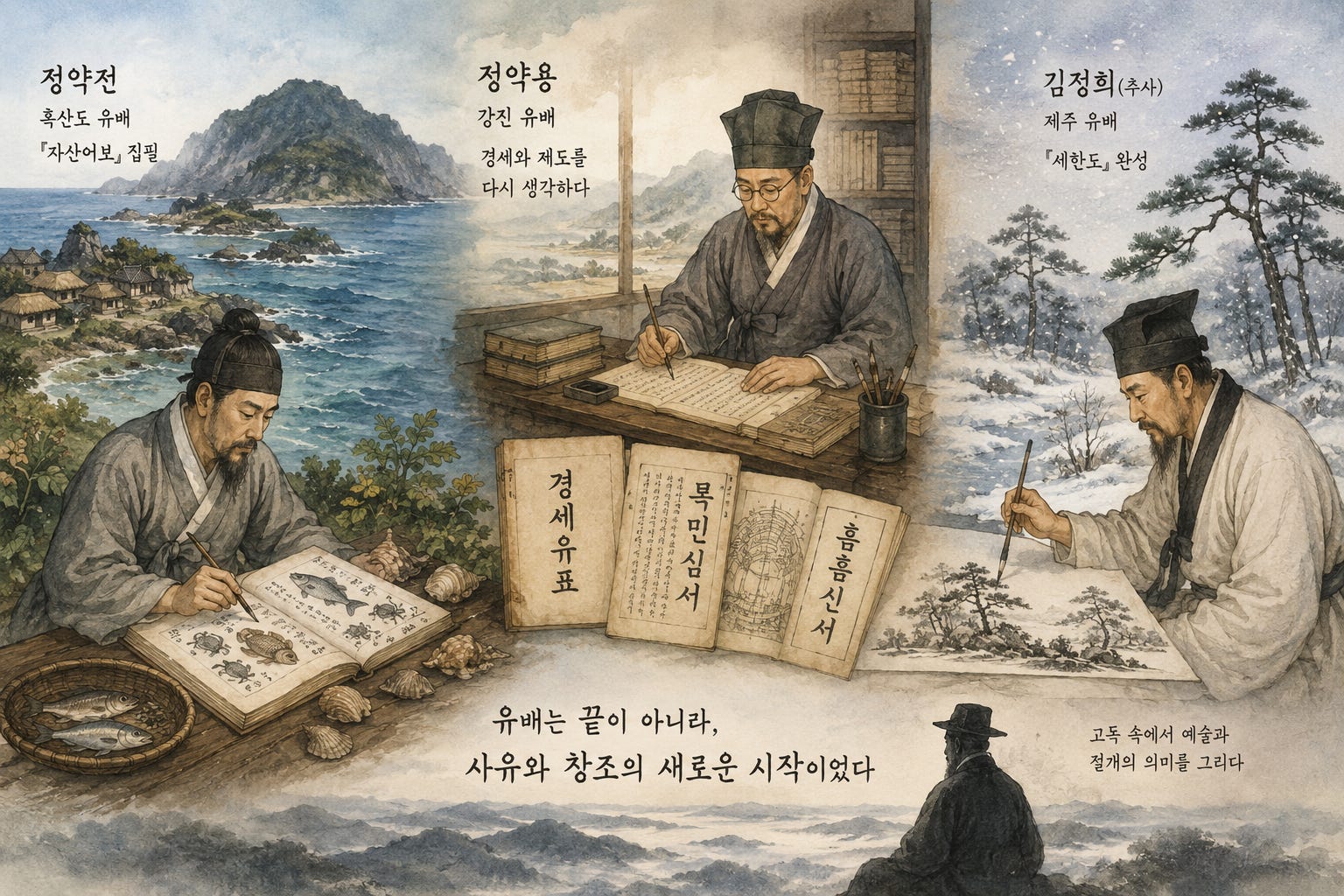
Exile and the Creativity of Intellectuals
From a Space of Hardship to a Space of Thought
Abstract
Throughout history, exile has meant political exclusion and social disconnection. Yet for some Korean intellectuals during the Joseon Dynasty, exile paradoxically became a space for intellectual production, creative reflection, and new forms of scholarship. The exile experiences of Jeong Yak-yong (丁若鏞) in Gangjin, Jeong Yak-jeon (丁若銓) on Heuksando Island, and Kim Jeong-hui (金正喜) on Jeju Island demonstrate how hardship could be transformed into scholarship, writing, and art. Jeong Yak-jeon’s Jasaneobo (玆山魚譜), Jeong Yak-yong’s writings on governance and statecraft, and Kim Jeong-hui’s Sehando (歲寒圖) illustrate how concrete experiences in exile could become sources of knowledge and artistic creativity. Yet exile itself did not automatically produce creativity. What mattered was the intellectual capacity to transform isolation and loss into observation, reading, questioning, and writing. Recent scholarship also shows that Jeong Yak-yong’s writings developed through collaboration with his students and that Kim Jeong-hui’s experience of exile has continued to be reinterpreted in later literature and art. In an age increasingly shaped by artificial intelligence and digital media, these historical experiences invite us to reconsider the value of “chosen solitude” rather than forced exile. This essay explores Joseon intellectuals in exile to argue that creativity arises less from the quantity of information than from questioning, distance, observation, and reflection.
Keywords: exile, intellectuals, creativity, Jeong Yak-yong, Jeong Yak-jeon, Kim Jeong-hui, Sehando, solitude, digital age, artificial intelligence
Was Exile an Ending—or a New Beginning?
Exile was never designed to foster creativity. It was a form of punishment through which the state removed individuals regarded as politically or socially dangerous from the center of society. An exiled person lost office, political influence, social connections, and often the familiar environment in which intellectual life had flourished.
Yet this is where history presents one of its most remarkable paradoxes.
Some people pushed away from the center of power eventually produced ideas and writings that survived much longer than the political institutions that had expelled them. Studies of Joseon intellectuals in exile show that their poetry and writings reflected the distinctive experiences of hardship, reflection, human relationships, and displacement created by exile (Yoon, 2021).
Exile, therefore, should not be understood simply as a ‘place of suffering.’ For some intellectuals, it became a space where the loss of political influence coincided with an expansion of intellectual space.
Jeong Yak-yong: Rethinking the State in Gangjin
This paradox is particularly evident in the life of Jeong Yak-yong, also known as Dasan.
During his long exile in Gangjin, Jeong Yak-yong developed a remarkable body of writings, including Gyeongseyupyo, Mokminsimseo, and Heumheumsinseo. These works were not merely private records produced by a scholar removed from political life.
They represented an attempt to reconsider how a state should be governed.
Research on Jeong Yak-yong’s conception of local communities in Gyeongseyupyo and Mokminsimseo demonstrates that he was deeply concerned with the organization of local society, communal ethics, and practical governance (Baek, 2014). His writings from exile were therefore not detached philosophical exercises. They were connected to a practical question: How can society actually be improved?
Even more interestingly, Jeong Yak-yong’s intellectual production was not entirely solitary. Research on the compilation of Heumheumsinseo shows that his work developed through the collection of materials and collaboration with students after his exile in Gangjin (Shim, 2019).
Here we encounter an important principle concerning exile and creativity: Solitude may provide a condition for creativity, but creativity does not require complete isolation.
One may think alone while exchanging knowledge with others. One may record personal experiences while remaining in dialogue with earlier texts. New knowledge emerges through this interaction between solitude and intellectual community.
Jeong Yak-jeon: Reading the Sea on Heuksando
The experience of Jeong Yak-jeon, Jeong Yak-yong’s elder brother, offers another fascinating example.
His exile on Heuksando Island took him far from the political world of the capital. Yet he began to observe the island’s natural environment and the lives of its inhabitants. The result was Jasaneobo, a remarkable work devoted to marine life.
What makes Jeong Yak-jeon’s case particularly important is that the reality of the exile site itself became an object of research.
Heuksando was not merely a place of punishment. It became a vast field of natural observation.
Research on Jeong Yak-jeon’s life and intellectual activities during exile demonstrates how living with island residents stimulated new interests and scholarly activities (Choi, 2015). Another study reassessing his exile and Jasaneobo examines his movements between Heuksando and Ui Island and the relationship between those experiences and his writing (Jo, 2017).
The lesson is strikingly modern: New knowledge does not necessarily require a new place. It can emerge from seeing a familiar place in an unfamiliar way.
For Jeong Yak-jeon, fish and the sea were ordinary parts of island life. Yet he transformed them into objects of systematic observation and knowledge.
The Silence of Sehando
The exile of Kim Jeong-hui, better known as Chusa, reveals another dimension of creativity.
Kim Jeong-hui was exiled to Jeju Island in 1840 and spent years far from the political center. Yet this physical and political isolation became intertwined with a deepening of his scholarship and artistic expression.
Its most famous symbol is Sehando (歲寒圖), often translated as A Winter Scene or Sehando: After the Coldest Days.
Sehando is more than a landscape painting produced during exile. The pine and cypress trees that remain steadfast in the cold have traditionally been interpreted as symbols of constancy, integrity, and enduring human relationships. Scholarship on Sehando demonstrates how the space of exile contributed to the symbolic and human meaning of the work (Jo, 2020).
More importantly, the significance of Sehando did not end with Kim Jeong-hui himself. Recent research shows how his life, art, and particularly Sehando have continued to be transformed and reinterpreted in later literature (Kim, 2025).
A creative work does not necessarily end when its creator puts down the brush.
A great work can become a new space for the imagination of later generations.
Hardship Does Not Automatically Create Creativity
At this point, however, we should resist romanticizing exile.
Not every person in exile produced a great book or work of art. Suffering does not automatically generate creativity. Poverty, loneliness, political oppression, and separation from family do not in themselves produce profound thought.
Therefore, the simple formula that “hardship creates creativity” is historically and psychologically inadequate.
A more accurate statement would be: Hardship is not itself the cause of creativity; it can become one of the conditions through which hardship is transformed creatively.
What makes that transformation possible?
Observation.
Reading.
Writing.
Questioning.
And above all, the intellectual determination to give meaning to one’s experience.
Reading in Exile Meant Reading the World Again
For intellectuals in exile, books acquired a special significance.
But reading was not merely a process of accumulating information.
They connected what they found in books with the realities surrounding them.
Jeong Yak-yong reconsidered government and administration. Jeong Yak-jeon observed island ecology and human life. Kim Jeong-hui transformed solitude, relationships, and spiritual integrity into artistic expression.
Their common characteristic was the connection between reading and experience.
Books generated questions. Reality challenged and refined those questions. The questions then became new records, arguments, and works.
A creative intellectual, therefore, is not simply someone who reads many books.
A creative intellectual is someone who connects what has been read with lived experience and transforms that connection into new questions.
A New Kind of Exile for Our Time
Here the history of Joseon exile meets the reality of the twenty-first century.
We are not generally forced into exile today. Instead, we live in a world of almost continuous connection.
Smartphones constantly demand attention. Social media delivers an endless stream of information. Algorithms compete for our attention. Generative AI can produce an answer almost instantly.
We are more connected than ever, yet we may have less time to think.
Research on technology, solitude, and privacy suggests that constant connectivity can weaken meaningful aloneness, while solitude can support creativity, moral courage, and self-realization (Stijovic, 2022).
This does not mean that we should recreate the suffering of historical exile.
Quite the opposite. What we may need today is not forced exile but ‘chosen solitude.’
It may mean turning off the smartphone for an hour, stopping the endless search for information, resisting the temptation to immediately ask AI for an answer, and spending time alone with a book and one’s own thoughts.
What Remains Human in the Age of AI?
Generative AI can search, summarize, analyze, and produce language at extraordinary speed.
What, then, remains uniquely important for human beings?
Perhaps it is the ability to choose the questions that matter.
AI can help formulate questions. It can provide possible answers. But deciding what deserves attention, what should be questioned, what experience is worth recording, and what values should be protected ultimately requires human judgment.
Jeong Yak-jeon looked at the sea and decided that it was worth documenting.
Jeong Yak-yong looked at local society and asked how institutions could be improved.
Kim Jeong-hui transformed solitude and human relationships into artistic expression.
In each case, creativity began not with information alone but with human judgment about what information means.
Exile Is Not Simply a Place—It Is a Perspective
Ultimately, the history of exile is not merely a story about human beings enduring hardship.
It is a story about how distance can change the way people see the world.
Those who were removed from the center could sometimes see the center differently.
Those separated from the mainland could see the sea differently.
Those separated from political relationships could reconsider the meaning of human relationships.
Exile pushed people away from society, yet for some intellectuals it opened a new perspective from which society could be examined.
That is the great paradox of exile: They lost political power but gained time to think.
They lost their place at the center but gained distance from which to observe the world.
They were restricted in their ability to speak publicly, yet through writing and art they sometimes spoke for centuries.
Conclusion: We Need a “Small Exile”
The most important lesson left by Joseon’s intellectuals in exile is not that we should glorify suffering.
It is that we should not lose our questions, even in times of difficulty.
Jeong Yak-yong used exile to rethink the state.
Jeong Yak-jeon transformed the sea into a field of knowledge.
Kim Jeong-hui transformed solitude into Sehando.
We cannot reproduce their historical circumstances, nor should we wish to. But we can learn from their intellectual attitude.
The more rapidly AI explains everything, the more important it becomes for human beings to preserve moments when they do not immediately receive an explanation.
The more information surrounds us, the more deliberately we may need to choose silence.
The more connected we become, the more important it may be to protect time for solitary thought.
And the more answers become available, the more important it becomes to formulate our own questions.
Perhaps what we need today is not another technology but a ‘small exile of our own.’
An hour of digital exile.
A quiet encounter with a book.
A notebook containing thoughts that need not be shown to anyone.
In such small moments of withdrawal, we can once again ask ourselves:
What am I really seeing?
What am I actually thinking?
And what can I leave behind?
The writings and works of Joseon’s exiled intellectuals have survived for centuries not simply because these individuals endured suffering.
They survived because these intellectuals transformed suffering into questions, questions into knowledge, and knowledge into cultural memory.
The principle remains relevant in the age of AI.
Creativity does not always begin with more information.
Sometimes it begins when we take one step back from the world.
References
Baek, M. J. (2014). Jeong Yak-yong’s Gyeongseyupyo and Mokminsimseo: Local rites and the operation of community. Journal of Eastern Philosophy, 41, 197–232. https://doi.org/10.19065/japk..41.201407.197
Choi, S. H. (2015). Jeong Yak-jeon’s exile on Heuksando and his intellectual activities. Island Culture, 46, 117–145.
Jo, S. J. (2017). Reconsidering Jeong Yak-jeon’s exile on Heuksando and Jasaneobo: Focusing on three major issues. Island Culture, 49, 41–72. https://doi.org/10.22917/island.2017..49.41
Jo, S. Y. (2020). A study of space represented in poetry based on Sehando. Korean Journal of Literary Criticism, 68, 181–211. https://doi.org/10.35832/kmlc..68.202012.181
Kim, M. H. (2025). Continuity and transformation of materiality and spirituality: Literary transformations of Chusa Kim Jeong-hui and Sehando. Cheongram Language and Literature Education, 103, 469–508. https://doi.org/10.26589/jockle..103.202501.469
Shim, J. W. (2019). Reconsidering the compilation process of Jeong Yak-yong’s Heumheumsinseo. The Korean Historical Review, 186, 363–394. https://doi.org/10.31791/JKH.2019.09.186.363
Stijovic, M. (2022). Solitude and privacy: How technology is destroying our aloneness and why it matters. Technology in Society, 68, 101858. https://doi.org/10.1016/j.techsoc.2021.101858
Yoon, I. H. (2021). A study of exile poetry by Confucian scholars in the late Joseon period: Focusing on Dasan, Chusa, and Myeonam. Journal of Korean Classical Studies, 55, 5–49. https://doi.org/10.20516/classic.2021.55.5
유배와 지식인의 창조성
고난의 공간에서 사유의 공간으로
초록
역사에서 유배는 정치적 배제와 사회적 단절을 의미했다. 그러나 조선의 지식인들에게 유배는 때때로 지적 생산과 창조적 성찰이 이루어지는 역설적인 공간이기도 했다. 정약용(丁若鏞)의 강진 유배, 정약전(丁若銓)의 흑산도 유배, 김정희(金正喜)의 제주 유배는 고난이 단순한 좌절로 끝나지 않고 저술·학문·예술의 새로운 형태로 전환될 수 있었음을 보여준다. 특히 정약전의 『자산어보(玆山魚譜)』와 정약용의 경세 저술, 김정희의 『세한도(歲寒圖)』는 유배지의 구체적 경험이 지식과 예술의 원천으로 변환된 사례이다. 다만 유배 자체가 창조성을 자동적으로 낳았다고 보아서는 안 된다. 중요한 것은 고립과 상실을 관찰·독서·질문·기록의 과정으로 전환하는 지식인의 능력이다. 최근 연구는 정약용의 유배 이후 저술이 제자들과의 협업을 통해 발전했음을 보여주며, 김정희의 유배 경험이 후대 문학과 예술에서 지속적으로 재해석되고 있음을 확인한다. 오늘날 인공지능과 디지털 미디어가 인간의 주의력을 끊임없이 점유하는 시대에 이러한 역사는 ‘강제된 유배’가 아니라 ‘선택된 고독’의 필요성을 다시 생각하게 한다. 이 글은 조선의 유배 지식인들을 통해 창조성이 정보의 양보다 질문과 거리두기, 관찰과 성찰에서 비롯된다는 점을 탐색한다.
핵심어: 유배, 지식인, 창조성, 정약용, 정약전, 김정희, 세한도, 고독, 디지털 시대, 인공지능
유배는 끝이었는가, 새로운 시작이었는가
유배는 본래 창조성을 위한 제도가 아니었다. 그것은 국가가 정치적·사회적으로 위험하다고 판단한 사람을 공동체의 중심에서 떼어내는 형벌이었다. 유배자는 관직과 정치적 영향력을 잃고 낯선 지역에서 제한된 삶을 살아야 했다.
그러나 역사의 아이러니는 여기에서 시작된다.
권력의 중심에서 밀려난 사람들이 오히려 훗날 더 오래 살아남는 사상과 저술을 남겼다. 조선 후기의 유배 지식인들을 연구한 윤인현(2021)은 다산 정약용, 추사 김정희, 면암 최익현 등의 유배 한시를 분석하면서 이들의 작품이 유배라는 특수한 공간과 그 속에서 경험한 고난, 사유, 인간관계를 독특하게 반영하고 있음을 보여준다.
따라서 유배를 단순히 “고난의 장소”라고만 규정하는 것은 충분하지 않다. 어떤 지식인에게 유배는 정치적 공간의 상실과 지적 공간의 확대가 동시에 일어나는 장소였다.
강진에서 국가를 다시 생각한 정약용
이 역설을 가장 선명하게 보여주는 인물이 다산 정약용이다.
정약용은 강진에서 오랜 유배 생활을 하면서 『경세유표』, 『목민심서』, 『흠흠신서』를 비롯한 방대한 저술을 발전시켰다. 중요한 것은 이 저술들이 단순한 개인적 기록이 아니었다는 점이다.
그는 유배지에서 국가의 제도와 행정, 지방사회, 법률과 공동체의 문제를 다시 생각했다.
백민정(2014)의 연구는 『경세유표』와 『목민심서』에 나타난 정약용의 향례(鄕禮) 구상을 분석하면서, 그가 지방 공동체의 운영과 윤리적 질서를 구체적으로 고민했음을 보여준다. 즉 정약용의 유배지 저술은 현실과 단절된 관념적 철학이 아니라 현실을 어떻게 개선할 것인가라는 실천적 질문과 연결되어 있었다.
더 흥미로운 점은 정약용의 지식 생산이 완전히 혼자 이루어진 것이 아니었다는 사실이다. 심재우(2019)는 『흠흠신서』의 편찬 과정을 재검토하면서 강진 유배 이후 제자들과의 협업을 통해 자료를 수집하고 초고를 발전시키며 최종적인 저술로 완성해 가는 과정을 밝혔다.
여기에서 유배와 창조성의 중요한 원리가 드러난다.
고독은 창조성의 조건일 수 있지만, 창조는 결코 고립만으로 이루어지지 않는다.
혼자 생각하되 다른 사람과 지식을 교환하고, 자신의 경험을 기록하되 기존의 문헌과 대화하는 과정에서 새로운 지식이 만들어진다.
흑산도에서 바다를 읽은 정약전
정약용의 형 정약전(丁若銓)은 더욱 흥미로운 사례를 보여준다.
흑산도 유배는 그를 중앙 정치의 세계에서 멀리 떨어뜨렸다. 그러나 그는 그곳에서 섬의 자연과 사람들의 삶을 관찰했다. 그 결과물이 바로 수산 생물에 관한 독특한 저술인 『자산어보』이다.
정약전의 사례가 중요한 이유는 유배지의 현실 자체가 연구 대상이 되었다는 것이다.
그에게 흑산도는 단순한 형벌의 장소가 아니라 하나의 거대한 자연과학적 관찰 공간이었다. 정약전의 흑산도 유배 생활과 저술 활동을 연구한 최성환(2015)은 그가 섬 주민들과 생활하면서 섬이라는 공간에서 새로운 관심과 지적 활동을 발전시켜 갔음을 분석한다.
조숙정(2017) 역시 정약전의 유배 시기와 『자산어보』를 재검토하면서 우이도와 대흑산도에서의 생활 및 이동 과정과 저술의 관계를 살펴보았다.
여기서 지식인의 창조성에 관한 매우 현대적인 교훈을 발견할 수 있다.
새로운 지식은 반드시 새로운 장소에서 오는 것이 아니다. 익숙한 장소를 낯설게 바라보는 데서도 새로운 지식이 탄생한다.
정약전에게 흑산도의 물고기와 바다는 다른 사람에게는 일상의 풍경이었지만, 그에게는 연구의 대상이었다.
제주에서 태어난 세한도의 침묵
추사 김정희의 제주 유배는 또 다른 차원의 창조성을 보여준다.
김정희는 1840년 제주로 유배되어 오랜 시간을 보냈다. 그곳에서 그는 정치적 중심으로부터 멀어졌지만 자신의 학문과 예술을 더욱 깊이 밀어붙였다.
그 대표적인 상징이 『세한도』이다.
『세한도』는 단순히 유배 중에 그린 풍경화가 아니다. 그것은 추위 속에서도 변하지 않는 소나무와 잣나무를 통해 인간의 절개와 변하지 않는 관계를 표현한 작품으로 해석되어 왔다. 『세한도』에 관한 연구는 유배 공간이 작품의 상징과 인간적 의미를 형성하는 중요한 배경이었음을 보여준다(조수윤, 2020).
더욱 주목할 점은 『세한도』의 의미가 추사 개인에게서 끝나지 않았다는 사실이다. 김명훈(2025)은 추사의 삶과 예술, 특히 『세한도』가 후대 문학에서 계속 재해석되고 변용되는 과정을 분석하면서 추사의 전통이 단순한 과거의 유산이 아니라 새로운 창작이 이루어지는 공간으로 기능해 왔다고 설명한다.
즉 창조적 작품은 만들어지는 순간에 끝나지 않는다.
좋은 작품은 다음 세대의 상상력을 다시 움직인다.
고난 자체가 창조성을 만드는 것은 아니다
여기에서 한 가지 중요한 주의가 필요하다.
유배를 지나치게 낭만화해서는 안 된다.
고통이 자동적으로 위대한 작품을 만들어 주는 것은 아니다. 모든 유배인이 정약용이나 정약전, 김정희처럼 방대한 저술과 예술을 남긴 것도 아니다. 유배에는 가난과 질병, 가족과의 이별, 정치적 좌절, 외로움이 실제로 존재했다.
따라서 “고난이 창조성을 만든다”라는 단순한 공식은 역사적으로도 심리학적으로도 지나친 일반화다.
더 정확한 표현은 이렇다.
고난은 창조성의 원인이 아니라, 창조적 전환이 일어날 수 있는 조건 가운데 하나였다.
그 전환을 가능하게 한 것은 관찰이었다.
독서였다.
기록이었다.
질문이었다.
그리고 무엇보다도 자신의 경험에 의미를 부여하려는 지적 의지였다.
유배지의 독서는 세상을 다시 읽는 일이었다
유배지의 지식인들은 책을 읽었다. 그러나 단순히 지식을 축적한 것이 아니었다.
그들은 책에서 얻은 지식과 자신이 처한 현실을 연결했다.
정약용은 국가와 행정을 다시 생각했고, 정약전은 섬의 생태와 인간의 생활을 관찰했으며, 김정희는 고독과 인간관계, 예술과 정신의 문제를 작품으로 표현했다.
이들의 공통점은 읽기와 경험 사이의 연결이었다.
책이 질문을 만들고, 현실이 그 질문을 수정하며, 다시 질문이 새로운 기록으로 이어지는 순환이 만들어졌다.
그렇다면 창조적인 지식인이란 단순히 책을 많이 읽는 사람이 아니다.
읽은 것을 자신의 경험과 연결하여 새로운 질문을 만들어내는 사람이다.
오늘날 우리에게 필요한 새로운 유배
이 지점에서 조선의 유배와 21세기의 삶이 만난다.
오늘날 우리는 유배를 당하지 않는다. 그러나 오히려 너무 많은 연결 속에서 살아간다.
스마트폰은 계속 울리고, 소셜미디어는 새로운 정보를 밀어 넣으며, 알고리즘은 우리의 관심을 붙잡는다. 생성형 AI는 질문에 즉시 답을 제공한다.
연결은 많아졌지만 사유의 시간은 줄어들고 있다.
기술과 고독의 관계를 연구한 Stijovic(2022)은 지속적인 연결성이 인간의 고독을 약화시킬 수 있으며, 고독이 창의성·도덕적 용기·자기실현과 연결되는 중요한 조건이라고 논의한다.
이것은 조선의 유배 경험을 오늘날 그대로 재현하자는 뜻이 아니다.
오히려 정반대다.
강제된 유배가 아니라 ‘선택된 고독’이 필요하다는 뜻이다.
하루에 일정한 시간 동안 스마트폰을 내려놓고, 검색을 멈추고, AI의 답변을 기다리지 않고, 한 권의 책과 자신의 생각만 마주하는 시간이다.
AI 시대에 인간에게 남는 것은 무엇인가
생성형 AI는 인간보다 훨씬 빠르게 정보를 검색하고 요약하며 문장을 만들 수 있다.
그렇다면 인간에게 남는 것은 무엇인가?
아마도 질문을 선택하는 능력일 것이다.
AI는 “무엇을 물어볼 것인가”에 대해서도 도움을 줄 수 있지만, 어떤 문제가 중요한지, 어떤 경험을 기록해야 하는지, 무엇을 의심해야 하는지, 어떤 가치가 지켜져야 하는지를 최종적으로 결정하는 것은 인간이다.
정약전이 바다를 보면서 “이것을 기록해야 한다”고 생각했던 것처럼, 정약용이 지방사회의 문제를 보며 “이 제도는 어떻게 바뀌어야 하는가”를 질문했던 것처럼, 김정희가 고독 속에서 인간의 관계와 절개를 예술로 표현했던 것처럼, 창조성은 정보 그 자체가 아니라 정보에 의미를 부여하는 인간의 판단에서 시작된다.
유배는 공간이 아니라 관점이다
결국 유배의 역사는 단순히 고난을 견디는 인간의 이야기가 아니다.
그것은 공간이 인간의 생각을 어떻게 변화시키는가에 관한 이야기다.
중앙에서 멀어진 사람은 중앙을 새롭게 바라볼 수 있었다.
육지에서 멀어진 사람은 바다를 새롭게 관찰할 수 있었다.
정치적 관계에서 멀어진 사람은 인간관계의 의미를 새롭게 성찰할 수 있었다.
유배는 사람을 사회에서 밀어냈지만, 어떤 지식인들에게는 사회를 바라보는 새로운 시야를 열어 주었다.
그래서 유배는 역사의 역설이다.
권력을 잃었지만 생각할 시간을 얻었고,
중심에서 밀려났지만 세상을 바라볼 거리를 얻었으며,
말할 권리를 제한받았지만 글과 예술을 통해 더 오래 말하게 되었다.
맺음말: 우리에게 필요한 것은 ‘작은 유배’다
조선의 유배 지식인들이 우리에게 남긴 가장 중요한 교훈은 고난을 찬양하라는 것이 아니다.
그것은 고난 속에서도 자신의 질문을 잃지 말라는 것이다.
정약용은 유배지에서 국가를 다시 설계했고, 정약전은 바다를 새로운 지식의 대상으로 만들었으며, 김정희는 고독을 『세한도』라는 예술적 언어로 바꾸었다.
그들의 삶을 오늘날 그대로 재현할 수는 없다. 그러나 그들의 지적 태도는 배울 수 있다.
AI가 모든 것을 빠르게 설명해 주는 시대일수록 인간은 때때로 설명을 받지 않는 시간을 가져야 한다.
정보가 넘칠수록 선택적으로 침묵해야 한다.
연결이 많아질수록 혼자 생각하는 시간을 확보해야 한다.
그리고 답이 넘쳐날수록 자신의 질문을 만들어야 한다.
어쩌면 오늘날 우리에게 필요한 것은 새로운 기술이 아니라 ‘작은 유배’인지도 모른다.
하루 한 시간의 디지털 유배, 한 권의 책과 마주하는 고독, 아무에게도 보여주지 않을 생각을 기록하는 시간.
그 작은 고립 속에서 우리는 다시 자신에게 질문할 수 있다.
“나는 무엇을 보고 있는가?”
“나는 무엇을 생각하고 있는가?”
“그리고 내가 남길 수 있는 것은 무엇인가?”
유배지에서 태어난 조선 지식인들의 저술과 예술이 수백 년을 넘어 오늘날까지 살아 있는 이유는 그들이 단순히 고통을 견뎠기 때문이 아니다.
그들은 고통을 ‘질문’으로 바꾸었고, 질문을 ‘지식’으로 바꾸었으며, 지식을 다시 ‘문명의 기억’으로 남겼기 때문이다.
AI 시대에도 이 원리는 변하지 않는다.
창조성은 더 많은 정보에서 시작되지 않는다.
때로는 세상에서 한 걸음 물러서는 순간, 비로소 시작된다.
참고문헌
김명석. (2019). 다산 정약용의 강진 유배와 문학적 형상화—『소설 목민심서』, 『다산』을 중심으로. 현대문학의 연구, 68, 197–236. https://doi.org/10.35419/kmlit.2019..68.007
김명훈. (2025). 물질과 정신의 지속과 변용—추사 김정희와 <세한도>의 문학적 전이를 중심으로. 청람어문교육, 103, 469–508. https://doi.org/10.26589/jockle..103.202501.469
백민정. (2014). 정약용 經世書의 鄕禮 규정과 공동체 운영의 특징—『경세유표』 및 『목민심서』의 鄕禮 문제를 중심으로. 동양철학, 41, 197–232. https://doi.org/10.19065/japk..41.201407.197
심재우. (2019). 정약용의 『흠흠신서』 편찬 과정에 대한 재검토. 한국사연구, 186, 363–394. https://doi.org/10.31791/JKH.2019.09.186.363
윤인현. (2021). 조선후기 유자(儒者)의 유배 한시 연구—다산·추사·면암 중심으로. 한국고전연구, 55, 5–49. https://doi.org/10.20516/classic.2021.55.5
조숙정. (2017). 정약전의 흑산도 유배기와 『자산어보』에 대한 재검토—세 가지 논쟁점을 중심으로. 도서문화, 49, 41–72. https://doi.org/10.22917/island.2017..49.41
조수윤. (2020). 〈세한도〉 제재 시에 나타난 공간 연구. 한국문예비평연구, 68, 181–211. https://doi.org/10.35832/kmlc..68.202012.181
Stijovic, M. (2022). Solitude and privacy: How technology is destroying our aloneness and why it matters. Technology in Society, 68, 101858. https://doi.org/10.1016/j.techsoc.2021.101858
2026년 8월 23일
{솔티}

Prof. Dr. Young Choi (Editor in Chief) — Regent University
Young B. Choi is a Professor in the Department of Engineering & Computer Science at Regent University. He published 38 books with ‘Selected Readings in Cybersecurity’ (2018) (over 800 copies archived globally at university/college libraries around the world) and ‘Cybersecurity Applications and Artificial Intelligence’ (2023) available in seven major world languages. He proposed the world’s first global and universal telecommunications “Service Order Handling (SOH)” Model (T-SOH Model) (1995) with Dr. Adrian Tang. With this innovative research work, he received the IEEE NOMS ’96 Best Paper Award and became the first recipient of the Outstanding Contribution Award of the TeleManagement Forum in 1998. His research areas include Natural Language Processing-focused AI, AI-applied cybersecurity, network and telecom service management, and Korean studies on Gani Choi Rip’s Jeonggwan (靜觀: Quiet Contemplation) philosophy and Shilhak ( 實學: Practical Learning).
© K-GSP (K-Global Scholars and Professionals) Forum. All rights reserved. 2026.
Choi, Y. B. (2026, August 23). Exile and the Creativity of Intellectuals: From a Space of Hardship to a Space of Thought. K-GSP.