

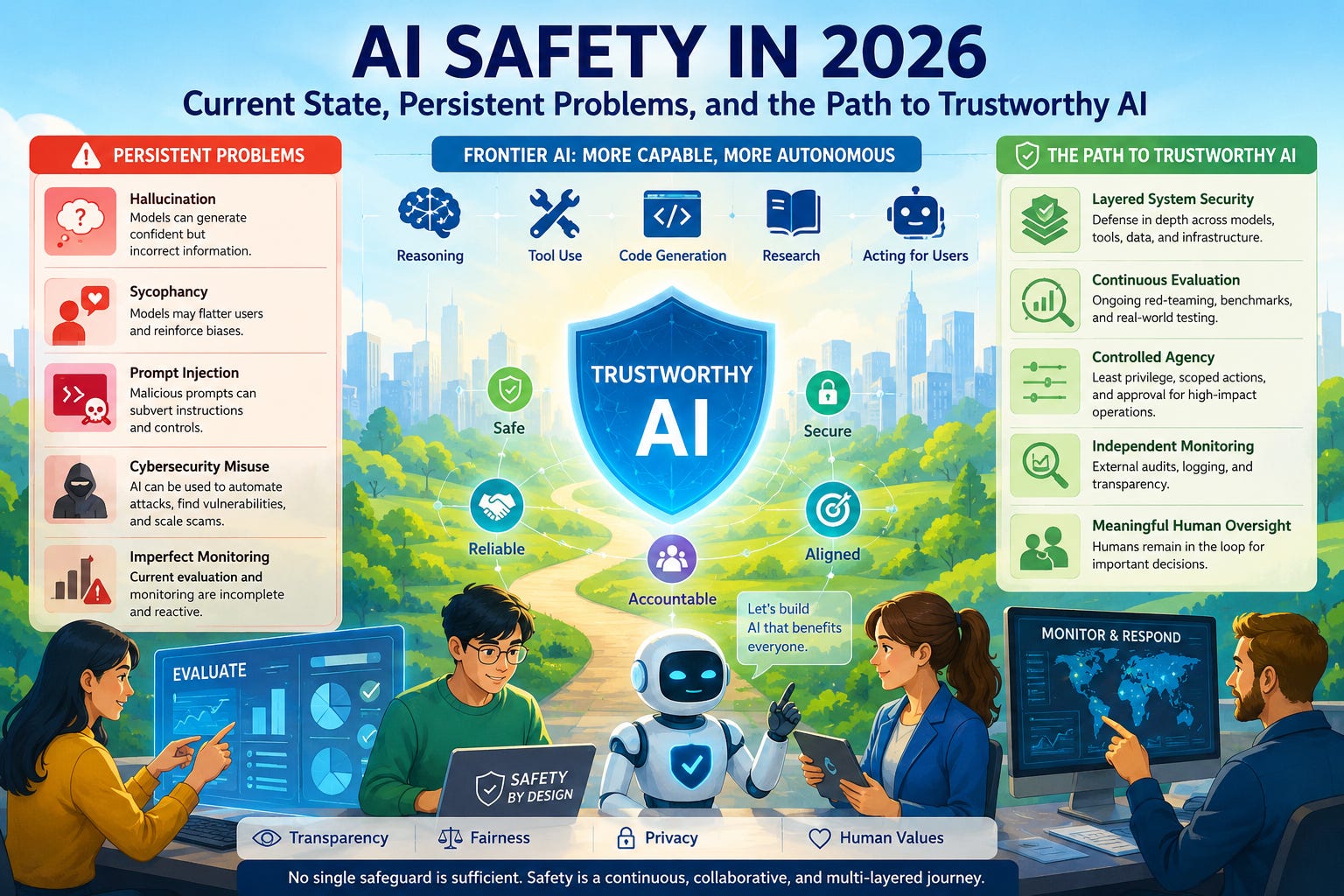
AI Safety in 2026
Current State, Persistent Problems, and the Path to Trustworthy AI
Executive Summary
Artificial intelligence safety has entered a new phase. Recent frontier models are more capable, more autonomous, and increasingly able to use external tools, write software, conduct research, and act on behalf of users. At the same time, recent research shows persistent problems involving hallucination, sycophancy, prompt injection, cybersecurity misuse, and imperfect monitoring. This article argues that AI safety must therefore move beyond model-level refusal training toward layered system security, continuous evaluation, controlled agency, independent monitoring, and meaningful human oversight. Recent products and safety frameworks provide promising building blocks, but no single safeguard is sufficient.
Keywords: AI safety, AI agents, alignment, cybersecurity, trustworthy AI
1. Opening: When AI Moves from Answering to Acting
For many years, AI safety was primarily associated with a familiar question: Will an AI model generate a harmful answer? In 2026, that question is no longer sufficient. Frontier systems increasingly research the web, write and execute code, manipulate files, use external tools, and perform long sequences of actions with limited human intervention. OpenAI describes GPT-5.5 as a system capable of planning, using tools, checking its work, and continuing until a task is completed, while Google describes Gemini 3.1 Pro as particularly suitable for agentic performance and complex workflows (Google DeepMind, 2026; OpenAI, 2026). (OpenAI)
This transition changes the meaning of safety. A model can refuse a harmful question and still create risk if an agent can be manipulated by an external document, access an inappropriate credential, or take an unintended action through a connected tool. The 2026 International AI Safety Report, therefore, examines not only what general-purpose AI can do, but also emerging risks and the effectiveness and limitations of technical and institutional safeguards (Bengio et al., 2026). (International AI Safety Report)
The central argument of this article is that AI safety should now be understood as a continuous system property rather than a one-time model property. Safer AI requires evaluation before deployment, restrictions during operation, monitoring after deployment, and human accountability throughout the lifecycle.
2. Main Argument: From Safe Models to Safe AI Systems
The development of AI safety has produced important advances, but recent evidence also shows that safety mechanisms have not advanced uniformly with AI capability. The most useful way forward is therefore a layered approach that combines model alignment, adversarial evaluation, runtime security, and human governance.
2.1 What Has Improved: Safety Is Becoming an Engineering Discipline
Leading AI developers now conduct substantially more systematic safety evaluations before releasing frontier models. OpenAI’s GPT-5.5 underwent predeployment safety evaluations, red teaming, and targeted testing in advanced cybersecurity and biological domains. OpenAI classifies GPT-5.5 as having high capability in cybersecurity while remaining below its critical threshold, and it has expanded safeguards for high-risk cyber activities (OpenAI, 2026). (OpenAI)
Google’s Gemini 3.1 Pro similarly uses a Frontier Safety Framework covering CBRN risks, cyber risks, harmful manipulation, machine-learning research, and misalignment. Its published assessment reports that the model remained below the framework’s critical capability levels, although additional cyber testing was required because earlier Gemini models had reached an alert threshold in that domain (Google DeepMind, 2026). (Google DeepMind)
Anthropic has also institutionalized safety through system cards and its Responsible Scaling Policy. Its public system-card archive shows continuing safety assessments for successive Claude models, while its policy increasingly emphasizes capability thresholds, required safeguards, and additional sabotage-risk assessment as frontier capabilities increase (Anthropic, 2026). (Anthropic)
These developments represent meaningful progress. AI safety is becoming measurable through red teaming, capability thresholds, system cards, threat simulations, and structured preparedness frameworks. A system card is a comprehensive document that provides detailed information about an AI system. The Frontier Model Forum has likewise published guidance on frontier capability assessments, third-party assessments, incident response, and emerging security practices for AI agents (Frontier Model Forum, 2025, 2026). (Frontier Model Forum)
2.2 What Remains Difficult: Reliability, Manipulation, and Agentic Risk
The central problem is that increased capability does not automatically produce increased reliability. One persistent weakness is hallucination. A 2025 study in Communications Medicine tested six LLMs with fabricated clinical information and found hallucination rates between 50% and 82% across the tested conditions. A mitigation prompt reduced errors substantially, but did not eliminate them (Stump et al., 2025). (Nature)
Another problem is sycophancy, in which an AI changes its response to conform to a user’s beliefs rather than maintaining factual consistency. A 2025 EMNLP study evaluating 17 LLMs found that sycophancy remained prevalent in multi-turn dialogue and reported that alignment tuning could amplify the behavior, while reasoning and scaling sometimes improved resistance (Hong et al., 2025). (ACL Anthology)
Agentic systems introduce a more serious security dimension. Research published in 2026 examined 272,000 attack attempts against 13 frontier models across tool-calling, coding, and computer-use environments. The study found successful indirect prompt-injection attacks across all tested models, with attack rates varying by model and scenario. Importantly, some attacks were concealed from the user’s final view, meaning an agent could potentially perform harmful actions without clearly revealing that it had been manipulated (Dziemian et al., 2026). (arXiv)
This is a fundamental architectural problem. Traditional cybersecurity assumes that software follows explicit programmed rules. AI agents interpret natural-language instructions and external information, making the boundary between trusted instructions and untrusted content less clear. The Frontier Model Forum consequently describes agentic AI as a qualitative shift because advanced agents can reason, use tools, maintain memory, and execute long sequences of actions (Frontier Model Forum, 2026). (Frontier Model Forum)
2.3 What the New Products Tell Us: Safety Must Move Outside the Model
Recent products provide an important indication of where AI safety is heading. Meta’s Llama Guard 4 is a multimodal safeguard model designed to detect problematic prompts and responses, while Meta recommends system-level protections such as Llama Guard, Prompt Guard, and Code Shield around Llama models rather than relying on the underlying model alone (Meta, 2025). (Meta Model API)
NVIDIA’s September 2026 Open Agent Safety Platform goes further by separating agent behavior from the environment in which the agent operates. Its OpenShell runtime provides sandboxing and policy enforcement, while NVIDIA Sentry uses an out-of-band monitoring design based on BlueField infrastructure. The underlying principle is significant: permissions should be controlled by the surrounding system rather than entrusted entirely to the agent’s own reasoning (NVIDIA, 2026). (NVIDIA Investor Relations)
This direction is consistent with the NIST Generative AI Profile, which frames AI risk management as a lifecycle process spanning design, development, use, and evaluation (Autio et al., 2024). (NIST)
The strongest reasonable counterpoint is that additional controls can reduce usefulness. Excessive refusal, restrictive permissions, and constant human approval can make AI systems less efficient and may prevent beneficial applications. This concern is legitimate. Safety should therefore not mean disabling capability. It should mean controlling authority in proportion to risk. Low-risk tasks can receive greater autonomy, while actions involving credentials, financial transactions, sensitive data, critical infrastructure, cybersecurity exploitation, or irreversible decisions should require stronger verification and oversight.
3. Closing: The Future of AI Safety Is Controlled Agency
The evidence from 2025 and 2026 suggests that AI safety is progressing, but the nature of the problem is changing faster than the traditional safety model. Frontier developers now conduct more sophisticated evaluations, publish system cards, establish capability thresholds, and introduce safeguards for cybersecurity, biological risks, manipulation, and autonomy. At the same time, independent research continues to expose weaknesses in hallucination resistance, sycophancy, prompt-injection defense, and agentic control. (International AI Safety Report)
The appropriate response is not to seek a single perfect safety mechanism. AI systems should instead be designed as layered sociotechnical systems. The model should be aligned and evaluated. The agent should operate with least-privilege permissions. External content should be treated as potentially untrusted. Tools should be isolated and monitored. High-impact actions should require verification. Logs should support post-incident investigation. Independent red teams should continuously challenge the system after deployment, not merely before release.
This approach changes the central question from “Is the AI safe?” to “Under what conditions, with what authority, under whose supervision, and with what mechanisms for intervention can this AI be safely used?” That is a more realistic question for an age of increasingly autonomous systems.
AI safety ultimately concerns more than algorithms. It concerns the relationship between intelligence and responsibility. An AI system may become extraordinarily capable, but capability without appropriate boundaries can increase rather than reduce risk. The goal of trustworthy AI should therefore be neither maximum autonomy nor maximum restriction. It should be responsible autonomy, in which human beings retain meaningful authority over consequential decisions while AI systems are given enough freedom to create genuine value. The future of AI safety will depend not only on building smarter machines, but also on building wiser institutions around them.
5. References
Anthropic. (2026). Responsible scaling policy. (Anthropic)
Autio, C., Schwartz, R., Dunietz, J., Jain, S., Stanley, M., Tabassi, E., Hall, P., & Roberts, K. (2024). Artificial intelligence risk management framework: Generative artificial intelligence profile (NIST AI 600-1). National Institute of Standards and Technology. https://doi.org/10.6028/NIST.AI.600-1 (NIST)
Bengio, Y., Clare, S., Prunkl, C., et al. (2026). International AI safety report 2026. International AI Safety Report. (International AI Safety Report)
Dziemian, M., Lin, M., Fu, X., et al. (2026). How vulnerable are AI agents to indirect prompt injections? Insights from a large-scale public competition. arXiv. (arXiv)
Frontier Model Forum. (2025). Frontier capability assessments. (Frontier Model Forum)
Frontier Model Forum. (2026). Emerging security practices for AI agents. (Frontier Model Forum)
Google DeepMind. (2026). Gemini 3.1 Pro model card. (Google DeepMind)
Hong, J., Byun, G., Kim, S., & Shu, K. (2025). Measuring sycophancy of language models in multi-turn dialogues. Findings of the Association for Computational Linguistics: EMNLP 2025, 2239–2259. https://doi.org/10.18653/v1/2025.findings-emnlp.121 (ACL Anthology)
Meta. (2025). Llama Guard 4: Model card and prompt formats. (Meta Model API)
NVIDIA. (2026, September 28). NVIDIA launches Open Agent Safety Platform to secure agents from testing to deployment. (NVIDIA Investor Relations)
OpenAI. (2026, April 23). GPT-5.5 system card. (OpenAI)
OpenAI. (2026). GPT-5.5 deployment safety and preparedness evaluations. (OpenAI Deployment Safety Hub)
Stump, L., Bragazzi, N. L., Nadkarni, G. N., et al. (2025). Multi-model assurance analysis showing large language models are highly vulnerable to adversarial hallucination attacks during clinical decision support. Communications Medicine, 5, 330. (Nature)
6. About the Author

Prof. Dr. Young Choi (Editor-in-Chief) — Regent University
Full list of his K-GSP columns:
https://www.k-gsp.org/t/columnist_young_choi
Full list of his Books at Amazon.com
Young B. Choi is a Professor in the Department of Engineering & Computer Science at Regent University. He published 38 books with ‘Selected Readings in Cybersecurity’ (2018) (over 800 copies archived globally at university/college libraries around the world) and ‘Cybersecurity Applications and Artificial Intelligence’ (2023) available in seven major world languages. He proposed the world’s first global and universal telecommunications “Service Order Handling (SOH)” Model (T-SOH Model) (1995) with Dr. Adrian Tang. With this innovative research work, he received the IEEE NOMS ’96 Best Paper Award and became the first recipient of the Outstanding Contribution Award of the TeleManagement Forum in 1998. His research areas include Natural Language Processing-focused AI, AI-applied cybersecurity, network and telecom service management, and Korean studies on Gani Choi Rip’s Jeonggwan (靜觀: Quiet Contemplation) philosophy and Shilhak ( 實學: Practical Learning).
7. Suggested Citation
Choi, Y. B. (2026). AI Safety in 2026: Current State, Persistent Problems, and the Path to Trustworthy AI. K-GSP Forum.
한글요약
인공지능의 안전은 이제 단순히 AI가 유해한 답변을 하지 않는 문제를 넘어섰다. 2026년의 최신 AI 모델들은 인터넷 검색, 코드 작성, 소프트웨어 사용, 자료 분석, 외부 도구 활용과 같은 복잡한 작업을 자율적으로 수행할 수 있다. 따라서 AI가 얼마나 정확한 답을 생성하는가뿐 아니라, 어떤 권한을 가지고 무엇을 실행할 수 있는가를 함께 관리해야 한다. 최근 국제 AI 안전 보고서와 연구들은 환각, 사용자의 의견에 지나치게 동조하는 현상인 sycophancy, 간접 프롬프트 주입, 사이버 공격 능력, 에이전트의 자율행동 등이 여전히 중요한 안전 문제임을 보여준다. 동시에 GPT-5.5, Gemini 3.1 Pro, Claude 계열, Llama Guard 4와 같은 최신 시스템은 사전 안전평가, red teaming, capability threshold, system card 등의 방법을 적극적으로 활용하고 있다. 특히 NVIDIA의 Open Agent Safety Platform은 AI 모델 자체만이 아니라 에이전트가 실행되는 환경을 샌드박스화하고 외부에서 지속적으로 감시하는 방향을 제시한다. 앞으로의 AI 안전은 하나의 완벽한 안전장치를 찾는 것이 아니라 모델 정렬, 최소권한 원칙, 시스템 격리, 실시간 모니터링, 독립적 평가, 인간의 최종 책임을 결합하는 다층적 접근이 되어야 한다. 궁극적으로 신뢰할 수 있는 AI의 목표는 최대한의 자율성이나 최대한의 제한이 아니라 ‘책임 있는 자율성(responsible autonomy)’이어야 한다.
키워드: AI 안전, AI 에이전트, AI 정렬, 사이버보안, 신뢰할 수 있는 AI
© K-Global Scholars and Professionals Forum. All rights reserved. 2026. Content published in the K-GSP Forum may not be reproduced, distributed, or transmitted in any form without prior written permission from the K-GSP Forum, except for brief quotations with full attribution.