

Executive Summary
A working adult student asked which Doctor of Business Administration (DBA) concentration would make him most marketable as he weighed senior leadership against founding a consulting firm. This column argues that no concentration guarantees marketability. What matters is the human capital a degree helps build, the sequence in which employment and entrepreneurship are pursued, and a habit of learning that turns given talents into a vocation. The practical advice is to define the service first and choose the concentration second.
Keywords: human capital, choosing a DBA concentration, entrepreneurial learning, career development, consulting startup, working adult students, vocational calling
Hashtags: #KGSPForum #HumanCapital #DBA #Entrepreneurship #CareerDevelopment
1. Introduction: A Late-Night Question
A little before eleven one night, an email arrived from a student in my program. He is a working adult who returned to school while holding a full-time job, and his question was direct. He was considering a Doctor of Business Administration (DBA) and weighing four concentrations: communication, public administration, organizational leadership, and information technology (IT). Which one, he asked, would make him more marketable? He hoped one day to launch his own consulting firm, and he was also interested in a senior leadership role with a strong company.
Figure 1

Note. Generated by Gemini for illustration only. Not a real photo.
It is a fair question, and a common one among working adults who spend scarce evenings and savings on a degree. Underneath it sits a hope that the right label on a diploma will open the right doors. My reply began with an honest smile: who knows what the future will bring? No concentration can guarantee marketability. What a degree can do is help build the capability that clients and employers actually pay for. In this column I expand that reply into three opinions drawn from my own path through engineering, operations, strategy consulting, ventures, and start-ups.
2. Human Capital Matters More Than the Concentration Label
My first opinion is that the concentration matters less than the human capital it helps a student build. Becker (1993) described education and training as investments in people that raise their productive capacity, comparable to investments in physical capital. The return comes from what the person can do afterward, not from the certificate. Employers and clients rarely hire a concentration. They hire someone who can solve a problem they have.
Seen this way, the four options fall into two paths. Organizational leadership suits a generalist path. It fits his interest in senior leadership and in moving across sectors, because the work of leading people and change travels well between industries. IT suits a specialist path. It makes sense if he wants deeper technical expertise and wants technology at the center of his consulting work. Communication or public administration could be equally sound if his future clients turn out to be in media, government, or nonprofit settings. The real question is not which label the market will reward in general, since no one can predict that, but which expertise he intends to own.
3. Employability First, Then the Startup
My second opinion concerns sequence. Employability is valuable, and I do not dismiss the senior leadership option. A good position in a strong company provides steady income and a close view of how large organizations decide. It also builds a network of colleagues who may later become clients. For a working adult, this is often the sensible first stage.
Starting one’s own business offers a different and usually broader kind of learning. Inside a company, a manager tends to learn one function deeply. A founder must find clients, price a service, deliver it, collect payment, and recover from mistakes, often in the same month. Cope (2005) argued that entrepreneurial learning is driven by such experience, especially by critical events and setbacks that force founders to revise how they understand their business and themselves. That learning is real, but it is expensive, and many new ventures do not survive. Sequence lowers the cost. A person who builds employable expertise first enters a venture with skills and savings in place and with a track record clients can check.
Figure 2
Strategic DBA Specialization Pathway and Focus Areas for Nontraditional Students.
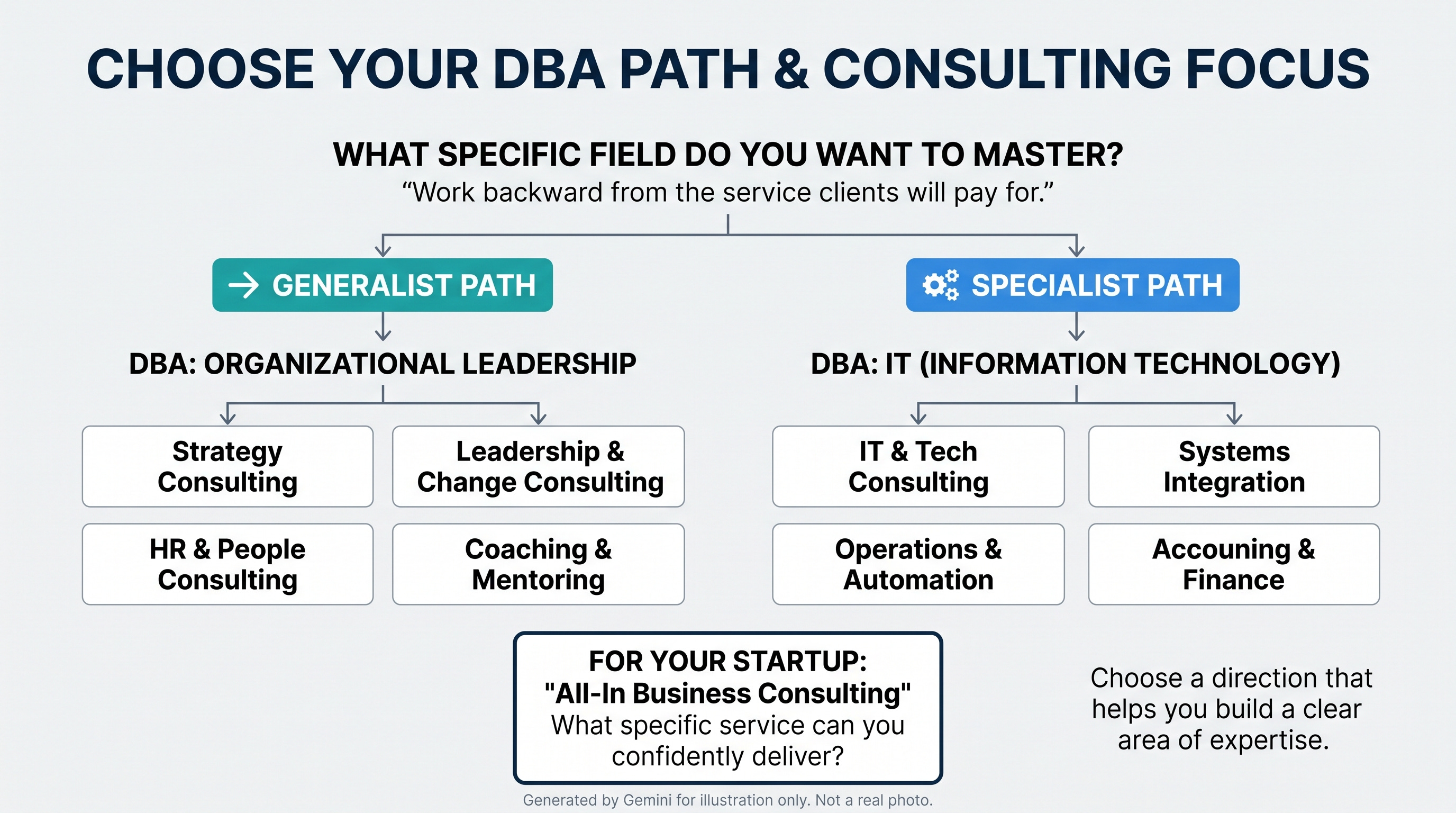
Note. Designed with guidance for working adult student’s all-in business consulting startup journey
Sequence also sharpens the startup itself. A broad firm name can wait. I asked my student to begin with a narrower question: “What specific service can I provide that clients would be willing to pay for?” Consulting covers very different businesses: strategy, IT, systems integration, operations and automation, human resources, organizational change, and leadership coaching. Each has its own clients, problems, and proof of results. Once he names the service and the client, he can work backward to the DBA concentration that best supports it.
4. Habituated Learning as a Calling
My third opinion is the one I care about most. Whatever a person’s starting point, growth depends less on the first choice than on the habit of learning that follows it. A working adult in an evening program, an engineer moving into management and a consultant weighing a first venture all face the same test. I call this habituated learning: learning that has become part of how one works each day, not an event reserved for degree programs.
My own career moved from engineering to operations, then to strategy consulting, ventures, and start-ups. None of those moves followed a plan drawn in advance. Each became possible because the previous role had left me with new skills and new questions, and because learning had become a habit rather than a project. The concentration a student chooses today matters, but it is one step in a longer sequence.
Weber (1905/1930) traced how the German word Beruf came to join two meanings: an occupation and a calling, a task given to a person rather than merely chosen. I find the idea useful for working adults. The talents each of us receives are not finished products. They become a vocation through steady learning in the work in front of us. A calling is not a guarantee of success, however. It supplies direction and endurance, while skill, clients, and judgment still have to be earned.
5. Conclusion
My student asked which concentration would make him more marketable. The honest answer is that no one knows what the future market will reward, and the degree title will matter less than the expertise he builds through it. Organizational leadership fits a generalist path toward senior leadership, and IT fits a specialist path toward technology consulting. Either can serve a future firm if he first defines the service clients will pay for.
The larger lesson for ambitious working adults is about order and habit. Build human capital where you are employed, let it mature into a service you can deliver with confidence, and then decide whether to start your own business. Keep learning as a daily practice throughout.
For Korean diaspora scholars, professionals, and students, who often build careers across languages, institutions, and countries, this habit of learning may be the most portable form of human capital they carry.
Rather than trying to predict the future, choose the direction that lets you keep growing in the work you have been given.
References
Becker, G. S. (1993). Human capital: A theoretical and empirical analysis, with special reference to education (3rd ed.). University of Chicago Press.
Cope, J. (2005). Toward a dynamic learning perspective of entrepreneurship. Entrepreneurship Theory and Practice, 29(4), 373–397. https://doi.org/10.1111/j.1540-6520.2005.00090.x
Weber, M. (1930). The Protestant ethic and the spirit of capitalism (T. Parsons, Trans.). Allen & Unwin. (Original work published 1905)
About the Author

Prof. Dr. Jeonghwan (Jerry) Choi (Managing Editor)
Full list of his K-GSP columns:
Jeonghwan (Jerry) Choi, PhD is Editor-in-Coordination of K-GSP Forum (contact: jeonghwan.choi at gmail.com). With over 25 years of industry and consulting experience, he specializes in leadership development, human resource management, organizational behavior, and social entrepreneurship. His research focuses on workforce resilience, organizational health, and self-directed leadership — bridging rigorous scholarship with practical insight to cultivate leaders who create meaningful, sustainable, and humane organizations.
Suggested Citation
Choi, J. (2026, October [Day]). Before the startup, build human capital: Advice to a working adult choosing a DBA concentration. K-GSP Forum.
Original Article:

한글요약
창업 전에 인적자본부터: DBA 전공 선택을 고민하는 직장인 학생에게
밤늦게 한 직장인 학생에게서 이메일이 왔습니다. 경영학박사(DBA) 과정을 준비하면서 커뮤니케이션, 공공관리, 행정학, 조직리더십, IT 관리 중 어떤 전공이 취업과 경력에 더 유리하냐는 질문이었습니다. 그는 언젠가 자기 컨설팅 회사를 세우고 싶어 했고, 좋은 기업의 고위 리더 자리에도 관심이 있었습니다. 이 글은 그에게 보낸 답장을 세 가지 의견으로 풀어 씁니다. 첫째, 어떤 전공도 성공을 보장하지 않습니다. 중요한 것은 학위를 통해 쌓는 실제 역량, 곧 인적자본입니다. 여러 분야를 넘나드는 리더를 꿈꾼다면 조직리더십이, 기술 전문 컨설팅을 원한다면 IT가 어울립니다. 둘째, 순서가 중요합니다. 먼저 직장에서 전문성과 경력을 쌓고, 그다음 창업에 도전하면 훨씬 넓은 배움을 얻으면서도 위험은 줄일 수 있습니다. 창업을 준비한다면 회사 이름보다 먼저 “고객이 돈을 내고 살 만한 구체적인 서비스가 무엇인가”를 물어야 하고, 그 답에서 거꾸로 전공을 고르면 됩니다. 셋째, 출발점이 어디든 배움을 날마다의 습관으로 삼으면 사람은 계속 자랍니다. 독일어 ‘Beruf’가 직업이자 소명 (Calling) 을 뜻하듯, 하늘이 준 재능은 꾸준한 배움을 통해 소명이 됩니다. 언어와 제도, 나라의 경계를 넘나들며 경력을 쌓아 가는 재외 한인 학자와 전문가, 학생들에게는 이 배움의 습관이야말로 어디서나 지니고 다닐 수 있는 가장 든든한 인적자본일 것입니다. 미래를 맞히려 애쓰기보다, 지금 맡은 일 속에서 계속 성장할 수 있는 방향을 고르라는 것이 이 글의 조언입니다.
주제어: 인적자본, DBA 전공 선택, 창업 학습, 경력개발, 소명
© K-Global Scholars and Professionals Forum. All rights reserved. Content published in the K-GSP Forum may not be reproduced, distributed, or transmitted in any form without prior written permission from the K-GSP Forum, except for brief quotations with full attribution.