

EXECUTIVE SUMMARY
Drawing on Johan Norberg’s (2025) analysis of the rise and decline of historical golden ages and the Thucydides Trap, this article examines whether the United States and China can sustain strategic competition without escalating toward war. Using the 2026 Beijing and Washington summits as contemporary illustrations, it distinguishes historical conflict frequencies from predictive probabilities while highlighting how economic convergence, alliance networks, and diplomatic engagement shape great-power rivalry. The article develops a 2×2 framework integrating strategic competition and institutionalized engagement to identify four possible pathways: strategic distance, cooperative accommodation, Thucydidean escalation, and managed strategic rivalry. Its central argument is that sustained institutional engagement may reduce escalation risks without eliminating strategic competition, although summit diplomacy alone does not establish durable stability. The framework offers five propositions and practical implications for South Korea’s alliance-based security, strategic flexibility, and capacity to navigate an increasingly contested geopolitical environment.
Keywords: Thucydides Trap; U.S.–China Relations; Great-Power Competition; Institutionalized Engagement; Managed Strategic Rivalry
1. Introduction
In Peak Human: What We Can Learn from the Rise and Fall of Golden Ages, Johan Norberg (2025) examines seven remarkable civilizations—ancient Athens, the Roman Republic, Abbasid Baghdad, Song China, Renaissance Italy, the Dutch Republic, and the Anglosphere—to explain why periods of extraordinary flourishing eventually decline. He argues that golden ages emerge through openness to trade, people, and ideas but deteriorate when fear, internal tensions, and the pursuit of control undermine creativity and dynamism. The fall of Athens during the Peloponnesian War, which inspired Thucydides’ account of rising power and established power rivalry, raises a contemporary question: can the United States and China sustain strategic competition without provoking war or sacrificing the openness essential to their prosperity (Thucydides, ca. 400 B.C.E./1996)?
This question gained renewed urgency during Chinese President Xi Jinping’s September 23–25, 2026 state visit to Washington, where discussions with President Donald Trump addressed the “Thucydides Trap,” peaceful coexistence, and persistent disagreements over trade, artificial intelligence (AI), advanced technologies, Taiwan, and regional security (Lewis et al., 2026). Although the Washington summit extended a temporary trade truce, it did not resolve underlying strategic tensions, just as the May 2026 Beijing summit’s vision of “constructive strategic stability” reflected differing Chinese and American interpretations (Liu, 2026; State Council of the PRC, 2026). Together, these diplomatic encounters illustrate how sustained engagement may coexist with strategic rivalry, raising the question of whether repeated communication can reduce crisis risks without eliminating competition.
Allison (2017) identified 16 historical cases in which a rising power challenged an established power, with 12 resulting in war, producing a striking historical proportion of 75%. However, this figure does not represent a 75% probability of a future U.S.–China war because the cases are limited, historically selected, and heterogeneous rather than a random sample of comparable confrontations. The more important analytical question concerns how strategic competition, crisis exposure, economic interdependence, deterrence, and institutionalized engagement interact to influence escalation risks, recognizing that historical patterns inform strategic judgment without determining future outcomes.
This article shifts the analytical focus from the presumed inevitability of power-transition conflict toward the governance of strategic rivalry by examining two dimensions—strategic competition and institutionalized engagement—and four possible outcomes: strategic distance, cooperative accommodation, Thucydidean escalation, and managed strategic rivalry. Its proposed mechanism, Strategic Competition × Institutionalized Engagement → Conditional Escalation Risk → Strategic Outcomes, explains how sustained engagement may moderate escalation risks even under conditions of intense competition, as illustrated—but not conclusively demonstrated—by the two 2026 U.S.–China summits. Five propositions further specify the conditions under which strategic rivalry may shift among these four pathways, offering a framework for understanding how competing powers might manage persistent disagreements without allowing competition to escalate into war.
2. Contextual Overview
The contemporary U.S.–China rivalry differs from classical power transitions because it combines changing relative economic capabilities with two very different geopolitical support structures. China’s rise has substantially narrowed the nominal economic gap with the United States, yet the United States continues to possess the larger nominal economy and a dense network of formal treaty alliances, while China relies more heavily on strategic partnerships and selective security relationships. Figure 1 and Table 1 therefore capture two complementary dimensions of the competition: economic capability and geopolitical architecture. Taken together, they suggest that the central strategic question is not simply whether China is “catching” the United States, but whether changes in relative economic power can be managed within a regional system in which the two countries possess very different forms of external influence.
2.1. The Thucydides Trap: Origins and Contemporary Relevance
The Thucydides Trap names the structural pressures that can arise when an emerging power challenges an established one. Its historical reference is Thucydides’ explanation of how Athenian power and Spartan fear contributed to the Peloponnesian War. Allison (2017) popularized the contemporary analogy, while subsequent scholars have questioned whether selection of historical cases can yield a general law of power transitions (Hamilton & Fisher, 2024; Platias & Trigkas, 2021). Applied to the United States and China, the framework is best treated as a warning about perceptions, security dilemmas, and miscalculation—not as a deterministic forecast.
Power-transition theory, developed by Organski (1958), examines how changes in relative national capabilities may challenge established international hierarchies. However, Chan (2017) cautions against overly deterministic interpretations of China’s rise, highlighting the importance of historical circumstances, strategic perceptions, and political choices. These perspectives reinforce the need to treat the Thucydides Trap as a contingent strategic problem rather than an inevitable route to war.
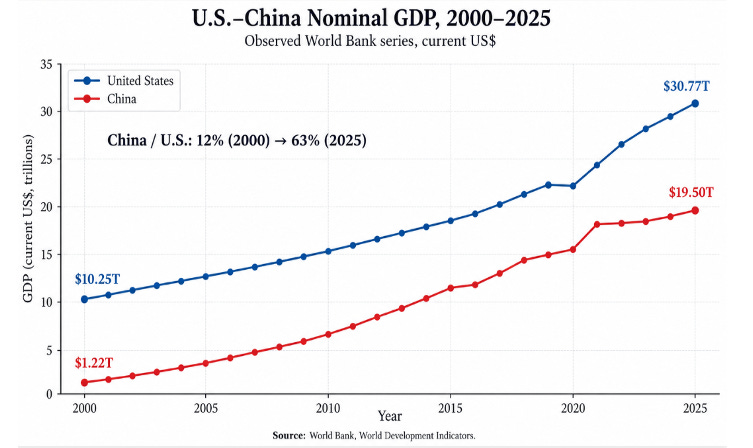
Figure 1. U.S.–China Nominal GDP Trends: The Changing Economic Power Gap
Source: World Bank (2026), World Development Indicators, GDP (current US$), indicator NY.GDP.MKTP.CD; data checked October 25, 2026 during the subsequent citation revision, with observations through 2025.
Figure 1 traces the increase in China’s nominal economic scale relative to the United States using year-specific observations from the World Bank’s World Development Indicators. In 2000, China’s GDP was approximately $1.22 trillion against $10.25 trillion for the United States (11.9%); in 2025, the corresponding values were $19.50 trillion and $30.77 trillion (63.4%). The intervening observations are plotted only for years confirmed in the cited DataBank series, without interpolating unavailable annual observations. The comparison illustrates substantial economic convergence, not the displacement of the United States; strategic consequences depend on institutions, technology, alliances, and policy choices as well as economic scale (Hong & Park, 2020; Nye, 2022).
2.2. Alliance Networks versus Strategic Partnership Networks
Economic output alone does not determine external influence. The United States maintains treaty-based security relationships with Japan, South Korea, Australia, the Philippines, and Thailand, although their legal instruments and obligations are not identical. China’s external relationships are more heterogeneous: North Korea is a separate treaty-based security case, while Russia, Pakistan, Cambodia, and Laos are strategic partners whose cooperation does not constitute equivalent mutual-defense guarantees. The revised Table 1 distinguishes formal treaty commitments from partnership declarations and avoids treating each relationship as interchangeable.
2.3. From Economic Convergence to Networked Strategic Competition
Long-term geopolitical forecasts underline the uncertainty surrounding changes in global power distributions (Friedman, 2009). More specifically, China’s technological catch-up and its position within global value chains reshape the economic and strategic context of great-power competition (Lee, 2021). Together, these perspectives show why GDP convergence alone cannot explain the evolution of technological, industrial, or security rivalry.
Figure 1 and Table 1 jointly illustrate why U.S.–China rivalry is both bilateral and networked. China’s industrial and technological capacity expands its ability to compete over trade, supply chains, infrastructure, and regional influence, while the United States possesses extensive treaty alliances and global institutional relationships. The comparative relationship is thus not a direct repetition of Athens and Sparta: production networks and diplomatic commitments connect many additional states to the rivalry. The 2026 summits can be interpreted as attempts to preserve channels of negotiation within this broader strategic ecosystem rather than as evidence of a completed settlement.
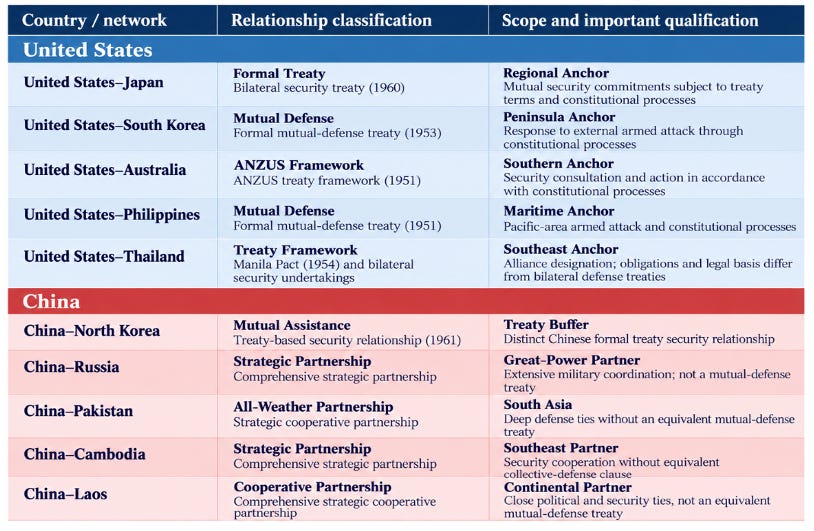
Table 1. Alliance Networks versus Strategic Partnership Networks
Sources: U.S. Department of State (n.d.) on collective-defense arrangements; U.S. Department of State (2022, 2024) on the U.S.–Thailand strategic alliance; Ministry of Foreign Affairs of the People’s Republic of China (2007) on the China–Russia strategic partnership. Other Chinese partnership categories summarize official bilateral terminology and do not constitute equivalent mutual-defense guarantees; treaty obligations differ in legal scope and constitutional procedures.

3. The 2026 U.S.–China Summits: Competition, Engagement, and Strategic Stability
The May Beijing and September Washington meetings offer two episodes through which to examine whether diplomatic engagement can coexist with strategic competition. Their agendas included trade, technology, critical minerals, Taiwan, and security. Evidence of communication is not the same as evidence of reduced conflict risk; evaluating governance requires attention to durable working-level channels, reciprocal commitments, and crisis procedures (Liu, 2026; Lewis et al., 2026).
3.1. Beijing Summit: Building Mechanisms for Strategic Stability
At their May 2026 Beijing meeting, Trump and Xi emphasized a constructive and strategically stable relationship, yet the two governments framed its meaning differently. China stressed a vision of manageable competition, while U.S. commentary emphasized practical negotiating outcomes. This difference reveals both the potential and the limits of summit diplomacy: direct talks may stabilize expectations temporarily without resolving technology controls, security dilemmas, and trade disputes (State Council of the PRC, 2026; Liu, 2026).
3.2. Washington Summit: Testing Managed Strategic Rivalry
Xi’s September 2026 Washington visit again paired high-level diplomacy with unresolved strategic disputes. Lewis et al. (2026) reported a temporary extension of the trade truce and continuing differences over Taiwan, advanced technology, and AI governance. Xi’s invocation of the Thucydides Trap underscored an interest in avoiding uncontrolled escalation; it did not demonstrate that the two governments had established a comprehensive AI-safety agreement or permanent emergency-communications regime. The observed pattern is continued negotiation under persistent competition.
3.3. From Beijing to Washington: What Changed—and What Did Not?
The two summits demonstrated continuity rather than fundamental transformation, as diplomatic engagement continued while major disagreements over Taiwan, regional security, trade, advanced technologies, and strategic influence remained unresolved. From the U.S. perspective, China’s expanding military capabilities, coercive pressure on Taiwan, state-supported technological competition, and use of economic leverage pose significant challenges to American strategic interests, alliance credibility, and the stability of the Indo-Pacific order. Consequently, effective management of U.S.–China rivalry requires not only sustained diplomatic communication but also credible military deterrence, technological leadership, economic resilience, reciprocal commitments, and coordinated security cooperation with regional allies. Institutionalized engagement should therefore complement rather than substitute for strategic preparedness and verifiable accountability, ensuring that efforts to prevent escalation do not compromise American national security, alliance commitments, or established international norms.
U.S.–China economic rivalry also requires distinguishing trade negotiations from technology competition: these conflicts entail different bargaining structures, strategic incentives, and possibilities for settlement (Wu, 2024). Consequently, a temporary trade accommodation should not be interpreted as resolving disputes over advanced technology, strategic capabilities, or alliance security.
4. A 2×2 Framework of Great-Power Competition: Four Strategic Pathways
The proposed 2×2 framework provides a systematic approach to understanding how great powers navigate strategic competition while managing the risks of confrontation and military escalation. By integrating strategic competition with institutionalized engagement, it moves beyond deterministic interpretations of the Thucydides Trap and highlights the importance of diplomatic governance, credible deterrence, and strategic preparedness. Its primary value lies in identifying alternative pathways through which competing powers may sustain rivalry, manage tensions, and reduce escalation risks without compromising national security or alliance commitments.
Figure 2 presents four strategic pathways based on the intensity of Strategic Competition (low–high) and the degree of Institutionalized Engagement (low–high), encompassing military security, technology, trade, supply chains, alliances, diplomacy, and crisis-management mechanisms. Strategic Distance (I) combines low competition and low engagement, while Cooperative Accommodation (II) reflects low competition and high engagement, creating greater opportunities for negotiation and cooperation. Thucydidean Escalation (III) represents high competition and low engagement, generating the greatest risks of miscalculation and conflict, whereas Managed Strategic Rivalry (IV) combines high competition with high engagement, offering opportunities to moderate escalation through sustained diplomacy and institutional governance.
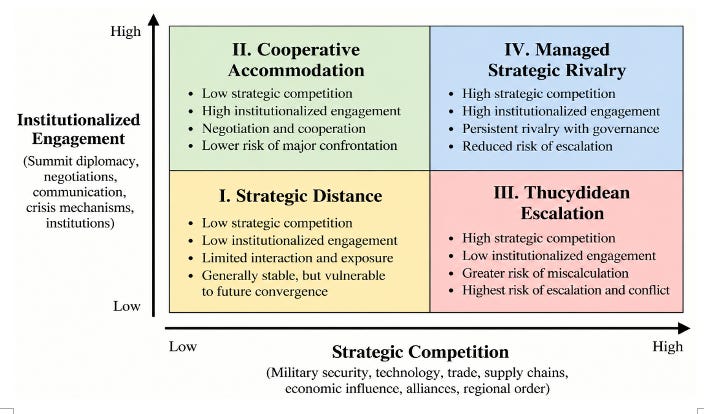
Figure 2. Four Pathways of U.S.–China Relations
Source: Author’s Synthesis
4.1. Scenario I: Strategic Distance — Low Competition × Low Engagement
Strategic Distance describes a relationship of low rivalry and low institutionalized engagement, where limited conflicting interests keep direct confrontation relatively unlikely, but this stability reflects limited strategic exposure rather than active cooperation or mature crisis-management mechanisms, so expanding economic, technological, territorial, or geopolitical overlap can quickly expose institutional weaknesses and make the relationship less stable.
Proposition 1: When both strategic competition and institutionalized engagement are low, great-power relations are likely to remain relatively stable as long as strategic interests remain substantially separated, but rising interaction can expose institutional weaknesses.
4.2. Scenario II: Cooperative Accommodation — Low Competition × High Engagement
Cooperative Accommodation combines relatively low strategic competition with extensive institutional engagement, facilitating negotiation, information sharing, and cooperative adjustment. Strong communication channels are more effective when neither side regards the other as an immediate challenge to vital interests. This is a conditional rather than permanent state.
Proposition 2: When strategic competition is relatively low and institutionalized engagement is high, sustained interaction is more likely to reinforce cooperative accommodation and reduce the likelihood of escalation.
4.3. Scenario III: Thucydidean Escalation — High Competition × Low Engagement
Thucydidean Escalation represents the most dangerous quadrant because intense strategic competition is accompanied by weak communication and limited institutional capacity to manage crises. Under such conditions, military deployments, technological restrictions, alliance commitments, economic coercion, or actions involving contested territories can be interpreted through increasingly adversarial expectations, while fewer trusted channels exist for correcting misperceptions before they generate counteractions. Structural power transition therefore becomes especially consequential when competition intensifies faster than institutions for managing competition, increasing exposure to miscalculation, escalation spirals, and potentially armed conflict.
Proposition 3: When strategic competition is high and institutionalized engagement is low, the risk of escalation increases because structural rivalry operates without sufficiently developed mechanisms for communication, reassurance, negotiation, and crisis management.
4.4. Scenario IV: Managed Strategic Rivalry — High Competition × High Engagement
Managed Strategic Rivalry captures the possibility most relevant to contemporary U.S.–China relations: two great powers can remain serious economic, technological, military, and geopolitical competitors while simultaneously developing institutions that constrain how that competition is conducted. The 2026 Beijing and Washington summits illustrate elements of this pattern because continuing disagreements over technology, security, Taiwan, trade, and strategic influence coexisted with repeated leader-level diplomacy and negotiations; however, whether this pattern proves durable remains an empirical question rather than an established outcome. The theoretical significance of this quadrant is that engagement does not have to eliminate rivalry to influence its trajectory; its more realistic function may be to establish boundaries, maintain communication, reduce miscalculation, and preserve opportunities for negotiated adjustment.
Managed rivalry also requires credible balancing rather than relying on dialogue alone. Desch (2025) examines strategic balancing as a possible pathway away from great-power war, supporting the analytical distinction between restraining coercion and sustaining channels of engagement. Deterrence and diplomacy should therefore be understood as potentially complementary, subject to credible commitments and careful crisis management.
Proposition 4: When strategic competition and institutionalized engagement are both high, sustained engagement may moderate escalation risks, provided that diplomatic commitments are reciprocal, credible, and supported by effective deterrence and established international norms. Without these conditions, engagement may temporarily reduce tensions while allowing coercive behavior and underlying strategic competition to continue.
4.5. From the Thucydides Trap to the Governance of Rivalry
The four pathways recast the Thucydides Trap as a governance question. Changes in engagement matter as much as the current level of rivalry: under high competition, deteriorating communication may shift the relationship toward Thucydidean Escalation, while stronger diplomatic and crisis-management procedures may create opportunities for Managed Strategic Rivalry. This is a conceptual mechanism, not a demonstrated statistical effect. Strategic Competition × Institutionalized Engagement → Conditional Escalation Risk → Strategic Outcomes summarizes the argument, while deterrence, alliances, domestic politics, leadership perceptions, and unforeseen crises remain important additional conditions.
The political and institutional conditions restraining confrontation also deserve explicit attention. Foot (2018) examines restraints on conflict in U.S.–China relations, while He and Feng (2025) connect strategic competition to institutional balancing and transitions in international order. These studies support the proposition that changes in relative power interact with institutions, strategic incentives, and political decisions rather than mechanically determining war or peace.
Proposition 5: The risk associated with great-power transition depends not only on the intensity of strategic competition but also on the direction and durability of institutionalized engagement; consequently, changes in engagement can alter the trajectory of rivalry even when the underlying distribution of power continues to shift.
5. Statistical Insight: From Historical Frequency to Conditional Risk
Historical cases are most valuable not as deterministic forecasts, but as evidence that power transitions create recurring risks whose outcomes depend on context. Statistical reasoning therefore shifts attention from simple historical frequency to conditional strategic risk shaped by competition, engagement, deterrence, alliances, and crisis management. The central lesson is that history provides frequencies, not destinies, because structural pressures can be governed in different ways.
5.1. Allison’s 16 Cases: What Does 12 out of 16 Really Tell Us?
Allison’s 16 selected power-transition cases include 12 wars (75%) and four non-war outcomes (25%) (Figure 3). A conventional Wilson interval for the fraction 12/16 is approximately 51%–90%, but that interval assumes a binomial sampling model that does not describe the historically selected and heterogeneous set of cases. It is included only to illustrate sampling uncertainty under a hypothetical model—not as a confidence interval for the chance of U.S.–China war. Neither the observed fraction nor the hypothetical interval establishes a predictive risk estimate; the more defensible conclusion is that power transitions warrant attention to contingent institutional and political conditions.
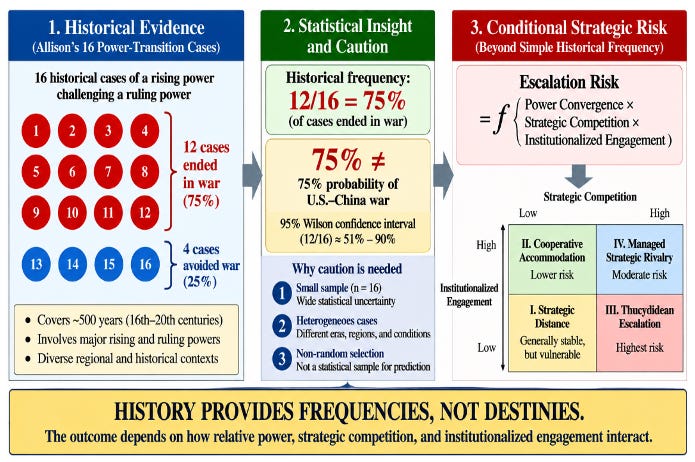
Figure 3. Historical Frequency, Statistical Caution, and Strategic Risk
Source: Allison (2017); author’s conceptual synthesis and illustrative calculation.
Drawing on Graham Allison’s 16 historical cases of power transitions spanning approximately 500 years, the framework highlights that 12 cases (75%) resulted in war, while four (25%) avoided military conflict. However, this historical frequency should not be interpreted as a 75% probability of U.S.–China war, given the small, heterogeneous, and non-random selection of cases; even a hypothetical binomial model yields a wide 95% Wilson confidence interval of approximately 51%–90%. Moving beyond historical frequencies, the proposed framework examines how power convergence, strategic competition, and institutionalized engagement interact to shape escalation risks across four possible pathways: Strategic Distance, Cooperative Accommodation, Thucydidean Escalation, and Managed Strategic Rivalry. The central insight is that history provides frequencies, not destinies, and that sustained institutionalized engagement may help manage great-power competition and reduce the risk of escalation without eliminating strategic rivalry.
Note: The 95% Wilson confidence interval is an illustrative calculation based on a hypothetical binomial sampling model, not a predictive estimate of U.S.–China war probability. Escalation risk is conceptualized as conditional on the interaction of power convergence, strategic competition, and institutionalized engagement.
5.2. From Historical Frequency to Conditional Strategic Risk
The explanatory task is to identify factors that raise or lower the potential for escalation: relative power change, crisis exposure, deterrence, economic interdependence, alliance commitments, leadership interpretation, and credible institutional engagement. The 2×2 framework posits that high competition combined with weak engagement may leave fewer pathways to prevent miscalculation, whereas high competition with durable engagement may improve crisis handling. These are directional propositions for comparative research, not estimated conditional probabilities. A future empirical study would need explicit case selection, observable measures of engagement, and competing explanations.
5.3. Implications for Korea: Alliance Security and Strategic Space
South Korea illustrates both the opportunities and limitations of managing U.S.–China strategic rivalry. The U.S.–ROK Mutual Defense Treaty, signed in 1953 and effective in 1954, remains the foundation of its national security, while China’s economic influence, coercive practices, and relationship with North Korea create persistent strategic challenges (Longo, 2026). Beijing’s economic retaliation following the deployment of the Terminal High Altitude Area Defense (THAAD) system demonstrated the vulnerability of economic relationships to security disputes (Meick & Salidjanova, 2017). North Korea’s expanding nuclear arsenal and advancing missile capabilities likewise underscore the continuing need for credible deterrence, military preparedness, and coordinated security cooperation with the United States and Japan (Office of the Director of National Intelligence, 2026).
The U.S.–ROK Nuclear Consultative Group has reaffirmed commitments to extended deterrence and bilateral consultation in response to these threats (United States Forces Korea, 2026). South Korea cannot simultaneously depend on the United States for security while maintaining strategic neutrality on threats directly affecting the alliance, because a credible security alliance requires a shared understanding of common threats, clear strategic priorities, and firm mutual defense commitments. Accordingly, Seoul should pursue alliance-based strategic autonomy through stronger deterrence, technological competitiveness, and supply-chain resilience while maintaining pragmatic economic engagement with China without compromising national sovereignty, alliance credibility, or regional security.

6. Conclusion
The 2026 Beijing and Washington summits demonstrate that sustained diplomatic engagement can coexist with intense U.S.–China strategic competition, but meaningful stability requires credible deterrence, reciprocal commitments, and restraint from coercive behavior. Historical power-transition patterns caution against complacency without establishing the inevitability of war, while the proposed governance framework identifies four strategic pathways shaped by competition and institutionalized engagement. The foundation of a credible alliance is a shared understanding of common security threats, potential adversaries, and strategic priorities, without which mutual defense commitments, coordinated deterrence, and effective crisis responses may be undermined by diverging national interests. For the United States, effective management of rivalry requires the protection of alliance credibility, technological competitiveness, and established international norms, alongside sustained diplomatic communication. For South Korea, a strong U.S.–ROK alliance, enhanced economic and technological resilience, and pragmatic engagement with China provide the foundations for preserving national sovereignty, regional stability, and strategic flexibility.
References
Allison, G. T. (2017). Destined for war: Can America and China escape Thucydides’s trap? Houghton Mifflin Harcourt.
Chan, S. (2017). The power-transition discourse and China’s rise. In Oxford research encyclopedia of politics. Oxford University Press.
Desch, M. C. (2025). Balancing away from war: How the USA and China can side-step the Thucydides’ Trap. The Chinese Journal of International Politics, 18(2), 151–172. https://doi.org/10.1093/cjip/poaf001
Foot, R. (2018). Restraints on conflict in the China-US relationship: Contesting power transition theory. In A. Toje (Ed.), Will China’s rise be peaceful? The rise of a great power in theory, history, politics, and the future (pp. 79–100). Oxford University Press.
Friedman, G. (2009). The next 100 years: A forecast for the 21st century. Doubleday.
Hamilton, M. D., & Fisher, M. (2024). Opening the Thucydides trap: A genealogy of rise-and-fall theory. International Affairs, 100(3), 1189–1206. https://doi.org/10.1093/ia/iiae082
He, K., & Feng, H. (2025). International order transition and US–China competition: Beyond the Thucydides Trap. In The upside of US-Chinese strategic competition: Institutional balancing and order transition in the Asia Pacific (pp. 1–29). Cambridge University Press.
Hong, P. C., & Park, Y. W. (2020). Rising Asia and American hegemony: Case of competitive firms from Japan, Korea, China and India. Springer.
Lee, K. (2021). Thucydides trap, global value chain, and future of China. In China’s technological leapfrogging and economic catch-up: A Schumpeterian perspective (pp. 218–238). Oxford University Press.
Lewis, S., Hunnicutt, T., & Brunnstrom, D. (2026, September 24). Five takeaways from Trump’s summit with Xi in Washington. Reuters. https://www.reuters.com/world/china/four-takeaways-trumps-summit-with-xi-washington-2026-09-24/
Liu, Z. Z. (2026, May 18). China and the U.S. agreed to “strategic stability” in Beijing. They don’t define it the same way. Council on Foreign Relations. https://www.cfr.org/articles/china-and-the-u-s-agreed-to-strategic-stability-in-beijing-they-dont-define-it-the-same-way
Longo, D. J. (2026, March 16). U.S.-South Korea alliance: Background and issues for Congress (Report No. R48877). Congressional Research Service. https://www.congress.gov/crs-product/R48877
Meick, E., & Salidjanova, N. (2017, July 26). China’s response to U.S.-South Korean missile defense system deployment and its implications [Staff research report]. U.S.-China Economic and Security Review Commission. https://www.uscc.gov/research/chinas-response-us-south-korean-missile-defense-system-deployment-and-its-implications
Ministry of Foreign Affairs of the People’s Republic of China. (2007, April 6). Joint statement between the People’s Republic of China and the Russian Federation. https://www.fmprc.gov.cn/eng/zy/gb/202405/t20240531_11367176.html
Norberg, J. (2025). Peak human: What we can learn from the rise and fall of golden ages. Atlantic Books.
Nye, J. S., Jr. (2022). How not to deal with a rising China: A US perspective. International Affairs, 98(5), 1635–1651. https://doi.org/10.1093/ia/iiac117
Office of the Director of National Intelligence. (2026, March). 2026 annual threat assessment of the U.S. intelligence community [Report]. https://www.dni.gov/files/ODNI/documents/assessments/ATA-2026-Unclassified-Report.pdf
Organski, A. F. K. (1958). World politics. Alfred A. Knopf.
Platias, A., & Trigkas, V. (2021). Unravelling the Thucydides’ Trap: Inadvertent escalation or war of choice? The Chinese Journal of International Politics, 14(2), 219–255.
State Council of the People’s Republic of China. (2026, May 15). Chinese, U.S. presidents agree on new vision for bilateral ties in Beijing talks. https://english.www.gov.cn/news/202605/15/content_WS6a0679c9c6d00ca5f9a0afa9.html
Thucydides. (1996). The landmark Thucydides: A comprehensive guide to the Peloponnesian War (R. B. Strassler, Ed.; R. Crawley, Trans.). Free Press. (Original work published ca. 431–400 B.C.E.)
United States Forces Korea. (2026, June 11). Joint press statement on the sixth Nuclear Consultative Group meeting [Press release]. https://www.usfk.mil/Media/Press-Products/Press-Releases/Article/4515329/joint-press-statement-on-the-sixth-nuclear-consultative-group-meeting/
U.S. Department of State. (n.d.). U.S. collective defense arrangements. https://2009-2017.state.gov/s/l/treaty/collectivedefense/index.htm
U.S. Department of State. (2022, July 10). United States–Thailand communiqué on strategic alliance and partnership. https://2021-2025.state.gov/united-states-thailand-communique-on-strategic-alliance-and-partnership/
U.S. Department of State. (2024, July 19). U.S. relations with Thailand. https://2021-2025.state.gov/u-s-relations-with-thailand/
World Bank. (2026). GDP (current US$) (NY.GDP.MKTP.CD) [Data set]. World Development Indicators. Retrieved October 25, 2026, from https://data.worldbank.org/indicator/NY.GDP.MKTP.CD
Wu, C. X. (2024). A bargaining theory of US–China economic rivalry: Differentiating the trade and technology wars. The Chinese Journal of International Politics, 17(4), 323–345.
About the Author

Paul C. Hong (Editor-in-Chief) - Distinguished University Professor, University of Toledo
Full list of his K-GSP columns:
Paul C. Hong is a Distinguished University Professor at the University of Toledo whose research spans global supply chain management, international competitiveness, geopolitical strategy, and institutional governance. He is co-author of Rising Asia and American Hegemony: Case of Competitive Firms from Japan, Korea, China and India (Springer, 2020), which examines the changing dynamics of Asian economic development and global competition. His scholarly work explores how geopolitical tensions, economic interdependence, technological transformation, and strategic networks shape national competitiveness and organizational responses to global uncertainty. Drawing on this interdisciplinary perspective, he examines U.S.–China great-power competition through historical evidence, strategic alliances, global supply chains, and institutional engagement, emphasizing the importance of governing rivalry, managing geopolitical risks, and sustaining international cooperation.
Suggested Citation
Hong, P. C. (2026, October 29). Beyond the Thucydides Trap: What the 2026 U.S.–China summits reveal about great-power competition. K-Global Scholars and Professionals Forum. pp.1-15.
Original Article

한글요약
투키디데스의 함정을 넘어서: 2026년 미·중 정상회담이 보여주는 강대국 경쟁의 미래
2026년 베이징과 워싱턴에서 열린 미·중 정상회담은 무역·인공지능(AI)·핵심광물·대만·지역안보를 둘러싼 치열한 전략경쟁 속에서도 정상외교와 제도화된 소통이 병행될 수 있음을 보여주었다. 이 글은 미·중 관계를 단순한 평화와 전쟁의 양자택일이 아니라 전략적 경쟁(Strategic Competition)과 제도화된 관여(Institutionalized Engagement)의 상호작용으로 이해하며, 경쟁 자체를 제거하기보다 경쟁을 어떻게 관리하고 군사적 충돌을 방지할 것인가가 핵심 과제라고 주장한다.
중국의 명목 GDP는 2000년 미국의 약 12% 수준에서 2025년 약 63% 수준으로 확대되었지만, 미국은 여전히 더 큰 경제 규모와 광범위한 동맹망을 보유하고 있어 경제적 수렴이 곧 패권 교체를 의미하지는 않는다. 이 글에서 제시하는 2×2 분석모형은 전략적 경쟁의 강도와 제도화된 관여의 수준에 따라 전략적 거리(Strategic Distance), 협력적 조정(Cooperative Accommodation), 투키디데스적 격화(Thucydidean Escalation), 관리된 전략적 경쟁(Managed Strategic Rivalry)이라는 네 가지 경로를 구분한다. 또한 그레이엄 앨리슨(Graham Allison)이 분석한 16개 권력전환 사례 중 12개가 전쟁으로 이어졌다는 75%의 역사적 빈도는 미래 미·중 전쟁의 발생 확률을 의미하지 않으며, 역사는 일정한 빈도를 제공하지만 미래의 운명을 결정하지 않는다는 점을 강조한다.
대한민국에 대한 함의는 더욱 분명하다. 안보동맹은 단순히 우호적인 두 국가 사이의 친선관계가 아니라, 공동의 안보 위협과 잠재적 적대세력에 대한 공통된 인식, 명확한 전략적 목표, 그리고 상호방위의 확고한 의지 위에 성립하는 국가 간 안보적 결속이다. 따라서 미국과 한국이 우호적인 관계라는 이유만으로 한·미동맹이 어떠한 상황에서도 자동적으로 유지될 것이라고 가정해서는 안 되며, 공동의 위협과 잠재적 적대세력에 대한 인식, 동맹의 전략적 목적, 유사시 상호방위의 책임에 근본적인 차이가 발생한다면 동맹의 신뢰성과 존립 기반 자체가 약화될 수 있다. 특히 한국이 미국의 안보보장에 의존하면서도 동맹의 핵심 안보 위협에 대해서는 전략적 중립을 유지하려 한다면 동맹의 공동 대응 능력과 장기적 지속가능성에 심각한 의문이 제기될 수 있다. 중국의 사드(THAAD) 배치 관련 경제적 보복과 북한의 핵·미사일 능력 증강은 경제적 상호의존이 안보를 보장하지 못하며, 신뢰할 수 있는 확장억제와 군사적 대비태세, 한·미·일 안보협력이 필수적임을 보여준다. 결국 대한민국은 한·미동맹을 국가안보의 핵심 축으로 유지하면서 공동의 위협에 대한 전략적 인식을 명확히 하고, 확장억제, 첨단기술 경쟁력, 공급망 회복력 및 경제안보 역량을 강화해야 한다. 동맹은 우호적 감정만으로 유지되는 것이 아니라 공동의 위협에 대한 명확한 인식과 상호방위의 실질적 의지로 유지되며, 이러한 전략적 공감대가 무너지면 동맹의 존재 이유와 지속가능성도 근본적으로 흔들릴 수 있다. 따라서 한국의 진정한 전략적 자율성은 안보적 중립이나 모호성이 아니라, 확고한 동맹의 신뢰와 국가적 경쟁력을 바탕으로 실용적 외교를 발전시키는 데서 확보될 수 있다.
Paul C. Hong은 미국 University of Toledo의 Distinguished University Professor로서 글로벌 공급망 관리, 전략, 거버넌스, 리더십 및 AI 시대의 의사결정을 연구해 왔으며, 기술·경제·제도뿐 아니라 인간의 성품, 역사적 경험, 문화적 기억과 도덕적 판단이 복잡한 시스템과 리더십을 형성한다는 관점에서 역사·철학·문학을 경영 및 전략 연구와 연결하고, 최근에는 지정학적 변화, 통계적 사고, 글로벌 경쟁과 책임 있는 리더십을 결합하는 학제적 연구와 저술을 수행하고 있다.
© K-Global Scholars and Professionals Forum. All rights reserved. Content published in the K-GSP Forum may not be reproduced, distributed, or transmitted in any form without prior written permission from the K-GSP Forum, except for brief quotations with full attribution.