

Executive Summary
MIT’s 2026 report on AI in teaching concludes that AI can now complete most take-home work, so assessment has to change. This column argues that policy needs a teaching philosophy behind it. I describe five commitments: systems thinking, evidence-based management, experiential learning, accessible multimodal instruction, and developmental mentorship. I then show how each translates into human–AI practice through the ROIT(C) prompting framework, AI-partnered projects, and a two-way learning loop built on video presentations, AI-supported grading, and relational video feedback.
Keywords: human–AI collaboration, teaching philosophy, AI-assisted oral exam, video feedback, technology-mediated identity formation, experiential learning, multilingual students
Hashtags: #KGSPForum #HumanAICollaboration #AIinEducation #TeachingPhilosophy #OralExam
1. Introduction: When the Essay Stops Proving Anything
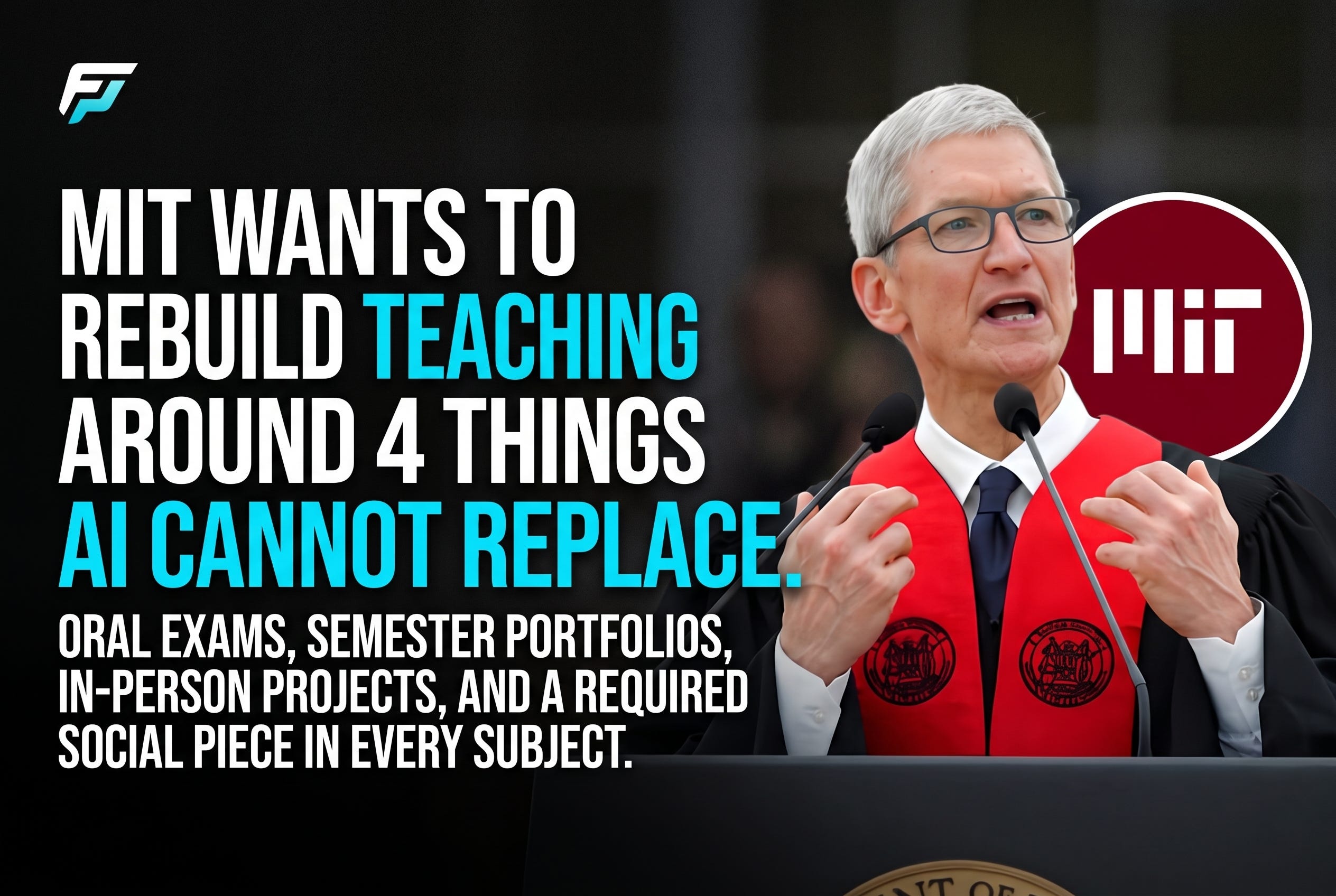
This past August, MIT’s Ad Hoc Committee on AI Use in Teaching, Learning, and Research Training put in writing what many instructors had already seen in their own grading. AI can produce a credible answer to almost any written assignment, so a problem set completed at home no longer proves much about what a student knows (Ad Hoc Committee on AI Use in Teaching, Learning, and Research Training [MIT AI Committee], 2026). The committee did not respond with prohibition.
It recommended 1) oral exams, 2) semester portfolios, 3) in-person project work, 4) a social component in every subject, and a clear AI policy for every course.

https://bpb-us-e1.wpmucdn.com/sites.mit.edu/dist/d/2418/files/2026/09/AI-Committee-Final-Report-Aug-13.pdf
I agree with most of it. A policy document, however, cannot tell an instructor why students learn or what to do on Monday morning. The question that first drew me from engineering and consulting into academic research was how people come to work by themselves, out of their own understanding and motivation. AI makes that question urgent. When a machine can produce the work, teaching has to shift from collecting products to forming people who can think, explain, and stand behind what they produce.
2. A Teaching Philosophy for the Age of AI
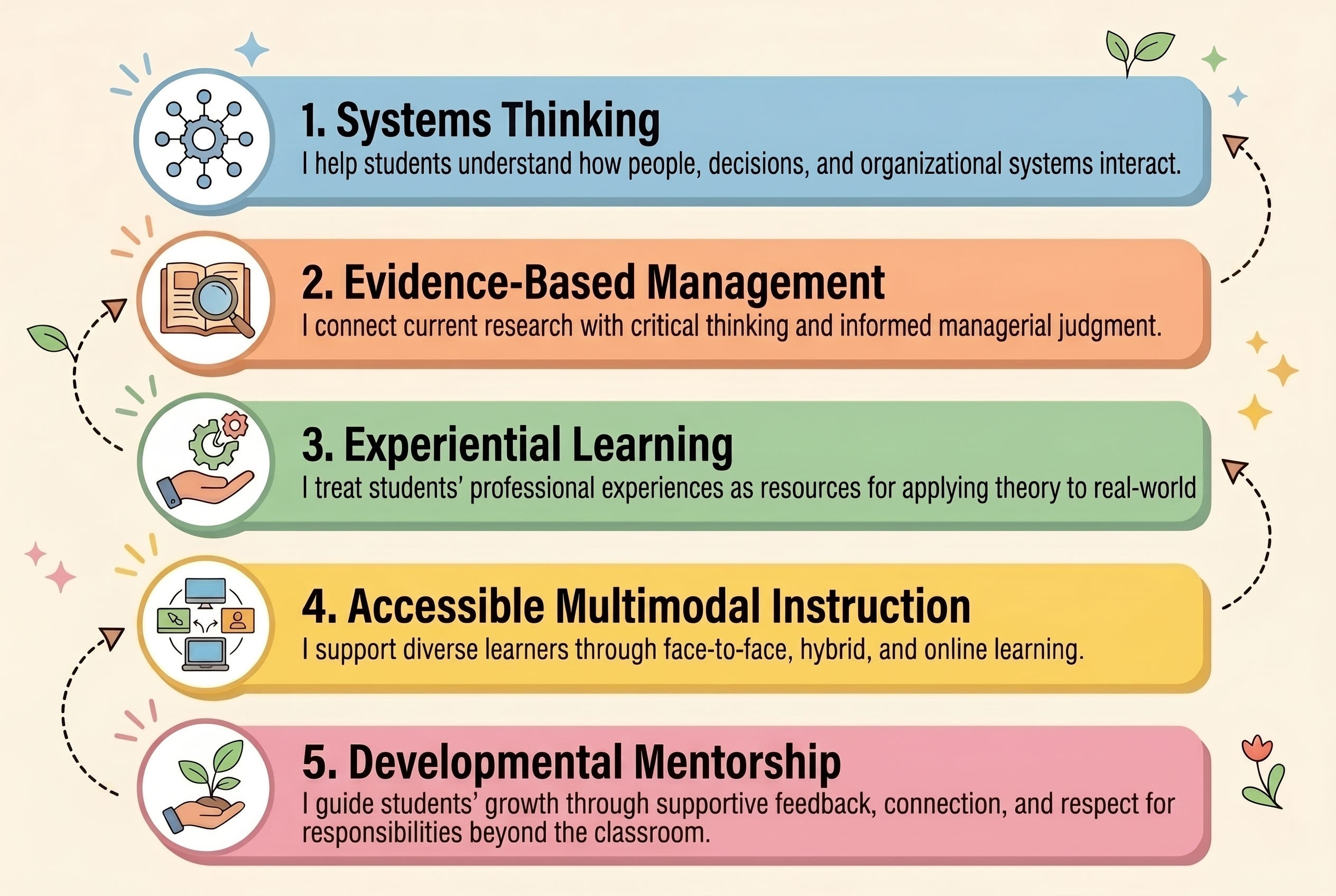
I describe my teaching philosophy as “an upward path of student transformation,” one that bridges supportive personal mentorship with critical systems thinking. It rests on five commitments, shown in Figure 1. AI has made none of them obsolete. It has changed how each one is practiced.
Figure 1
My Teaching Philosophy: A Journey of Holistic Student Growth
Note. Figure created by the author.
The first commitment is systems thinking: helping students understand how people, decisions, and organizational systems interact (Senge, 1990). AI is now part of that system, so students must learn where it improves a decision and where it distorts one. The second is evidence-based management, which connects current research with critical thinking and informed managerial judgment (Rousseau, 2006). In practice, that means students test AI outputs against evidence instead of accepting them as answers. The third is experiential learning. I treat students’ professional experiences as resources for applying theory to real-world challenges, which matters a great deal for working adults. The fourth is accessible multimodal instruction that supports diverse learners in face-to-face, hybrid, and online courses. Video now lets face-to-face communication reach students wherever they study. The fifth is informal learning through developmental mentorship. I guide growth through supportive feedback, meaningful connection, and respect for students’ responsibilities beyond the classroom.
Beneath all five lies a conviction from a research on human–AI career integration, HACI): learning is identity work (Yoo and Choi, 2026). Students rehearse who they are becoming, trying on what Ibarra (1999) called “provisional selves” and refining them through feedback. When AI writes the essay, the student skips the struggle in which a professional self takes shape. Well-designed technology can do the opposite, making the student more visible and more confident in their own voice. I call this technology-mediated identity formation, and it is the test I apply to every tool. Does the student become more present because of it?
3. Partnering With AI Through Projects
3.1 Teaching AI With ROIT(C)
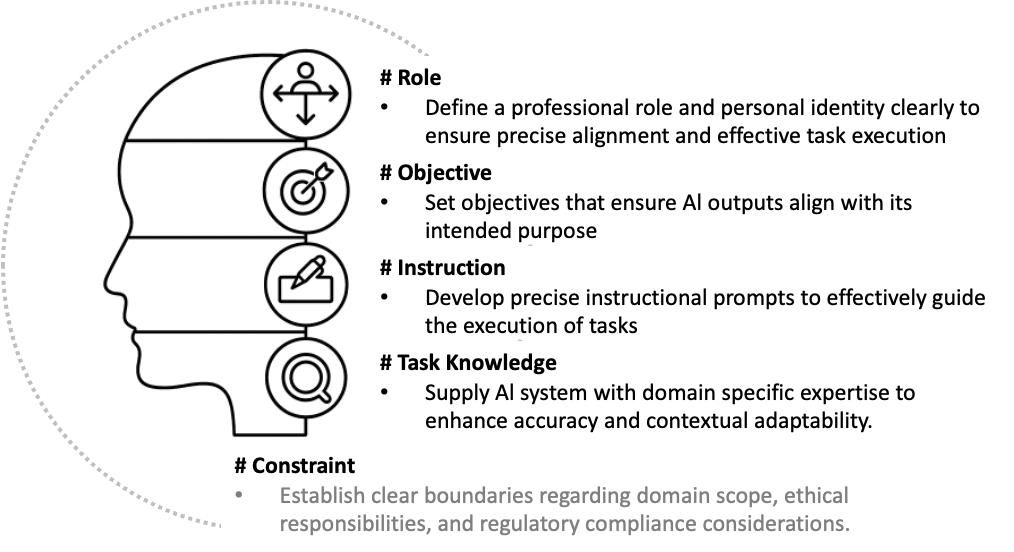
Students who use AI should learn to use it as good professionals do, with purpose and with responsibility for the result. I teach a structured approach I call ROIT(C), summarized in Figure 2.
Figure 2
ROIT(C) Framework for Teaching AI
Note. Figure created by the author. Originally published in Choi (2025), “Trainability for Human–AI Collaboration,”https://leadershipcenter.tistory.com/749
The framework turns prompting from guesswork into a disciplined act of specification. A student who must state the objective and context before asking for help has already done part of the thinking the assignment is meant to develop. That student can later explain why an output fits the problem, or why it does not. The framework also puts evidence-based management into practice, because every output becomes a claim to be checked.
3.2 AI-Partnered Experiential Learning
The framework matters most inside projects. Following the experiential learning cycle that Kolb (1984) described, in which concrete experience leads to reflection, conceptualization, and new experiment, my students tackle applied business problems drawn from their own workplaces, with AI as a declared partner. They use it to research, draft, and test options. They then explain what they accepted, what they rejected, and why. The MIT report reaches a similar point from another direction. In its capstone software class, AI tools now let students build near production-quality work in one semester, yet the committee insists that such work happen where people can question it (MIT AI Committee, 2026, pp. 13, 16). AI raises the ceiling of what a project can achieve. Human questioning keeps the floor of understanding in place.
4. A Two-Way Learning Loop: Video, AI, and the Oral Exam
Three principles anchor my philosophy: authentic engagement, rigorous criteria, and human-centered mentorship. They become concrete in a learning loop that runs from student to instructor and back, with video and AI each doing specific work (Figure 3). The MIT committee lists oral exams first among its alternatives to take-home work and notes that immediate feedback can matter more to a student than a grade (MIT AI Committee, 2026, p. 16). Video makes that conversation possible at scale and on the student’s schedule, without losing face-to-face presence.
Figure 3
Two-Way Video Communication: Leveraging Video and AI to Build a Social Learning Loop
Note. This vidie is created by the author under the written permission from all participatns.
The loop moves past isolated AI outputs toward meaningful student–instructor connection. It has three functions: Fostering real understanding; Objective, data-informed grading support; Restoring the human touch.
4.1 Fostering Real Understanding
The first move, authentic engagement, shifts assessment away from easily copied AI outputs toward authentic, identity-verified video presentations. Students record themselves in Brightspace VideoNote explaining an analysis, defending a recommendation, or answering follow-up questions. A face and a voice working through an idea cannot be outsourced the way a document can. Explaining an idea aloud also makes the student own it. I pitch questions just beyond what the student can explain alone, in the zone where, as Vygotsky (1978) argued, development happens with the right support.
4.2 Objective, Data-Informed Grading Support
The second move, rigorous criteria, is about consistency. AI transcribes each presentation and produces a first-pass evaluation against the rubric, so I can benchmark performance across sections and cohorts instead of relying on memory and late-night fatigue. “Objective” needs care here. The model does not grade; it organizes evidence. I review every case and assign every final grade. The system provides a consistent starting point and a record that makes my judgment easier to explain.
4.3 Restoring the Human Touch
The third move, human-centered mentorship, is relational. I return feedback by video, speaking to each student about what worked and what to try next. Hattie and Timperley (2007) argued that feedback is most powerful when it answers three questions for the learner: where am I going, how am I doing, and where to next. Hearing those answers from a person who watched you think carries a credibility that a comment box rarely does. Technology serves the learner instead of overshadowing the teaching. A public example is available on my YouTube channel: [insert link].
4.4 What the Pilot and Students Showed
I tested this on-demand oral exam model for feasibility across 20 cases, using a two-stage assessment framework. These are feasibility data from a small pilot, not proof of learning gains. A comparison across cohorts is the next step. The pilot does show that the loop can run within an ordinary teaching load.
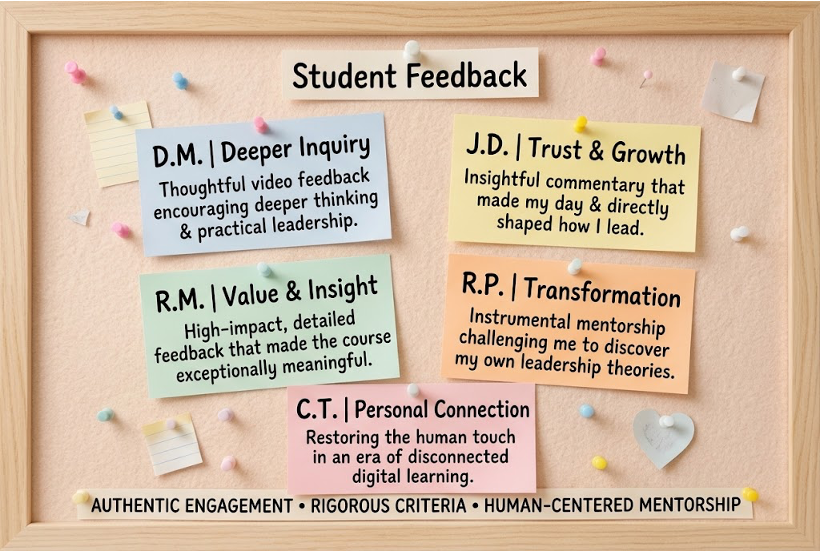
Students’ own words point to the relational side of the loop. The comments below, a selection from end-of-course messages and shown in Figure 4, were unsolicited. They are illustrations, not measured outcomes.
Figure 4
Selected Student Comments on Written and Video Feedback
Note. Comments are shared with the students’ permission and non-identifiable initials only.
Student D.M.: “Thank you for your thoughtful written and video feedback throughout this course... I appreciate the time and care you put into your responses and the way you encourage deeper thinking while remaining supportive. Your guidance has made a meaningful difference in how I approach these leadership questions.”
Student J.D.: “Your kind words about my reflection video and essay made my day... your feedback has truly shaped how I think about leadership. You are an amazing professor, and I am so grateful for the way you go above and beyond for your students.”
Student R.M.: “I truly want to express to the school how much I valued your class and the detailed, insightful feedback you provided throughout the course.”
Student R.P.: “You have been incredibly instrumental in my academic and professional journey. Thank you for pushing me to explore new perspectives and helping me to find my own theories and ideas as to how I will lead in the future.”
Student C.T.: “Honestly I haven’t had a teacher who put so much effort and time into assessing and giving feedback. You helped immensely with my thoughts, and especially hearing your detailed feedback from each assignment... There is an ever growing lack of personal connection, which I am sure you witness everyday! Thank you for being you.”
C.T.’s last observation names the problem this loop is designed to address. AI can make learning faster and more solitary. Video and human feedback can make it personal again.
5. Conclusion: Keep the Student in the Frame
The MIT report ends with a governance agenda, and rightly so. Institutions need course policies and equal access to AI tools. They also need to stop relying on AI detectors, which the committee rejects in part because detectors misread non-native English writers (MIT AI Committee, 2026, p. 18). Policy is only the frame. Inside it, each instructor still has to decide what the classroom is for.
My answer is that it is for forming people who can work with AI and still be recognizably themselves. They should be able to see the system, weigh the evidence, partner with a machine, explain the result face to face, and grow through feedback from a mentor who knows them. For Korean diaspora scholars, professionals, and students who teach and learn across languages and educational systems, assessment that values reasoning over polish may also be the fairest kind. The machines will keep improving at producing answers. Our task is to keep the student in the frame.
References
Ad Hoc Committee on AI Use in Teaching, Learning, and Research Training. (2026). Report of MIT’s Ad Hoc Committee on AI Use in Teaching, Learning, and Research Training. Massachusetts Institute of Technology. https://sites.mit.edu/ai-use/ai-committee-final-report-aug-13/
Choi, J. (2025.). Trainability for human–AI collaboration [Blog post]. Leadership Center. https://leadershipcenter.tistory.com/749
Hattie, J., & Timperley, H. (2007). The power of feedback. Review of Educational Research, 77(1), 81–112. https://doi.org/10.3102/003465430298487
Ibarra, H. (1999). Provisional selves: Experimenting with image and identity in professional adaptation. Administrative Science Quarterly, 44(4), 764–791. https://doi.org/10.2307/2667055
Kolb, D. A. (1984). Experiential learning: Experience as the source of learning and development. Prentice Hall.
Rousseau, D. M. (2006). Is there such a thing as “evidence-based management”? Academy of Management Review, 31(2), 256–269. https://doi.org/10.5465/amr.2006.20208679
Senge, P. M. (1990). The fifth discipline: The art and practice of the learning organization. Doubleday.
Yoo, S. J., & Choi, J. (2026). From Career Ladders to Digital Jungle Gyms: An HRD Theoretical Framework for Understanding Human-AI Interaction in Career Development. Human Resource Development Review, 0(0). https://doi.org/10.1177/15344843261491397
Vygotsky, L. S. (1978). Mind in society: The development of higher psychological processes. Harvard University Press.
About the Author
Jeonghwan (Jerry) Choi, PhD, MBA, ME · Managing Editor of K-GSP
Jeonghwan (Jerry) Choi is Managing Editor of K-GSP. He brings more than 25 years of business consulting experience, including work with entrepreneurs and start-ups, and 15 years of teaching and research in leadership, human resource management, human resource development, and organizational behavior and development. His current work examines human–AI career integration and AI-assisted assessment that keeps human judgment at the center.
Suggested Citation
Choi, J. (2026, October 15). Teaching and learning through human–AI collaboration: Building a two-way learning loop with video, AI, and human judgment. K-GSP Forum.
한글요약
인간과 AI가 함께하는 가르침과 배움: 영상과 AI, 사람의 판단으로 만드는 양방향 학습 고리
2026년 MIT 보고서는 AI가 이제 거의 모든 과제를 해낼 수 있어서 평가 방식이 바뀌어야 한다고 말합니다. 필자는 정책 뒤에 분명한 교육 철학이 있어야 한다고 봅니다. 필자의 교육 철학은 따뜻한 개인 멘토링과 비판적 시스템 사고를 잇는 ‘학생 성장의 오르막길’이며, 다섯 가지 약속으로 이루어집니다. 사람과 결정, 조직이 어떻게 얽혀 움직이는지 보게 하는 시스템 사고, 연구와 비판적 사고를 경영 판단으로 잇는 증거 기반 경영, 학생의 직장 경험을 이론 적용의 자원으로 삼는 경험 학습, 대면·하이브리드·온라인을 아우르는 다중 방식 수업, 그리고 교실 밖의 책임까지 존중하는 성장 멘토링입니다. AI 시대에 이 약속들은 새로운 방식으로 실천됩니다. 학생은 ROIT(C) 틀로 AI를 목적 있게 다루는 법을 배우고, 자기 직장 문제를 다루는 프로젝트에서 AI를 공개적인 협력자로 삼되 무엇을 받아들이고 버렸는지 설명합니다. 평가는 영상과 AI로 만든 양방향 학습 고리로 이루어집니다. 학생 본인이 직접 설명하는 영상 발표로 진짜 이해를 확인하고, AI의 받아쓰기와 1차 평가로 반과 학기를 넘어 일관되게 비교하며, 최종 성적은 교수가 매깁니다. 피드백도 영상으로 돌려줘 사람의 온기를 되살립니다. 20건의 구술시험 시범 운영은 이 방식이 실제 수업 부담 안에서 가능함을 보여 주었고, 학생들이 남긴 소감은 영상 피드백이 사라져 가는 인간적 연결을 되살릴 수 있음을 보여 줍니다. 여러 언어와 교육 제도를 오가는 재외 한인 학자와 전문가, 학생들에게도 겉모습보다 생각을 평가하는 방식이 가장 공정할 수 있습니다.
주제어: 인간-AI 협업, 교육 철학, AI 활용 구술시험, 영상 피드백, 기술 매개 정체성 형성
© K-Global Scholars and Professionals Forum. All rights reserved. Content published in the K-GSP Forum may not be reproduced, distributed, or transmitted in any form without prior written permission from the K-GSP Forum, except for brief quotations with full attribution.