
Korean in the Age of Artificial Intelligence
Hangul, Human Communication, and the Promise of a Language-Rich Future
Abstract
Artificial intelligence can now write essays, translate documents, explain scientific concepts, and converse with people in many languages. As these capabilities expand, an important question arises: What makes the language Korean particularly interesting in the age of AI? Korean cannot scientifically be declared the best language for every AI application. Nevertheless, its writing system, grammatical structure, honorific expressions, and context-sensitive communication offer valuable opportunities for language technology. Hangul combines alphabetic principles with syllable-block organization, while Korean uses particles and verb endings to convey grammatical relationships and social nuances. These characteristics create both opportunities and challenges for natural language processing. Drawing on linguistic research and practical examples of human–AI interaction, this essay explains how Korean can support more precise, culturally aware, and accessible communication with AI. It also examines the technical limitations that must be addressed, including tokenization, contextual interpretation, and the quality of Korean-language training data. The central argument is that Korean’s significance lies not in defeating other languages, but in helping AI communicate more effectively with people and cultures.
Keywords: Korean language, Hangul, artificial intelligence, generative AI, natural language processing, prompt engineering, human–AI interaction
When a Computer Learns to Speak Korean
Imagine asking an AI assistant: “My grandmother is ill. Please help me write her a comforting letter.” The assistant produces a polite and affectionate message. You read it and decide that something is missing. The words are correct, but the letter sounds as though it was written by a government office announcing a change in parking regulations.
You try again: “Please make it warmer and more personal. Use simple language, as if I were speaking gently to someone I love. Avoid sounding dramatic.” The revised letter may be much better.
What changed? You did not necessarily change the language or the central message. Instead, you explained the audience, purpose, tone, and emotional setting more clearly. This simple example illustrates an important principle of generative AI: The quality of an answer depends partly on how clearly the user communicates what is needed.
Korean offers particularly interesting examples of this process because its grammatical endings, honorific expressions, and context-sensitive conventions provide several ways to communicate relationships and attitudes. These features do not make Korean automatically superior to English or other languages. They do, however, make Korean a valuable language for exploring how AI can adapt its communication to human needs. To understand why, we should begin with Hangul, the writing system used to represent Korean.
Hangul: Small Building Blocks, Remarkable Organization
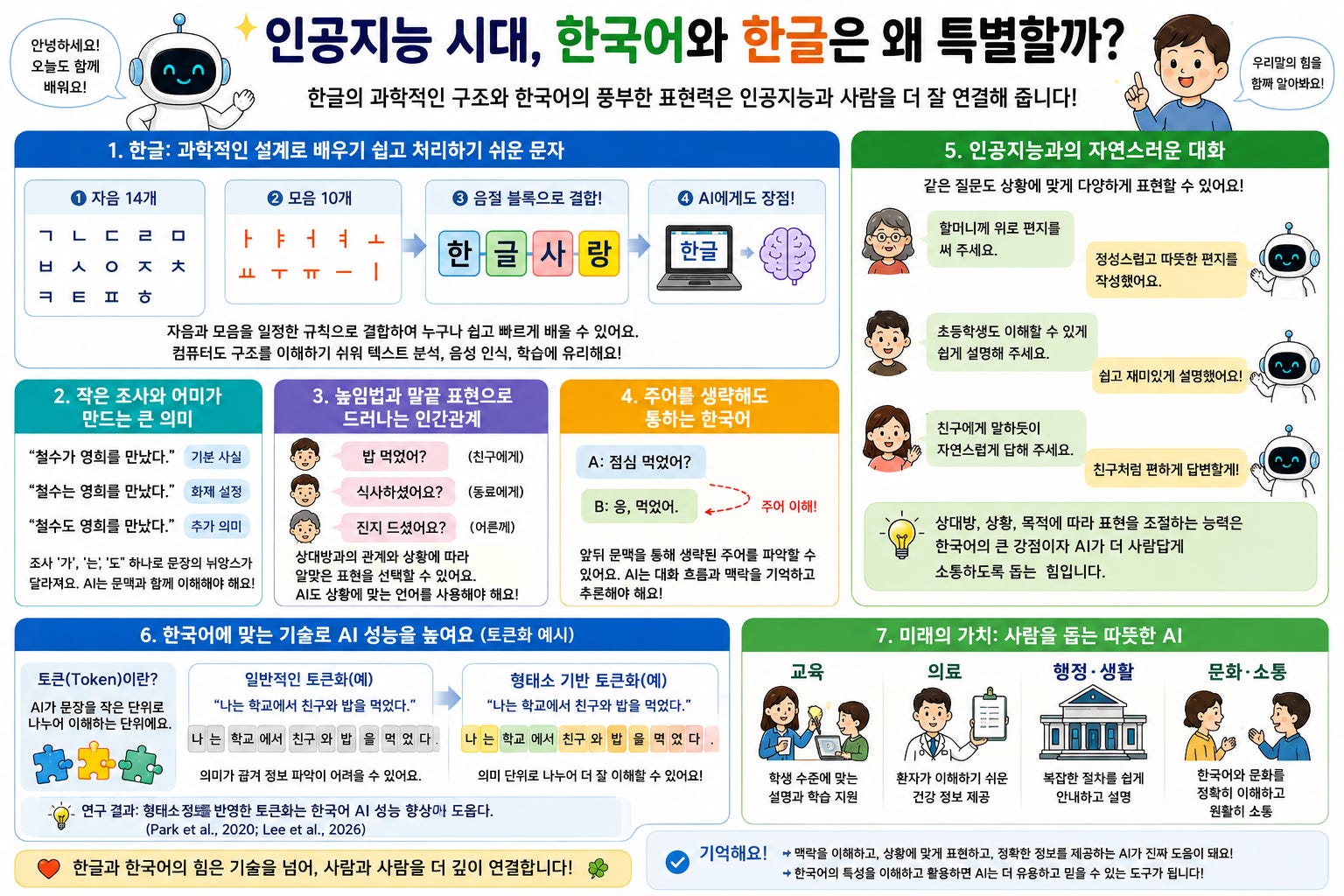
Consider the Korean word 한글 (Hangul).
The syllable 한 consists of the consonants and vowel represented by ㅎ, ㅏ, and ㄴ. The syllable 글 combines ㄱ, ㅡ, and ㄹ.
These elements are arranged into syllable blocks rather than written as a simple horizontal sequence of separate letters. The result is a writing system with a recognizable relationship between individual letters and syllable-level visual organization.
Think of building with LEGO bricks. A relatively small collection of pieces can be assembled into many different structures. Hangul is not literally a LEGO system, but the comparison helps explain how a limited set of basic elements can be systematically combined.
Hangul’s design also reflects relationships between written symbols and speech sounds. Some consonant letters are historically associated with features of the vocal organs involved in producing their sounds.
However, the orthography is more sophisticated than the claim that every written symbol always corresponds to one pronunciation. O’Grady (2024) argues that Hangul combines different spelling principles: consonant representation follows morphophonemic conventions, while vowel representation follows phonetic conventions. Pae (2011) likewise explains why Hangul is best understood through the interaction of alphabetic principles and syllable-oriented representation.
Why does this matter for AI? A writing system’s structure can influence how computers represent and process text. Nevertheless, Hangul’s systematic organization does not automatically guarantee that every AI model will process Korean more accurately or efficiently than English. Model architecture, training data, tokenization, and the task being evaluated all matter.
Hangul gives language technologists an interesting system to study, not a magic shortcut to artificial intelligence.
Small Particles, Big Differences
Consider these three Korean sentences:
철수가 영희를 만났다.
철수는 영희를 만났다.
철수도 영희를 만났다.
All three can be translated into English using some version of “Cheolsu met Younghee,” but their nuances differ. The particle 가 helps mark the grammatical subject. The particle 는 can mark a topic or create a contrast, depending on the context. The particle 도 commonly conveys an additive meaning, similar to “also” or “too.” These small grammatical elements can influence how a sentence should be interpreted.
English also expresses topics, emphasis, and contrast. The difference is not that English lacks these capabilities, but that Korean distributes grammatical and discourse information across particles, endings, word order, and context in distinctive ways.
For AI systems, this creates an important challenge: Understanding a Korean sentence requires more than recognizing the dictionary meanings of its words. A system must also identify grammatical relationships and interpret the sentence within its conversational setting.
Consider another everyday expression:
“밥은 먹었니?”
Literally, this asks whether someone has eaten. Depending on the circumstances, however, it may also function as an expression of concern or affection.
A parent calling a child might be checking on the child’s well-being. A friend might be asking a straightforward question about lunch. A restaurant employee might simply be confirming whether a meal has been served. The words alone do not determine the complete meaning. An effective AI assistant must therefore consider context rather than assuming that every expression has one fixed interpretation.
“먹어,” “먹어요,” and “드시겠어요?”
Korean provides several ways to express the same basic idea while adjusting the level of formality or respect.
A friend might hear: “밥 먹었어?”
A colleague might hear: “식사하셨어요?”
In a more formal or respectful setting, someone might ask: “진지 드셨어요?”
These expressions differ in vocabulary, grammatical form, and social tone. Their appropriateness depends on the relationship between speakers and the situation in which they are used. This feature has practical implications for AI applications.
A hospital assistant should communicate differently with a physician than with a patient who has little medical knowledge. A classroom tutor should adapt its explanations to the learner’s age and experience. A public-service chatbot should be courteous without making official instructions unnecessarily complicated. Korean provides useful linguistic resources for making such adjustments.
But we should distinguish polite language generation from genuine human understanding. An AI system can produce an appropriate honorific ending without experiencing respect, affection, or empathy. Its performance must be judged by whether it communicates accurately, appropriately, and helpfully—not merely by whether its sentences sound polite.
The Mystery of the Missing Subject
Korean conversations often omit subjects or objects when the intended meaning can be recovered from context.
Consider this exchange:
Person A: 점심 먹었어?
Did you eat lunch?
Person B: 응, 먹었어.
Yes, I did.
Person B does not need to repeat “I ate lunch.” The context makes the intended meaning clear.
English also permits ellipsis in conversation, but its grammatical conventions often require subjects in sentences where Korean does not.
Now imagine a longer conversation involving several people. Someone says:
“그 사람이 만나고 싶어해.”
Depending on the preceding discussion, the listener may need to determine who “that person” refers to and whom the person wants to meet. If the conversation contains several possible referents, even a human listener may need clarification.
For AI, this is a problem of discourse understanding and reference resolution. A system must track people, events, and previously established information across multiple sentences.
Korean provides useful examples for studying these problems, although similar challenges occur in many other languages. The lesson is straightforward: Short sentences are not necessarily simple sentences. Sometimes, a short sentence carries information that can be understood only by remembering what happened earlier.
Can AI Process Korean More Efficiently?
Here comes the technical complication.
Many language models process text through units called tokens. A token may represent a word, part of a word, or another text segment, depending on the tokenizer.
Korean presents a particular challenge because grammatical endings and particles attach to stems, producing many related word forms.
Consider the verb 먹다 (to eat):
먹고 — eating and/or then eating, depending on context
먹으면 — if one eats
먹었지만 — although one ate
먹겠습니다 — I will eat, in a formal or polite form
드셨습니다 — an honorific expression indicating that someone ate
These forms share grammatical and lexical relationships, but a computer does not automatically represent them as a human linguist would.
Park et al. (2020) compared tokenization strategies across several Korean natural language processing tasks. Their experiments found that combining morphological segmentation with Byte Pair Encoding performed well on several translation and language-understanding tasks, although Byte Pair Encoding alone worked better on one question-answering benchmark.
More recent work by Lee et al. (2026) proposed a morpheme-based subword tokenization method for Korean language models. The researchers reported improvements on several Korean benchmarks and fewer tokens per input sequence in their experiments.
These findings demonstrate that language-specific design choices can matter. They do not establish that one tokenization strategy is best for every Korean application or that Korean is universally more efficient than English. The practical lesson is that AI systems can benefit from methods designed with the Korean linguistic structure in mind.
A Practical Conversation With AI
The following is an illustrative conversation that readers can try with an AI assistant. The sample response is provided to demonstrate the task, not to claim a controlled experiment or a verbatim output from a particular model.
User: “Explain artificial intelligence to my 75-year-old uncle. Use a familiar everyday example, avoid technical jargon, and mention one important limitation.”
Possible AI response: “Artificial intelligence is a computer system that can perform tasks such as answering questions, recognizing patterns, or helping write documents.
Think of it as a very capable assistant. You might ask it to organize a shopping list, explain a confusing letter, or help plan a trip.
But it is not an all-knowing expert. It can misunderstand a question or provide incorrect information, so important facts should be checked.”
Now try a Korean prompt:
사용자: “인공지능을 컴퓨터를 잘 모르는 75세 어르신에게 설명해 주세요. 일상생활의 예를 하나 들고, 어려운 전문용어는 피하며, 마지막에는 주의할 점을 알려 주세요.”
가능한 AI 답변: “인공지능은 컴퓨터가 사람의 질문에 답하거나, 글을 정리하거나, 필요한 정보를 찾는 일을 도와주는 기술입니다.
예를 들어 여행을 가고 싶을 때 어디에 가면 좋을지 물어보거나, 어려운 안내문을 쉬운 말로 설명해 달라고 부탁할 수 있습니다.
다만 인공지능도 틀린 답을 할 수 있습니다. 건강이나 돈과 관련된 중요한 정보는 반드시 믿을 만한 자료와 전문가를 통해 확인하는 것이 좋습니다.”
Both prompts specify the audience, style, example, and limitation. Both can work well. The important advantage is not that the Korean prompt is inherently more powerful. It is just that users can express their intentions in a language they understand comfortably and precisely.
This is especially valuable when people want to specify subtle preferences, such as a respectful tone, a warm but restrained style, or an explanation suitable for a particular age group. Good prompting is fundamentally an exercise in clear communication.
Language Is More Than Information
Languages also preserve cultural experiences and ways of describing the world.
Korean expressions such as 정 (jeong), 눈치 (nunchi), and 마음이 놓이다 (maeumi noyida, roughly, to feel relieved) can be difficult to translate with a single English word in every context. For example, 눈치 can refer to noticing social cues, sensing an unspoken expectation, or recognizing how a situation is developing. The precise meaning depends on how the word is used. Similarly, 정 can refer to an accumulated sense of affection, attachment, or interpersonal connection. No single English equivalent captures every use.
A capable AI translator should therefore do more than substitute words. It should preserve meaning, tone, and relevant cultural context. This requires high-quality language data and careful evaluation. Literary works, historical documents, contemporary conversations, and regional expressions can all contribute to a richer representation of Korean.
Pae et al. (2025) provide a broad scholarly resource on Hangul, Korean literacy, and text processing. Such research helps establish the linguistic background needed for developing and evaluating language technologies.
Nevertheless, exposure to cultural texts does not mean that an AI system experiences a culture as a human does. The goal is reliable interpretation, not the illusion of human experience.
Bringing AI Closer to Ordinary People
The future value of Korean-language AI extends beyond writing and translation.
In education, it can help students understand difficult concepts. In healthcare, it can help explain medical information in an accessible language. In public administration, it can clarify complicated application procedures.
Consider this formal instruction:
“구비서류를 첨부하여 신청서를 제출하십시오.”
A simpler version might be:
“필요한 서류를 준비해 신청서와 함께 제출하세요.”
The second sentence may be easier for many readers to understand. Yet simplifying language must never mean removing legally required steps or changing the meaning of official instructions. The same principle applies to AI-generated health information, financial explanations, and legal guidance. Fluency is not proof of accuracy.
To serve the public responsibly, Korean-language AI systems need reliable information, appropriate safeguards, careful evaluation, and ways of correcting mistakes. They should also serve people with different educational backgrounds, ages, abilities, and regional language preferences.
The objective is not merely to build an AI that speaks Korean elegantly. It is to build one that helps Korean speakers understand information, make informed decisions, and communicate more effectively.
Conclusion: The Best Language Is One That Helps Us Communicate
Is Korean the most suitable language for the age of artificial intelligence? The answer depends on what we mean by suitable.
Hangul has a systematic structure that combines alphabetic principles with syllable-block organization. Korean uses particles and grammatical endings to express relationships and nuances. Its honorific forms provide ways to adjust language to social situations, while its context-sensitive expressions offer useful examples for studying discourse understanding. These characteristics make Korean an important language for AI research and practical applications.
However, linguistic elegance does not guarantee superior performance on every technical task. Korean AI systems must still address tokenization, contextual ambiguity, data quality, and the reliable representation of cultural meaning. The best way to promote Korean is therefore not to declare victory over English or any other language. It is to understand the Korean characteristics, develop appropriate language technologies, and evaluate the results carefully.
Imagine King Sejong, who oversaw the creation of Hangul, encountering an AI assistant today. We cannot know what he would say. But for this essay, let us imagine that after watching the machine write a polished letter, he asks a simple question: “Does the letter actually help the person who receives it?” That question remains more important than how quickly the machine produces its sentences.
AI can generate words, but humans remain responsible for deciding what those words should accomplish, whose needs they should serve, and how their accuracy should be judged.
The language Korean’s greatest promise in the age of AI is not that it will defeat other languages. It can help people express their thoughts, feelings, knowledge, and cultural experiences while making intelligent technology more accessible and useful.
Hangul provides a distinctive writing system through which that promise can be explored. The future of Korean-language AI will depend on how thoughtfully we develop and use it.
References
Lee, D., Park, J., Cho, K., & Lee, J. S. (2026). Morpheme matters: Morpheme-based subword tokenization for Korean language models. In Proceedings of the 19th Conference of the European Chapter of the Association for Computational Linguistics (Volume 2: Short Papers) (pp. 297–306). Association for Computational Linguistics. https://doi.org/10.18653/v1/2026.eacl-short.22
O’Grady, W. (2024). Hangul—A hybrid orthography. Korean Linguistics, 20(2), 113–126. https://doi.org/10.1075/kl.00009.ogr
Pae, H. K. (2011). Is Korean a syllabic alphabet or an alphabetic syllabary? Writing Systems Research, 3(2), 103–115. https://doi.org/10.1093/wsr/wsr002
Pae, H. K., Winskel, H., & Kim, S. Y. (Eds.). (2025). Handbook on the Korean language and literacy: Insights into Hangul and text processing. Springer. https://doi.org/10.1007/978-3-031-88087-2
Park, K., Lee, J., Jang, S., & Jung, D. (2020). An empirical study of tokenization strategies for various Korean NLP tasks. In Proceedings of the 1st Conference of the Asia-Pacific Chapter of the Association for Computational Linguistics and the 10th International Joint Conference on Natural Language Processing (pp. 133–142). Association for Computational Linguistics. https://doi.org/10.18653/v1/2020.aacl-main.17
인공지능 시대의 한국어는 왜 특별한가?
한글의 과학성과 인간 소통의 무한한 가능성
초록
인공지능은 이제 글을 쓰고, 문서를 번역하며, 어려운 과학 지식을 설명하고, 사람과 대화한다. 이러한 변화 속에서 우리가 매일 사용하는 한국어는 어떤 특별한 가능성을 지니고 있을까? 한국어가 모든 인공지능 작업에서 다른 언어보다 우수하다고 단정할 수는 없다. 그러나 한글의 체계적인 문자 구조, 한국어의 조사와 어미, 높임법, 문맥에 따른 의미 표현은 인공지능 기술을 연구하고 발전시키는 데 중요한 가능성을 제공한다. 한글은 알파벳의 원리와 음절 단위의 문자 배열을 결합한 독특한 문자 체계이며, 한국어는 문법적 관계와 사회적 맥락을 다양한 언어적 수단으로 표현한다. 이러한 특징은 자연어 처리에 기회를 제공하는 동시에 해결해야 할 기술적 과제도 만들어 낸다. 본 에세이는 언어학 및 한국어 자연어 처리 연구를 바탕으로 한글과 한국어의 특징을 설명하고, 실제로 활용할 수 있는 인공지능 대화 사례를 통해 그 가능성을 살펴본다. 또한 토큰화, 문맥 해석, 학습 자료의 품질 등 한국어 기반 인공지능이 해결해야 할 과제도 논의한다. 핵심 주장은 분명하다. 한국어의 가치는 다른 언어를 이기는 데 있는 것이 아니라, 인공지능이 인간과 더 정확하고 풍부하며 문화적으로 적절하게 소통하도록 돕는 데 있다.
핵심어: 한글, 한국어, 인공지능, 생성형 AI, 자연어 처리, 프롬트 엔지니어링, 인간–인공지능 상호작용
컴퓨터가 한국어를 배운다면?
어느 날 인공지능에게 다음과 같이 부탁했다고 상상해 보자.
“할머니께서 편찮으신데, 위로의 편지를 써 주세요.”
인공지능은 정중하고 다정한 편지를 작성한다. 그런데 막상 읽어 보니 어딘가 어색하다. 문법은 정확하고 표현도 공손하지만, 마치 주차 규정이 변경되었다고 안내하는 관공서의 공문처럼 느껴진다.
그래서 다시 부탁한다.
“조금 더 따뜻하고 개인적인 편지로 고쳐 주세요. 사랑하는 사람에게 조용히 이야기하듯 쉽게 써 주세요. 너무 과장하지는 말고요.”
이번에는 훨씬 자연스러운 편지가 나올 수 있다. 무엇이 달라졌을까? 반드시 언어나 핵심 내용이 바뀐 것은 아니다. 독자, 목적, 말투, 감정적인 상황을 좀 더 명확하게 설명했을 뿐이다.
이 간단한 사례는 생성형 인공지능을 잘 활용하기 위한 중요한 원칙을 보여 준다. 인공지능이 좋은 답을 만들려면 사용자가 원하는 바를 명확하게 전달하는 것이 중요하다.
한국어는 이러한 상호작용을 연구하기에 특히 흥미로운 사례를 제공한다. 다양한 조사와 어미, 높임법, 문맥에 따른 표현을 활용해 상대방과의 관계와 말하는 사람의 태도를 여러 방식으로 나타낼 수 있기 때문이다. 그렇다고 한국어가 영어를 비롯한 다른 언어보다 자동으로 우수한 것은 아니다. 다만 한국어는 인공지능이 인간의 언어와 의사소통을 어떻게 처리하고 조절해야 하는지 살펴볼 수 있는 풍부한 연구 대상이다. 그 가능성을 이해하려면 먼저 한국어를 기록하는 문자, 한글부터 살펴볼 필요가 있다.
한글은 작은 레고 블록과 같다
‘한글’이라는 단어를 살펴보자. ‘한’은 ㅎ, ㅏ, ㄴ이라는 자음과 모음이 결합해 만들어진 음절이다. ‘글’도 ㄱ, ㅡ, ㄹ이 결합한 음절이다. 한글은 자음과 모음을 단순히 가로로 늘어놓는 대신, 일정한 규칙에 따라 음절 단위로 배열한다. 그 결과 각각의 글자는 개별 자모의 구성과 음절의 형태를 함께 보여 준다.
레고 블록을 떠올리면 이해하기 쉽다. 비교적 적은 종류의 블록을 일정한 규칙에 따라 조립하면 다양한 구조물을 만들 수 있다. 한글 역시 기본적인 문자 요소를 체계적으로 결합해 수많은 음절을 표현한다. 물론 한글과 레고가 완전히 같은 원리로 작동한다는 뜻은 아니다. 이 비유는 기본 요소의 결합과 체계적인 구성을 이해하기 위한 것이다.
한글의 특징은 문자와 소리의 관계에서도 나타난다. 자음 글자 가운데 일부는 소리를 낼 때 사용되는 발음 기관의 모양과 관련이 있다. 그러나 한글의 표기 체계가 모든 경우에 발음과 일대일로 대응하는 것은 아니다.
O’Grady(2024)는 한글을 자음과 모음에 서로 다른 표기 원리가 적용되는 혼합적 문자 체계로 설명한다. Pae(2011) 역시 한글을 이해할 때 알파벳의 원리와 음절 단위의 시각적 배열을 함께 고려해야 한다고 논의한다.
그렇다면 이러한 구조가 인공지능에 어떤 의미를 가질까? 컴퓨터가 글자를 표현하고 처리하는 방식은 언어 모델의 성능에 영향을 줄 수 있다. 그러나 한글의 구조가 체계적이라는 사실만으로 모든 인공지능이 한국어를 영어보다 정확하거나 효율적으로 처리한다고 결론 내릴 수는 없다. 학습 자료, 모델 구조, 토큰화 방식, 수행 과제 등 여러 요소가 함께 작용하기 때문이다. 한글의 과학성은 인공지능 연구에 활용할 수 있는 중요한 자산이다. 다만 그것은 모든 기술적 문제를 한꺼번에 해결하는 마법의 열쇠는 아니다.
‘철수가’, ‘철수는’, ‘철수도’의 작은 차이
이번에는 다음 세 문장을 살펴보자.
“철수가 영희를 만났다.”
“철수는 영희를 만났다.”
“철수도 영희를 만났다.”
세 문장은 모두 철수가 영희를 만났다는 상황과 관련되어 있지만, 전달하는 의미와 강조점에는 차이가 있다. ‘가’는 주어를 표시하는 역할을 한다. ‘는’은 문맥에 따라 화제를 나타내거나 대조의 의미를 전달할 수 있다. ‘도’는 일반적으로 ‘역시’ 또는 ‘또한’과 같은 추가의 의미를 나타낸다. 이처럼 짧은 조사 하나가 문장의 해석에 영향을 줄 수 있다.
물론 영어에도 화제와 강조, 대조를 표현하는 방법이 있다. 중요한 차이는 한국어가 조사와 어미, 어순, 문맥을 결합해 이러한 정보를 표현하는 독특한 방식을 지닌다는 점이다. 따라서 인공지능이 한국어를 제대로 이해하려면 단어의 사전적 의미만 파악해서는 부족하다. 조사와 어미가 문장에서 어떤 역할을 하는지, 문장 전체가 어떤 맥락에서 사용되었는지도 고려해야 한다.
다음 표현을 보자.
“밥은 먹었니?”
이 질문은 문자 그대로는 식사 여부를 묻는다. 그러나 상황에 따라 상대방을 걱정하거나 안부를 확인하는 표현으로 사용될 수도 있다. 부모가 자녀에게 전화하면서 이 말을 했다면 단순히 식사 여부뿐 아니라 건강과 생활에 대한 관심을 전달할 수 있다. 친구가 점심시간에 물었다면 실제로 식사를 했는지 확인하는 질문일 수 있다.
같은 문장이라도 누가 누구에게, 어떤 상황에서 말했는지에 따라 의미가 달라질 수 있는 것이다. 인공지능이 이러한 차이를 잘 처리하려면 문장 자체뿐 아니라 대화의 문맥도 분석해야 한다. 한국어의 복잡성은 인공지능에 어려움을 주지만, 동시에 언어와 인간의 관계를 연구할 수 있는 흥미로운 기회를 제공한다.
‘먹어’, ‘먹어요’, ‘드시겠어요?’—말끝에 담긴 관계
한국어의 또 다른 특징은 높임법과 다양한 종결 표현이다.
친구에게는 이렇게 말할 수 있다: “밥 먹었어?”
직장 동료에게는 다음과 같이 말할 수 있다: “식사하셨어요?”
더 정중한 상황에서는 다음과 같은 표현을 사용할 수 있다: “진지 드셨어요?”
세 표현은 모두 식사와 관련된 질문이지만, 어휘와 문법 형태, 사회적 어감이 서로 다르다. 어떤 표현이 자연스러운지는 상대방과의 관계와 상황에 따라 달라진다. 이러한 특징은 인공지능의 활용에서도 중요하다.
병원에서 환자에게 건강 정보를 설명하는 인공지능은 의료진에게 전문적인 내용을 전달하는 시스템과 표현 방식이 달라야 한다. 교육용 인공지능은 학생의 나이와 이해 수준에 맞추어 설명해야 한다. 공공기관의 상담 시스템은 정중하면서도 이해하기 쉬운 표현을 사용해야 한다. 한국어는 이러한 표현 조절에 활용할 수 있는 다양한 문법적·어휘적 수단을 제공한다.
하지만 공손한 문장을 생성하는 능력과 상대방의 감정을 실제로 이해하는 능력은 서로 다르다. 인공지능이 적절한 높임말을 사용한다고 해서 인간과 같은 존중이나 공감을 경험한다고 볼 수는 없다. 중요한 것은 인공지능이 상황에 맞는 표현을 선택하고, 정보를 정확하고 이해하기 쉽게 전달하며, 사용자에게 도움이 되는 방식으로 소통하는가 하는 점이다.
주어가 없어도 통하는 한국어
한국어 대화에서는 문맥상 분명한 주어나 목적어를 생략하는 경우가 많다.
다음과 같은 대화를 생각해 보자.
A: 점심 먹었어?
B: 응, 먹었어.
B는 “나는 점심을 먹었어”라고 완전한 문장을 반복하지 않는다. 앞선 질문을 통해 필요한 정보가 이미 주어졌기 때문이다.
다음 대화도 자연스럽다.
A: 어디 가?
B: 학교에.
A: 언제 와?
B: 저녁에.
문장만 따로 떼어 놓으면 생략된 정보가 많지만, 대화의 흐름을 따라가면 의미를 이해할 수 있다.
영어에서도 대화에서 생략이 일어나지만, 문장에 주어를 명시해야 하는 경우가 한국어보다 많다.
이러한 특징은 인공지능에 중요한 과제를 제시한다.
예를 들어 여러 사람이 등장하는 대화에서 다음과 같은 문장이 나왔다고 하자.
“그 사람이 만나고 싶어해.”
이 문장의 의미를 정확하게 이해하려면 앞서 등장한 인물 가운데 누가 ‘그 사람’인지, 그 사람이 누구를 만나고 싶어 하는지 파악해야 할 수 있다.
대화에 여러 인물이 등장하거나 정보가 충분하지 않다면 사람도 혼동할 수 있다. 인공지능 역시 앞선 대화의 정보를 제대로 추적하지 못하면 잘못된 해석을 내놓을 수 있다.
따라서 한국어를 정확하게 처리하려면 개별 문장의 문법뿐 아니라 대화의 흐름, 등장인물, 이미 주어진 정보까지 고려해야 한다.
이것은 한국어만의 문제는 아니다. 여러 언어가 생략과 문맥을 활용한다. 다만 한국어의 이러한 특성은 인공지능의 문맥 이해 능력을 연구하는 데 유용한 사례를 제공한다.
인공지능은 한국어를 효율적으로 처리할 수 있을까?
여기에는 흥미로운 기술적 문제가 있다.
많은 언어 모델은 입력된 문장을 토큰(token)이라는 단위로 나누어 처리한다. 토큰은 단어 전체일 수도 있고, 단어의 일부나 문자 조각일 수도 있다.
한국어에서는 어근에 여러 조사와 어미가 결합해 다양한 형태의 단어를 만든다.
예를 들어 ‘먹다’는 다음과 같이 바뀔 수 있다.
먹고
먹으면
먹었지만
먹겠습니다
드셨습니다
이 표현들은 서로 관련된 의미와 문법적 정보를 지니지만, 컴퓨터가 사람처럼 그 관계를 자동으로 이해하는 것은 아니다. 문장을 어떤 단위로 나누고 학습하느냐에 따라 관련 정보를 표현하는 방식이 달라질 수 있다.
Park et al.(2020)은 여러 한국어 자연어 처리 과제에서 다양한 토큰화 전략을 비교했다. 연구 결과, 형태소 분석과 Byte Pair Encoding을 결합한 방법은 여러 번역 및 언어 이해 과제에서 좋은 성능을 보였다. 다만 질의응답 과제에서는 Byte Pair Encoding만 사용하는 방법이 더 효과적이었다.
Lee et al.(2026)은 한국어의 형태소 구조를 고려한 새로운 하위 단어 토큰화 방법을 제안했다. 연구진은 여러 한국어 벤치마크에서 성능 향상을 보고했으며, 입력 문장당 토큰 수를 줄이는 결과도 제시했다.
이러한 연구는 한국어의 언어적 특성을 고려한 기술 설계가 중요할 수 있음을 보여 준다.
그러나 특정 연구에서 얻은 결과가 모든 모델과 과제에 그대로 적용되는 것은 아니다. 어떤 토큰화 방식이 가장 좋은지는 모델의 구조, 데이터, 평가 과제에 따라 달라질 수 있다.
따라서 중요한 것은 한국어가 기술적으로 무조건 유리하거나 불리하다고 단정하는 것이 아니다. 한국어의 구조를 고려해 인공지능을 설계하고, 실제 실험을 통해 성능을 검증하는 것이다.
인공지능과 실제로 대화해 보기
이제 독자가 직접 활용할 수 있는 예를 살펴보자.
아래는 특정 모델에서 통제된 실험을 수행해 얻은 결과를 인용한 것이 아니라, 실제 인공지능 서비스에서 시도할 수 있는 질문과 그에 대한 가능한 응답을 보여 주는 예시다.
사용자: “인공지능을 컴퓨터를 잘 모르는 75세 어르신에게 설명해 주세요. 일상생활의 예를 하나 들고, 어려운 전문용어는 피하며, 마지막에는 주의할 점을 알려 주세요.”
가능한 인공지능 답변: “인공지능은 컴퓨터가 사람의 질문에 답하거나, 글을 정리하거나, 필요한 정보를 찾는 일을 도와주는 기술입니다.
예를 들어 여행을 가고 싶을 때 어디에 가면 좋을지 물어보거나, 어려운 안내문을 쉬운 말로 설명해 달라고 부탁할 수 있습니다.
다만 인공지능도 틀린 답을 할 수 있습니다. 건강이나 돈과 관련된 중요한 정보는 믿을 만한 자료와 전문가를 통해 확인하는 것이 좋습니다.”
이번에는 영어가 아닌 한국어의 장점을 살려, 자신이 원하는 설명 방식을 더욱 구체적으로 지정해 보자.
사용자: “인공지능을 컴퓨터를 잘 모르는 어르신에게 설명해 주세요. 옆집 이웃에게 차근차근 설명하듯 친절하게 말하고, 너무 어린아이에게 이야기하는 듯한 말투는 피하세요. 일상생활의 예를 들고, 마지막에는 주의할 점을 알려 주세요.”
이 요청에는 대상 독자뿐 아니라 친절함의 정도와 피하고 싶은 말투까지 포함되어 있다. 이처럼 좋은 프롬트는 단순히 질문을 던지는 것을 넘어 인공지능이 어떤 방식으로 답해야 하는지 구체적으로 알려 준다. 물론 이러한 요청은 영어로도 충분히 표현할 수 있다. 한국어만의 독점적인 능력은 아니다.
그러나 자신이 가장 편안하게 생각하고 표현할 수 있는 언어로 질문하면, 다른 언어로 먼저 생각한 뒤 번역해야 하는 부담을 줄일 수 있다. 특히 말투와 관계, 정서적 분위기를 세밀하게 설명할 때 모국어는 유용한 도구가 된다.
좋은 프롬프트의 핵심은 어려운 단어를 사용하는 데 있지 않다. 목적, 문맥, 대상, 원하는 결과를 명확하게 전달하는 데 있다.
언어는 정보뿐 아니라 문화를 담는다
언어는 단순히 정보를 전달하는 도구가 아니다. 한 사회의 경험과 문화, 인간관계를 표현하는 수단이기도 하다.
한국어에는 ‘정(情)’, ‘눈치’, ‘마음이 놓이다’처럼 다른 언어로 한 단어에 정확하게 대응시키기 어려운 표현이 있다. 예를 들어 ‘눈치’는 상황에 따라 상대방의 의도를 알아차리는 능력, 말로 표현되지 않은 기대를 감지하는 능력, 주변의 분위기를 파악하는 능력 등을 의미할 수 있다. ‘정’ 역시 문맥에 따라 애정, 친밀감, 오랜 관계에서 쌓인 유대감 등을 나타낼 수 있다. 따라서 이러한 표현을 다른 언어로 번역할 때는 단어만 바꾸는 것으로 충분하지 않을 수 있다. 사용 상황과 문화적 배경을 함께 고려해야 의미가 제대로 전달되는 경우가 있다.
한국어를 잘 처리하는 인공지능을 개발하려면 문법뿐 아니라 다양한 문맥에서 사용되는 언어 자료도 필요하다. 문학 작품, 역사 문헌, 일상 대화, 지역별 표현, 세대에 따른 언어 사용은 모두 한국어의 다양한 모습을 보여 준다. 이러한 자료는 인공지능이 한국어를 더 정확하게 처리하도록 돕는 데 활용될 수 있다.
Pae et al.(2025)은 한글과 한국어 문해력, 문자 및 텍스트 처리에 관한 폭넓은 연구를 정리한 학술 편저를 제공한다. 이러한 연구는 한국어의 구조와 읽기 과정을 이해하고 언어 기술을 발전시키는 데 유용한 학문적 기반이 된다. 다만 문화적 자료를 많이 학습했다고 해서 인공지능이 인간과 같은 방식으로 문화를 경험하거나 이해한다고 볼 수는 없다. 목표는 인간의 경험을 흉내 내는 데 있는 것이 아니라, 언어의 의미를 정확하고 적절하게 해석하는 데 있다.
인공지능을 더 많은 사람에게 가까이
한국어 기반 인공지능의 가능성은 글쓰기와 번역에만 머물지 않는다. 교육에서는 학생의 이해 수준에 맞는 설명을 제공할 수 있다. 의료 분야에서는 환자가 이해하기 쉬운 건강 정보를 작성하는 데 도움을 줄 수 있다. 공공기관에서는 복잡한 행정 절차를 일반인이 이해할 수 있는 표현으로 바꿀 수 있다.
다음과 같은 안내문을 생각해 보자: “구비서류를 첨부하여 신청서를 제출하십시오.” 이를 다음과 같이 바꿀 수 있다: “필요한 서류를 준비해 신청서와 함께 제출하세요.” 두 문장은 핵심 의미가 비슷하지만, 두 번째 문장이 일부 독자에게 더 친숙하게 느껴질 수 있다.
물론 쉬운 표현을 사용하더라도 필수 절차나 법적 요건을 빠뜨려서는 안 된다. 이해하기 쉬운 설명과 정확한 정보는 함께 제공되어야 한다. 건강, 금융, 법률과 관련된 정보도 마찬가지다. 인공지능이 유창한 한국어로 답한다고 해서 그 내용이 반드시 정확한 것은 아니다. 한국어 기반 인공지능이 사회에 실질적으로 기여하려면 신뢰할 수 있는 자료, 적절한 안전장치, 정확성을 평가하는 방법, 잘못된 답을 수정할 수 있는 절차가 필요하다. 또한 다양한 연령, 교육 수준, 장애, 지역적 언어 사용을 고려해야 한다.
목표는 단순히 한국어를 유창하게 구사하는 인공지능을 만드는 것이 아니다. 사람들이 정보를 더 쉽게 이해하고, 합리적인 결정을 내리며, 서로 더 효과적으로 소통하도록 돕는 인공지능을 만드는 것이다.
결론: 가장 좋은 언어는 인간을 잘 표현하는 언어다
그렇다면 한국어는 인공지능 시대에 가장 적합한 언어일까? 그 답은 ‘적합하다’는 말을 어떤 의미로 사용하는지에 달려 있다.
한글은 알파벳의 원리와 음절 단위의 배열을 결합한 체계적인 문자 구조를 지닌다. 한국어는 조사와 어미를 활용해 문법적 관계와 의미를 표현하고, 높임법을 통해 사회적 상황에 맞는 언어를 선택할 수 있다. 또한 문맥에 따라 생략된 정보를 이해하는 능력은 인공지능의 대화 처리와 문맥 해석을 연구하는 데 흥미로운 사례를 제공한다. 이러한 특징은 한국어 기반 인공지능을 발전시키는 데 중요한 가능성을 제공한다.
그러나 언어의 아름다움이나 문자 체계의 과학성이 모든 기술적 과제에서 우수한 성능을 보장하는 것은 아니다. 한국어 인공지능은 토큰화, 문맥의 모호성, 학습 자료의 품질, 문화적 의미의 정확한 표현 등 여러 문제를 해결해야 한다.
따라서 한국어의 미래를 낙관하는 가장 좋은 방법은 영어를 비롯한 다른 언어보다 우수하다고 선언하는 것이 아니다. 한국어의 특성을 정확히 이해하고, 그에 적합한 인공지능 기술을 개발하며, 실제 사용 환경에서 결과를 검증하는 것이다.
한글을 창제한 세종대왕이 오늘날의 인공지능을 보았다면 어떤 말씀을 하셨을까? 물론 우리가 그분의 실제 반응을 알 수는 없다. 하지만 이 글을 위해 다음과 같은 장면을 상상해 볼 수는 있다. 세종대왕께서 인공지능이 유창한 편지를 작성하는 모습을 지켜보신 뒤 이렇게 물으신다. “그 편지가 받는 사람에게 정말 도움이 되느냐?” 이 질문은 기계가 얼마나 빨리 글을 쓰는가보다 훨씬 중요하다. 인공지능은 문장을 만들 수 있다. 그러나 그 문장으로 무엇을 전달하고, 누구를 도우며, 어떤 세상을 만들 것인지는 인간이 결정해야 한다.
한국어가 인공지능 시대에 지닐 수 있는 가장 큰 가치는 다른 언어를 이기는 데 있지 않다. 우리의 생각과 감정, 지식과 문화적 경험을 풍부하게 표현하고, 인공지능을 더 많은 사람에게 유익한 도구로 발전시키는 데 있다.
한글은 이러한 가능성을 탐구할 수 있는 독특하고 가치 있는 문자 체계다. 그리고 한국어 기반 인공지능의 미래는 우리가 그 가능성을 얼마나 창의적이고 책임감 있게 활용하느냐에 달려 있다.
참고문헌
Lee, D., Park, J., Cho, K., & Lee, J. S. (2026). Morpheme matters: Morpheme-based subword tokenization for Korean language models. In Proceedings of the 19th Conference of the European Chapter of the Association for Computational Linguistics (Volume 2: Short Papers) (pp. 297–306). Association for Computational Linguistics. https://doi.org/10.18653/v1/2026.eacl-short.22
O’Grady, W. (2024). Hangul—A hybrid orthography. Korean Linguistics, 20(2), 113–126. https://doi.org/10.1075/kl.00009.ogr
Pae, H. K. (2011). Is Korean a syllabic alphabet or an alphabetic syllabary? Writing Systems Research, 3(2), 103–115. https://doi.org/10.1093/wsr/wsr002
Pae, H. K., Winskel, H., & Kim, S. Y. (Eds.). (2025). Handbook on the Korean language and literacy: Insights into Hangul and text processing. Springer. https://doi.org/10.1007/978-3-031-88087-2
Park, K., Lee, J., Jang, S., & Jung, D. (2020). An empirical study of tokenization strategies for various Korean NLP tasks. In Proceedings of the 1st Conference of the Asia-Pacific Chapter of the Association for Computational Linguistics and the 10th International Joint Conference on Natural Language Processing (pp. 133–142). Association for Computational Linguistics. https://doi.org/10.18653/v1/2020.aacl-main.17
About the Author

Prof. Dr. Young Choi (Editor-in-Chief) — Regent University
Full list of his K-GSP columns
Full list of his Books at Amazon.com
Young B. Choi is a Professor in the Department of Engineering & Computer Science at Regent University. He published 38 books with ‘Selected Readings in Cybersecurity’ (2018) (about 800 copies archived globally at university/college libraries around the world) and ‘Cybersecurity Applications and Artificial Intelligence’ (2023) available in seven major world languages. He proposed the world’s first global and universal telecommunications “Service Order Handling (SOH)” Model (T-SOH Model) (1995) with Dr. Adrian Tang. With this innovative research work, he received the IEEE NOMS ’96 Best Paper Award and became the first recipient of the Outstanding Contribution Award of the TeleManagement Forum in 1998. His research areas include Natural Language Processing-focused AI, AI-applied cybersecurity, network and telecom service management, and Korean studies on Gani Choi Rip’s Jeonggwan (靜觀: Quiet Contemplation) philosophy and Shilhak ( 實學: Practical Learning).
Suggested Citation
Choi, Y. B. (2026). Korean in the Age of Artificial Intelligence: Hangul, Human Communication, and the Promise of a Language-Rich Future. K-GSP Forum.
© K-Global Scholars and Professionals Forum. All rights reserved. 2026. Content published in the K-GSP Forum may not be reproduced, distributed, or transmitted in any form without prior written permission from the K-GSP Forum, except for brief quotations with full attribution.