
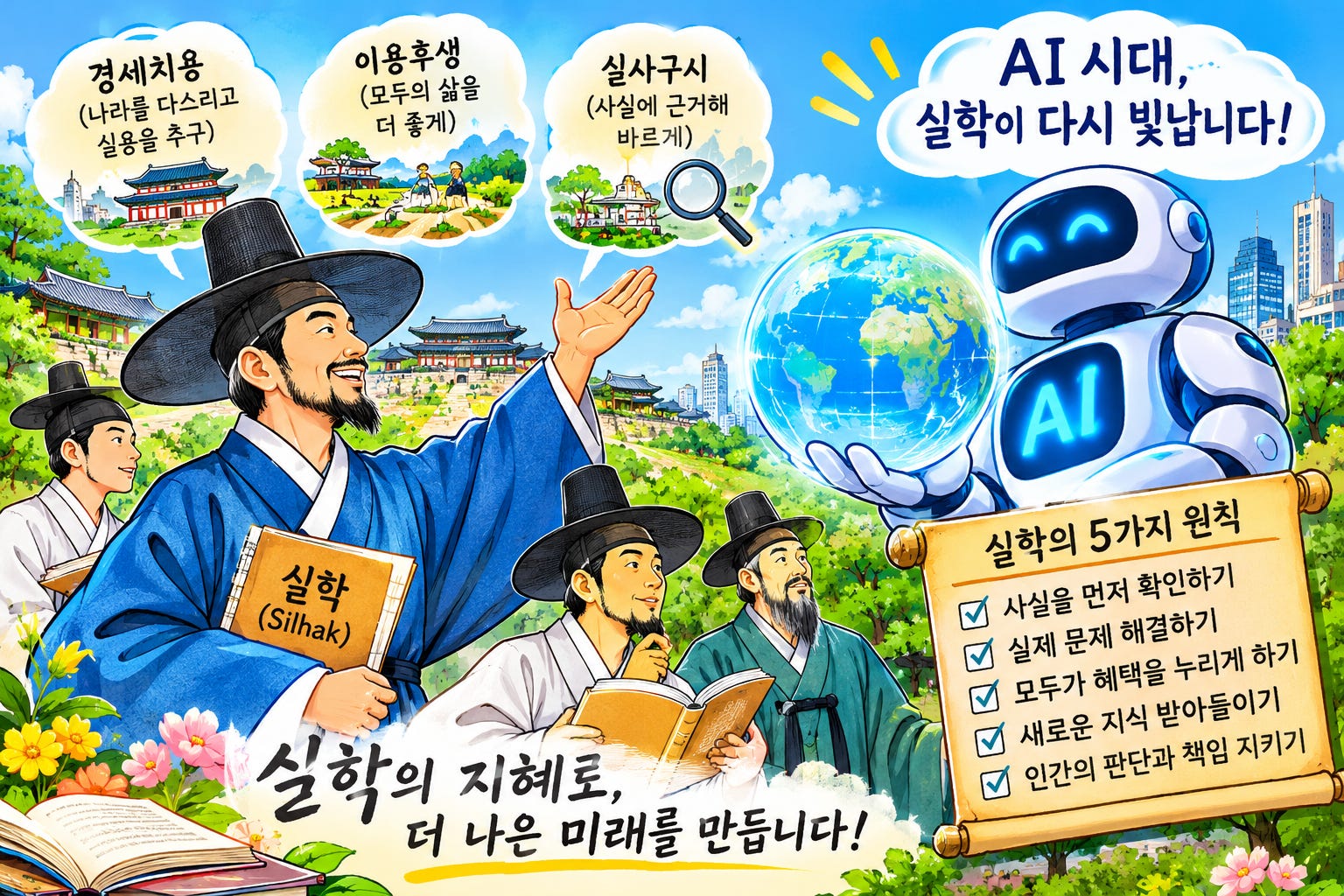
Image credit: Illustration generated with OpenAI’s ChatGPT image-generation tool with the author’s idea, 2026
Rediscovering Korean Silhak Thought in the Age of Artificial Intelligence
From Practical Learning to Human-Centered Wisdom
Abstract
Artificial intelligence (AI) is transforming how humanity generates, accesses, and applies knowledge. However, the growing capabilities of AI raise an important question: Does having more knowledge necessarily make human beings wiser? This essay revisits Silhak (實學), or Practical Learning, a significant intellectual tradition of late Joseon Korea, to explore its relevance to contemporary AI development and society. Drawing on the principles of Silsagusi (seeking truth through facts and evidence), Gyeongse Chiyong (applying knowledge to practical social and institutional problems), and Iyong Husaeng (improving people’s lives through useful technologies and institutions), the essay examines how traditional Korean intellectual values can inform responsible AI development and application. It also considers the contributions of influential Silhak scholars, including Yu Hyeongwon, Yi Ik, Park Jiwon, and Jeong Yakyong, while acknowledging modern scholarly debates concerning the historical definition and development of Silhak. By connecting Korean intellectual heritage with contemporary discussions of AI ethics, social responsibility, and human-centered innovation, this essay proposes five principles for the AI era: factual verification, practical problem-solving, inclusive technological benefits, open-minded learning, and human accountability. Ultimately, it argues that technological progress should be measured not simply by the amount of knowledge machines can generate but by how effectively technology contributes to human dignity, social well-being, and collective wisdom.
Keywords: Artificial Intelligence; Korean Silhak; Practical Learning; Silsagusi; Gyeongse Chiyong; Iyong Husaeng; AI Ethics; Human-Centered AI; Korean Intellectual History; Human Wisdom
What Are We Creating Artificial Intelligence For?
Artificial intelligence (AI) can now write essays, create paintings, compose music, and analyze complex problems. Tasks once considered uniquely human are increasingly being performed by machines. Access to knowledge and information has also become remarkably easy. Yet one important question remains:
As machines become more knowledgeable, are human beings necessarily becoming wiser?
AI can process enormous amounts of information, but it cannot independently assume responsibility for determining what truly matters, which decisions benefit society, or what constitutes a meaningful human life. As technology advances, human judgment and ethical responsibility become even more important.
Interestingly, when considering these challenges, we can discover valuable insights in the intellectual traditions of Korea’s Joseon Dynasty. One particularly relevant tradition is Silhak (實學), or Practical Learning, which developed during the late Joseon period.
Silhak was more than an academic movement of the past. It represented efforts by various scholars to examine reality, reconsider established assumptions, and apply knowledge to improve society. In contemporary terms, Silhak can be understood as an intellectual approach that connects knowledge with practical problem-solving and human well-being.
This is why revisiting Silhak is meaningful in the age of AI. Rather than asking only what technology can accomplish, we must also ask what it should accomplish, whom it should serve, and how it should be used.
What Did Silhak Seek to Accomplish?
Silhak developed during a period of significant intellectual, political, and economic change in Korea, particularly from the seventeenth through the nineteenth centuries. Korean society faced political conflicts, economic difficulties, and limitations imposed by its traditional social hierarchy. Some intellectuals recognized that abstract academic debates alone could not adequately address the challenges facing society.
They therefore turned their attention to practical issues involving agriculture, economics, science, technology, education, and public administration.
Three concepts help explain important dimensions of the Silhak tradition.
Gyeongse Chiyong (經世致用) emphasizes applying knowledge to governing the nation, improving institutions, and addressing real-world problems.
Iyong Husaeng (利用厚生) emphasizes developing technology and institutions to make people’s lives more convenient, productive, and prosperous.
Silsagusi (實事求是) emphasizes discovering truth through facts and evidence rather than relying blindly on assumptions, authority, or unsupported arguments.
These concepts sound remarkably contemporary. Collecting data, analyzing problems, validating solutions, and applying knowledge for the benefit of society are also essential activities in the age of artificial intelligence.
However, understanding Silhak requires historical perspective. It should not be treated as a single, clearly defined intellectual school whose members shared identical beliefs. The meaning and historical boundaries of Silhak have themselves been subjects of modern scholarly investigation.
Noh (2019) examined how the historical understanding of Silhak developed through Korean history textbooks published during the twentieth century. By reviewing 30 textbooks, beginning with Hyeon Chae’s Dongguk Saryak (1906), Noh demonstrated that the interpretation of Silhak changed over time. Different generations of historians emphasized Korean Learning, Western Learning, and Qing Learning in explaining the intellectual development of late Joseon Korea.
Noh (2023) further examined how modern historical knowledge about Silhak was constructed. His research identified several important factors, including the relationship between the Way and practical instruments in Confucian scholarship, the concepts of Gyeongse Chiyong and Iyong Husaeng, growing interest in Jeong Yakyong’s scholarship, and the increasing recognition of practicality as an intellectual value.
Baek (2024) examined major debates in Silhak scholarship during the late twentieth century. She discussed different scholarly interpretations, including approaches emphasizing critical social reform, the Ganghwa School, the intellectual activities of the capital region, and the Northern Learning School. Importantly, Baek questioned whether Silhak should be narrowly defined as practical statecraft, arguing that research should also consider classical studies, ritual studies, and the study of the mind.
Gim (2024) placed Korean Silhak within a broader East Asian intellectual context. His research discussed the emergence of Korean Silhak, Chinese Qixue (氣學), and Japanese Kogaku (古學) as intellectual developments emphasizing practical learning and reform. This perspective helps us understand that the search for more practical forms of knowledge was part of a wider transformation in East Asian intellectual history.
Taken together, these studies demonstrate that Silhak is both an important historical tradition and a subject of continuing scholarly interpretation. This distinction matters because we should appreciate the contributions of historical scholars without assuming that every modern interpretation of Silhak represents their original intentions.
Korean Intellectuals Who Sought to Transform Society
Several influential Korean scholars illustrate the practical and reform-oriented dimensions of this intellectual tradition.
Yu Hyeongwon (柳馨遠, 1622–1673)
Yu Hyeongwon is regarded as an important pioneer of Silhak. In his major work, Bangye Surok, he proposed reforms involving land distribution, government administration, and education. His central concern was not simply accumulating academic knowledge but discovering how institutions could be improved to serve society more effectively.
Yi Ik (李瀷, 1681–1763)
Yi Ik explored agriculture, economics, politics, natural sciences, and social institutions in works such as Seongho Saseol. He regarded everyday observations and practical problems as legitimate subjects of serious intellectual inquiry. His approach offers an interesting connection to contemporary interdisciplinary research.
Park Jiwon (朴趾源, 1737–1805)
Through Yeolha Ilgi, Park Jiwon documented his observations of Qing China’s technology, commerce, culture, and society. He encouraged Koreans to examine developments beyond their own borders and consider what could be learned from other societies. His intellectual openness offers an important example of learning beyond familiar traditions.
Jeong Yakyong (丁若鏞, 1762–1836)
Jeong Yakyong, also known as Dasan, was one of the most influential scholars associated with Silhak. His major works included Mokminsimseo, Gyeongseyupyo, and Heumheumsinseo. He examined local administration, national institutions, legal systems, and criminal justice. His writings emphasized public service, institutional fairness, and the responsibilities of government officials.
These scholars had different intellectual interests and approaches. Nevertheless, their contributions demonstrate the importance of examining reality, reconsidering established institutions, accepting useful knowledge, and connecting scholarship with social improvement.
Their significance should be understood within the broader development of Korean and East Asian intellectual history, rather than through the simplified assumption that all practical-minded scholars belonged to one unified school (Baek, 2024; Gim, 2024; Noh, 2023).
Why Silhak Matters Again in the Age of AI
Artificial intelligence is transforming human intellectual activities more rapidly than almost any previous technology. However, technological advancement does not automatically produce social progress or human happiness.
The three central principles of Silhak offer useful perspectives for thinking about the development and application of AI.
Silsagusi: Do Not Mistake AI Responses for Facts
Generative AI produces remarkably natural and persuasive responses. However, a well-written answer is not necessarily an accurate one. AI systems can generate nonexistent academic publications, incorrect statistics, and misleading historical information. Therefore, AI-generated information should be compared with reliable sources. References and supporting evidence must be examined, and important claims should be independently verified. This represents a contemporary interpretation of Silsagusi. The more answers AI provides, the more important it becomes for humans to develop the habit of checking evidence.
Gyeongse Chiyong: Apply AI to Real Social Problems
The value of AI should not be measured solely by how much information it can process. More importantly, we should evaluate how effectively it addresses actual social challenges.
Consider several examples:
Education: Supporting personalized learning based on students’ abilities and learning speeds.
Healthcare: Helping medical professionals analyze information and make informed clinical decisions.
Agriculture: Improving productivity through climate, soil, and environmental data.
Public administration: Improving the efficiency and accessibility of government services.
Cybersecurity: Detecting cyberattacks and developing technologies to prevent security incidents.
These applications reflect the spirit of Gyeongse Chiyong because they use technology not for its own sake but for the benefit of individuals and society.
Iyong Husaeng: Ensure That Everyone Benefits from Technological Progress
If AI provides benefits only to a limited number of corporations and technology professionals, its broader social value will remain limited.
Older adults, people with disabilities, low-income communities, immigrants, and individuals unfamiliar with digital technologies should also have opportunities to benefit from AI.
For example, AI-powered translation and educational tools can reduce language barriers and expand learning opportunities for immigrant families. In rural communities, telemedicine and intelligent agricultural services can contribute to better living conditions.
This represents a contemporary interpretation of Iyong Husaeng. Technological progress should do more than increase convenience; it should enable more people to enjoy dignified and meaningful lives.
Silhak and AI Ethics: Human Beings Must Remain at the Center
In the age of AI, ethical responsibility is just as important as technological accuracy.
When AI is used in hiring, lending, education, healthcare, and judicial systems, flawed data or biased algorithms can cause serious harm to individuals and society. Privacy protection, transparency, fairness, and accountability must therefore be carefully considered.
UNESCO (2021), in its Recommendation on the Ethics of Artificial Intelligence, establishes an international framework for responsible AI development and use. Its principles include proportionality, safety, privacy, accountability, transparency, human oversight, sustainability, public awareness, and fairness.
Here we can discover an interesting connection between Silhak and contemporary AI ethics. Silhak scholars sought to connect institutions and public policies with the well-being of ordinary people. Similarly, contemporary AI ethics seeks to connect technological development with human rights and social values. Although the historical circumstances and technological environments are very different, both traditions raise an important question: Knowledge and technology should ultimately serve humanity. The historical development and interpretation of Silhak also remind us that intellectual traditions must be examined critically rather than treated as unchanging doctrines (Baek, 2024; Noh, 2019, 2023). In the same way, AI ethics must continue to evolve as technologies and their social consequences change.
Five Principles for Applying Silhak in the Age of AI
By interpreting the spirit of Silhak in a contemporary context, we can identify five principles for developing and using artificial intelligence.
1. Verify Facts First — Silsagusi
Do not automatically trust AI-generated answers. Verify information through reliable data, references, and supporting evidence.
2. Solve Real-World Problems — Gyeongse Chiyong
Apply technology to practical challenges in education, healthcare, economics, public administration, and society.
3. Make Benefits Accessible to Everyone — Iyong Husaeng
Ensure that the advantages of technological progress are not concentrated among a small number of privileged groups.
4. Embrace New Knowledge — Open-Minded Learning
Avoid becoming overly dependent on established knowledge. Continue learning from different academic disciplines, technologies, and cultures.
5. Preserve Human Judgment and Responsibility — Human-Centered Wisdom
Use AI as a tool to support decision-making, while maintaining human responsibility for final ethical judgments and important decisions.
These five principles represent a contemporary interpretation of various aspects of Silhak. They do not suggest that historical Silhak scholars directly addressed artificial intelligence or modern digital ethics.
Connecting Korean Intellectual Traditions with the Future of the World
The value of Silhak lies not merely in preserving Korea’s historical heritage. Its greater potential lies in connecting traditional Korean intellectual resources with the new challenges facing the world.
Today, humanity confronts complex issues involving artificial intelligence, climate change, aging populations, economic inequality, cybersecurity, and educational disparities. These challenges cannot be adequately addressed through a single academic discipline or technology.
The age of AI therefore requires cooperation among science and technology, the humanities, social sciences, and ethics. Engineers and technology professionals must understand not only technological possibilities but also their social consequences. Scholars in the humanities must also understand emerging technologies while examining questions of human values and responsibility. Such interdisciplinary collaboration represents a contemporary extension of Silhak’s emphasis on practical learning and problem-solving.
Korea, in particular, has an important opportunity to connect its traditional intellectual and cultural heritage with modern science and technology. The scientific achievements of King Sejong’s era, the reform-minded spirit of late Joseon scholars, and the universal communication potential of Hangul can all contribute to educational and intellectual development in the age of AI. Korea’s intellectual traditions need not remain historical artifacts. They can become creative resources for the future.
AI Generates Knowledge, but Humans Must Complete the Journey Toward Wisdom
The Silhak scholars of late Joseon did not ignore the realities of their time. They examined established knowledge and customs, explored new information, and searched for ways to improve society. Their efforts were not perfect, but they left behind an important lesson: Learning should contribute to real-world conditions and the well-being of humanity.
Modern scholarship has also shown that our understanding of Silhak has evolved through historical research, intellectual debates, and changing interpretations of Korean and East Asian history (Baek, 2024; Gim, 2024; Noh, 2019, 2023). Recognizing this historical complexity makes Silhak more valuable as a source of reflection rather than simply a collection of traditional ideas.
Today, we possess a powerful new instrument for knowledge: artificial intelligence. Just as earlier scholars sought to understand new developments in their world, we must actively explore the possibilities of AI. However, technological advancement should never be accepted as progress without critical examination. Providing more information does not automatically make people wiser. Knowledge requires judgment, judgment requires responsibility, and responsibility requires an understanding of humanity. Ultimately, the true competitive advantage in the age of AI does not lie solely in possessing the most powerful artificial intelligence. It lies in the ability to understand AI, verify information, apply technology for the benefit of society, and protect human dignity.
Use Silsagusi to discover facts, Gyeongse Chiyong to solve real-world problems, and Iyong Husaeng to improve the lives of everyone. These are the values we should rediscover in Korean Silhak thought today. The dream of the historical Silhak scholars was not simply to create a society with more knowledge. It was to build a better society, establish better institutions, and improve the lives of human beings.
If artificial intelligence has opened the age of knowledge, it is now humanity’s responsibility to open the age of wisdom.
References
Baek, M. (2024). The issues and prospects of studies on practical learning (Silhak) in Korea during the late 20th century. Hanguk Silhak Yeongu, (48), 49–102. https://doi.org/10.23945/KSS.48.49.102
Gim, G. (2024). Rethinking the foundation and development of “East Asian Silhak”: With a focus on the establishment of its concept and periodic classification. Journal of Confucian Philosophy and Culture, 41, 177–202. https://doi.org/10.22916/jcpc.2024..41.177
Noh, K. B. (2019). Hanguk tongsa-ro boneun “Silhak”-ui jisiksa siron [An essay on the history of historical knowledge “Silhak” in Korean history textbooks]. Hanguk Munhwa, (88), 209–253. https://doi.org/10.22943/han.2019..88.008
Noh, K. B. (2023). The history of the formation of Silhak in modern Korea: A preliminary research. Seoul Journal of Korean Studies, 36(1), 277–310. https://doi.org/10.1353/seo.2023.a902142
UNESCO. (2021). Recommendation on the ethics of artificial intelligence. https://unesdoc.unesco.org/ark:/48223/pf0000381137
인공지능 시대에 한국 실학사상을 재조명하다
실용적 학문에서 인간 중심의 지혜로
초록
인공지능(AI)은 인류가 지식을 생성하고, 접근하며, 활용하는 방식을 근본적으로 변화시키고 있다. 그러나 인공지능의 역량이 지속적으로 발전하면서 한 가지 중요한 질문이 제기된다. 과연 더 많은 지식을 보유하는 것이 인간을 반드시 더 지혜롭게 만드는가? 본 에세이는 조선 후기 한국의 중요한 지적 전통인 실학(實學, Practical Learning)을 재조명하고, 현대 인공지능의 발전과 사회에 적용할 수 있는 가치를 탐구한다. 특히 사실과 증거를 통해 진리를 추구하는 실사구시(實事求是), 지식을 실제 사회 및 제도적 문제 해결에 활용하는 경세치용(經世致用), 유용한 기술과 제도를 통해 백성의 삶을 풍요롭게 하는 이용후생(利用厚生)의 원칙을 중심으로 한국 전통사상의 현대적 의미를 살펴본다. 또한 유형원, 이익, 박지원, 정약용 등 주요 실학자들의 사상적 기여를 검토하는 한편, 실학의 역사적 정의와 발전 과정에 관한 현대 학계의 다양한 논의도 함께 고려한다. 한국의 지적 유산을 인공지능 윤리, 사회적 책임, 인간 중심의 기술 혁신에 관한 현대적 논의와 연결함으로써, 본 에세이는 인공지능 시대를 위한 다섯 가지 원칙을 제시한다. 즉, 사실과 증거의 검증, 실질적인 문제 해결, 기술 혜택의 포용적 공유, 개방적 학습, 그리고 인간의 책임 있는 판단이다. 궁극적으로 기술 발전은 기계가 얼마나 많은 지식을 생성할 수 있는가만으로 평가되어서는 안 되며, 기술이 인간의 존엄성, 사회적 복지, 그리고 인류 공동의 지혜에 얼마나 효과적으로 기여하는가를 기준으로 평가되어야 한다고 주장한다.
주제어: 인공지능, 한국 실학, 실용적 학문, 실사구시, 경세치용, 이용후생, 인공지능 윤리, 인간 중심 인공지능, 한국 지성사, 인간의 지혜
우리는 무엇을 위해 인공지능을 만들고 있는가?
인공지능(AI)은 이제 논문을 작성하고, 그림을 그리고, 음악을 작곡하며, 복잡한 문제를 분석할 수 있다. 과거에는 인간만이 할 수 있다고 여겨졌던 일들을 기계가 점점 더 많이 수행하고 있다. 지식과 정보에 접근하는 일도 놀라울 정도로 쉬워졌다. 그러나 여전히 한 가지 중요한 질문이 남아 있다.
기계가 더 많은 지식을 갖게 될수록 인간도 반드시 더 지혜로워지는가?
인공지능은 방대한 양의 정보를 처리할 수 있지만, 무엇이 진정으로 중요한지, 어떤 결정이 사회에 이로운지, 의미 있는 인간의 삶이란 무엇인지 스스로 판단하고 그 결과에 책임을 질 수는 없다. 기술이 발전할수록 인간의 판단력과 윤리적 책임은 더욱 중요해진다. 흥미롭게도 이러한 문제를 생각하다 보면 조선시대 한국의 지적 전통에서 소중한 통찰을 발견할 수 있다. 그중에서도 특히 주목할 만한 전통이 조선 후기에 발전한 실학(實學)이다.
실학은 단순히 과거의 학문적 운동에 그치지 않았다. 여러 학자가 현실을 살펴보고, 기존의 통념을 재검토하며, 사회를 개선하기 위해 지식을 활용하려 했던 지적 흐름이었다. 오늘날의 관점에서 실학은 지식을 실질적인 문제 해결 및 인간의 삶의 질 향상과 연결하는 지적 접근법으로 이해할 수 있다. 그렇기 때문에 인공지능 시대에 실학을 재조명하는 일은 의미가 있다. 우리는 기술이 무엇을 할 수 있는지만 물을 것이 아니라, 기술이 무엇을 해야 하는지, 누구를 위해 존재해야 하는지, 그리고 어떻게 활용되어야 하는지도 질문해야 한다.
실학은 무엇을 추구했는가?
실학은 특히 17세기부터 19세기까지 정치·경제·지적 환경이 크게 변화하던 시기에 발전했다. 당시 한국 사회는 정치적 갈등과 경제적 어려움, 전통적인 사회 계층 구조가 초래한 여러 제약에 직면해 있었다. 일부 지식인은 추상적인 학문 논쟁만으로는 사회가 당면한 문제를 충분히 해결할 수 없다는 사실을 인식했다. 이에 따라 그들은 농업, 경제, 과학, 기술, 교육, 행정 등 현실적인 문제에 관심을 돌렸다.
실학의 중요한 측면을 이해하는 데 도움이 되는 세 가지 개념이 있다.
경세치용(經世致用)은 국가를 다스리고 제도를 개선하며 현실의 문제를 해결하는 데 학문과 지식을 활용하는 것을 강조한다.
이용후생(利用厚生)은 사람들의 삶을 더욱 편리하고 생산적이며 풍요롭게 만들기 위해 기술과 제도를 발전시키는 것을 강조한다.
실사구시(實事求是)는 가정이나 권위, 근거 없는 주장에 맹목적으로 의존하지 않고 사실과 증거를 통해 진리를 탐구하는 태도를 의미한다.
이러한 개념은 놀라울 정도로 현대적이다. 데이터를 수집하고, 문제를 분석하며, 해결책을 검증하고, 사회의 이익을 위해 지식을 활용하는 일은 인공지능 시대에도 필수적인 활동이다.
그러나 실학을 이해하려면 역사적 관점이 필요하다. 실학을 구성원 모두가 동일한 신념을 공유했던 하나의 명확한 학파로 간주해서는 안 된다. 실학의 의미와 역사적 범위 자체가 현대 학계에서 계속 연구되고 논의되어 왔기 때문이다.
노관범(2019)은 20세기에 출판된 한국 역사 교과서를 통해 실학에 대한 역사적 이해가 어떻게 형성되었는지를 살펴보았다. 현채의 『동국사략』(1906)부터 시작하여 30종의 교과서를 검토한 노관범은 실학에 대한 해석이 시대에 따라 변화했음을 보여주었다. 역사가들은 조선 후기의 지적 발전을 설명하면서 국학, 서학, 청학 등 서로 다른 측면을 강조해 왔다. 노관범(2023)은 실학에 관한 근대적 역사 지식이 어떻게 형성되었는지도 살펴보았다. 그의 연구는 유학에서 도와 기의 관계, 경세치용과 이용후생이라는 개념, 정약용 학문에 대한 관심의 확대, 그리고 실용성을 지적 가치로 인식하게 된 과정 등 여러 요인을 확인했다.
백민정(2024)은 20세기 후반 실학 연구에서 나타난 주요 논쟁을 검토했다. 그녀는 사회개혁을 강조하는 관점뿐 아니라 강화학파, 서울 지역의 지적 활동, 북학파 등 다양한 학문적 해석을 논의했다. 특히 백민정은 실학을 실용적인 국가 경영이라는 좁은 범위로만 정의하는 것이 적절한지 문제를 제기하며, 경학, 예학, 심학에 관한 연구도 함께 고려해야 한다고 강조했다.
김교열(2024)은 한국 실학을 보다 넓은 동아시아 지적 맥락에서 살펴보았다. 그의 연구는 실용적 학문과 개혁을 강조하는 지적 흐름으로서 한국의 실학, 중국의 기학(氣學), 일본의 고학(古學)이 어떻게 등장했는지를 논의했다. 이러한 관점은 보다 실용적인 지식을 추구하려는 움직임이 동아시아 지성사 전반의 중요한 변화였음을 이해하는 데 도움을 준다.
이러한 연구를 종합하면 실학은 중요한 역사적 전통인 동시에 지속적인 학문적 해석의 대상임을 알 수 있다. 이 구분은 중요하다. 역사적 학자들의 업적을 존중하면서도 현대의 모든 실학 해석이 당시 학자들의 원래 의도를 그대로 반영한다고 가정해서는 안 되기 때문이다.
사회를 변화시키고자 했던 한국의 지식인들
한국의 여러 대표적인 학자는 실학 전통의 실용적이고 개혁 지향적인 측면을 잘 보여준다.
유형원(柳馨遠, 1622~1673)
유형원은 실학의 중요한 선구자로 평가받는다. 그의 대표 저서인 『반계수록』에서 그는 토지 분배, 정부 행정, 교육 등과 관련된 개혁안을 제시했다. 그의 핵심 관심사는 단순히 학문적 지식을 축적하는 것이 아니라, 사회에 더 효과적으로 기여할 수 있도록 제도를 어떻게 개선할 것인가를 모색하는 데 있었다.
이익(李瀷, 1681~1763)
이익은 『성호사설』과 같은 저술에서 농업, 경제, 정치, 자연과학, 사회제도 등을 폭넓게 탐구했다. 그는 일상적인 관찰과 현실적인 문제도 진지한 학문적 탐구의 대상이 될 수 있다고 보았다. 그의 접근 방식은 오늘날의 학제 간 연구와도 흥미로운 연결점을 제공한다.
박지원(朴趾源, 1737~1805)
박지원은 『열하일기』를 통해 청나라의 기술, 상업, 문화, 사회에 관한 관찰을 기록했다. 그는 조선 사람들이 자국의 경계를 넘어 다른 사회의 발전을 살펴보고, 그곳에서 무엇을 배울 수 있는지 생각해야 한다고 강조했다. 익숙한 전통을 넘어 새로운 것을 배우려는 그의 개방적인 태도는 중요한 본보기가 된다.
정약용(丁若鏞, 1762~1836)
다산으로도 알려진 정약용은 실학과 관련된 가장 영향력 있는 학자 가운데 한 사람이다. 그의 대표 저서로는 『목민심서』, 『경세유표』, 『흠흠신서』 등이 있다. 그는 지방 행정, 국가 제도, 법률 체계, 형사 사법 등을 폭넓게 연구했다. 그의 저술은 공공 봉사, 제도적 공정성, 그리고 공직자의 책임을 강조했다.
이 학자들은 각기 다른 지적 관심과 접근 방식을 지니고 있었다. 그럼에도 이들의 업적은 현실을 살피고, 기존 제도를 재검토하며, 유용한 지식을 수용하고, 학문을 사회 개선과 연결하는 일이 얼마나 중요한지를 보여준다.
이들의 역사적 의미는 모든 실용적 학자를 하나의 통일된 학파에 속한 사람으로 단순화하기보다는 한국과 동아시아 지성사의 더 넓은 발전 과정 속에서 이해해야 한다(백민정, 2024; 김교열, 2024; 노관범, 2023).
인공지능 시대에 실학이 다시 중요한 이유
인공지능은 인류의 지적 활동을 과거의 어떤 기술보다 빠르게 변화시키고 있다. 그러나 기술의 발전이 자동으로 사회 발전이나 인간의 행복을 가져오는 것은 아니다. 실학의 세 가지 핵심 원칙은 인공지능의 개발과 활용을 생각하는 데 유용한 관점을 제공한다.
실사구시: 인공지능의 답변을 사실로 착각하지 말라
생성형 인공지능은 놀라울 정도로 자연스럽고 설득력 있는 답변을 만들어 낸다. 그러나 문장이 훌륭하다고 해서 반드시 정확한 것은 아니다. 인공지능 시스템은 존재하지 않는 학술 논문, 잘못된 통계, 오해를 불러일으키는 역사 정보를 생성할 수 있다. 따라서 인공지능이 생성한 정보는 신뢰할 수 있는 자료와 대조해야 한다. 참고문헌과 근거를 검토하고, 중요한 주장은 독립적으로 확인해야 한다. 이것이 바로 실사구시를 현대적으로 해석한 모습이다. 인공지능이 더 많은 답변을 제공할수록 인간에게는 근거를 확인하는 습관이 더욱 중요해진다.
경세치용: 인공지능을 현실의 사회 문제 해결에 활용하라
인공지능의 가치는 얼마나 많은 정보를 처리할 수 있는가만으로 평가해서는 안 된다. 더 중요한 것은 실제 사회 문제를 얼마나 효과적으로 해결할 수 있는가이다.
다음과 같은 사례를 생각해 볼 수 있다.
교육: 학생의 능력과 학습 속도에 맞춘 개인별 학습 지원
의료: 의료 전문가가 정보를 분석하고 충분한 근거에 기반해 임상적 결정을 내리도록 지원
농업: 기후, 토양, 환경 데이터를 활용한 생산성 향상
공공 행정: 정부 서비스의 효율성과 접근성 개선
사이버보안: 사이버 공격 탐지 및 보안 사고 예방 기술 개발
이러한 활용 사례는 기술 자체를 위한 기술이 아니라 개인과 사회의 이익을 위해 기술을 사용한다는 점에서 경세치용의 정신을 반영한다.
이용후생: 모든 사람이 기술 발전의 혜택을 누리도록 하라
인공지능이 일부 기업이나 기술 전문가에게만 혜택을 제공한다면, 그 사회적 가치는 제한적일 수밖에 없다. 고령자, 장애인, 저소득층, 이민자, 디지털 기술에 익숙하지 않은 사람들도 인공지능의 혜택을 누릴 기회를 가져야 한다. 예를 들어 인공지능 기반 번역 및 교육 도구는 언어 장벽을 낮추고 이민자 가정의 학습 기회를 확대할 수 있다. 농촌 지역에서는 원격의료와 지능형 농업 서비스가 생활 여건을 개선하는 데 기여할 수 있다. 이는 이용후생을 현대적으로 해석한 것이다. 기술 발전은 단순히 편리함을 높이는 데 그쳐서는 안 되며, 더 많은 사람이 존엄하고 의미 있는 삶을 누릴 수 있도록 해야 한다.
실학과 인공지능 윤리: 인간은 반드시 중심에 있어야 한다
인공지능 시대에는 기술적 정확성만큼이나 윤리적 책임이 중요하다.
인공지능이 채용, 대출, 교육, 의료, 사법 제도 등에 활용될 때 잘못된 데이터나 편향된 알고리즘은 개인과 사회에 심각한 피해를 초래할 수 있다. 따라서 개인정보 보호, 투명성, 공정성, 책임성을 신중하게 고려해야 한다. 유네스코(UNESCO, 2021)는 『인공지능 윤리에 관한 권고』를 통해 책임 있는 인공지능 개발과 활용을 위한 국제적 틀을 제시했다. 이 권고에는 비례성, 안전성, 개인정보 보호, 책임성, 투명성, 인간의 감독, 지속가능성, 대중의 인식 제고, 공정성 등의 원칙이 포함되어 있다.
여기서 우리는 실학과 현대 인공지능 윤리 사이의 흥미로운 연결점을 발견할 수 있다. 실학자들은 제도와 공공정책이 일반 백성의 삶에 기여하도록 하는 데 관심을 두었다. 마찬가지로 현대의 인공지능 윤리는 기술 발전을 인권과 사회적 가치에 연결하고자 한다. 역사적 상황과 기술 환경은 매우 다르지만, 두 전통은 모두 중요한 질문을 던진다. 지식과 기술은 궁극적으로 인류를 위해 봉사해야 한다는 것이다.
실학의 역사적 발전과 해석은 지적 전통을 변하지 않는 교리로 받아들이기보다는 비판적으로 검토해야 한다는 점도 일깨워 준다(백민정, 2024; 노관범, 2019, 2023). 마찬가지로 인공지능 윤리도 기술과 그 사회적 영향이 변화함에 따라 계속 발전해야 한다.
인공지능 시대에 실학을 적용하기 위한 다섯 가지 원칙
실학의 정신을 현대적 맥락에서 해석하면 인공지능을 개발하고 활용하기 위한 다섯 가지 원칙을 도출할 수 있다.
1. 먼저 사실을 검증하라 — 실사구시
인공지능이 생성한 답변을 무조건 신뢰하지 말라. 신뢰할 수 있는 데이터, 참고문헌, 뒷받침하는 증거를 통해 정보를 검증하라.
2. 현실의 문제를 해결하라 — 경세치용
교육, 의료, 경제, 공공 행정 및 사회가 직면한 실제 문제에 기술을 활용하라.
3. 모든 사람이 혜택을 누릴 수 있도록 하라 — 이용후생
기술 발전의 혜택이 소수의 특권층에 집중되지 않도록 하라.
4. 새로운 지식을 적극적으로 받아들여라 — 개방적 학습
기존 지식에 지나치게 의존하지 말라. 다양한 학문 분야와 기술, 문화로부터 끊임없이 배우라.
5. 인간의 판단과 책임을 지켜라 — 인간 중심의 지혜
인공지능을 의사결정을 지원하는 도구로 활용하되, 최종적인 윤리적 판단과 중요한 결정에 대한 책임은 인간이 유지해야 한다.
이 다섯 가지 원칙은 실학의 여러 측면을 현대적으로 해석한 것이다. 역사적 실학자들이 인공지능이나 현대의 디지털 윤리를 직접 다루었다는 의미는 아니다.
한국의 지적 전통과 세계의 미래를 연결하다
실학의 가치는 단순히 한국의 역사적 유산을 보존하는 데만 있지 않다. 더 큰 가능성은 한국의 전통적인 지적 자원을 오늘날 세계가 직면한 새로운 도전과 연결하는 데 있다. 오늘날 인류는 인공지능, 기후변화, 고령화, 경제적 불평등, 사이버보안, 교육 격차 등 복잡한 문제에 직면해 있다. 이러한 문제는 하나의 학문 분야나 기술만으로 충분히 해결할 수 없다.
따라서 인공지능 시대에는 과학기술, 인문학, 사회과학, 윤리학 간의 협력이 필요하다. 공학자와 기술 전문가는 기술적 가능성뿐 아니라 그 기술이 사회에 미치는 영향도 이해해야 한다. 인문학자들 역시 인간의 가치와 책임에 관한 문제를 탐구하는 동시에 새롭게 등장하는 기술을 이해해야 한다. 이러한 학제 간 협력은 실용적 학문과 문제 해결을 강조했던 실학 정신을 현대적으로 확장한 것이라 할 수 있다.
특히 한국은 전통적인 지적·문화적 유산을 현대 과학기술과 연결할 수 있는 중요한 기회를 가지고 있다. 세종대왕 시대의 과학적 성취, 조선 후기 학자들의 개혁 정신, 그리고 한글이 지닌 보편적인 소통의 가능성은 모두 인공지능 시대의 교육과 지적 발전에 기여할 수 있다. 한국의 지적 전통은 과거의 유물로만 남아 있을 필요가 없다. 미래를 위한 창의적인 자원이 될 수 있다.
인공지능은 지식을 생성하지만, 지혜로 가는 여정은 인간이 완성해야 한다
조선 후기의 실학자들은 자신들이 살던 시대의 현실을 외면하지 않았다. 그들은 기존의 지식과 관습을 검토하고, 새로운 정보를 탐구하며, 사회를 개선할 방법을 모색했다. 그들의 노력이 완벽했던 것은 아니지만, 중요한 교훈을 남겼다. 배움은 현실의 여건과 인류의 복지 향상에 기여해야 한다는 것이다.
현대 학계의 연구 역시 역사적 연구와 지적 논쟁, 한국 및 동아시아 역사에 대한 변화하는 해석을 통해 실학에 대한 우리의 이해가 발전해 왔음을 보여준다(백민정, 2024; 김교열, 2024; 노관범, 2019, 2023). 이러한 역사적 복합성을 인정할 때 실학은 단순한 전통 사상의 모음이 아니라 오늘날에도 성찰할 가치가 있는 지적 자원이 된다.
오늘날 인류는 지식을 위한 강력한 새로운 도구인 인공지능을 갖게 되었다. 과거의 학자들이 자신들의 시대에 등장한 새로운 변화를 이해하려 했던 것처럼, 우리도 인공지능의 가능성을 적극적으로 탐구해야 한다. 그러나 기술 발전을 비판적 검토 없이 무조건 진보로 받아들여서는 안 된다. 더 많은 정보를 제공한다고 해서 사람이 자동으로 더 지혜로워지는 것은 아니다. 지식에는 판단이 필요하고, 판단에는 책임이 필요하며, 책임에는 인간에 대한 이해가 필요하다.
궁극적으로 인공지능 시대의 진정한 경쟁력은 가장 강력한 인공지능을 보유하는 데에만 있지 않다. 인공지능을 이해하고, 정보를 검증하며, 사회의 이익을 위해 기술을 활용하고, 인간의 존엄성을 지키는 능력에 있다. 실사구시로 사실을 발견하고, 경세치용으로 현실의 문제를 해결하며, 이용후생으로 모든 사람의 삶을 향상시키자. 이것이 바로 오늘날 우리가 한국의 실학사상에서 다시 발견해야 할 가치이다.
역사 속 실학자들의 꿈은 단순히 더 많은 지식을 가진 사회를 만드는 것이 아니었다. 더 나은 사회를 건설하고, 더 나은 제도를 확립하며, 인간의 삶을 개선하는 것이었다. 인공지능이 지식의 시대를 열었다면, 이제 지혜의 시대를 여는 것은 인류의 책임이다.
참고문헌
Baek, M. (2024). The issues and prospects of studies on practical learning (Silhak) in Korea during the late 20th century. Hanguk Silhak Yeongu, (48), 49–102. https://doi.org/10.23945/KSS.48.49.102
Gim, G. (2024). Rethinking the foundation and development of “East Asian Silhak”: With a focus on the establishment of its concept and periodic classification. Journal of Confucian Philosophy and Culture, 41, 177–202. https://doi.org/10.22916/jcpc.2024..41.177
Noh, K. B. (2019). Hanguk tongsa-ro boneun “Silhak”-ui jisiksa siron [An essay on the history of historical knowledge “Silhak” in Korean history textbooks]. Hanguk Munhwa, (88), 209–253. https://doi.org/10.22943/han.2019..88.008
Noh, K. B. (2023). The history of the formation of Silhak in modern Korea: A preliminary research. Seoul Journal of Korean Studies, 36(1), 277–310. https://doi.org/10.1353/seo.2023.a902142
UNESCO. (2021). Recommendation on the ethics of artificial intelligence. https://unesdoc.unesco.org/ark:/48223/pf0000381137
About the Author

Prof. Dr. Young Choi (Editor-in-Chief) — Regent University
Full list of his K-GSP columns
Full list of his Books at Amazon.com
Young B. Choi is a Professor in the Department of Engineering & Computer Science at Regent University. He published 38 books with ‘Selected Readings in Cybersecurity’ (2018) (about 800 copies archived globally at university/college libraries around the world) and ‘Cybersecurity Applications and Artificial Intelligence’ (2023) available in seven major world languages. He proposed the world’s first global and universal telecommunications “Service Order Handling (SOH)” Model (T-SOH Model) (1995) with Dr. Adrian Tang. With this innovative research work, he received the IEEE NOMS ’96 Best Paper Award and became the first recipient of the Outstanding Contribution Award of the TeleManagement Forum in 1998. His research areas include Natural Language Processing-focused AI, AI-applied cybersecurity, network and telecom service management, and Korean studies on Gani Choi Rip’s Jeonggwan (靜觀: Quiet Contemplation) philosophy and Shilhak ( 實學: Practical Learning).
Suggested Citation
Choi, Y. B. (2026). Rediscovering Korean Silhak Thought in the Age of Artificial Intelligence: From Practical Learning to Human-Centered Wisdom. K-GSP Forum.
© K-Global Scholars and Professionals Forum. All rights reserved. 2026. Content published in the K-GSP Forum may not be reproduced, distributed, or transmitted in any form without prior written permission from the K-GSP Forum, except for brief quotations with full attribution.