

Executive Summary
Within months, the London startup Humanoid won pilot and partnership agreements with Siemens, Bosch, and Schaeffler. Its route in was a boring, measurable task, not a futuristic robot. This essay argues that Humanoid sold a solved problem, and that it built partnerships in which each company gains when the technology succeeds. Pilots and nonbinding preorders are not yet proof of scale. The larger lesson is that industrial transformation depends on adapting capabilities and preparing people.
Keywords: humanoid robots, industrial AI, complementary assets, automation, workforce transformation
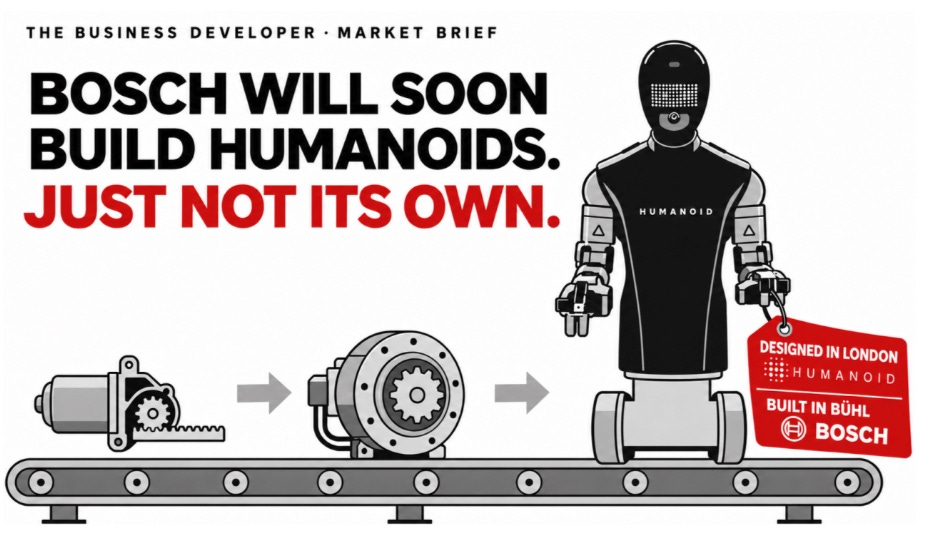
1. A Familiar Plant, a New Product
For years, Bosch’s plant in Bühl, on the edge of the Black Forest, has made electric motors and parts for car window lifts.
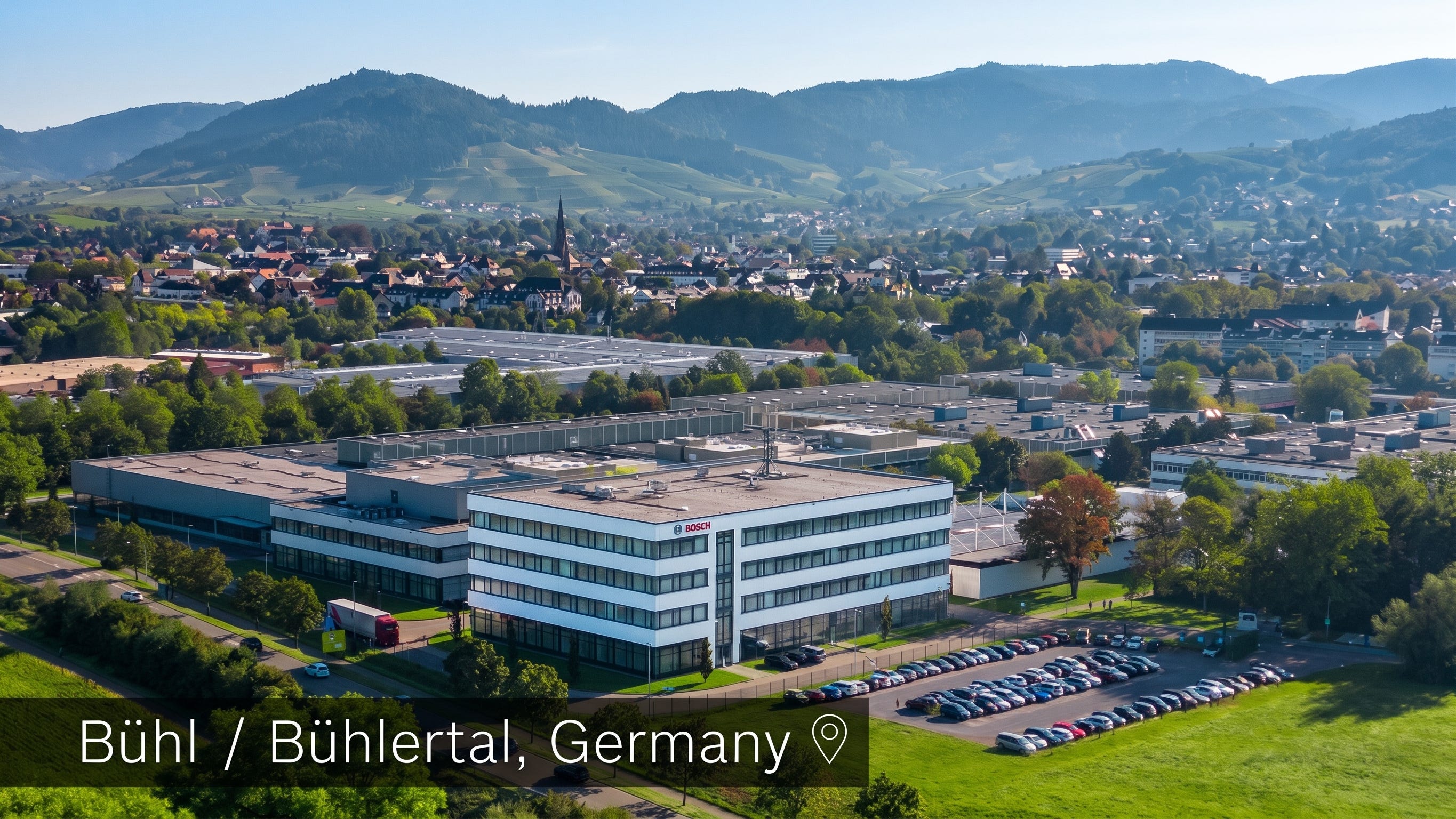
Photo Source: https://www.bosch.de/unternehmen/bosch-in-deutschland/buehl-buehlertal/
According to media reports, the same plant is set to start building humanoid robots in 2027 (Ürün, 2026). Bosch did not design those robots. They come from Humanoid, a London startup founded only a few years ago.
This story has a personal connection for me. I worked periodically at Bosch in Bühl. Reading about the plant’s planned role in robot manufacturing brought that experience back. It also made the changes driven by AI and higher levels of automation feel especially tangible. I knew a factory built around automotive parts. It may soon be a factory that builds machines meant to work beside people.
How did a young startup win over three German industrial groups not known for fast decisions? The answer is less about the robot than about what Humanoid chose to sell, and with whom.
2. Why Humanoid Got In
Humanoid’s path ran through three stages within a year: a test at Siemens, a manufacturing deal with Bosch, and a deployment and supply deal with Schaeffler. Two choices explain most of its progress.
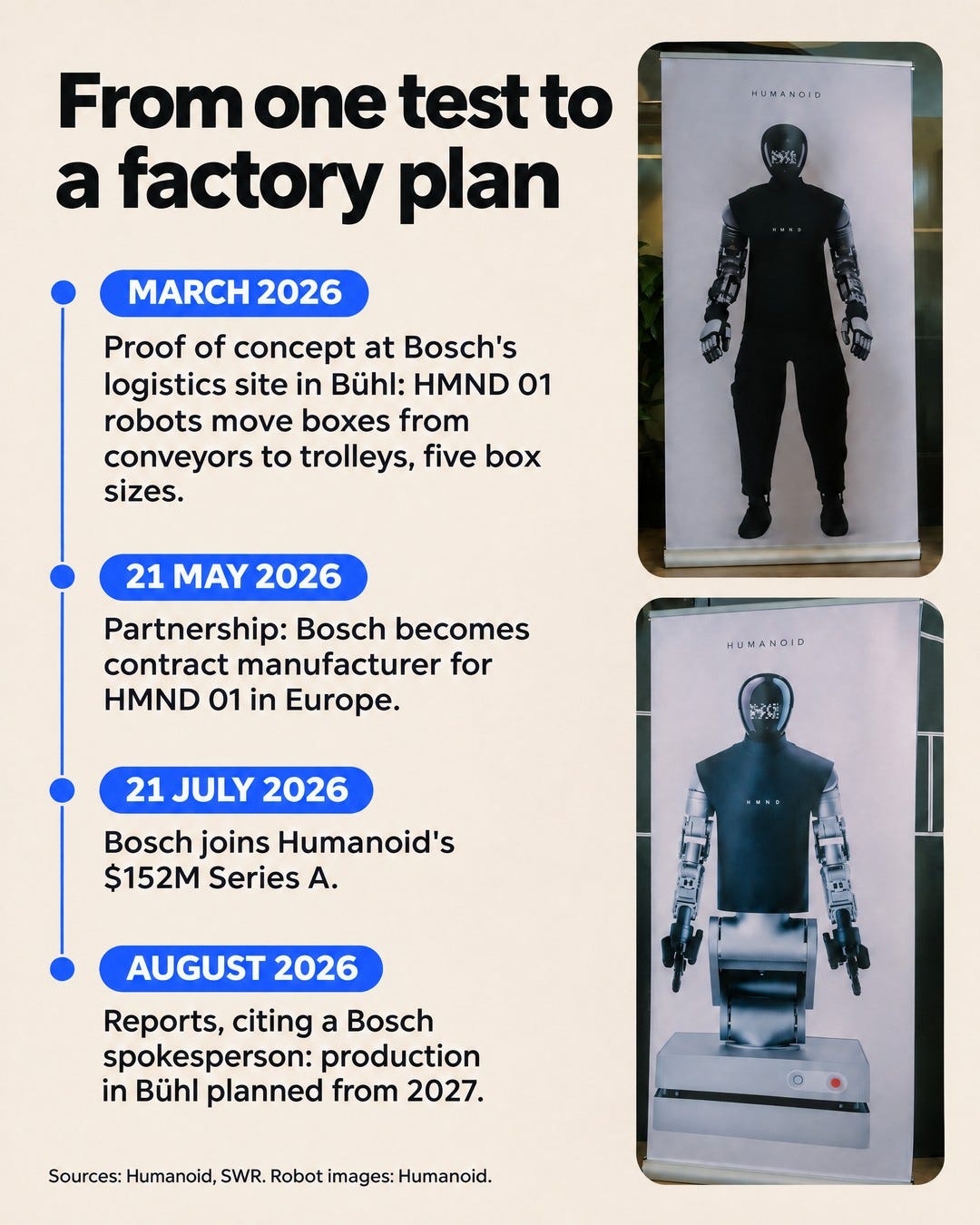
Source: Humanoid, SWR, Robot Images: Humanoid.
2.1 A Task Buyers Can Price
Humanoid did not lead with walking, dancing, or a hand holding an egg. It focused on moving boxes, a repetitive task found in nearly every plant.
At Siemens’ electronics factory in Erlangen, the HMND 01 robot worked for two weeks in real operations. It reached 60 tote moves per hour and ran autonomously for more than 30 minutes at a stretch. Uptime exceeded eight hours, and the pick-and-place success rate was above 90 percent (The Robot Report, 2026). At Bosch in Bühl, the robot moved boxes of five sizes from conveyors onto trolleys in a live logistics workflow (Abdullahi, 2026a).
These are numbers a plant manager can compare with what the work costs today. The question shifts from “How advanced is this robot?” to “Can it do this job reliably and economically?” Christensen et al. (2016) argued that customers do not buy products. They “hire” them to get a specific job done. Humanoid made the job visible and gave buyers a way to judge throughput, reliability, and fit with existing operations, instead of asking them to speculate about a humanoid’s future potential.
The robot’s design follows the same logic. Its wheeled version rolls rather than walks, because factory floors are flat and buyers pay for uptime, not for legs (Ürün, 2026).
2.2 Partners Who Win When You Win
The second choice concerns partners. Teece (1986) showed decades ago that innovators often fail to profit from good technology because others own the complementary assets needed to commercialize it: manufacturing, distribution, service, and access to customers. Humanoid did not try to build those assets alone. It gave the companies that already hold them a stake in its success.
Bosch brings manufacturing capability and investment. It became the contract manufacturer of HMND 01 for Europe and will help with production planning, hardware design, and supply chains (Abdullahi, 2026a).
Siemens provides real-world testing and connects the robot to factory systems through its own software (Ürün, 2026).
Schaeffler combines three roles. It plans to deploy more than 1,000 robots across its sites by 2032 under a robot-as-a-service model. It becomes the preferred supplier for more than half of the joint actuators in Humanoid’s wheeled robots through 2031 (Abdullahi, 2026b). According to Ürün (2026), it also joined Bosch as an investor.
Each partner has a practical reason to help the technology succeed. When a company earns from your success as customer, supplier, and investor, it will also help you over the next hurdle.
2.3 Pilots Are Not Proof
None of this guarantees profitable, large-scale deployment. Schaeffler’s first deployment phase runs from December 2026 to June 2027 (Abdullahi, 2026b). Humanoid reports about 34,000 preorders, but they are nonbinding. Reuters noted this month that most of Europe’s “physical AI” remains in pilots rather than mass deployment (Ürün, 2026). The real test is how many pilots turn into firm orders, and whether robots-as-a-service costs less than the work it replaces once maintenance, integration, and downtime are counted.
I would add a further caution. Sources so far describe the partnerships and pilot targets. Independent evidence on long-run productivity, safety, and the effect on workers is not yet available.
3. Transformation Is About Capabilities and People
For me, the Bühl story is a reminder that industrial transformation is about more than adopting new technology. A plant that made window-lift motors is now preparing to make robots. That move is possible because motors, sensors, and actuators, the core of a robot, are capabilities the plant already has. Transformation here means adapting existing strengths, not replacing them.
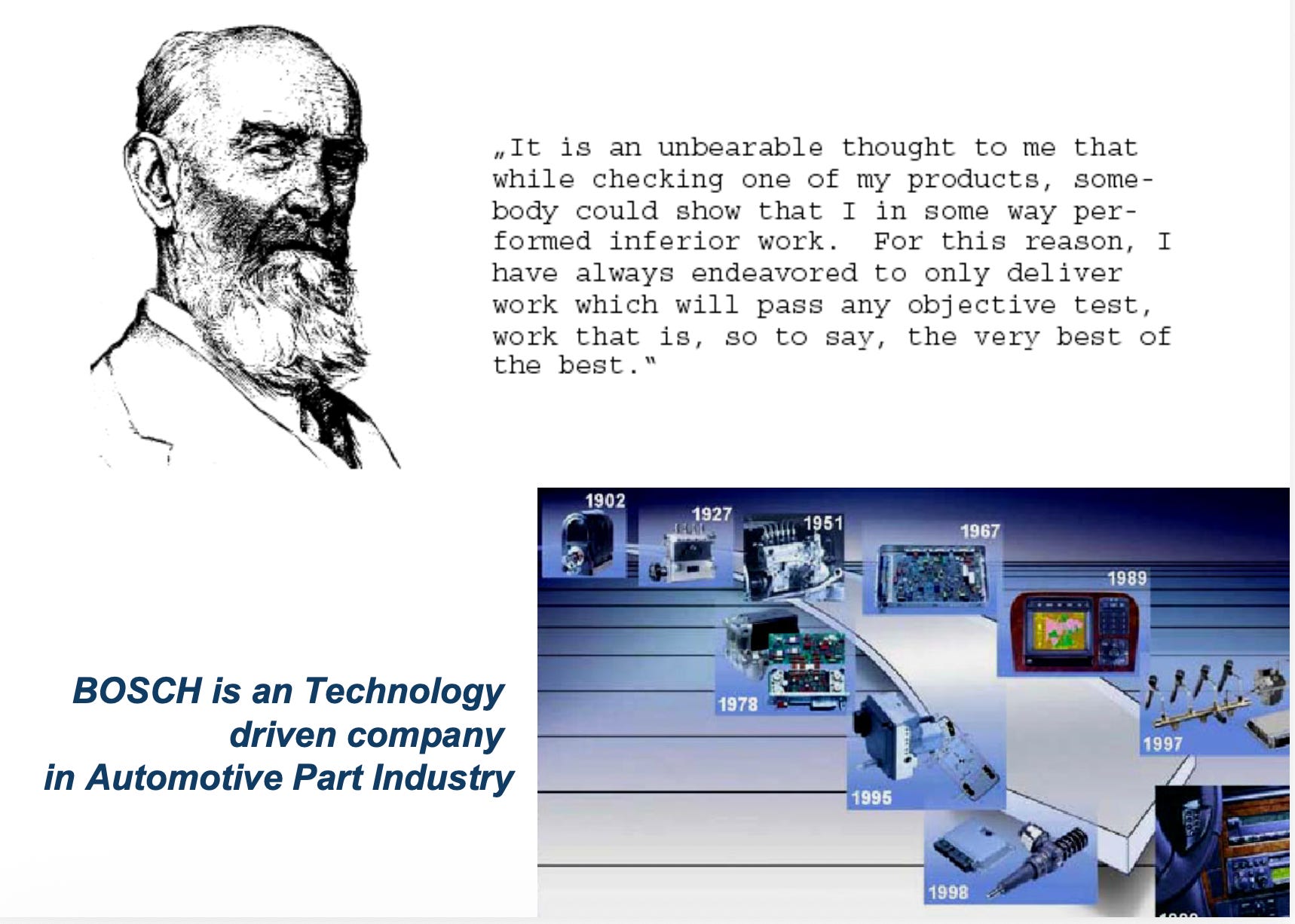
Figure: Robert Bosch’s remarks and product evolution of BOSCH GmbH.
It also means preparing people for changing work. The engineers, technicians, and line workers in Bühl will need new skills to build robots. Workers in Schaeffler’s plants will need new skills to work alongside them. For those of us in human resource development, this is where the real work begins: redesigning jobs, building those skills, and helping people see a future for themselves in the new factory.
The robot opens the conversation. What decides the outcome is whether a company solves a problem customers will pay to resolve, whether it chooses partners who gain from its success, and whether people can grow into the work that follows.
References
Abdullahi, A. (2026a, May 25). Humanoid turns to Bosch to bring its warehouse robots into mass production. eWeek. https://eweek.com/news/humanoid-bosch-warehouse-robots-production
Abdullahi, A. (2026b, May 18). Schaeffler eyes 1,000+ humanoid robots across global factories by 2032. eWeek. https://eweek.com/news/humanoid-schaeffler-factory-robot-deployment
Christensen, C. M., Hall, T., Dillon, K., & Duncan, D. S. (2016). Know your customers’ “jobs to be done.” Harvard Business Review, 94(9), 54–62.
Teece, D. J. (1986). Profiting from technological innovation: Implications for integration, collaboration, licensing and public policy. Research Policy, 15(6), 285–305. https://doi.org/10.1016/0048-7333(86)90027-2
The Robot Report. (2026, January 16). Humanoid and Siemens proof of concept shows the way to industrial deployments. https://www.therobotreport.com/humanoid-siemens-proof-of-concept-may-lead-more-industrial-deployments/
Ürün, E. (2026, November 15). Bosch will soon build humanoid robots. Just not its own. The Business Developer Brief [Newsletter]. LinkedIn., https://www.linkedin.com/pulse/bosch-soon-build-humanoid-robots-just-its-own-erdem-%C3%BCr%C3%BCn-u6p0e/
About the Author

Prof. Dr. Jeonghwan (Jerry) Choi (Managing Editor)
Full list of his K-GSP columns:
Jeonghwan (Jerry) Choi, PhD is Editor-in-Coordination of K-GSP Forum (contact: jeonghwan.choi at gmail.com). With over 25 years of industry and consulting experience, he specializes in leadership development, human resource management, organizational behavior, and social entrepreneurship. His research focuses on workforce resilience, organizational health, and self-directed leadership — bridging rigorous scholarship with practical insight to cultivate leaders who create meaningful, sustainable, and humane organizations.
Suggested Citation
Choi, J. (2026, November 22). Sell a solved problem, not a technology: What Bosch, Siemens, and Schaeffler teach about industrial AI. K-GSP Forum.
Original Article

REMARKS
Bosch is cutting 1,100 to 1,550 jobs at its Bühl/Bühlertal site by 2030 to close a €2.5 billion Mobility cost gap.
Root Causes: High German labor and energy costs make manufacturing standardized, low-margin electric motors uncompetitive amid stagnant European car demand and U.S. tariffs. Bosch is offshoring next-generation production to cheaper regions, though forced layoffs remain banned until late 2027.
China’s Effect: Chinese EV makers (like BYD) have eroded German automakers’ market share, slashing parts orders. Meanwhile, low-cost Chinese suppliers force severe price cuts, and Bosch is shifting R&D directly to China to serve faster-moving local clients, reducing the need for German headquarters staff.
한글요약
기술이 아니라 해결된 문제를 팔아라: 보쉬, 지멘스, 셰플러가 보여 준 산업 AI의 교훈
영국 런던의 신생 기업 휴머노이드(Humanoid)는 불과 몇 달 만에 독일의 지멘스, 보쉬, 셰플러와 시험 운영과 협력 계약을 맺었습니다. 비결은 화려한 로봇이 아니라 상자 옮기기라는 평범한 일이었습니다. 지멘스 공장에서 이 로봇은 시간당 60개의 상자를 옮기고, 8시간 넘게 작동하며, 90퍼센트 이상의 성공률을 보였습니다. 구매자는 로봇이 얼마나 첨단인지가 아니라 이 일을 믿을 만하고 경제적으로 해낼 수 있는지를 따질 수 있었습니다. 또 휴머노이드는 각 협력사가 성공에서 이익을 얻도록 관계를 짰습니다.
보쉬는 제조와 투자를, 지멘스는 현장 시험과 공장 시스템 연결을, 셰플러는 고객이자 부품 공급자이자 투자자 역할을 맡았습니다. 필자는 보쉬 뷜(Bühl) 공장에서 일한 적이 있어 이 소식이 더 가깝게 느껴졌습니다. 자동차 엔진, 윈도우, 와이퍼, 시트, ABS 등에 들어가는 전기 모터를 만들던 공장이 2027년부터 로봇을 만들 예정입니다. 다만 시험 운영과 구속력 없는 선주문만으로는 수익성 있는 대규모 보급을 증명할 수 없습니다.
필자는 산업 전환이 새 기술 도입만이 아니라 기존 역량을 바꾸어 쓰고, 달라질 일에 사람을 준비시키며, 고객이 돈을 내고 해결하고 싶은 문제를 푸는 일이라고 봅니다.
참고
보쉬는 모빌리티 부문의 25억 유로 규모 비용 격차를 메우기 위해 2030년까지 뷜/뷜러탈(Bühl/Bühlertal) 사업장에서 일자리 1,100~1,550개를 줄일 계획입니다.
근본 원인: 독일의 높은 인건비와 에너지 비용 때문에, 표준화된 저마진 전기 모터를 독일에서 만들어서는 경쟁력을 갖기 어렵습니다. 여기에 유럽의 자동차 수요가 정체되어 있고 미국의 관세 부담까지 겹쳤습니다. 이에 보쉬는 차세대 제품 생산을 비용이 낮은 지역으로 옮기고 있습니다. 다만 2027년 말까지는 강제 해고가 금지되어 있습니다.
중국의 영향: BYD 같은 중국 전기차 업체들이 독일 완성차 업체의 시장 점유율을 잠식하면서 부품 주문이 크게 줄었습니다. 동시에 값싼 중국 부품업체들 때문에 가격을 대폭 낮춰야 하는 압박도 커졌습니다. 보쉬는 빠르게 움직이는 현지 고객에 대응하기 위해 연구개발 기능을 중국으로 직접 옮기고 있으며, 그만큼 독일 본사 인력의 필요성은 줄어들고 있습니다.
© K-Global Scholars and Professionals Forum. All rights reserved. Content published in the K-GSP Forum may not be reproduced, distributed, or transmitted in any form without prior written permission from the K-GSP Forum, except for brief quotations with full attribution.