

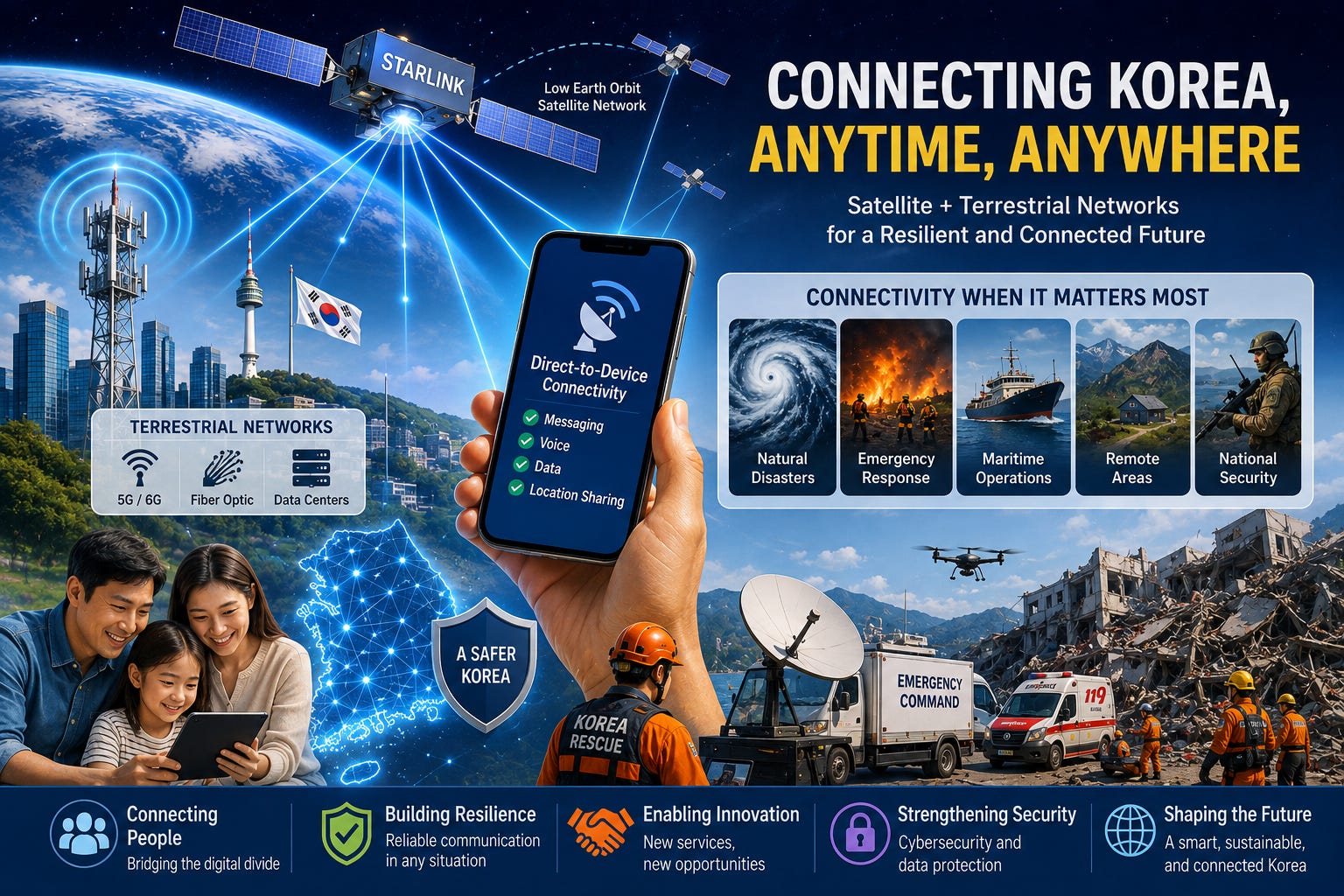
Image credit: Illustration generated with OpenAI’s ChatGPT image-generation tool, 2026.
Starlink and the Future of Telecommunications Industry
A Wake-Up Call for Korea: Competition, Connectivity, and Emergency Preparedness
Abstract
The rapid development of Starlink and direct-to-device (D2D) satellite communications is challenging traditional telecommunications business models and creating new opportunities for global connectivity. Recent strategic initiatives by SpaceX and major European telecommunications operators highlight the growing importance of integrating satellite and terrestrial networks. Although Korea benefits from advanced mobile and broadband infrastructure, its existing strengths do not eliminate the need to prepare for technological disruption, changing market competition, and communications failures during disasters. This essay examines the implications of satellite-based connectivity for Korea, focusing on telecommunications competition, emergency preparedness, cybersecurity, privacy, and strategic dependence on foreign service providers. It argues that satellite communications should complement rather than simply replace terrestrial networks. A practical national strategy should include regulatory clarity, partnerships between telecommunications and satellite providers, targeted emergency-communications pilot programs, cybersecurity assessments, and redundant connectivity options for critical facilities and vulnerable communities. Ultimately, the value of satellite communications extends beyond commercial competition: it lies in strengthening national resilience and ensuring that essential communications remain available when conventional infrastructure is disrupted.
Keywords: Starlink, direct-to-device (D2D) communications, satellite communications, telecommunications competition, Korea, emergency preparedness, cybersecurity, network resilience
Introduction: When the Sky Becomes a Telecommunications Network
For decades, telecommunications companies have built their businesses around a familiar principle: connect people through networks of towers, cables, fiber-optic lines, and undersea communication links. These terrestrial networks have transformed modern life, enabling people to communicate, businesses to operate, and governments to deliver essential services. In countries with advanced digital infrastructure, reliable connectivity has become so commonplace that people rarely consider how vulnerable it can be.
Yet a new development is challenging this traditional model. Satellite-based services, particularly SpaceX’s Starlink, are bringing the possibility of internet connectivity directly from space to ordinary users and, increasingly, to mobile devices. The boundary between terrestrial telecommunications and satellite communications is becoming less distinct. A service once associated mainly with remote expeditions, ships, and specialized equipment may become an increasingly important part of everyday communications.
A Chosun Ilbo article published on October 21, 2026, highlighted a growing contrast between telecommunications companies in the United States and Europe, which are exploring ways to respond to Starlink, and Korean operators, whose immediate reaction appears more limited (Gu, 2026). The article raises an important question: Is Korea’s advanced telecommunications infrastructure sufficient protection against a changing competitive landscape, or does the country need a more forward-looking strategy?
The answer requires us to look beyond the rivalry between companies. The emergence of satellite-to-device communication raises broader questions about technological innovation, national resilience, emergency preparedness, cybersecurity, and the public interest. For Korea, the challenge is not simply to compete with Starlink. It is to ensure that its communications infrastructure remains reliable, secure, and accessible when people need it most.
Starlink’s Challenge to Traditional Telecommunications
Starlink is a satellite internet service developed by SpaceX, the aerospace company founded by Elon Musk. Unlike traditional satellite internet systems that often rely on satellites in geostationary orbit, Starlink operates a large constellation of satellites in low Earth orbit. Their relatively short distance from Earth helps reduce communication latency and makes interactive applications more practical than with many older satellite systems.
Starlink initially attracted attention by providing broadband connectivity to locations where conventional networks were unavailable, unreliable, or expensive to build. Rural communities, ships, aircraft, isolated industrial sites, and emergency-response teams are among the potential beneficiaries. The service also demonstrated that satellite connectivity could become a commercial alternative rather than remain a specialized technology.
The next stage is more consequential: direct-to-device, or D2D, connectivity. The concept aims to allow compatible mobile devices to communicate with satellites, potentially without relying on a nearby terrestrial cell tower. The precise capabilities depend on the satellite system, spectrum, device compatibility, regulatory authorization, and service configuration. Initial services may support messaging or emergency communications, while more advanced services may expand the range of applications.
The International Telecommunication Union (ITU, 2026) explains that direct-to-device satellite systems can help extend connectivity beyond the reach of conventional terrestrial networks. Such systems are not necessarily replacements for mobile networks. Rather, they can provide an additional layer of coverage where terrestrial infrastructure is unavailable or disrupted.
This distinction matters. A satellite service does not have to replace an entire telecommunications network to change the market. It may compete for selected customers, provide an alternative in underserved locations, or become an essential partner for mobile operators seeking broader coverage. Even limited satellite functionality could influence how consumers evaluate connectivity and how telecommunications companies design their services.
The $8 Billion Spectrum Deal and the Competitive Response
A major development in October 2026 brought the competition into sharper focus. Reuters reported that SpaceX had agreed to acquire low-band 800 MHz spectrum from Grain Management in a transaction valued at approximately $8 billion, subject to regulatory approval (Sriram & Shepardson, 2026).
Spectrum is a fundamental resource in wireless communications. It provides the radio frequencies through which devices and networks transmit information. Access to suitable spectrum can influence coverage, capacity, device compatibility, and the commercial feasibility of new services.
However, spectrum ownership alone does not create a complete mobile network. A successful service also requires compatible devices, supporting infrastructure, regulatory permissions, network management, and a sustainable commercial model. The reported transaction should therefore be understood as a significant strategic move rather than proof that SpaceX has already displaced established mobile operators.
Nevertheless, the implications are substantial. A company that already operates a large satellite constellation and has experience delivering connectivity could seek to integrate satellite capabilities more closely with mobile services. Traditional telecommunications companies may then face competition not only from other mobile operators but also from technology companies whose infrastructure and business models differ from their own.
The response in Europe illustrates how seriously some operators are treating this possibility. On October 19, 2026, Deutsche Telekom announced that it, Orange, Telefónica, and Vodafone had signed a letter of intent to explore a joint bid for Mobile Satellite Services spectrum and advance direct-to-device services (Deutsche Telekom, 2026).
This announcement is an exploratory initiative, not a completed spectrum acquisition or an operational joint satellite network. The companies indicated that they intended to investigate cooperation and potential satellite partnerships rather than immediately build their own satellite constellations. Even so, their willingness to coordinate is meaningful. It suggests that established telecommunications operators recognize the value of cooperation when responding to a technology that may cross national borders and traditional industry boundaries.
The strategic lesson is clear: telecommunications companies may need to reconsider the assumption that their competitive position rests primarily on terrestrial infrastructure. In a world of converging networks, partnerships, spectrum strategy, and the ability to integrate different communication technologies may be just as important.
Why Korea Cannot Rely on Its Existing Strength Alone
Korea has compelling reasons to feel confident about its telecommunications capabilities. Its dense population centers, extensive fiber networks, advanced mobile infrastructure, and technologically sophisticated consumers have helped establish a highly connected society. In many everyday situations, terrestrial mobile and broadband networks offer excellent performance and convenience.
These strengths also help explain why satellite internet may have a more limited immediate commercial impact in Korea than in countries with large remote territories or substantial coverage gaps. Where terrestrial service is already reliable and competitively priced, consumers may have little reason to switch to a satellite-based alternative.
Geography and market structure, however, should not be confused with permanent immunity from technological change. Even if satellite services do not immediately threaten the majority of Korea’s mobile subscriptions, they could become important in maritime communications, remote islands, disaster recovery, military-adjacent civilian logistics, industrial operations, and specialized enterprise services.
The more fundamental concern is strategic. If satellite-to-device services become widely available, Korean telecommunications operators may need to offer integrated connectivity rather than rely exclusively on terrestrial networks. Customers may increasingly expect their devices to remain connected when they leave conventional coverage areas or when local infrastructure fails.
Korea also has a strong interest in maintaining technological autonomy and resilient communications. Dependence on a single external provider can introduce questions about service continuity, foreign jurisdiction, data protection, pricing, and national security. These concerns do not mean that foreign satellite services should be rejected. They mean that participation should be guided by a clear policy framework that balances innovation with the public interest.
The appropriate response is neither complacency nor alarm. Korea should use its existing telecommunications strengths as a foundation for adaptation, not as a reason to postpone it.
The Emergency Dimension: When Satellite Connectivity Becomes a Lifeline
The strongest argument for satellite connectivity may not be commercial competition. It may be emergency preparedness.
Modern societies depend on communications during earthquakes, typhoons, floods, wildfires, major power outages, and other disasters. Emergency responders need to coordinate rescue operations, hospitals must communicate with one another, authorities must distribute warnings, and residents need reliable ways to contact family members and request assistance.
Terrestrial networks are highly capable, but they are not invulnerable. Mobile towers may lose power, fiber-optic cables may be damaged, and transport networks may be disrupted. Congestion can also occur when large numbers of people attempt to contact others simultaneously. A disaster can therefore create a dangerous paradox: people need communications most precisely when the systems they normally depend on may be least reliable.
Satellite communications can provide an additional route for transmitting information when terrestrial infrastructure is unavailable or damaged. The ITU’s work on satellite communications for early-warning systems emphasizes the importance of satellite technologies in supporting disaster preparedness and communication with remote or disaster-affected communities (International Telecommunication Union, n.d.).
For Korea, this possibility deserves particular attention. Severe storms, flooding, landslides, coastal emergencies, and maritime incidents can disrupt local infrastructure or isolate communities. An earthquake or other major event could affect multiple communication systems at once. Islands and coastal areas may face additional challenges when transport and terrestrial connections are interrupted.
Imagine a powerful typhoon damaging mobile towers and power lines in a coastal region. Local emergency services need to report road closures, coordinate evacuation routes, and contact hospitals. Residents need to receive official instructions and let relatives know they are safe. If conventional connectivity becomes unavailable, a satellite-enabled communication option could help maintain a minimum level of contact.
Starlink or another satellite service might contribute to this response, depending on service availability, compatible equipment, network capacity, and government authorization. It should not, however, be assumed that every smartphone can automatically connect to Starlink in every emergency. Direct-to-device capability varies by service and device, and a satellite internet terminal is not equivalent to ordinary mobile-phone connectivity.
This distinction suggests a practical policy. Korea should not build its emergency strategy around a promise that one commercial service will always be available. Instead, it should develop a resilient, multi-layered communications system that can combine terrestrial mobile networks, fiber, satellite broadband, direct-to-device services where supported, and dedicated emergency communication systems.
The objective should be continuity of essential communications—not loyalty to a particular technology or provider.
From Commercial Service to National Resilience
Preparing for emergencies requires more than purchasing satellite terminals after a disaster has occurred. Connectivity must be incorporated into emergency planning before a crisis begins.
Korean authorities could begin by identifying critical locations where alternative communications would have the greatest value. These might include emergency operations centers, selected hospitals, island communities, coastal rescue stations, evacuation centers, and facilities responsible for coordinating disaster response.
Pilot programs could then evaluate several questions. How quickly can satellite connectivity be activated when terrestrial networks fail? How many users can it support? What happens during prolonged power outages? Can emergency agencies exchange information securely? How well does the service perform in heavy rain or in locations with limited visibility of the sky? What arrangements are needed for equipment maintenance and staff training?
These questions should be answered through exercises and independent testing rather than assumptions. A satellite connection may provide a valuable backup, but its practical usefulness depends on power, equipment, installation, network capacity, and the ability of personnel to use it under pressure.
Korea should also consider how satellite connectivity could support its existing public-warning systems. Emergency alerts, evacuation instructions, and requests for assistance must reach people through channels that remain usable during disruptions. Satellite-enabled devices could potentially complement these channels, especially in remote areas or when terrestrial systems are impaired.
At the same time, emergency communications require clear operational responsibility. Authorities should establish who can activate backup services, which organizations receive priority access, how service costs are covered, and how sensitive information is protected. Contracts should address service availability, restoration procedures, and the responsibilities of both government agencies and private providers.
A resilient system should have alternatives. If a commercial satellite network is unavailable, congested, or incompatible with the devices in use, emergency services must still have other ways to communicate. The purpose of redundancy is to ensure that one failure does not become a system-wide failure.
Cybersecurity, Privacy, and Strategic Dependence
Connectivity from space does not eliminate cybersecurity risks. Satellite services remain part of a larger digital ecosystem involving user devices, ground stations, network-management systems, cloud infrastructure, applications, and service providers. Vulnerabilities in any of these components may affect the security or availability of the overall service.
For Korea, the use of satellite connectivity in emergency response and critical infrastructure should therefore include cybersecurity assessments. Agencies should examine authentication, encryption, access controls, software updates, incident reporting, and the protection of operational data. They should also determine how satellite links will be integrated with existing government and enterprise networks without creating unnecessary exposure.
Privacy deserves equal attention. A communications service may process information about users, devices, locations, and network activity. The collection and handling of such information should comply with applicable laws and be subject to clear rules, especially when the service supports public agencies or emergency operations.
Strategic dependence is another consideration. A foreign commercial provider can offer valuable capabilities without requiring Korea to build an entire satellite constellation from the beginning. Yet relying on one provider for essential national functions could create risks involving pricing, service policies, geopolitical tensions, or changes in commercial priorities.
The answer is not necessarily to develop every component domestically. Such an approach could be expensive and inefficient. A more balanced strategy would combine international partnerships with domestic capabilities, multiple service options, transparent procurement, and tested contingency arrangements. Korea could also encourage cooperation among telecommunications operators, satellite providers, equipment manufacturers, universities, and public research institutions.
This approach would allow the country to benefit from global innovation while retaining the ability to make independent decisions about critical communications.
A Practical Agenda for Korea
Korea’s response should begin with a national assessment of the role that satellite connectivity can play in both commercial telecommunications and emergency preparedness. The assessment should distinguish immediate needs from longer-term possibilities.
First, policymakers and telecommunications operators should monitor developments in spectrum allocation, direct-to-device technology, and international regulatory coordination. The agreements and proposals emerging in the United States and Europe should be studied carefully, while recognizing that their market conditions may differ from those in Korea.
Second, Korea should conduct targeted emergency-communications pilots. These should involve realistic exercises with local governments, fire and rescue services, hospitals, maritime agencies, and telecommunications operators. Testing should measure availability, recovery time, capacity, usability, security, and cost—not merely whether a satellite connection can be established.
Third, regulators should clarify the requirements for satellite-to-device and satellite broadband services, including spectrum use, device compatibility, emergency access, consumer protection, and cybersecurity responsibilities. Clear rules can support innovation while reducing uncertainty for businesses and public agencies.
Fourth, telecommunications companies should evaluate partnerships with satellite operators and other technology providers. Competition will remain important, but cooperation may be necessary where networks must interoperate or where nationwide resilience benefits society as a whole. Operators should also assess how satellite services could complement their existing mobile and broadband offerings.
Finally, the government should treat resilient communications as an essential public capability. Emergency connectivity should not depend entirely on whether a commercial service happens to be profitable in a particular region. Public procurement, shared infrastructure, and carefully designed service agreements may be needed to ensure that high-risk communities and critical facilities are adequately prepared.
These measures would not require Korea to abandon its terrestrial telecommunications strengths. Rather, they would extend those strengths into a more flexible architecture in which terrestrial and satellite networks support one another.
Conclusion: Looking Beyond the Towers
Starlink’s rise represents more than a new competitor in the telecommunications market. It reflects a broader transformation in how societies understand connectivity. Communication networks are increasingly becoming integrated systems that may combine terrestrial infrastructure, satellites, cloud services, mobile devices, and intelligent network management.
The United States and European operators are exploring ways to respond to this transformation. Their initiatives do not guarantee commercial success, but they demonstrate that established companies are beginning to consider strategic options beyond conventional network boundaries. Korea should pay close attention to these developments without assuming that the same solutions will automatically fit its own market.
The country’s advanced infrastructure remains a significant advantage. Yet technological leadership cannot be preserved through infrastructure alone. It also requires strategic foresight, regulatory adaptability, international cooperation, and the willingness to test new approaches before they become urgent necessities.
Most importantly, satellite connectivity should be evaluated not only by its capacity to attract customers or challenge traditional operators but also by its potential to protect people when ordinary communications fail. During a disaster, the value of a network may be measured not by its market share but by whether a rescue team can reach an isolated community, a hospital can coordinate treatment, or a family can learn that its loved ones are safe.
Korea does not need to choose between terrestrial telecommunications and satellite services. It needs to build a system in which both can contribute to a secure, competitive, and resilient digital society. The sky may become another part of the communications network, but the ultimate purpose of that network remains firmly on the ground: connecting people, protecting communities, and ensuring that no one is left without a way to communicate when it matters most.
References
Deutsche Telekom. (2026, October 19). Four European operators sign letter of intent to explore a joint bid for Mobile Satellite Services spectrum and advance Direct-to-Device services. https://www.telekom.com/en/newsroom/latest-updates/news/2026/10/deutsche-telekom-orange-telefonica-and-vodafone-have-signed-a-letter-of-intent
Gu, D. (2026, October 21). U.S. and European telecommunications industries mount a “Starlink counteroffensive,” while South Korean carriers watch from the sidelines [English translation of Korean-language article]. The Chosun Ilbo. https://www.chosun.com/economy/tech_it/2026/10/21/QZIFOAIPBBDTHHMJZSY36Q5BVQ/
International Telecommunication Union. (n.d.). Satellite communications for early warning systems. https://www.itu.int/en/ITU-D/Emergency-Telecommunications/Pages/EW4ALL/satellite-for-ew4all.aspx
International Telecommunication Union. (2026, March 16). Direct-to-device satellites: Four ways to connect the world. https://www.itu.int/hub/2026/03/direct-to-device-satellites-four-ways-to-connect-the-world/
Sriram, A., & Shepardson, D. (2026, October 8). SpaceX takes aim at U.S. wireless carriers with spectrum acquisition. Reuters. https://www.reuters.com/business/media-telecom/spacex-acquire-spectrum-that-enables-starlink-mobile-services-2026-10-08/
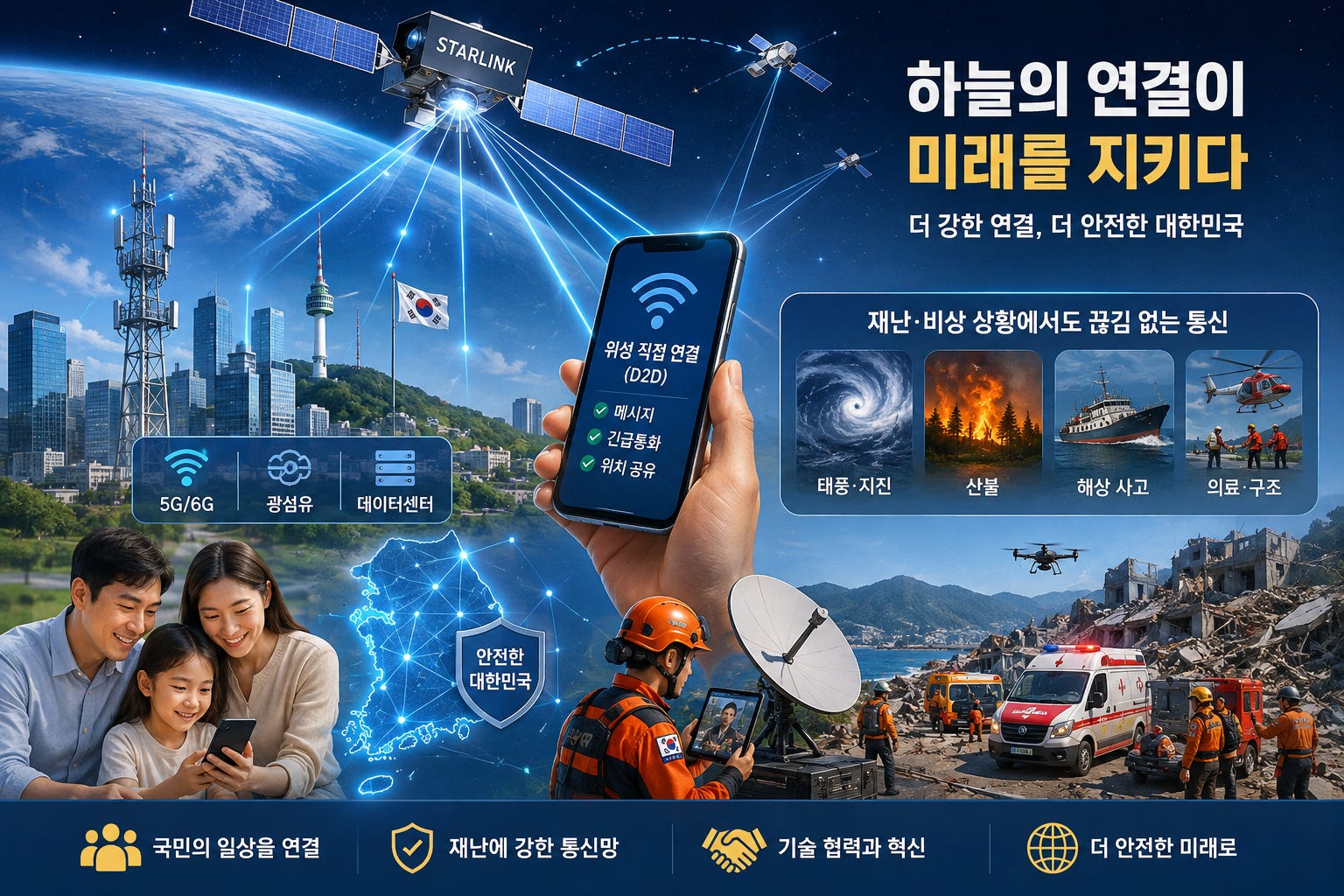
Image credit: Illustration generated with OpenAI’s ChatGPT image-generation tool, 2026.
스타링크와 통신 산업의 미래
한국에 주는 시사점: 경쟁, 연결성, 그리고 비상사태 대비
서론: 하늘이 통신망이 되는 시대
수십 년 동안 통신 기업들은 익숙한 원칙에 따라 사업을 구축해 왔다. 기지국, 케이블, 광섬유, 해저 통신망을 통해 사람들을 연결하는 것이었다. 이러한 지상 통신망은 현대 사회를 변화시켜 사람들이 서로 소통하고, 기업이 사업을 운영하며, 정부가 필수 서비스를 제공할 수 있도록 했다. 디지털 인프라가 발달한 국가에서는 안정적인 연결성이 일상생활의 일부가 되었기 때문에 사람들은 통신망이 얼마나 취약해질 수 있는지 거의 생각하지 않는다.
그러나 새로운 기술이 이러한 전통적인 모델에 도전하고 있다. 특히 스페이스X(SpaceX)의 스타링크(Starlink)를 비롯한 위성 기반 서비스는 우주에서 일반 사용자와 점차 모바일 기기에 직접 인터넷 연결을 제공할 가능성을 열고 있다. 지상 통신과 위성 통신 사이의 경계가 점점 흐려지고 있는 것이다. 과거에는 주로 오지 탐험, 선박, 특수 장비에 국한되었던 서비스가 이제는 일상적인 통신의 중요한 구성 요소로 발전할 가능성이 커지고 있다.
2026년 10월 21일 자 《조선일보》 기사는 미국과 유럽의 통신 기업들이 스타링크에 대응할 방안을 모색하는 반면, 한국 통신 사업자들의 즉각적인 대응은 상대적으로 제한적인 것으로 보인다는 점을 조명했다(Gu, 2026). 이 기사는 중요한 질문을 제기한다. 한국의 앞선 통신 인프라는 변화하는 경쟁 환경으로부터 우리를 충분히 보호해 줄 것인가? 아니면 한국에도 더욱 미래지향적인 전략이 필요한가?
이 질문에 답하려면 기업 간 경쟁을 넘어 더 넓은 시각에서 문제를 살펴보아야 한다. 위성 직접 연결 통신의 등장은 기술 혁신뿐 아니라 국가적 회복탄력성, 재난 대비, 사이버보안, 공공의 이익과도 관련된다. 한국의 과제는 단순히 스타링크와 경쟁하는 것이 아니다. 국민이 가장 필요로 하는 순간에도 통신 인프라가 안정적이고 안전하며 접근 가능한 상태를 유지하도록 하는 것이다.
스타링크가 기존 통신 산업에 던지는 도전
스타링크는 일론 머스크가 설립한 우주항공 기업 스페이스X가 개발한 위성 인터넷 서비스다. 전통적인 위성 인터넷 시스템이 정지궤도 위성에 의존하는 경우가 많은 것과 달리, 스타링크는 지구 저궤도에 다수의 위성을 배치해 운용한다. 위성과 지구 사이의 거리가 상대적으로 짧기 때문에 통신 지연 시간을 줄일 수 있으며, 과거의 많은 위성 시스템보다 양방향 상호작용이 필요한 응용 서비스에 적합하다.
스타링크는 기존 통신망을 구축하기 어렵거나 서비스가 불안정하고 비용이 많이 드는 지역에 광대역 연결을 제공하면서 처음 주목받았다. 농어촌 지역, 선박, 항공기, 고립된 산업 시설, 재난 대응 현장 등이 잠재적인 수혜 대상이다. 스타링크는 위성 연결이 더 이상 특수한 기술에 머물지 않고 상업적으로 활용될 수 있음을 보여주었다.
그러나 다음 단계는 더욱 중요한 의미를 지닌다. 바로 위성 직접 연결(Direct-to-Device, D2D)이다. 이 기술은 호환되는 모바일 기기가 인근 지상 기지국에 의존하지 않고 위성과 직접 통신할 수 있도록 하는 것을 목표로 한다. 실제 제공되는 기능은 위성 시스템의 특성, 주파수 자원, 기기 호환성, 규제 승인, 서비스 구성에 따라 달라진다. 초기에는 문자 메시지나 긴급 통신을 중심으로 서비스가 제공될 수 있으며, 기술 발전에 따라 더 다양한 응용 서비스로 확대될 가능성도 있다.
국제전기통신연합(ITU, 2026)은 위성 직접 연결 시스템이 기존 지상 통신망의 도달 범위를 벗어난 지역까지 연결성을 확대하는 데 도움을 줄 수 있다고 설명한다. 이러한 시스템이 반드시 기존 이동통신망을 대체하는 것은 아니다. 오히려 지상 인프라가 없거나 손상된 지역에서 추가적인 통신 수단을 제공할 수 있다.
이 차이는 중요하다. 위성 서비스가 통신 산업 전체를 대체하지 않더라도 시장의 구조를 바꿀 수 있기 때문이다. 일부 고객층을 놓고 경쟁하거나, 통신 취약 지역에 대안을 제공하거나, 이동통신 사업자들이 서비스 범위를 확대하도록 지원할 수 있다. 위성 서비스의 기능이 제한적이더라도 소비자의 통신 서비스 선택 기준과 통신 사업자의 네트워크 설계 방식에 영향을 미칠 수 있다.
80억 달러 규모의 주파수 거래와 통신 업계의 대응
2026년 10월, 통신 산업의 경쟁 구도를 더욱 주목하게 만든 사건이 발생했다. 로이터통신은 스페이스X가 그레인 매니지먼트(Grain Management)로부터 저대역 800MHz 주파수를 약 80억 달러에 인수하기로 합의했다고 보도했다. 이 거래는 규제 당국의 승인을 전제로 한다(Sriram & Shepardson, 2026).
주파수는 무선통신의 핵심 자원이다. 기기와 네트워크가 정보를 주고받는 데 사용하는 전파 대역이기 때문이다. 적절한 주파수를 확보하는 것은 통신 서비스의 도달 범위, 수용 용량, 기기 호환성, 상업적 실현 가능성 등에 영향을 미칠 수 있다.
그러나 주파수만 확보한다고 완전한 이동통신망이 구축되는 것은 아니다. 성공적인 서비스를 제공하려면 호환 가능한 기기, 지원 인프라, 규제상 허가, 네트워크 관리, 지속 가능한 사업 모델이 필요하다. 따라서 이번 거래는 스페이스X가 기존 이동통신 사업자를 이미 대체했다는 증거라기보다, 자사의 전략적 입지를 강화하려는 중요한 움직임으로 이해해야 한다.
그럼에도 그 파급효과는 상당할 수 있다. 이미 대규모 위성망을 운영하고 연결 서비스 제공 경험을 갖춘 기업이 위성 통신과 이동통신 서비스를 더욱 긴밀하게 통합하려 할 수 있기 때문이다. 기존 통신 기업들은 다른 이동통신 사업자뿐 아니라 인프라와 사업 모델이 근본적으로 다른 기술 기업들과도 경쟁해야 할 가능성이 있다.
유럽 통신 사업자들의 대응은 일부 기업들이 이러한 가능성을 얼마나 심각하게 받아들이고 있는지를 보여준다. 2026년 10월 19일, 도이체텔레콤은 오렌지(Orange), 텔레포니카(Telefónica), 보다폰(Vodafone)과 함께 이동위성서비스(Mobile Satellite Services, MSS) 주파수의 공동 입찰 가능성을 검토하고 위성 직접 연결 서비스를 발전시키기 위한 의향서에 서명했다고 발표했다(Deutsche Telekom, 2026).
이 발표는 탐색 단계의 협력 계획이지, 주파수 확보가 완료되었거나 공동 위성망이 이미 운영되고 있다는 의미는 아니다. 해당 기업들은 자체 위성군을 즉시 구축하기보다는 협력 방안과 잠재적인 위성 파트너십을 검토하겠다는 뜻을 밝혔다. 그럼에도 이들의 공동 대응 의지는 의미가 있다. 기존 통신 사업자들이 국경을 넘나드는 기술과 전통적인 산업 경계를 넘어서는 사업 모델에 대응할 때 협력이 중요하다는 사실을 인식하기 시작했음을 보여주기 때문이다.
여기서 얻을 수 있는 전략적 교훈은 분명하다. 통신 기업들은 자사의 경쟁력이 지상 인프라에만 달려 있다는 생각을 재검토해야 한다. 네트워크가 융합되는 시대에는 제휴, 주파수 확보 전략, 서로 다른 통신 기술을 통합하는 역량이 기존 인프라만큼 중요해질 수 있다.
한국은 기존의 강점만으로 안심할 수 있는가?
한국이 자국의 통신 역량에 자신감을 가질 만한 이유는 충분하다. 인구 밀도가 높은 도시 지역, 광범위한 광섬유망, 첨단 이동통신 인프라, 기술에 익숙한 소비자층은 한국을 높은 수준의 연결성을 갖춘 사회로 발전시키는 데 기여했다. 일상생활의 많은 상황에서 지상 이동통신망과 초고속 인터넷은 우수한 성능과 편리함을 제공한다.
이러한 강점은 위성 인터넷이 한국에서 단기간에 미칠 상업적 영향이 상대적으로 제한적일 수 있는 이유이기도 하다. 광범위한 지역에서 지상 통신 서비스가 이미 안정적이고 가격 경쟁력까지 갖추고 있다면 소비자가 굳이 위성 기반 서비스로 전환할 이유는 크지 않을 수 있다.
그러나 지리적 조건과 시장 구조를 근거로 한국이 기술 변화로부터 영구적으로 안전하다고 생각해서는 안 된다. 위성 서비스가 당장 국내 이동통신 가입자의 대부분을 위협하지 않더라도 해상 통신, 외딴섬, 재난 복구, 군사시설과 인접한 민간 물류, 산업 현장, 특수 목적의 기업 서비스 등에서는 중요한 역할을 할 수 있다.
더 근본적인 문제는 전략적 대응 능력이다. 위성 직접 연결 서비스가 널리 보급되면 한국의 이동통신 사업자들도 지상망 중심의 서비스에서 벗어나 다양한 네트워크를 통합적으로 제공하는 방향으로 발전해야 할 수 있다. 고객들은 기존 통신망의 서비스 범위를 벗어나거나 지역 인프라가 고장 난 상황에서도 기기가 계속 연결되기를 기대할 가능성이 커진다.
한국은 기술적 자율성과 통신 회복탄력성을 유지하는 데에도 큰 관심을 가져야 한다. 핵심 통신 서비스를 하나의 해외 사업자에게 지나치게 의존하면 서비스 연속성, 외국의 법률과 관할권, 가격, 국가안보와 관련된 문제가 발생할 수 있다. 그렇다고 외국 위성 서비스를 배제해야 한다는 뜻은 아니다. 혁신의 이점을 활용하되 공공의 이익과 균형을 이루는 명확한 정책 체계를 마련해야 한다는 의미다.
적절한 대응은 안일함도 과도한 위기감도 아니다. 한국은 기존 통신 인프라의 강점을 변화에 대한 대응을 미룰 이유가 아니라 미래 전략의 토대로 활용해야 한다.
재난 상황에서의 위성 통신: 생명을 지키는 연결망
위성 통신의 가장 강력한 활용 근거는 통신 시장의 경쟁이 아니라 재난 대비에 있을 수 있다.
현대 사회는 지진, 태풍, 홍수, 산불, 대규모 정전 등 각종 재난 상황에서 통신에 의존한다. 구조대원은 구조 활동을 조율해야 하고, 병원은 서로 연락을 유지해야 하며, 당국은 주민들에게 경보를 전달해야 한다. 주민들은 가족과 연락하거나 도움을 요청할 수 있어야 한다.
지상 통신망은 매우 뛰어난 성능을 제공하지만 완전히 무결한 시스템은 아니다. 이동통신 기지국은 전력 공급이 끊길 수 있고, 광섬유 케이블은 손상될 수 있으며, 교통망과 통신망이 동시에 마비될 수도 있다. 많은 사람이 동시에 연락을 시도하면 통신망에 과부하가 발생할 가능성도 있다. 결국 재난 상황에서는 통신이 가장 필요한 순간에 평소 의존하던 시스템이 오히려 제대로 작동하지 않을 수 있다는 역설이 발생한다.
위성 통신은 지상 인프라를 이용할 수 없거나 손상된 상황에서 정보를 전달할 또 다른 경로를 제공할 수 있다. 국제전기통신연합은 조기경보 체계에서 위성 통신이 재난 대비와 외딴 지역 및 재난 피해 지역과의 통신을 지원할 수 있다는 점을 강조한다(International Telecommunication Union, n.d.).
한국도 이러한 가능성에 특별한 관심을 기울일 필요가 있다. 태풍, 홍수, 산사태, 해안 지역의 재난, 해상 사고 등은 지역 통신 인프라를 손상하거나 일부 지역을 고립시킬 수 있다. 지진이나 다른 대규모 재난은 여러 통신 시스템에 동시에 영향을 미칠 수도 있다. 섬과 해안 지역은 교통과 지상 통신이 동시에 끊길 때 더욱 큰 어려움을 겪을 수 있다.
강력한 태풍으로 해안 지역의 이동통신 기지국과 전력선이 손상되는 상황을 상상해 보자. 지역 재난 대응 기관은 도로 통제 상황을 파악하고, 대피 경로를 조정하며, 병원과 연락해야 한다. 주민들은 공식 지침을 전달받고 가족에게 자신의 안전을 알려야 한다. 기존 통신망이 작동하지 않는다면 위성 기반 통신 수단이 최소한의 연결성을 유지하는 데 도움을 줄 수 있다.
스타링크 또는 다른 위성 서비스는 서비스 제공 여부, 호환 장비, 네트워크 용량, 정부의 승인 등에 따라 이러한 대응에 기여할 가능성이 있다. 그러나 모든 스마트폰이 모든 재난 상황에서 자동으로 스타링크에 연결될 수 있다고 가정해서는 안 된다. 위성 직접 연결 기능은 서비스와 기기에 따라 다르며, 위성 인터넷 단말기를 이용하는 방식과 일반 휴대전화의 직접 연결은 동일하지 않다.
이러한 차이는 실질적인 정책 방향을 제시한다. 한국은 하나의 상용 서비스가 모든 비상사태에서 항상 이용 가능하다는 전제에 국가 재난 대응 전략을 의존해서는 안 된다. 대신 지상 이동통신망, 광섬유망, 위성 광대역 통신, 지원되는 경우의 위성 직접 연결 서비스, 전용 재난 통신 시스템을 결합한 다층적 통신 체계를 구축해야 한다.
목표는 특정 기술이나 사업자를 선택하는 것이 아니라 필수적인 통신 서비스를 중단 없이 유지하는 것이어야 한다.
상용 서비스를 넘어 국가적 회복탄력성으로
재난에 대비한다는 것은 재난이 발생한 뒤 위성 단말기를 구매하는 것만을 의미하지 않는다. 통신은 위기가 발생하기 전에 재난 대응 계획에 포함되어야 한다.
한국 정부는 우선 대체 통신 수단이 가장 큰 가치를 발휘할 수 있는 주요 시설과 지역을 파악할 수 있다. 여기에는 재난 대응 지휘센터, 일부 병원, 섬 지역 공동체, 해안 구조 기관, 대피소, 재난 대응을 조정하는 시설 등이 포함될 수 있다.
그다음에는 실제 상황에 가까운 시범사업을 통해 여러 가지 문제를 검증해야 한다. 지상 통신망이 고장 났을 때 위성 통신을 얼마나 신속하게 가동할 수 있는가? 동시에 몇 명의 사용자를 지원할 수 있는가? 장기간 정전이 발생하면 어떻게 되는가? 재난 대응 기관들이 정보를 안전하게 주고받을 수 있는가? 폭우가 내리거나 하늘이 충분히 보이지 않는 장소에서도 서비스가 원활하게 작동하는가? 장비의 유지·관리와 직원 교육에는 어떤 준비가 필요한가?
이러한 질문은 추측이 아니라 실제 훈련과 독립적인 시험을 통해 답해야 한다. 위성 연결은 유용한 백업 수단이 될 수 있지만, 그 실질적인 효과는 전력 공급, 장비, 설치 환경, 네트워크 용량, 위기 상황에서의 사용자 숙련도 등에 달려 있다.
한국은 위성 통신이 기존 공공 경보 체계를 어떻게 지원할 수 있는지도 검토해야 한다. 긴급 경보, 대피 지침, 구조 요청은 통신 장애 상황에서도 사람들에게 전달되어야 한다. 위성 기반 기기는 특히 외딴 지역이나 지상 통신망이 손상된 상황에서 이러한 전달 경로를 보완할 가능성이 있다.
동시에 재난 통신에는 명확한 운영 책임이 필요하다. 누가 대체 통신 서비스를 가동할 수 있는지, 어떤 기관이 우선 접속 권한을 갖는지, 서비스 비용을 누가 부담하는지, 민감한 정보를 어떻게 보호할지 등을 정해야 한다. 계약에는 서비스 가용성, 복구 절차, 정부 기관과 민간 사업자의 책임도 명시되어야 한다.
회복탄력성이 높은 시스템에는 여러 대안이 있어야 한다. 상용 위성망을 이용할 수 없거나, 혼잡하거나, 사용 중인 기기와 호환되지 않는 경우에도 재난 대응 기관은 다른 통신 수단을 이용할 수 있어야 한다. 중복성과 대체 수단을 마련하는 목적은 하나의 장애가 전체 시스템의 마비로 이어지는 것을 막는 데 있다.
사이버보안, 개인정보 보호, 전략적 의존
통신이 우주를 통해 제공된다고 해서 사이버보안 위험까지 사라지는 것은 아니다. 위성 서비스는 사용자 기기, 지상국, 네트워크 관리 시스템, 클라우드 인프라, 응용 프로그램, 서비스 제공자 등이 연결된 더 큰 디지털 생태계의 일부다. 이 가운데 어느 한 구성 요소에 취약점이 발생하더라도 전체 서비스의 보안이나 가용성에 영향을 미칠 수 있다.
따라서 한국은 재난 대응과 핵심 인프라에 위성 통신을 활용할 때 사이버보안 평가를 포함해야 한다. 인증, 암호화, 접근 통제, 소프트웨어 업데이트, 보안 사고 보고, 운영 데이터 보호 등을 점검해야 한다. 또한 위성 연결을 기존 정부 및 기업 네트워크에 통합하는 과정에서 불필요한 보안 노출이 발생하지 않도록 해야 한다.
개인정보 보호 역시 중요하다. 통신 서비스는 사용자, 기기, 위치, 네트워크 활동과 관련된 정보를 처리할 수 있다. 이러한 정보의 수집과 이용은 관련 법률을 준수해야 하며, 특히 공공기관이나 재난 대응 업무를 지원할 때는 명확한 규칙의 적용을 받아야 한다.
전략적 의존 문제도 고려해야 한다. 해외 민간 사업자는 한국이 처음부터 대규모 위성군을 구축하지 않고도 유용한 통신 역량을 확보하도록 도울 수 있다. 그러나 국가의 핵심 기능을 하나의 상용 사업자에게 의존하면 가격 정책, 서비스 제공 방침, 지정학적 긴장, 기업의 사업 우선순위 변화 등으로 인해 위험이 발생할 수 있다.
그렇다고 모든 구성 요소를 국내에서 자체 개발해야 하는 것은 아니다. 그러한 접근은 비용이 많이 들고 비효율적일 수 있다. 보다 균형 잡힌 전략은 국제 협력과 국내 기술 역량을 결합하고, 여러 서비스 선택지를 확보하며, 투명한 조달 절차와 검증된 비상 대응 체계를 마련하는 것이다. 한국은 통신 사업자, 위성 서비스 제공자, 장비 제조업체, 대학, 공공 연구기관 간의 협력도 촉진할 수 있다.
이러한 접근은 한국이 세계적인 기술 혁신의 혜택을 누리면서도 핵심 통신에 관한 독립적인 의사결정 능력을 유지하도록 도울 것이다.
한국을 위한 실천 과제
한국의 대응은 위성 통신이 상업적 통신 서비스와 재난 대비에서 어떤 역할을 할 수 있는지 종합적으로 평가하는 데서 시작해야 한다. 이 평가에서는 당장 필요한 사항과 장기적인 가능성을 구분해야 한다.
첫째, 정책 당국과 통신 사업자는 주파수 배분, 위성 직접 연결 기술, 국제 규제 협력의 변화를 지속적으로 살펴보아야 한다. 미국과 유럽에서 나타나는 제안과 협력 움직임을 면밀히 검토하되, 해당 지역의 시장 여건이 한국과 다를 수 있다는 점도 고려해야 한다.
둘째, 표적화된 재난 통신 시범사업을 추진해야 한다. 지방자치단체, 소방·구조 기관, 병원, 해양 관련 기관, 통신 사업자가 실제 상황에 가까운 훈련에 참여하도록 해야 한다. 평가는 단순히 위성 연결이 가능한지 확인하는 데 그쳐서는 안 된다. 서비스 가용성, 복구 시간, 수용 용량, 사용 편의성, 보안, 비용 등을 측정해야 한다.
셋째, 규제 당국은 위성 직접 연결과 위성 광대역 서비스에 적용되는 요건을 명확히 해야 한다. 여기에는 주파수 이용, 기기 호환성, 긴급 통신 접근, 소비자 보호, 사이버보안 책임 등이 포함된다. 명확한 규정은 사업자의 불확실성을 줄이면서 혁신을 촉진할 수 있다.
넷째, 통신 기업들은 위성 사업자 및 다른 기술 기업과의 제휴를 검토해야 한다. 경쟁은 여전히 중요하지만, 네트워크 상호운용성이 필요하거나 국가 전체의 통신 회복탄력성이 사회적 이익에 기여하는 분야에서는 협력이 필요할 수 있다. 통신 사업자들은 위성 서비스를 기존 이동통신 및 광대역 서비스와 어떻게 결합할 수 있을지도 평가해야 한다.
마지막으로, 정부는 통신 회복탄력성을 필수적인 공공 역량으로 다루어야 한다. 특정 지역에서 상업적으로 수익성이 있는지에 따라 재난 통신의 확보 여부가 결정되어서는 안 된다. 위험도가 높은 지역과 핵심 시설에 충분한 대비 역량을 확보하려면 공공 조달, 공동 인프라, 신중하게 설계된 서비스 계약 등이 필요할 수 있다.
이러한 조치는 한국이 기존 지상 통신망의 강점을 포기하도록 요구하지 않는다. 오히려 지상망과 위성망이 상호 보완하는 보다 유연한 통신 구조로 기존의 강점을 확장하도록 한다.
결론: 기지국 너머를 바라보다
스타링크의 부상은 통신 시장에 새로운 경쟁자가 등장했다는 사실 이상의 의미를 지닌다. 이는 사회가 연결성을 이해하는 방식 자체가 변화하고 있음을 보여준다. 통신망은 점점 더 지상 인프라, 위성, 클라우드 서비스, 모바일 기기, 지능형 네트워크 관리가 결합된 통합 시스템으로 발전하고 있다.
미국과 유럽의 통신 사업자들은 이러한 변화에 대응할 방안을 모색하고 있다. 이들의 계획이 반드시 상업적 성공으로 이어진다는 보장은 없지만, 기존 기업들이 전통적인 네트워크의 경계를 넘어 전략적 선택지를 검토하기 시작했음을 보여준다. 한국도 이러한 움직임에 주목하되, 다른 지역에서 채택한 해법이 한국에도 자동으로 적합하다고 가정해서는 안 된다.
한국의 첨단 통신 인프라는 여전히 중요한 경쟁력이다. 그러나 기술적 리더십은 인프라만으로 유지할 수 없다. 미래를 내다보는 전략적 통찰력, 변화에 적응하는 규제 체계, 국제 협력, 긴급한 필요가 닥치기 전에 새로운 접근법을 시험하는 자세가 함께 필요하다.
무엇보다 위성 통신은 고객을 확보하거나 기존 통신 사업자에 도전하는 수단으로만 평가해서는 안 된다. 평상시의 통신망이 작동하지 않을 때 사람들을 보호할 수 있다는 점도 중요하게 평가해야 한다. 재난 상황에서 통신망의 가치는 시장점유율로만 측정되지 않는다. 구조대가 고립된 지역에 연락할 수 있는지, 병원이 치료를 조율할 수 있는지, 가족이 사랑하는 사람의 안전을 확인할 수 있는지에 따라 그 가치가 달라진다.
한국은 지상 통신과 위성 통신 중 하나를 선택할 필요가 없다. 두 기술이 모두 안전하고 경쟁력 있으며 회복탄력성이 높은 디지털 사회를 만드는 데 기여하도록 해야 한다. 하늘이 통신망의 일부가 되는 시대에도 통신망의 궁극적인 목적은 여전히 지상에 있다. 사람들을 연결하고, 공동체를 보호하며, 가장 중요한 순간에 누구도 소통할 방법을 잃지 않도록 하는 것이다.
참고문헌
Deutsche Telekom. (2026, October 19). Four European operators sign letter of intent to explore a joint bid for Mobile Satellite Services spectrum and advance Direct-to-Device services. https://www.telekom.com/en/newsroom/latest-updates/news/2026/10/deutsche-telekom-orange-telefonica-and-vodafone-have-signed-a-letter-of-intent
Gu, D. (2026, October 21). U.S. and European telecommunications industries mount a “Starlink counteroffensive,” while South Korean carriers watch from the sidelines [English translation of Korean-language article]. The Chosun Ilbo. https://www.chosun.com/economy/tech_it/2026/10/21/QZIFOAIPBBDTHHMJZSY36Q5BVQ/
International Telecommunication Union. (n.d.). Satellite communications for early warning systems. https://www.itu.int/en/ITU-D/Emergency-Telecommunications/Pages/EW4ALL/satellite-for-ew4all.aspx
International Telecommunication Union. (2026, March 16). Direct-to-device satellites: Four ways to connect the world. https://www.itu.int/hub/2026/03/direct-to-device-satellites-four-ways-to-connect-the-world/
Sriram, A., & Shepardson, D. (2026, October 8). SpaceX takes aim at U.S. wireless carriers with spectrum acquisition. Reuters. https://www.reuters.com/business/media-telecom/spacex-acquire-spectrum-that-enables-starlink-mobile-services-2026-10-08/
About the Author

Prof. Dr. Young Choi (Editor-in-Chief) — Regent University
Full list of his K-GSP columns
Full list of his Books at Amazon.com
Young B. Choi is a Professor in the Department of Engineering & Computer Science at Regent University. He published 38 books with ‘Selected Readings in Cybersecurity’ (2018) (over 800 copies archived globally at university/college libraries around the world) and ‘Cybersecurity Applications and Artificial Intelligence’ (2023) available in seven major world languages. He proposed the world’s first global and universal telecommunications “Service Order Handling (SOH)” Model (T-SOH Model) (1995) with Dr. Adrian Tang. With this innovative research work, he received the IEEE NOMS ’96 Best Paper Award and became the first recipient of the Outstanding Contribution Award of the TeleManagement Forum in 1998. His research areas include Natural Language Processing-focused AI, AI-applied cybersecurity, network and telecom service management, and Korean studies on Gani Choi Rip’s Jeonggwan (靜觀: Quiet Contemplation) philosophy and Shilhak ( 實學: Practical Learning).
Suggested Citation
Choi, Y. B. (2026). Starlink and the Future of Telecommunications Industry: A Wake-Up Call for Korea: Competition, Connectivity, and Emergency Preparedness. K-GSP Forum.
한글 요약
초록
스타링크(Starlink)와 위성 직접 연결(Direct-to-Device, D2D) 통신 기술의 급속한 발전은 기존 통신 산업의 사업 모델에 도전하는 동시에 전 세계적인 연결성을 확대할 새로운 기회를 제공하고 있다. 스페이스X(SpaceX)의 전략적 행보와 유럽 주요 통신 사업자들의 공동 대응 움직임은 위성 네트워크와 지상 통신망의 통합이 점점 더 중요해지고 있음을 보여준다. 한국은 첨단 이동통신 및 초고속 인터넷 인프라를 갖추고 있지만, 이러한 강점만으로 기술적 변화와 시장 경쟁의 재편, 재난 발생 시 통신 장애에 대한 대비가 충분하다고 볼 수는 없다. 본 수필은 위성 기반 통신이 한국에 미치는 영향을 통신 산업의 경쟁, 재난 대비, 사이버보안, 개인정보 보호, 해외 서비스 제공자에 대한 전략적 의존이라는 관점에서 살펴본다. 또한 위성 통신은 지상 통신망을 단순히 대체하기보다 상호 보완하는 역할을 해야 한다고 주장한다. 이를 위해 규제 체계의 명확화, 통신 사업자와 위성 서비스 제공자 간의 협력, 재난 통신 시범사업, 사이버보안 평가, 주요 시설과 취약 지역을 위한 다중·대체 통신 수단의 확보가 필요하다. 궁극적으로 위성 통신의 가치는 상업적 경쟁을 넘어선다. 그 핵심은 국가적 회복탄력성을 강화하고 기존 통신 인프라가 손상되거나 중단되는 상황에서도 필수적인 통신 서비스를 유지하는 데 있다.
핵심어: 스타링크, 위성 직접 연결(D2D) 통신, 위성 통신, 통신 산업 경쟁, 한국, 재난 대비, 사이버보안, 네트워크 회복탄력성
© K-Global Scholars and Professionals Forum. All rights reserved. 2026. Content published in the K-GSP Forum may not be reproduced, distributed, or transmitted in any form without prior written permission from the K-GSP Forum, except for brief quotations with full attribution.