

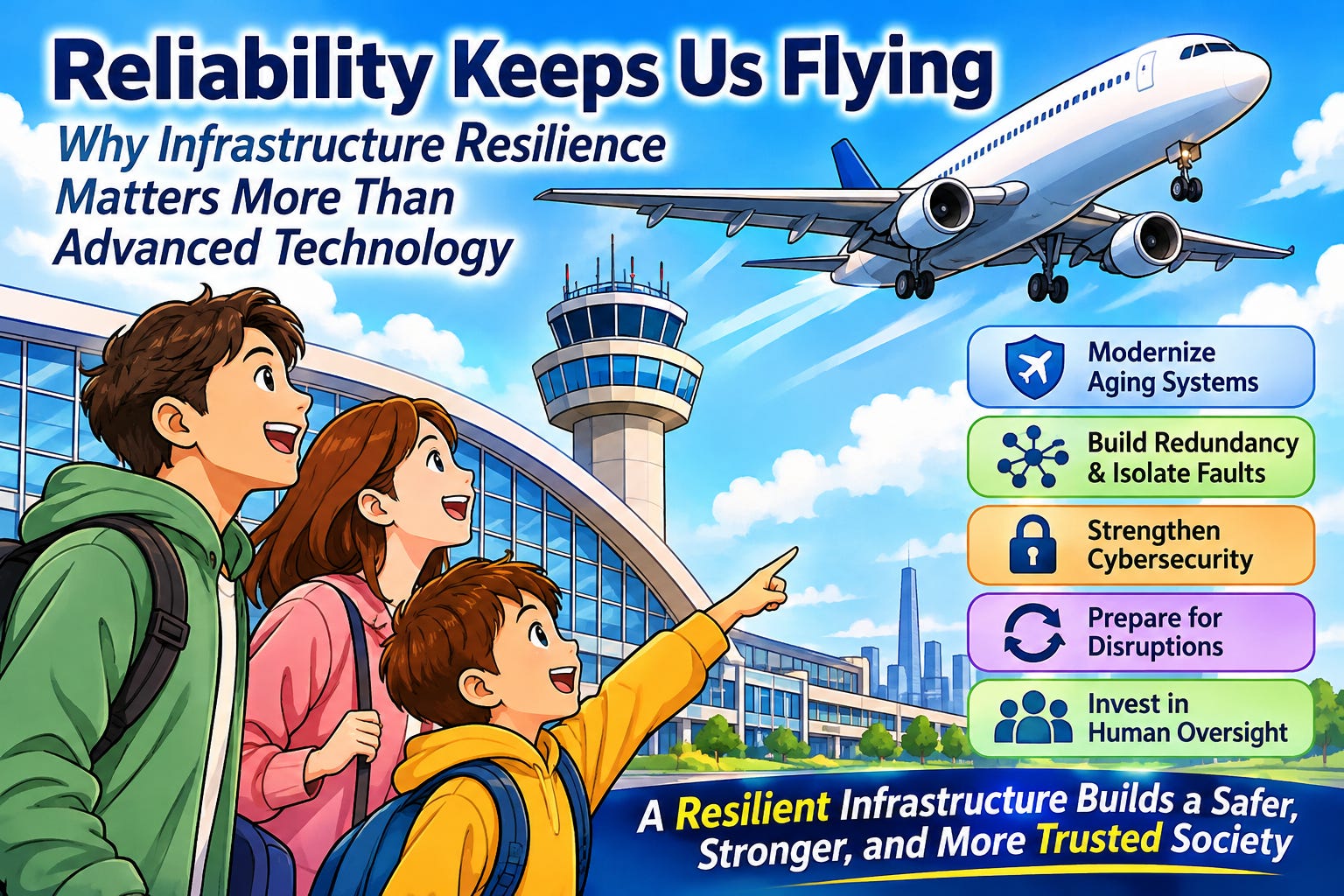
Image credit: Illustration generated with OpenAI’s ChatGPT image-generation tool, 2026
The Day America’s Skies Stood Still
Why Infrastructure Reliability Matters More Than Advanced Technology
When a Wealthy Nation’s Air Traffic System Ground to a Halt
Abstract
The nationwide grounding of aircraft in the United States on November 13, 2026, following an air traffic control communications disruption, exposed the vulnerabilities of critical infrastructure in even the world’s most technologically advanced nations. The incident highlighted longstanding concerns about aging aviation systems, technical debt, network reliability, and the challenges of integrating new technologies with legacy infrastructure. Drawing on reports from major U.S. and Korean news organizations and official government statements, this essay examines the broader implications of the disruption for aviation safety, cybersecurity, national infrastructure resilience, and public trust. It compares the infrastructure challenges facing the United States and Korea and identifies key policy priorities, including system modernization, network redundancy, fault isolation, disaster recovery, human oversight, and responsible artificial intelligence integration. The essay argues that technological advancement and economic prosperity alone cannot guarantee national security or operational stability. Instead, sustainable national competitiveness depends on the ability to prevent disruptions, maintain essential services during crises, and recover quickly when failures occur. Ultimately, infrastructure reliability, institutional responsibility, and system resilience are as important as technological innovation in building a safe and trusted society.
Keywords: United States, Korea, Aviation Safety, Federal Aviation Administration (FAA), Critical Infrastructure, Air Traffic Control, Telecommunications, Cybersecurity, System Resilience, Artificial Intelligence
When the Skies of the World’s Leading Power Stood Still
On Friday, November 13, 2026, something extraordinary happened in the United States. The Federal Aviation Administration (FAA) ordered a nationwide ground stop, temporarily preventing aircraft from taking off at airports across the country. From New York to Los Angeles, thousands of passengers found themselves waiting while planes remained on the ground.
The immediate cause was a communications disruption affecting several air traffic control facilities. Citing safety concerns, the FAA suspended departures nationwide. The restriction was lifted approximately four hours and twenty minutes later, at 8:15 p.m. Eastern Time (Federal Aviation Administration [FAA], 2026a, 2026b).
According to the Associated Press (AP) and Reuters, thousands of flights were canceled or delayed, disrupting travel plans for more than a million passengers. Some aircraft had to return to their departure airports or divert to other destinations. The disruption also affected aircraft positioning, crew schedules, and cargo operations, making it difficult for airlines to return to normal operations (Funk & Weissert, 2026; Singh, 2026).
This was more than a temporary technical problem in the American aviation system. It demonstrated how a communications failure involving critical infrastructure could disrupt everyday life across an entire country—even one with enormous economic resources and some of the world’s most advanced technologies.
The incident raises an important question: How could one of the world’s wealthiest and most technologically advanced nations be forced to ground its aircraft because of a communications problem in its air traffic control system?
Aging Systems and the Paradox of Modernization
One of the most important aspects of this incident is the aging condition of America’s air traffic control infrastructure. U.S. Transportation Secretary Sean Duffy explained that switches and routers in the existing air traffic control network had experienced data overload. He also raised concerns that older equipment might not have been able to handle the demands of newer technologies being introduced into the system. However, the precise technical sequence that caused the failure was still under investigation at the time of the initial reports (Singh, 2026).
Reuters cited a 2024 assessment by the U.S. Government Accountability Office (GAO), which found that 51 of the 138 air traffic control systems reviewed were unsustainable, while another 54 were potentially unsustainable. Together, these represented more than three-quarters of the systems examined (Singh, 2026). These figures suggest a problem far more serious than simply having too many old computers.
They point to the accumulation of technical debt across critical national infrastructure. Technical debt occurs when organizations postpone necessary system upgrades and rely on temporary fixes or outdated technologies. Although these decisions may save money in the short term, they often increase maintenance costs, operational risks, and the likelihood of future failures. Technical debt is a concern for ordinary businesses, but in critical infrastructure such as air traffic control, its consequences can extend directly to public safety.
The U.S. government has been working to modernize its air traffic control infrastructure. Congress approved $12.5 billion for related modernization efforts in 2025, while the administration has sought additional funding. One important part of the effort involves replacing aging copper communication lines with fiber-optic networks (Singh, 2026).
However, this incident demonstrates that replacing old equipment with new hardware is not enough. Modernization must improve the architecture, integration, security, and operational resilience of the entire system.
Why a Small Communications Failure Can Become a National Crisis
Modern air traffic control is a complex system in which numerous technologies and organizations must work together. Safe aircraft operations depend on communications between pilots and controllers, aircraft location data, flight paths, weather information, and airport operations. These components do not function independently. They continuously exchange information to maintain the safe and orderly movement of aircraft.
When one important communications network or piece of equipment fails, the consequences can spread far beyond the original problem. A delayed departure can disrupt operations at the destination airport. When an aircraft cannot arrive as scheduled, its next flight may also be delayed. Aircraft and crew members may end up in the wrong locations, affecting additional routes and passengers.
Reuters also reported that a separate communications failure involving a Philadelphia-area air traffic control facility in September 2026 disrupted approximately 9,500 flights through delays and cancellations. Damage to a backup fiber-optic connection contributed to the problem (Singh, 2026).
This is an example of systemic risk. Systemic risk occurs when a failure in one component spreads through interconnected systems and threatens the operation of the larger network. The same problem can occur in financial networks, electric power grids, telecommunications systems, and healthcare information infrastructure.
In today’s interconnected world, national competitiveness cannot be measured simply by the performance of individual systems. It also depends on whether the entire infrastructure can continue operating safely when unexpected disruptions occur.
Cybersecurity and the Resilience of Critical Infrastructure
It is important not to describe the November 13 incident as a cyberattack without supporting evidence. U.S. Homeland Security Secretary Markwayne Mullin stated that investigators had found no indication of a cyberattack or malicious activity. Initial government explanations focused instead on aging equipment, technical problems, and the interaction between older infrastructure and newer technologies. The Associated Press also reported that authorities had found no evidence of a cyberattack (Funk & Weissert, 2026).
The lesson, therefore, is not simply that governments need stronger defenses against hackers. They also need infrastructure capable of surviving technical failures. Cybersecurity is traditionally explained through the CIA Triad: Confidentiality (C), Integrity (I), and Availability (A). In systems such as air traffic control, availability is particularly important because service disruptions can directly affect public safety.
However, availability should mean more than keeping systems operational under normal conditions. Critical infrastructure must also be able to maintain essential services during disruptions, limit the spread of failures, and recover quickly. This broader capability is known as cyber resilience.
Several measures are essential for strengthening national infrastructure resilience.
System modernization and technical debt management
Governments must continuously replace aging hardware, software, and communications equipment while testing compatibility between existing and new systems.
Network redundancy and fault isolation
If a primary communications connection fails, an independent backup network should be capable of maintaining essential operations. Network architectures should also prevent a problem in one component from spreading throughout the entire system.
Business continuity and disaster recovery
Organizations must establish emergency operating procedures and recovery plans. Regular exercises should verify that these plans actually work under realistic conditions.
Human-centered safety management
When automated systems fail, trained professionals must be able to understand the situation and make safe decisions. Automation should support human judgment, not eliminate human responsibility.
Supply chain and external dependency management
Governments should reduce excessive dependence on individual telecommunications providers, equipment vendors, or technology platforms. Risks throughout the supply chain must be evaluated and managed.
Ultimately, the security of national infrastructure depends not only on how effectively it prevents attacks but also on how well it withstands unexpected failures.
Lessons for the Age of Artificial Intelligence: AI Cannot Solve Every Problem
Another interesting aspect of this incident concerns artificial intelligence. Some early reports raised questions about whether new AI technologies being introduced into the U.S. air traffic control system might have contributed to the disruption. However, U.S. officials stated that the incident was not caused by the FAA’s new AI-based air traffic prediction system (Funk & Weissert, 2026). This distinction matters.
AI can be useful in many aviation applications, including predicting air traffic volumes, optimizing flight routes, analyzing weather risks, and identifying potential aircraft conflicts. However, AI cannot automatically solve problems caused by aging communications networks or poorly designed infrastructure.
In fact, introducing new AI systems without adequate testing may create unexpected interoperability problems when they interact with older technologies. Therefore, responsible AI adoption requires several principles:
Thorough compatibility testing between existing systems and new AI technologies.
Testing under realistic operating conditions before deployment.
Explainability and verification of AI-generated recommendations.
Human oversight and the ability to intervene when automated systems fail.
Resilience against technical failures and cybersecurity threats affecting AI systems.
In the age of AI, true technological leadership does not mean introducing more AI into every system. It means building systems in which AI can be used safely, responsibly, and reliably.
The United States and Korea: Different Environments, Shared Challenges
The United States and Korea have very different aviation environments and infrastructure structures. The United States operates a geographically extensive aviation network, with numerous major airports and 22 Air Route Traffic Control Centers. Korea, by contrast, has a relatively small geographic area, with major international and domestic airports concentrated within a more limited space. Incheon International Airport serves as a central hub for much of the country’s international air traffic.
Although their operating environments differ, both countries face similar challenges involving communications reliability, infrastructure modernization, operational continuity, and cyber resilience.
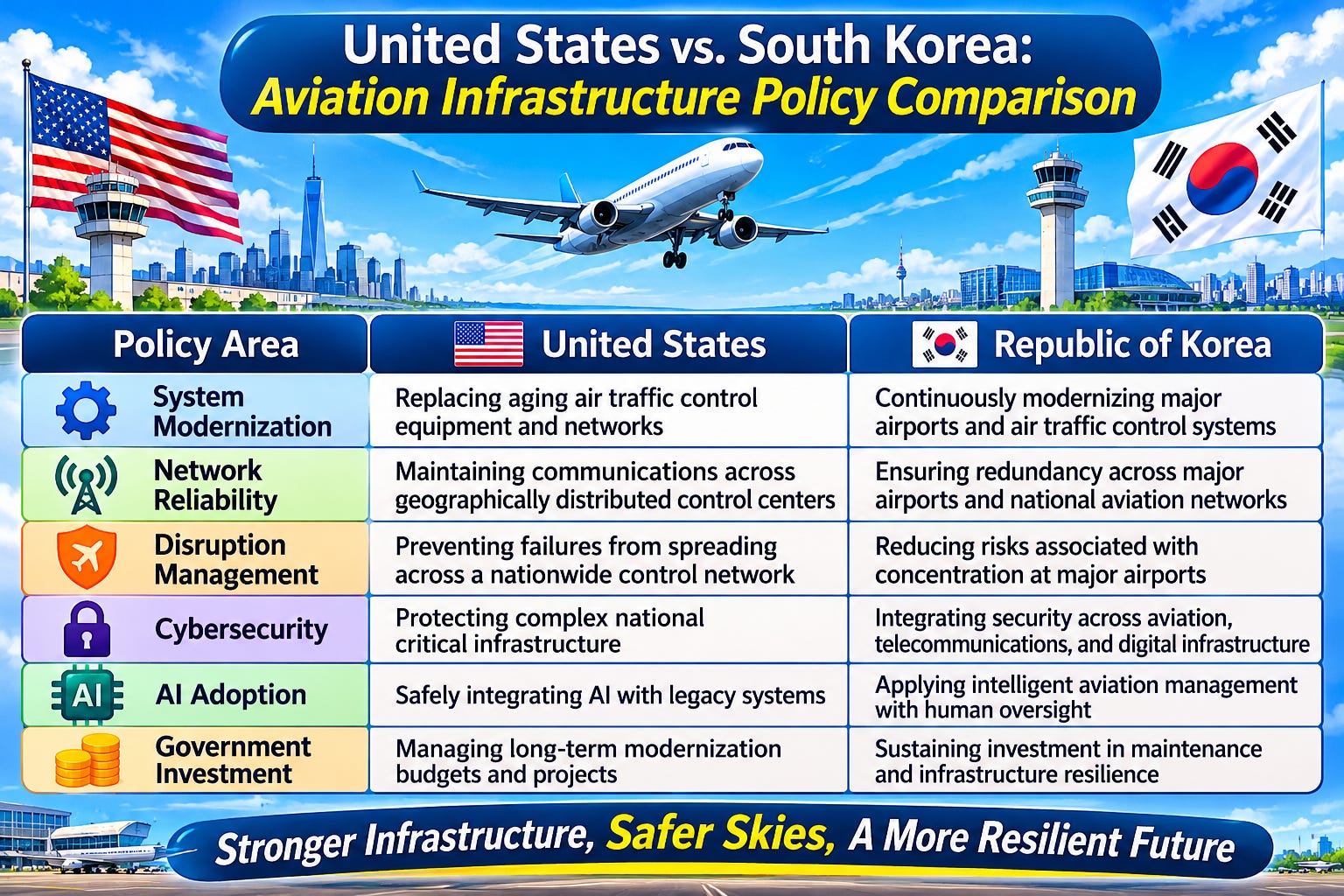
Image credit: Illustration generated with OpenAI’s ChatGPT image-generation tool with the author’s idea, 2026
The American experience offers useful lessons for Korea. In particular, Korea should ensure that major airports, including Incheon International Airport, can maintain essential operations even when communications networks or central operating systems experience disruptions. The country should also strengthen cooperation among government agencies, airport authorities, airlines, telecommunications providers, and technology vendors.
However, it would be incorrect to assume that Korea faces exactly the same technical weaknesses as the United States. Each country’s infrastructure requires independent technical evaluation. The important lesson is not to criticize another country’s failure but to learn from it and reduce similar risks at home.
Government Responsibility: Investing in Prevention Is More Important Than Paying for Recovery
Modernizing national critical infrastructure requires substantial financial investment. Nevertheless, preventive investment is often the most practical way to reduce the financial and social costs of major disruptions. Reuters reported that the GAO had identified weaknesses in the management of the FAA’s modernization program, including problems involving integrated schedules and cost estimates. As of September 2026, thousands of individual project schedules had not been sufficiently integrated, creating risks of delays and cost overruns (Singh, 2026).
This illustrates an important point: technological modernization cannot succeed through funding alone. Governments should follow several principles when developing national infrastructure policies.
First, they should regularly assess the age, condition, and risk levels of critical infrastructure.
Second, they should thoroughly test compatibility between existing systems and new technologies before deployment.
Third, they should establish effective crisis communication procedures so that the public receives accurate and timely information during disruptions.
Fourth, governments and private organizations should conduct joint emergency response and recovery exercises.
Finally, modernization programs should be evaluated not only by how much money they spend but also by how much they improve actual system performance and resilience.
A government’s effectiveness should not be measured only by how quickly it identifies those responsible after a failure. More importantly, it should be measured by how effectively it identifies and reduces risks before a failure occurs.
Reliability Is the Most Important Measure of National Competitiveness
The November 13, 2026, nationwide grounding of aircraft in the United States demonstrated that even the world’s most powerful nations are not immune to infrastructure failures. The United States has leading technology companies, world-class research institutions, enormous economic resources, and advanced military capabilities. Yet aging air traffic control infrastructure and a communications disruption were enough to create widespread disruption in everyday life. This incident is not simply an American problem. It represents a shared challenge for every modern nation, including Korea.
In the future, national competitiveness will not be determined solely by how much artificial intelligence a country develops or how fast its telecommunications networks become. It will increasingly depend on whether essential systems can operate reliably during unexpected crises, how quickly they can recover from failures, and how much confidence citizens can place in them.
We often measure national progress through impressive buildings, advanced airports, high-speed railways, artificial intelligence, and economic growth. However, a truly developed nation is one that can protect its citizens and maintain essential services not only when everything works normally but also when unexpected failures occur.
A wealthy nation is one that possesses many resources. A powerful nation is one that can withstand crises. But a trusted nation is one that is prepared to protect its people before a crisis occurs.
Ultimately, the most important source of national competitiveness is not technology itself. It is the wisdom of the people who operate it responsibly, the maturity of the institutions that govern it, sustained investment in essential infrastructure, and the reliability of the systems on which society depends.
References
Federal Aviation Administration. (2026a, November 13). FAA statement on nationwide ground stop. https://www.faa.gov/newsroom/faa-statement-nationwide-ground-stop
Federal Aviation Administration. (2026b, November 13). ATCSCC advisory 120: Nationwide ground stop. https://www.fly.faa.gov/ois/oisedit/adv_oisedit_dis?day=11132026&number=120
Funk, J., & Weissert, W. (2026, November 14). FAA says airplane departures can resume following ground stop. Associated Press. https://apnews.com/article/f81b0904331dafad6133f291e5f531a8
Singh, R. K. (2026, November 14). US flight shutdown exposes deepening air traffic network crisis. Reuters. https://www.reuters.com/business/aerospace-defense/us-flight-shutdown-exposes-deepening-air-traffic-network-crisis-2026-11-14/
Yonhap News Agency. (2026, November 14). U.S. nationwide flight disruption following communications failure; aftermath continues [In Korean]. https://www.yna.co.kr/view/AKR20261114010353071
Jo, H. (2026, November 14). U.S. lifts nationwide aircraft departure suspension order; more than 8,000 flights delayed amid widespread disruption [In Korean]. Hankyoreh. https://www.hani.co.kr/arti/international/international_general/1287311.html
Park, Y. (2026, November 14). U.S. lifts flight departure suspension; Incheon–U.S. cancellations and delays affect operations [In Korean]. JoongAng Ilbo. https://www.joongang.co.kr/article/25478614
부자 나라 미국의 하늘이 멈춘 날
첨단 기술보다 중요한 국가 인프라의 신뢰성
세계에서 가장 부유한 나라의 하늘이 멈췄을 때: 첨단 기술보다 중요한 인프라의 신뢰성
초록 (Abstract)
2026년 11월 13일, 항공교통관제 통신 장애로 인해 미국 전역의 항공기 이륙이 중단된 사건은 세계에서 가장 기술적으로 발전한 국가에서도 국가 핵심 인프라가 취약할 수 있음을 보여주었다. 이번 사건은 항공 시스템의 노후화, 기술적 부채, 네트워크 신뢰성, 그리고 기존 인프라에 새로운 기술을 통합하는 과정에서 발생할 수 있는 문제를 부각시켰다. 본 수필은 미국과 한국의 주요 언론 보도 및 정부의 공식 발표를 바탕으로 이번 항공 운항 중단 사태가 항공 안전, 사이버보안, 국가 인프라 복원력, 그리고 공공의 신뢰에 미치는 광범위한 영향을 분석한다. 또한 미국과 한국이 직면한 인프라 관련 과제를 비교하고, 시스템 현대화, 네트워크 이중화, 장애 격리, 재해 복구, 인간의 감독과 판단, 책임 있는 인공지능 도입 등 주요 정책 과제를 제시한다. 본 수필은 기술 발전과 경제적 번영만으로 국가 안보와 운영 안정성이 보장되는 것은 아니라고 주장한다. 지속 가능한 국가 경쟁력은 장애를 사전에 예방하고, 위기 상황에서도 필수 서비스를 유지하며, 시스템 장애가 발생했을 때 신속하게 복구할 수 있는 능력에 달려 있다. 궁극적으로 안전하고 신뢰받는 사회를 구축하기 위해서는 기술 혁신만큼이나 인프라의 신뢰성, 제도적 책임성, 그리고 시스템의 복원력이 중요하다.
핵심어: 미국, 대한민국, 항공 안전, 미국 연방항공청(FAA), 국가 핵심 인프라, 항공교통관제, 통신, 사이버보안, 시스템 복원력, 인공지능
세계 최강국의 하늘이 멈추다
2026년 11월 13일 금요일 오후, 미국의 하늘에서 매우 이례적인 사건이 발생했다. 세계에서 가장 부유하고 기술적으로 발전한 국가 중 하나인 미국에서 연방항공청(Federal Aviation Administration, FAA)이 전국 공항의 항공기 이륙을 중단시켰다. 뉴욕에서 로스앤젤레스까지, 미국 전역의 공항에서 출발하려던 항공기들이 지상에 머물러야 했다.
이번 조치의 직접적인 배경은 여러 항공교통관제센터(Air Route Traffic Control Centers)에 영향을 미친 통신 장애였다. FAA는 안전상의 이유로 전국적인 지상 중단(Ground Stop)을 명령했으며, 약 4시간 20분이 지난 오후 8시 15분(미 동부시간)에 이를 해제했다(Federal Aviation Administration [FAA], 2026a, 2026b).
Associated Press(AP)와 Reuters에 따르면 이번 사태로 수천 편의 항공편이 취소되거나 지연되었으며, 150만 명이 넘는 승객의 여행 일정에도 잠재적인 영향이 발생했다. 일부 항공기는 목적지로 향하지 못하고 출발 공항으로 돌아오거나 다른 공항으로 우회했다. 항공기뿐 아니라 승무원과 화물의 배치까지 차질을 빚으면서 정상적인 운항으로 복귀하는 데 추가 시간이 필요했다(Funk & Weissert, 2026; Singh, 2026).
이 사건은 미국의 항공교통 시스템에 발생한 일시적인 기술적 장애 이상의 의미를 갖는다. 세계 최고 수준의 경제력과 첨단 기술을 보유한 국가에서도 기본적인 통신 인프라의 문제가 국가 전체의 교통망을 마비시킬 수 있다는 사실을 보여주었기 때문이다.
여기서 우리는 중요한 질문을 던져야 한다.
왜 세계에서 가장 부유하고 기술적으로 발전한 국가가 항공교통관제 통신 장애 하나로 전국의 항공기 이륙을 중단해야 했을까?
노후화된 시스템과 현대화의 역설
이번 사건에서 가장 주목할 부분은 미국 항공교통관제 시스템의 노후화 문제다. 미국 교통부 장관 숀 더피(Sean Duffy)는 기존 항공교통관제 네트워크의 스위치와 라우터가 데이터 과부하를 겪으면서 장애가 발생했다고 설명했다. 새로운 기술을 기존 시스템에 도입하는 과정에서 구형 장비가 이를 감당하지 못했을 가능성도 제기했다. 다만 정확한 과부하 발생 경위와 근본 원인은 당시 조사 중이었다(Singh, 2026).
Reuters는 미국 회계감사원(Government Accountability Office, GAO)의 2024년 평가를 인용해 FAA가 검토한 항공교통관제 시스템 138개 가운데 51개를 지속 가능하지 않은 상태로, 54개를 잠재적으로 지속 가능하지 않은 상태로 분류했다고 보도했다. 이는 전체 검토 대상의 4분의 3을 넘는 규모다(Singh, 2026). 이 수치는 단순히 오래된 컴퓨터가 많다는 의미가 아니다. 국가 핵심 인프라가 기술적 부채(Technical Debt)를 장기간 축적해 왔다는 점을 시사한다.
기술적 부채란 기존 시스템을 즉시 교체하지 않고 임시적인 개선이나 보완으로 운영하면서 미래에 더 큰 유지보수 비용과 위험을 초래하는 현상이다. 기업의 정보시스템에서도 문제가 되지만, 항공교통관제와 같은 국가 핵심 인프라에서는 그 결과가 국민의 안전과 직결된다. 미국 정부는 이러한 문제를 해결하기 위해 항공교통관제 시스템 현대화 사업을 추진하고 있다. 의회는 2025년 125억 달러의 관련 예산을 승인했으며, 행정부는 추가적인 현대화 재원을 요청하고 있다. 기존 구리 통신선을 광섬유로 교체하는 작업도 진행되고 있다(Singh, 2026).
그러나 이번 사건은 장비를 최신 제품으로 교체하는 것만으로는 충분하지 않다는 사실을 보여준다. 현대화는 하드웨어 교체가 아니라 시스템 전체의 구조와 운영 방식을 개선하는 과정이어야 한다.
작은 통신 장애가 국가적 위기로 확대되는 이유
현대 항공교통 시스템은 수많은 기술과 조직이 서로 연결된 복합 시스템이다. 항공기의 안전한 운항에는 조종사와 관제사 간 통신, 항공기 위치 정보, 비행 경로, 기상 데이터, 공항 운영 정보가 필요하다. 이러한 요소는 독립적으로 작동하는 것이 아니라 서로 정보를 교환하면서 전체 항공교통을 관리한다. 따라서 특정 통신망이나 장비에 문제가 발생하면 그 영향은 해당 장비에만 머물지 않는다. 항공기 출발이 지연되면 도착 공항의 운영 일정이 변경된다. 항공기가 예정된 공항에 도착하지 못하면 다음 운항 일정도 차질을 빚는다. 승무원과 항공기가 원래 계획된 위치에 있지 않게 되면서 다른 노선까지 영향을 받는다.
이번 사태는 이러한 상호의존성이 얼마나 강력한지를 보여주었다. Reuters는 2026년 9월에도 필라델피아 지역 관제시설의 통신 장애와 백업 광섬유 회선의 손상이 결합해 약 9,500편의 항공편에 지연과 결항을 초래했다고 보도했다(Singh, 2026). 이러한 현상을 시스템적 위험(Systemic Risk)이라고 한다. 하나의 구성 요소에서 발생한 장애가 연결된 다른 구성 요소로 확산되면서 전체 시스템의 기능을 위협하는 것이다. 금융 네트워크, 전력망, 통신망, 의료정보 시스템도 동일한 위험을 가지고 있다.
오늘날 국가 경쟁력은 개별 시스템의 성능만으로 평가할 수 없다. 서로 연결된 시스템 전체가 예기치 않은 상황에서도 얼마나 안정적으로 작동하는지가 더욱 중요하다.
사이버보안과 국가 핵심 인프라의 복원력
이번 사건을 사이버 공격의 결과라고 단정해서는 안 된다. 미국 국토안보부 장관 마크웨인 멀린(Markwayne Mullin)은 당시 사이버 공격이나 악의적인 행위의 흔적이 없다고 설명했다. 정부 관계자들은 노후 장비와 새로운 기술의 상호작용 및 통신 시스템의 기술적 문제에 초점을 맞추었다. AP 역시 당국이 사이버 공격의 증거를 발견하지 못했다고 보도했다(Funk & Weissert, 2026). 따라서 이번 사건의 교훈은 해킹에 대한 방어만으로 국가 인프라의 안전을 확보할 수 없다는 것이다.
사이버보안은 전통적으로 기밀성(Confidentiality), 무결성(Integrity), 가용성(Availability)의 CIA Triad를 중심으로 설명한다. 특히 항공교통관제와 같은 시스템에서는 가용성이 국민의 안전과 직접 연결된다. 하지만 가용성을 확보한다는 것은 시스템이 단순히 정상적으로 작동하는 상태를 유지한다는 의미를 넘어선다. 장애가 발생하더라도 핵심 서비스를 유지하고, 피해를 제한하며, 신속하게 복구할 수 있어야 한다. 이를 사이버 복원력(Cyber Resilience)이라고 한다.
국가 핵심 인프라의 복원력을 확보하기 위해서는 다음과 같은 접근이 필요하다.
시스템 현대화와 기술적 부채 관리
노후화된 하드웨어와 소프트웨어, 통신 장비를 지속적으로 교체하고 기존 시스템과 새로운 시스템 간의 호환성을 검증해야 한다.
네트워크 이중화와 장애 격리
주요 통신 경로가 실패하더라도 독립적인 백업 네트워크가 기능을 이어받을 수 있어야 한다. 하나의 장애가 전체 시스템으로 확산되지 않도록 네트워크를 분리하고 장애 영향을 제한해야 한다.
운영 연속성과 재해 복구
장애 발생 시 핵심 서비스를 유지하기 위한 비상 운영 계획과 복구 절차가 필요하다. 정기적인 복구 훈련을 통해 실제 상황에서 계획이 작동하는지 확인해야 한다.
인간 중심의 안전 관리
자동화 시스템이 정상적으로 작동하지 않을 때 관제사와 운영자가 상황을 이해하고 안전한 결정을 내릴 수 있어야 한다. 자동화가 인간의 책임과 판단 능력을 대체해서는 안 된다.
공급망과 외부 의존성 관리
특정 통신사업자, 장비 공급업체 또는 기술 플랫폼에 대한 지나친 의존을 줄이고, 공급망 전체의 위험을 평가해야 한다.
결국 국가 인프라의 보안 수준은 공격을 얼마나 잘 막는가뿐 아니라 예상하지 못한 장애를 얼마나 잘 견뎌내는가에 의해 결정된다.
인공지능 시대의 교훈: AI가 모든 문제를 해결하지는 않는다
이번 사건에서 흥미로운 부분은 AI와의 관계다. 일부 초기 보도에서는 미국 항공교통관제 시스템에 도입되는 새로운 인공지능 기술과 장애의 연관성이 거론되었다. 그러나 미국 정부는 이번 장애가 FAA의 새로운 AI 기반 항공교통 예측 시스템 때문에 발생한 것은 아니라고 설명했다(Funk & Weissert, 2026). 이 구분은 매우 중요하다.
AI는 항공교통량 예측, 비행 경로 최적화, 기상 위험 분석, 항공기 간 충돌 가능성 탐지 등 다양한 분야에서 유용하게 활용될 수 있다. 그러나 AI가 기존 통신망의 노후화나 네트워크 구조의 취약성을 자동으로 해결해 주지는 않는다. 오히려 충분한 검증 없이 새로운 AI 시스템을 기존 인프라에 통합하면 예상하지 못한 상호운용성 문제가 발생할 수 있다.
따라서 AI 도입에는 다음과 같은 원칙이 필요하다.
기존 시스템과 새로운 AI 시스템 간의 호환성 검증
실제 운영 환경을 반영한 사전 시험
AI의 판단 결과에 대한 설명 가능성과 검증 가능성
자동화 실패 시 인간이 개입할 수 있는 통제 구조
AI 시스템 자체의 장애와 사이버 공격에 대한 복원력 확보
AI 시대의 진정한 기술 경쟁력은 더 많은 AI를 도입하는 데 있지 않다. AI를 안전하고 책임 있게 운영할 수 있는 시스템을 구축하는 데 있다.
미국과 한국의 비교: 서로 다른 환경, 같은 과제
미국과 한국은 항공교통 환경과 국가 인프라 구조에서 차이가 있다. 미국은 광대한 영토에 수많은 대형 공항과 22개 항공로 관제센터를 운영하는 복잡한 항공교통 체계를 가지고 있다. 반면 한국은 상대적으로 좁은 영토에 주요 국제공항과 국내 공항이 집중되어 있으며, 인천국제공항이 국제 항공교통의 핵심적인 역할을 수행한다. 두 국가의 환경은 다르지만, 통신망의 안정성, 시스템 현대화, 운영 연속성, 사이버 복원력은 공통적인 정책 과제다.
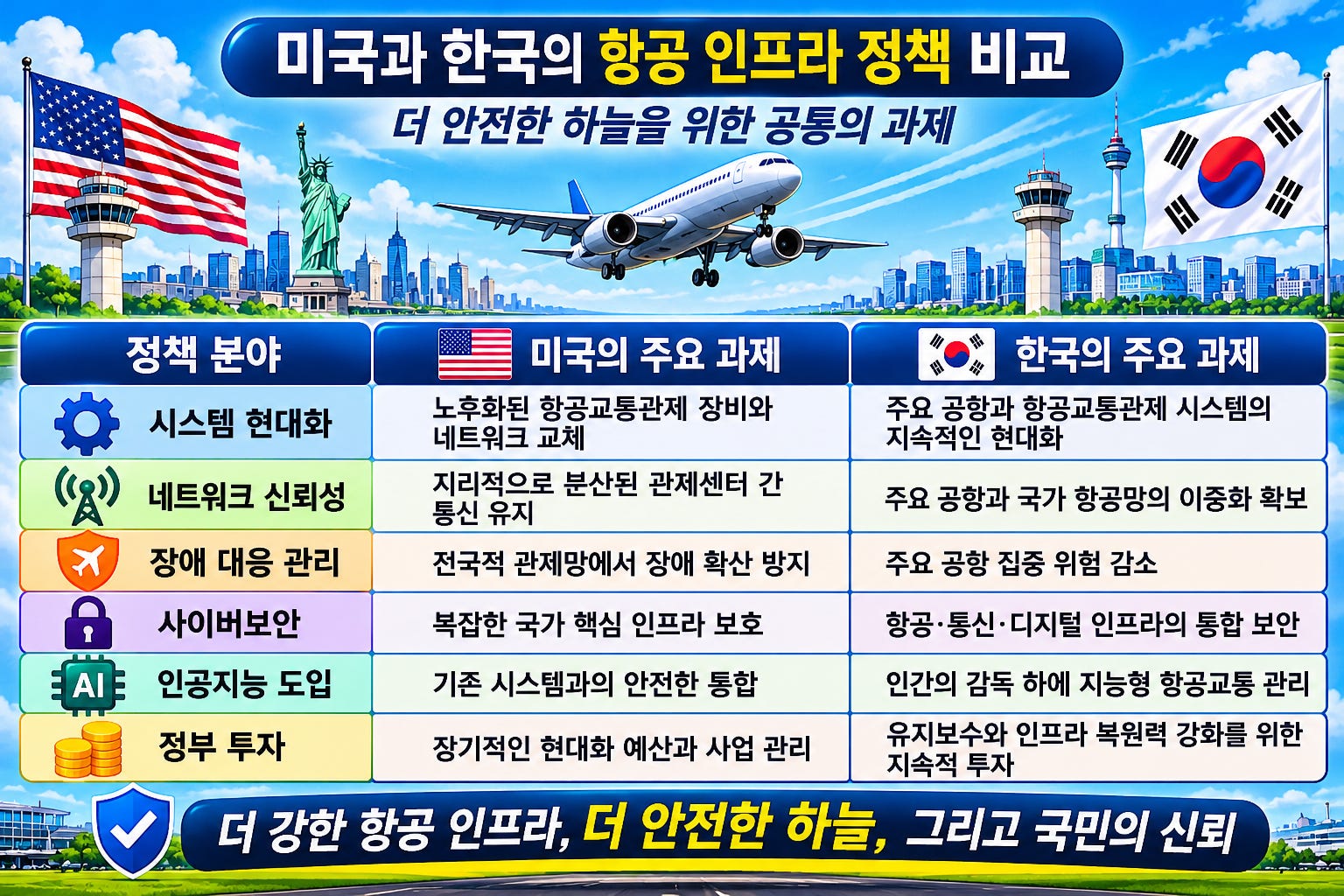
Image credit: Illustration generated with OpenAI’s ChatGPT image-generation tool with the author’s idea, 2026
미국의 사례는 한국이 자국의 항공교통 시스템을 점검하는 데 중요한 참고자료가 될 수 있다. 특히 한국은 인천국제공항과 주요 국내 공항의 운영 연속성을 확보하는 동시에, 통신망이나 중앙 운영 시스템에 문제가 발생하더라도 다른 시스템이 기능을 유지할 수 있는 구조를 갖추어야 한다. 또한 정부와 공항공사, 항공사, 통신사업자, 시스템 공급업체 간의 협력 체계가 명확해야 한다.
다만 미국에서 발생한 장애가 한국에서도 동일하게 발생할 것이라고 단정할 수는 없다. 두 국가의 시스템 구조와 운영 환경에 대한 별도의 기술적 평가가 필요하다. 중요한 것은 다른 나라의 실패를 비판하는 데 그치지 않고, 그 실패에서 자국의 위험을 줄일 수 있는 교훈을 찾는 것이다.
정부의 책임: 예방에 투자하는 것이 복구보다 중요하다
국가 핵심 인프라의 현대화에는 상당한 재정이 필요하다. 그러나 예방을 위한 투자는 장애 발생 이후의 복구 비용과 사회적 손실을 줄이는 가장 현실적인 방법이다. Reuters는 미국 GAO가 FAA의 현대화 사업 관리에서 통합 일정과 비용 추정의 문제를 지적했다고 보도했다. 2026년 9월 기준으로 수천 개의 개별 프로젝트 일정이 충분히 통합되지 않아 사업 지연과 비용 초과 위험이 존재한다는 것이다(Singh, 2026). 이는 기술 현대화가 단순한 예산 확보만으로 성공할 수 없다는 사실을 보여준다.
정부는 다음과 같은 원칙을 바탕으로 국가 인프라 정책을 추진해야 한다.
첫째, 국가 핵심 인프라의 노후화 정도와 위험 수준을 정기적으로 평가해야 한다.
둘째, 새로운 시스템을 도입할 때 기존 시스템과의 상호운용성을 충분히 검증해야 한다.
셋째, 장애 발생 시 국민에게 정확하고 신속한 정보를 제공할 수 있는 위기소통 체계를 마련해야 한다.
넷째, 정부와 민간 부문이 공동으로 장애 대응과 복구 훈련을 실시해야 한다.
다섯째, 현대화 사업의 예산 집행뿐 아니라 실제 성능 개선과 복원력 향상 여부를 평가해야 한다.
국가의 능력은 문제가 발생한 이후 얼마나 신속하게 책임자를 찾는가로만 평가할 수 없다. 문제가 발생하기 전에 위험을 얼마나 정확하게 발견하고 줄였는가가 더욱 중요하다.
가장 중요한 국가 경쟁력은 신뢰성이다
2026년 11월 13일 미국의 항공기 이륙 중단 사건은 세계 최강국이라는 지위가 모든 문제를 해결해 주지는 않는다는 사실을 보여주었다. 미국은 세계 최고의 기술기업과 연구기관, 막대한 경제력과 군사력을 보유하고 있다. 그러나 항공교통관제 시스템의 노후화와 통신 장애는 이러한 국가적 역량과 별개로 국민의 일상을 혼란에 빠뜨릴 수 있었다.
이번 사건은 미국만의 문제가 아니다. 한국을 포함한 모든 현대 국가가 직면한 공통적인 도전이다. 앞으로 국가 경쟁력은 얼마나 많은 인공지능을 개발하고 얼마나 빠른 통신망을 구축하는가만으로 결정되지 않을 것이다. 국가의 핵심 시스템이 예상하지 못한 위기에서도 얼마나 안정적으로 작동하는지, 장애가 발생했을 때 얼마나 신속하게 복구되는지, 그리고 국민이 그 시스템을 얼마나 신뢰할 수 있는지가 더욱 중요해질 것이다.
우리는 흔히 국가의 발전을 고층 빌딩, 첨단 공항, 고속철도, 인공지능, 경제성장률로 평가한다. 그러나 진정으로 발전한 국가는 이러한 시설이 정상적으로 작동할 때뿐 아니라 예상하지 못한 장애가 발생했을 때도 국민의 안전과 일상을 지켜낼 수 있는 나라다.
부유한 국가는 많은 것을 소유한 나라이고, 강한 국가는 위기를 견뎌내는 나라다. 그러나 신뢰받는 국가는 위기가 발생하기 전에 국민을 보호할 준비가 되어 있는 나라다.
결국 가장 중요한 국가 경쟁력은 기술 그 자체가 아니다. 기술을 책임 있게 운영하는 인간의 지혜, 제도의 성숙함, 지속적인 투자, 그리고 시스템의 신뢰성이다.
References
Federal Aviation Administration. (2026a, November 13). FAA statement on nationwide ground stop. https://www.faa.gov/newsroom/faa-statement-nationwide-ground-stop
Federal Aviation Administration. (2026b, November 13). ATCSCC advisory 120: Nationwide ground stop. https://www.fly.faa.gov/ois/oisedit/adv_oisedit_dis?day=11132026&number=120
Funk, J., & Weissert, W. (2026, November 14). FAA says airplane departures can resume following ground stop. Associated Press. https://apnews.com/article/f81b0904331dafad6133f291e5f531a8
Singh, R. K. (2026, November 14). US flight shutdown exposes deepening air traffic network crisis. Reuters. https://www.reuters.com/business/aerospace-defense/us-flight-shutdown-exposes-deepening-air-traffic-network-crisis-2026-11-14/
연합뉴스. (2026년 11월 14일). 美전역 항공편 통신장애로 4시간반 ‘올스톱’…후폭풍 지속. https://www.yna.co.kr/view/AKR20261114010353071
조해영. (2026년 11월 14일). 미국, ‘전 항공편 이륙 중단 명령’ 해제…비행 8천편 이상 지연 ‘대혼란’. 한겨레. https://www.hani.co.kr/arti/international/international_general/1287311.html
박영우. (2026년 11월 14일). 美 항공편 이륙 중단 해제…인천발 미국행 결항 취소·지연 운항. 중앙일보. https://www.joongang.co.kr/article/25478614
About the Author

Prof. Dr. Young Choi (Editor-in-Chief) — Regent University
Full list of his K-GSP columns
Full list of his Books at Amazon.com
Young B. Choi is a Professor in the Department of Engineering & Computer Science at Regent University. He published 38 books with ‘Selected Readings in Cybersecurity’ (2018) (about 800 copies archived globally at university/college libraries around the world) and ‘Cybersecurity Applications and Artificial Intelligence’ (2023) available in seven major world languages. He proposed the world’s first global and universal telecommunications “Service Order Handling (SOH)” Model (T-SOH Model) (1995) with Dr. Adrian Tang. With this innovative research work, he received the IEEE NOMS ’96 Best Paper Award and became the first recipient of the Outstanding Contribution Award of the TeleManagement Forum in 1998. His research areas include Natural Language Processing-focused AI, AI-applied cybersecurity, network and telecom service management, and Korean studies on Gani Choi Rip’s Jeonggwan (靜觀: Quiet Contemplation) philosophy and Shilhak ( 實學: Practical Learning).
Suggested Citation
Choi, Y. B. (2026). The Day America’s Skies Stood Still: Why Infrastructure Reliability Matters More Than Advanced Technology. K-GSP Forum.
© K-Global Scholars and Professionals Forum. All rights reserved. 2026. Content published in the K-GSP Forum may not be reproduced, distributed, or transmitted in any form without prior written permission from the K-GSP Forum, except for brief quotations with full attribution.